Jason Locasale

3.6K posts

Jason Locasale banner
Jason Locasale

Jason Locasale

@LocasaleLab

Scientist (metabolism, cancer, AI, health/longevity). Academic & scientific reform. Former: Duke, Cornell, Harvard, MIT. DMs open • dr.jason.locasale@gmail

Raleigh, NC 가입일 Mart 2015
698 팔로잉14K 팔로워
고정된 트윗
Jason Locasale
Jason Locasale@LocasaleLab·
I left a successful academic career in STEM after publishing 200+ papers. I believed in science and truth but learned the system valued optics over integrity, conformity over courage. In academia, bureaucracy replaced discovery, egos replaced expertise, and silence replaced accountability. It’s time to speak clearly about what universities have become.
English
80
273
1.9K
261.3K
Jason Locasale
Jason Locasale@LocasaleLab·
Boston biotech has been running the same playbook for years and everyone in the ecosystem knows it. Early-stage companies are built less on validated biology and more on signaling: a splashy Nature or Science paper, a thin patent scaffold, and the reputational gravity of well-networked academic founders. That combination is often enough to unlock large funding rounds. The problem is that high-impact publication has become a proxy for truth. It isn’t. It’s a selection mechanism for novelty and narrative. The result is predictable: – groupthink gets reinforced – weak or irreproducible findings persist for years – dissent is disincentivized – hype substitutes for validation In many cases, the goal is not to rigorously test whether an idea is correct, it’s to create enough mystique that it feels important. That perception alone can carry a company surprisingly far. So it’s not surprising to see the same voices recycled across boards and advisory roles—people who helped build and legitimize this model in the first place.
Flagship Pioneering@FlagshipPioneer

Flagship welcomes @EricTopol M.D., as Academic Advisor. A renowned physician-scientist, researcher, and author, Dr. Topol has long been at the forefront of advancing medicine through science and technology. His leadership at the intersection of digital health, genomics and AI has reshaped how we understand disease detection and prevention. We look forward to working with Dr. Topol as we as we accelerate a new era of preemptive health and medicine.

English
7
6
94
18.7K
Jason Locasale
Jason Locasale@LocasaleLab·
My timeline today is filled with coordinated personal attacks on Prasad and other FDA officials. Much of it centers on conflating standard aspects of academic employment with personal financial gain. In academic research, obtaining external funding is part of the job. Grants are awarded to institutions, not individuals. The contracts, oversight, and financial control all sit with the employer. This is how the system is structured. What is being presented instead is a narrative that reframes these institutional funding mechanisms as personal enrichment. That is a misrepresentation. The timing also matters. Much of this appears to follow specific regulatory decisions affecting individual companies. That raises the possibility that these criticisms are not about underlying principles, but are reactive to outcomes. This is not a serious way to engage with regulatory reasoning. It is a way to attack individuals.
Jessica Adams@RxRegA

The same cycle that contributed to Prasad’s ousting appears to be expanding to others in leadership. It’s relentless criticism across news and social media that centers on narratives around individuals rather than engaging with the reasoning behind decisions. The risk is not only losing good people, but also deterring those who care about standards from stepping into or staying in these roles. That’s a problem for the institution, not just the individuals, and by extension for all who care about maintaining standards.

English
0
2
14
1K
Jason Locasale
Jason Locasale@LocasaleLab·
This reflects how science has been packaged and evaluated over the past two decades. In the 2000s figure preparation software such as PowerPoint and Illustrator became straightforward to use. By the early 2010s, high-impact journals came to associate dense, elaborate figures (i.e. the exhibits of a scientific study) with rigor and depth. The implicit assumption was that more panels and more data reflected more thorough and careful work. At the same time, the editorial decision on whether to proceed to peer review was made by individuals not deeply embedded in the specific science, relying more on visual presentation and the perceived completeness of the data. The aesthetics of the figure panels became a proxy for scientific thoroughness. In response, scientists adapted. Figures became more complex, more densely populated, and more expansive in scope. This gave the appearance of rigor independent of whether the additional data materially clarified the central questions of the study. Reviewers were tasked with evaluating these large and complex datasets under significant time constraints, typically within a few days and without compensation, while managing substantial professional responsibilities. Under these conditions, it is impossible to systematically interrogate every component of a multi-panel figure. There is also a reluctance to question whether key elements of a study are missing if there is a possibility they are included somewhere within the large amount of presented data. The result is a publication system in which the presentation of large volumes of data in complex figure formats can facilitate publication in high-profile journals, often with limited connection to the underlying clarity, coherence, or quality of the science itself.
Banana Oncology@Banana_Oncology

Ok this figure is pretty intimidating...

English
6
12
96
11.6K
Jason Locasale
Jason Locasale@LocasaleLab·
When coordinated attacks target someone’s character, the stated reason is often just a pretext. The real motive is usually retaliation, something that person said, did, or represented that upset others. In professional settings, one of the easiest tools to weaponize is conflict of interest. This is because in reality, everyone is conflicted to some degree. These are small, interconnected worlds. Anyone who has built a career, collaborated broadly, or held leadership roles has ties that can be traced to someone, somewhere. COI policies are often vague, inconsistently applied, or so expansive that they can capture almost anything, including perceived conflicts. That makes them less a safeguard and more a flexible instrument. What we are seeing now with attacks on FDA officials is a clear example. Their past academic roles require securing external funding for their institutions to sustain research and operations. These are not payments to individuals, but funds directed to their employers, just as any organization engages with external partners. Instead, this is being framed as if some kind of quid pro quo took place, which is absurd. The conflict is not the problem. The weaponization of it is.
English
1
2
12
1.1K
Jason Locasale
Jason Locasale@LocasaleLab·
If we care about basic science, the focus should be on how it’s funded, not just how much. The issue isn’t the size of the NSF budget. Basic science, when it’s funded efficiently and aligned with its true purpose, is one of the highest-return public goods we have. The problem is that the NSF system has drifted far from that ideal. Funding decisions have become increasingly shaped by bureaucracy, virtue signaling, and internal politics rather than clear merit and scientific value. That leads a lot of work that is incremental, redundant, or simply not very informative. Simply adding more money doesn’t fix the problem, it amplifies it.
Dimitris Papailiopoulos@DimitrisPapail

The entire NSF research budget is ~$9B/year. This is literally funding every awarded PI at every field and every institution. But we've decided that all of basic science is a rounding error in comparison to venture bets. Please consider funding basic science more.

English
2
2
33
2.2K
Jason Locasale
Jason Locasale@LocasaleLab·
This is an important conversation. Anthony is raising awareness of the massive growth of nonprofit hospital systems, many tied to universities and medical schools. The 340B loophole (a buy low from pharma, sell high to patients program) is especially worth scrutiny. It is generating large opaque revenue streams for academic medical centers by manipulating drug pricing, possibly up to hundreds of millions of dollars annually. Yet these same academic institutions cry poor and push that narrative onto their biomedical scientists in efforts to extract more money. That gap between reality and messaging is worth examining.
Anthony DiGiorgio, DO, MHA@DrDiGiorgio

It was an honor to testify in front of the @HouseCommerce subcommittee on health regarding healthcare affordability. We discussed consolidation and the demise of independent physician practice. My solutions include: Repeal section 6001 of the ACA which banned physician owned hospitals Reform Stark law Implement site neutral payments Reform 340B Use FMAP to encourage states to be pro-competition (repeal CON, eliminate non competes)

English
3
5
21
1.6K
Jason Locasale
Jason Locasale@LocasaleLab·
Thank you, Carlos. This is one of countless examples of social media influencers pushing misleading narratives to support a negative thesis about NIH. I saw many of these circulating, often echoed by science media using the same framing. It is a coordinated distortion of reality. Some of it even relied on statements from Jeremy Berg, who spends much of his time trolling and harassing the NIH director.
Carlos E Alvarez@CarlosEAlvare17

Exhibit A: "we now have 90% less funding for medical research... We are sacrificing our children's future", illustrated with a 'scientific graph' labeled FUNDING CALLS PLUMMET and accented with a big red arrow That was a reprise of 2024's proclamations of the same Not mentioned were the last 3 NIH budgets signed into law: - 2024, ~$47.6B - 2025, ~$48.3B - 2026, $48.7B In other words, this is what we get when 'Science is Truth' meets 'The end justifies the means'

English
2
0
9
1.4K
Jason Locasale
Jason Locasale@LocasaleLab·
The reality is that scientists are minor players in the decision-making of these large administrations. When pressure hits, administrators protect their own first. The people least embedded in those decisions are the ones who get compromised. That ends up being the scientists.
William Hu@williamhu43

@R_H_Ebright @LocasaleLab You don’t lay-off nurses and other essential personnel like when Medicare payments are delayed. Instead, you lay-off non-essential personnel. It should be the same with NIH delays.

English
0
0
23
2.9K
Jason Locasale
Jason Locasale@LocasaleLab·
I’m sorry you’re dealing with this. But when a university taking in billions in revenue chooses not to buffer even short-term funding delays or prioritize its resources around science, while administrators expand their offices and take in seven-figure salaries, it says everything about the model. Scientists are treated less as scholars to be supported and more as revenue generators for indirect costs, with all the financial risk pushed onto them.
Katayoun Ayasoufi@KAyasoufi

@LocasaleLab Maby have lost their labs and more continue to lose them with delays and lack of funding in hand. I, myself, have had to downsize and could also lose my lab by the end of the year if none of my in process grants happen. There are real consequences to NIH not fundings grants.

English
4
8
94
14.7K
Jason Locasale
Jason Locasale@LocasaleLab·
Jason Locasale@LocasaleLab

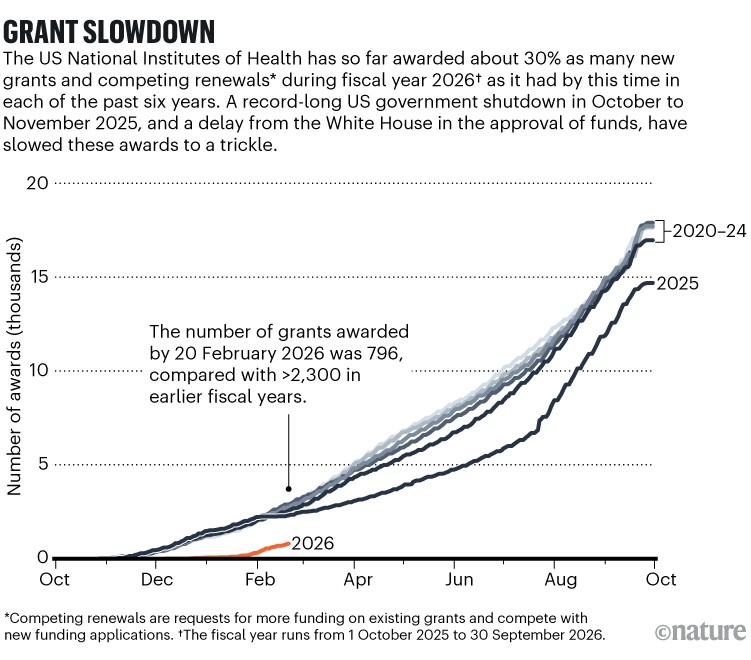
Nature’s Max Kozlov insists it’s simply public data he's reporting. Yes, the data can be public but it still can be framed to imply intent. “Adapted from Jeremy Berg” matters because it imports someone else’s selection choices—time window, labeling (“grant slowdown”), and interpretation—whether or not he’s quoted in the text. The article never cleanly distinguishes budget execution steps after a shutdown from discretionary obstruction. For example, here are framing cues the article uses (I believe verbatim but please correct if I missed something): 1) Villain–Victim Causality (Intent Implied) •“White House stalls release of approved US science budgets” •“have had their spending slowed.” •“has been slow to authorize its release.” 2) Illegitimacy Cueing (Approved/Signed-Into-Law Emphasis) •“release of approved US science budgets” •“funds that they signed into law for 2026” •“funding … is still not freely flowing.” •“as is required by law.” 3) Crisis Language & Severity Inflation •“rejected sweeping cuts…” •“rejected unprecedented cuts…” •“with an unusual restriction…” •“This is a drastic departure from historical practice,” •“record-breaking 43-day shutdown…” 4) Conclusion-as-Label (Interpretation Baked In) •“Going slow” •“Grant slowdown” •“Rare restriction” 5) Panic Metaphors (Flow/Scarcity) •“new grant awards have slowed to a trickle” •“still not freely flowing.” 6) Power-Grab Framing (Control & Priorities) •“an ‘indispensable statutory tool’…” •“adhering to White House priorities.” •“assert more control over how agencies spend their money,” 7) Advocacy-by-Proxy (Data Presentation Choice) •“Source: NIH Reporter; adapted from Jeremy Berg” 8) Silence-as-Evidence (Non-response Weaponized) •“The OMB did not respond to Nature’s queries…” •“did not respond … about these moves…” •“did not respond … about the delays.” 9) Deviance Framing (“Usually/Normally” as Indictment) •“Usually, after a full-year budget bill is signed into law…” •“Normally, NASA has the discretion…” •“the OMB tweaked the rules…” •“a little-known document…” 10) Scarcity-by-Word-Choice (Only/Leftover/Stopgap) •“can issue new research awards only…” •“using leftover money…” •“meant to be a stopgap…”

QME
2
0
2
339
Jason Locasale
Jason Locasale@LocasaleLab·
The “NIH is no longer functioning” narrative was always dramatically overstated. A delayed apportionment coming after a prolonged government shutdown was framed as institutional collapse rather than what it likely was: a lag in funding flow tied to broader delays in federal operations. That context was largely ignored. Instead, a handful of social influencers amplified by outlets like Science and Nature pushed a doomsday storyline that was far more dramatic than the underlying reality.
Max Kozlov@maxdkozlov

BREAKING: @rosadelauro announces at a House Oversight hearing with NIH director Jay Bhattacharya that OMB approved the agency's apportionment last night. That means the agency should* have access to its appropriated funds — 42 days after its spending bill passed.

English
8
5
49
37.4K
Jason Locasale
Jason Locasale@LocasaleLab·
This is a non-story and you could have reported on any number of things, including reforms that would actually improve the funding system. You and others took a post-shutdown funding lag and inflated it into a crisis because sensationalism travels better than context. Your word choices did a lot of work to make a temporary delay sound like a collapse. That is not just reporting facts. That is called framing.
English
5
0
4
644
Jason Locasale
Jason Locasale@LocasaleLab·
American universities such as Duke and NYU have built deep partnerships with foreign government entities through satellite campuses in China. Entire campuses are constructed, and financial relationships exist with limited transparency. On the Chinese side, the incentives are straightforward. CCP officials are evaluated on economic spending and possibly their international ties. Attaching the name of a major American university and building a physical campus carries political value. For students, these campuses function as an expensive American-branded education for rich Chinese families whose children would not gain admission to more competitive Chinese universities. For universities, it is revenue extraction. If these institutions want to operate as global enterprises, the baseline should be clear: full financial transparency, enforceable protections for academic freedom and free expression, and a clear commitment to their teaching and research missions.
Under Secretary of State Sarah B. Rogers@UnderSecPD

In 2020, after universities failed to report at least $6.5 billion in foreign funding, the Department of Education opened investigations into Harvard and Yale. U.S. higher-education institutions were, according to the Department’s report, “multibillion-dollar, multinational enterprises using opaque foundations, foreign campuses, and other sophisticated legal structures to generate revenue.” wsj.com/articles/educa…

English
1
4
36
7.1K
Jason Locasale
Jason Locasale@LocasaleLab·
The issue is the hypercompetitive, monolithic, zero-sum nature. If the goal is to optimize for metrics like standardized test scores, publication numbers, or university rankings, there is no question China will outperform anyone. A flourishing society is defined by its values, whether it encourages and produces independent thinkers and builders, fosters discovery and innovation, improves the quality of life of its people, and contributes positively to the world.
乐集@s3x1919

@LocasaleLab Just keep telling yourself that until China comes out on top. That’s the plan.

English
4
1
28
4.3K
Jason Locasale
Jason Locasale@LocasaleLab·
I used to think this 20 years ago, coming from a background in chemistry and physics and having done research in biophysics. In principle, biology is governed by physical laws. However, I’ve come to learn that framing progress in biology primarily in terms of missing mathematical theory does not capture the nature of the problem. Biological systems are not like simple fluids, particles, or quantum systems where a small number of variables and approximations for interactions make governing equations intuitive and predictive. They are closer to cities, automobiles, or societal systems — high-dimensional, adaptive, and historically contingent, where interactions are not cleanly separable and the relevant variables are often unknown or context-dependent. In that setting, equations like Navier–Stokes or Schrödinger are useful for framing intuition, but are not the path to prediction. Progress tends to come from iterative application of the scientific method through decomposition and reconstruction — perturbing systems, building models, and using simulation to approximate behavior. AI will accelerate that paradigm by automating hypothesis generation, model building, and simulation. But it does not remove the core constraint: progress is limited by the quality, structure, and interpretability of the underlying data, and by our ability to extract signal from an increasingly noisy literature.
DonDeG@theREALdondeg

@LocasaleLab Progress is limited by lack of mathematical theories of biological behavior. More data is just noise when you lack a testable theory.

English
13
6
60
9K
Jason Locasale
Jason Locasale@LocasaleLab·
In all seriousness, AI will transform biology and accelerate discovery — there are already many immediate applications that are obvious. But progress is limited by data quality and availability, and the difficulty of extracting merit from an increasingly noisy literature. There is also too much inertia in the academic system for many of these innovations to take flight quickly.
Jason Locasale@LocasaleLab

AI is going to transform academic science. Mostly by helping scientists write grant proposals faster so they can get rejected more efficiently.

English
5
1
27
3.1K
Jason Locasale
Jason Locasale@LocasaleLab·
We are talking about universities that take in $10B in annual revenue. As nonprofit institutions they are required to direct those resources toward advancing their intended mission — teaching and research. The issue is that much of the spending has gone toward administrative expansion, real estate development, and luxury amenities rather than supporting the core scientific enterprise.
SJ Williams@sjwill99

@LocasaleLab For sure. But even a government building has ongoing costs. It’s not one and done.

English
0
3
45
3.9K