Stephen J Shaw

1.2K posts

Stephen J Shaw banner
Stephen J Shaw

Stephen J Shaw

@StephenJShaw

Data Scientist & Demographer examining collapsing birthrates • Joint Founder and CEO of @XYWorldwide • Writer & Producer of the documentary series @Birthgap

Tokyo/New York/London 가입일 Kasım 2022
193 팔로잉5.4K 팔로워
Stephen J Shaw
Stephen J Shaw@StephenJShaw·
@DChexs My guess is that reducing cost was a factor, but I don't know for certain. Many people in demography and beyond are unhappy for the reason you state.
English
1
0
0
62
DChex
DChex@DChexs·
@StephenJShaw What possible motive could they have for modifying a long standing survey question? I just don't get it. I could understand adding additional questions, but modifying existing long-standing questions breaks your continuity.
English
1
0
0
131
Stephen J Shaw
Stephen J Shaw@StephenJShaw·
It’s not happening. Desire for children among U.S. adults hasn’t collapsed. CDC and Pew know the data problems (I am on good terms and communicate with both), but the narrative rolled anyway. In 2022–23 the CDC’s NSFG switched to a new survey approach. Response rate collapsed from 63% → 23%. They explicitly warned researchers: do not compare 2022–23 to prior survey waves. Pew ignored the warning, pooled the data, and published the “sharp decline in fertility desire” story anyway. I advised they at least add a cautionary note in a call to their research team. They listened. That didn't happen. A lot of media and academics followed. And now we have this wave of misinformation. My upcoming paper shows the apparent drop is largely a measurement artifact. When you use consistent CDC data, fertility intentions among 25–35 year olds have been remarkably stable for decades. The “generational turn away from parenthood” story is a non-story. Birthrate decline has been at the heart of my ten-year research program, but lack of desire for children is not evident in any of the fifty-plus nations I have studied. @pewresearch I told you this would happen!
Andra@BioavailableNd

Why do you think this is happening?

English
3
20
64
13.6K
Stephen J Shaw
Stephen J Shaw@StephenJShaw·
I am honored to be speaking in Warsaw later this month at #PolandFutureSummit, on the future of Poland and the wider demographic challenges facing nations today. The summit is held under the Honorary Patronage of the President of Poland, @prezydentpl, and I’m delighted to be joining such a strong group of speakers.
Centrum Strategii Rozwojowych@FundacjaCSR

📢 Mamy zaszczyt ogłosić, że do grona prelegentów #PolandFutureSummit pod Patronatem Honorowym @prezydentpl dołącza @StephenJShaw - twórca dokumentu i projektu badawczego Birthgap. 🎙️Nasz Gość wystąpi w bloku „Co daje siłę narodom?” z prelekcją: „Kryzys globalny, a nie lokalny: zwyczajna historia spadku wskaźnika urodzeń”, a także w panelu w ramach ścieżki demograficznej: "Kryzys w związku, bezdzietność i zmiany kulturowe". 📅 22 czerwca 2026 r. | Hotel Arche, Warszawa 🔗 Zarejestruj się do 12 czerwca przez formularz na stronie internetowej: polandfuturesummit.pl #Demografia #Birthgap #CSR #Gospodarka

English
1
1
12
424
Stephen J Shaw
Stephen J Shaw@StephenJShaw·
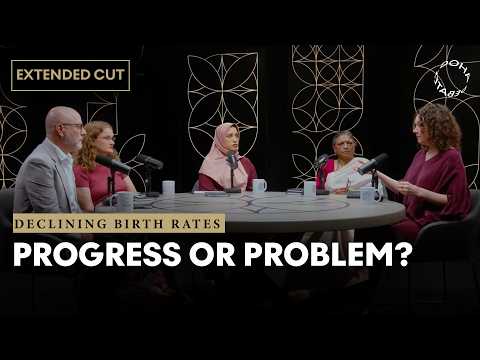
It was a pleasure to join the other panelists in Doha to debate the world's falling birthrates. This is the story of our age...
Doha Debates@DohaDebates

This week's debate asks: Are falling birth rates a problem or a sign of progress? Featuring @alakabasu, Laurie DeRose, Antonina Lewandowska and @StephenJShaw. Moderated by @sosalam 01:52 Should having children be seen as a moral obligation? 05:09 “Having children is one thing, and creating a loving, supportive family is another.” 08:19 Instability, climate and the child-free choice: Why are birth rates declining? 13:00 Is child-free the right term? 19:09 Do we include men enough in these conversations? 20:21 Do men benefit from having children more than women? 24:39 Should we care that people are having fewer children? 34:08 Can technology fix falling birth rates? 36:53 Cultural continuity and preservation amidst global population shifts 45:28 India, demographics and our global future 49:08 Can immigration fix an aging society? 51:34 Marriage, partnership and why timing matters 02:14:54 Experts’ final message to young people

English
1
0
10
2.2K
DChex
DChex@DChexs·
@StephenJShaw @lymanstoneky @SimoneHCollins @DohaDebates @CRPakaluk True and very wise. Your approach is more likely to win you friends, but it's less likely to get clipped for the kids on tik tok. Also if you and other experts disagree on if it is 9 or 11 the listeners will see the experts are around 10 that implicitly shows what is settled.
English
1
0
1
28
Stephen J Shaw
Stephen J Shaw@StephenJShaw·
Not one but two birth rate decline debates released in the past week! Very honored to be part of both of them. @chriswilx led a Modern Wisdom debate alongside @lymanstoneky and @SimoneHCollins, which perhaps had more of a North American perspective. Then @DohaDebates helped provide a more global perspective, including the Global South. If you have six hours to devote to this topic, dive in. Given the era we are only just starting to understand, six hours is worth it. You won’t agree with every statement and nor do I. But you will likely come away with your mind opened to the scale of the challenge we are facing. youtu.be/8eCM3NTBeb4?si… youtube.com/watch?v=WbjPmj…
YouTube video
YouTube
YouTube video
YouTube
English
2
4
22
3.5K
Stephen J Shaw 리트윗함
More Births
More Births@MoreBirths·
THE GREAT BIRTH RATE DEBATE Chris Williamson hosted a nearly four-hour deep dive into the problem of collapsing fertility with leading experts @lymanstoneky, @SimoneHCollins and @StephenJShaw. The wide-ranging discussion covered tremendous ground. Here are some key highlights! The severity of the crisis Few really grasp how bad the birthrate crisis is going to be. Shaw emphasized the dramatic effect of compounding and how countries with below replacement fertility will be orders of magnitude smaller in the future. That means the collapse of whole economies and countries, especially those with fertility rates continuously well-below replacement, which is 2/3 of countries today. Loss of innovation Innovation is a numbers game, and it takes large populations to give rise to brilliant innovators and entrepreneurs. More than that, Stone explained that a large and highly educated population and an advanced economy are preconditions for innovation to flourish, and that benefits the whole world. But populations that are high in innovation are in sharp decline, and aging societies are much less innovative and slower to adopt new technology. Thinkers like Robin Hanson say that innovation itself will grind to a halt. Decline of small towns and rural areas Collins mentioned the “urban population shredder” because birthrates are far lower in cities. But Shaw described a great irony: small towns and rural areas will be ravaged the most by population decline, as people migrate to a few marquee cities. That means in a declining country like Japan, a city like Tokyo can remain healthy long after rural areas and smaller towns face abandonment and collapse. How do you invest in a declining world? How do you make new businesses work when there are fewer customers every year than the year before? We have gotten used to a growing world, where growth doesn’t come at a cost to anyone because the entire economy is growing. But before the Industrial Revolution, conflict was high because the pie was small and your gain was someone else’s loss. A shrinking world that is losing population every year could be like that. This topic is upsetting but necessary Williamson reflected how much he was attacked when he brought up this topic earlier in the year, because it tramples on so many sensitivities. The Internet got so mad at him it showed up in Google trends! But Stone and Collins said ruffling feathers is inevitable and a good sign. Shaw marveled at how much public awareness has grown and how far people have come in just the last three years. Perhaps hope for change lies in growing awareness of the problem. 40% of today’s young women will never be mothers Most women and men have no idea how little time they have, how quickly fertility drops off, and how high the odds are they will end up accidentally childless. The single easiest way to boost fertility may be to educate young people about how little time they have and how high the odds are that they will never have children past given ages. Shaw said that when young people learned this, the effects were life changing. You can’t save the environment without innovators There is little relationship between population growth and pollution, said Stone. What matters is technology. Emissions reductions have almost always come from changes in technology, not through changes in birthrates. We need better technology, and more innovators not fewer, to solve our environmental problems. Expectations are getting more expensive The most common reason people give for not having kids is that they can’t afford it. But society is collectively richer than ever before. What is going on? There has been a huge inflation of standards and expectations, both in material goods and in the level of parenting you are supposed to give your kids. A generation ago, hardly anyone ate fresh blueberries and most people never travelled abroad. Now these things are normal, even expected. Collins argued you should opt out and go rogue, but Stone sided with the masses that these options are great and pretty hard to resist. Economic success comes too late Male earnings peak in the 40s. Apparently, men’s earnings used to be near their peak in the 20s. This creates a big problem because people often delay until their economic value is higher, missing most of their fertility window. Shaw believes we won’t fix the birthrate crisis without finding a way to structure society so that people can get on with making money and having a family much earlier. Housing in cities is terrible for families Stone explained how there are modern norms and laws that say you need a certain number of bedrooms for a certain number of people. When you are renting, landlords often have strict occupancy limits and Child Protective Services is looming in the background. That means having a family in a place that is small is really risky. Most urban housing (studios and 1 and 2 BR apartments) would be practically illegal for a larger family and there are hardly any larger units to be found inside most cities. The pain of unplanned childlessness Not having the children you hoped to have is a source of incredible grief. How do we know? It turns out that there is a natural experiment. With fertility treatments one set of people is successful and another set of people is just unlucky. It turns out that prescriptions for antidepressants and antipsychotics are far higher among the group of people that undergoes fertility treatment without success. Do kids make you happy? Most research says yes, according to Stone. Collins objected to the whole framing. A lot of parenting is really hard, she admitted, but pleasure not how she thinks you should measure things. Deeper fulfillment along with the value of the lives brought forth should be the measure. Men are more domestic than ever before A lot of people say that men need to step up and help around the house. But today’s generation of young fathers already do more housework and are more involved with their children than any previous generation of men while birthrates are the lowest they have ever been. Work from home Stone pointed out that WFH is extremely pronatal and has a larger effect size on fertility than almost any single factor we can measure. Collins talked about how the economy used to be much more home based in the past, and how the huge conflict between work and family is kind of recent to our history. Both Stone, with four kids so far and Collins, with five so far, work from home the majority of the time. Cash for babies? Here the debate got really heated! Stone says that everyone has a price and if you give people large enough sums for babies, you will get more of them. He thinks we could get the TFR up to replacement in America for what we spend on seniors, although admitted that might not create great incentives. Collins and Shaw were much more skeptical and said that governments haven’t had great success with just financial incentives. Collins argued that this would produce few net taxpayers and would be unsound financially. The problem of travel Young people, especially young women, LOVE to travel, especially internationally and that desire comes in big conflict with having family. A lot of people feel they will lose part of themselves if they have to give that up. Stone loves to travel with his kids and wishes society prioritized families and kids in those environments. Is education the problem? All agree that we want both high education and high fertility, to have the kind of society we would want to live in. Shaw urges that we need to find ways to find ways to allow education to be achieved more quickly so that people can get on with the business of having families more quickly. Everyone felt that more people should have kids while in college or graduate school, but that is still niche and rare. The Laestadian Lutherans Most high fertility groups in the world today have low education or are weirdly insular. But there is a group that achieves high education, high achievement and high integration into modern society, all while achieving a TFR of 4 or 5 births per woman. Stone says that the Laestadian Lutherans of Scandinavia are exactly what we need more of, a group that contributes to society at a high level while maintaining very high birthrates. It’s hard to argue with that. Making motherhood high status Williamson reflected that if you could elevate the status of motherhood, that would be like the holy grail to solving the fertility crisis. He mentioned the Republic of Georgia and Stone, the author of the seminal paper on Georgian fertility, was on the scene to narrate about the power of the revered Patriarch Ilya II to create a baby boom all by himself. The difficult question, which should be a topic of great interest and research, is how to give motherhood high status in many different cultural contexts. Families aren’t getting smaller As Shaw explained, children per mother in the US is even higher than it was a generation ago. The problem is that far fewer women are becoming mothers at all. This reflects a big decline in marriage and big challenges with partnering. How can we get more people to partner up? Shaw was nothing if not consistent: we need to teach people how little time they have. The vast majority of people still want children, after all. Doctors and C-sections Simone Collins has had five kids, and plans to have more, all by C-section. Most people aren’t aware that this even possible and doctors usually people tell people who have C-sections that they can’t have more than two or three kids. Collins had a thing or two to say about that. “The world record is eleven. My surgeon who did my last C-section, her record [for one patient] is eight.” The risks for C-sections are manageable and most women who have more of them will be fine. Stone notes the irony that fear rules pregnancy in an era when pregnancy does not increase mortality at all in advanced countries. Here is the whole four-hour podcast: youtu.be/8eCM3NTBeb4?si… via @YouTube
YouTube video
YouTube
English
15
24
139
20.1K
ZUBY:
ZUBY:@ZubyMusic·
@DouglasCarswell There's no 'correct' answer, just wondering what people think.
English
3
1
11
2.5K
ZUBY:
ZUBY:@ZubyMusic·
If GDP per capita is the best single measure to approximate the economic health of country, what is the best single measure of its social or cultural health?
English
662
30
530
89.7K
Stephen J Shaw
Stephen J Shaw@StephenJShaw·
@ZubyMusic This is an uncannily well-timed great question, @ZubyMusic! The answer is… in a paper I submitted less than 24 hours ago for (fingers crossed!) peer review. Hint: it relates to the age of parenthood.
English
1
0
6
135
Stephen J Shaw
Stephen J Shaw@StephenJShaw·
@OldDadYoungFam Yes we recorded it recently. I expect you will see it released in the next few weeks. Lots of popcorn needed...
English
1
0
3
32
Stephen J Shaw 리트윗함
ZUBY:
ZUBY:@ZubyMusic·
@RealJarnoSays @deumcole Watch @StephenJShaw documentary. And draw your conclusions. I'm pointing out the obvious. The economic arguments don't hold much water. Poor people have more children globally.
English
5
2
23
1.7K
Stephen J Shaw
Stephen J Shaw@StephenJShaw·
@Bennyhumma4242 @echetus Names are truly so much less important than the information we want to share... thank you for sharing what matters.
English
0
0
2
34
Ben Hummel
Ben Hummel@Bennyhumma4242·
@StephenJShaw @echetus The Stephen! I did look up your name after the post but neglected to amend the tweet. Great work you’re doing.
English
1
0
0
29
Stakeholder Consultant
Stakeholder Consultant@echetus·
Something that gets overlooked in the Birth Rates discourse is that childlessness is down and falling. 16% of 45 year old women have no children, the lowest in 25 years. A woman born in 1982 is as likely to have a child as woman born in 1923 was!
English
31
26
565
57.6K