Universe Lost

297 posts

Universe Lost banner
Universe Lost

Universe Lost

@Universelostcom

Welcome to the X page of https://t.co/qT49TKtmXr, an immersive online platform dedicated to the exploration of a vast and mysterious universe.

Poland 가입일 Mayıs 2026
47 팔로잉42 팔로워
고정된 트윗
Universe Lost
Universe Lost@Universelostcom·
The Hunt for Earth 2.0: How Lockheed Martin Plans to Spot Potentially Habitable Exoplanets On its quest to find Earth’s twin, NASA is designing a next-generation space telescope, Habitable Worlds Observatory (HWO) that will focus on one specific, audacious goal: to directly image potentially habitable worlds and scan them for chemical signatures of life. “Lockheed Martin has steadily contributed to different phases of research and development for HWO, securing four different contracts for TechMAST maturation since 2018,” Tat’yana Berdan, Lockheed Martin spokesperson told Universelost. @LockheedMartin @LMSpace @NASA @NASAUniverse @NASAWebb @ESA_Webb @SpaceTelescope #NASA #LockheedMartin #astronomy #space #exoplanets #habitableworlds #HWO Full story below 👇👇👇
Universe Lost tweet media
English
2
1
4
1K
Universe Lost
Universe Lost@Universelostcom·
Becoming only the 7th country in the world to master independent orbital launch capability with domestic tech is an absolute masterclass in aerospace engineering! 🚀Looking forward to seeing Nuri fly its 5th mission and continue building out South Korea's incredible space economy!🤞 @kari2030 #kari #nuri
English
0
0
0
12
한국항공우주연구원
[발사 성공 4주년, 누리호의 도전은 계속됩니다!] 2022년 6월 21일, 한국형 발사체 누리호(KSVL-Ⅱ)가 우주를 향해 날아올랐습니다. 국내 독자 기술로 개발한 누리호의 성공적인 발사로 대한민국은 우주 발사체 자력 발사 능력을 갖춘 세계 일곱 번째 국가가 되었고, 독자적인 우주 수송 능력을 증명하며 대한민국의 우주경제 시대를 향한 새로운 가능성을 열었습니다. 한국항공우주연구원은 누리호와 함께 쌓아올린 기술력을 바탕으로 더 먼 우주를 향한 도전을 이어가고, 누리호 5차 발사 역시 성공적으로 수행할 수 있도록 최선을 다하겠습니다 :) #한국항공우주연구원 #항우연 #KARI #6월21일 #누리호 #누리호발사성공4주년
한국항공우주연구원 tweet media
한국어
3
45
106
4.1K
Space innovation
Space innovation@All_inspace·
Full stack: 397 feet. 33 engines. 1 catch tower. Starbase. Mechazilla: It doesn’t roll back. It gets caught. Chopsticks: Lift. Stack. Catch. Repeat. Night shift: Boca Chica doesn’t sleep. Neither does Mars. Power: 7,590 tons thrust. 0 landing legs. Trust the chopsticks. Starbase: Where rockets are born. And caught.
Space innovation tweet media
English
4
6
41
1.6K
Universe Lost
Universe Lost@Universelostcom·
@AmericaPartyX Massive milestone that officially cements SpaceX as a core pillar of US national security and orbital infrastructure!👏👏🚀
English
0
0
1
33
America News
America News@AmericaPartyX·
🚨 SPACEX STARSHIELD WINS 2.29 BILLION DOLLAR SPACE FORCE CONTRACT FOR MILITARY DATA NETWORK SpaceX is becoming a central pillar of America’s military space infrastructure. Through Starshield and new Space Force contracts, SpaceX is building the actual data layer the military will rely on in orbit. The Space Force recently awarded SpaceX a $2.29B contract for the Space Data Network Backbone. Starshield is turning SpaceX into a national security backbone.
America News tweet media
English
24
154
1.3K
25.5K
Universe Lost
Universe Lost@Universelostcom·
@XEthan_Carter It’s one single roadmap. Every user becomes a supporter of the multiplanetary future!🚀👏
English
0
0
0
11
X Ethan
X Ethan@XEthan_Carter·
Elon Musk is so smart he knew the only way to make humanity multiplanetary was with reusable rockets 🚀 To fund that, he built Starlink, so if you’re using Starlink, you’re funding the Mars mission!
English
1
4
13
571
Anish Moonka
Anish Moonka@anishmoonka·
A single gram of antimatter costs about $62.5 trillion to make. That is roughly half of everything the world economy makes in a year, for one gram. Reaching the nearest star would take hundreds of thousands of tons of it. Antimatter packs more energy per ounce than anything else. A normal rocket barely turns any of its fuel's weight into energy, less than a billionth of it. Nuclear fission, the reaction inside a power plant, releases about 0.1 percent of its fuel as energy. Fusion, the reaction in the sun, reaches 0.7 percent. Matter meeting antimatter converts almost all of it. Per pound, that is about ten billion times the energy in rocket fuel. Nothing else we know of could push a ship to a fraction of the speed of light. Speed is the whole point. The nearest star sits 4.2 light years away. Voyager 1, the fastest object we have ever launched, would need about 70,000 years to get there. An antimatter ship could make the trip in a few decades. Closer to home, it could reach Pluto in weeks instead of the 9.5 years the New Horizons probe actually took. The price comes from how antimatter gets made. You cannot mine it. It is built one particle at a time in machines like the collider at CERN in Geneva. Every scrap humanity has ever made adds up to under 20 nanograms, enough to light a 100 watt bulb for a few seconds. At the current rate, a single gram would take about 100 billion years. The universe is 13.8 billion years old. So the dollar figure is just multiplication. A 2003 NASA design figured that a crewed ship fast enough to reach the nearest star in 40 years would need roughly 815,000 tons of antimatter. At today's price, that bill lands past 50 trillion-times-a-trillion dollars. The number in the tweet is, if anything, on the low side. The price tag is really a yardstick. It measures the distance between making antimatter one particle at a time, the way we do now, and making it by the ton. The obstacle is closing that distance. The dollar figure is just what that gap costs.
Elon Musk@elonmusk

In the future, a trillion times a trillion dollars will be spent on making antimatter to travel to other star systems

English
177
169
1.2K
238.7K
Universe Lost
Universe Lost@Universelostcom·
@Defence_Index Flagship NASA science missions launching under budget and ahead of schedule is a beautiful thing to witness 👏 Incredible to see Roman down in Florida getting ready for its summer liftoff!💪 @Defence_Index
English
0
0
0
29
Defence Index
Defence Index@Defence_Index·
🚀🇺🇸🌌 A giant space telescope is getting closer to launch NASA’s Nancy Grace Roman Space Telescope has arrived at the Space Coast in Florida for final launch preparations. 🔭 This next generation observatory features a 2.4 meter class mirror (Hubble sized) but with a field of view about 100× wider, allowing it to survey huge regions of the universe in a single glance. Its mission is to study dark energy, exoplanets, and the large scale structure of the cosmos, helping answer how the universe is expanding and evolving. Roman is currently planned to launch aboard SpaceX Falcon Heavy, one of the most powerful rockets in operation. From final integration on Earth to deep space discovery ahead, NASA’s next major eye on the universe is moving one step closer to flight.
English
2
14
53
4.2K
sourcery
sourcery@sourceryy·
SpaceX employee #13 @_Eric_Romo on why we don't see many Falcon Heavy launches: "Falcon Heavy is extremely expensive, in part because it's three Falcon 9s strapped together." "SpaceX has been clear they would prefer not to fly that vehicle." "And it makes sense—every time they fly one of those, they have to shut down the pad for longer than they would for a Falcon 9." "So when you look at how much time it takes to launch one Falcon Heavy and how many Falcon 9s they could have launched during that time, it's actually economically better for them to launch Falcon 9s." " They have to launch Falcon Heavies because they've got big contracts with Space Force. Our government really needs it. NASA really needs it. But in the commercial market, those launches don't happen very often."
English
17
29
540
75.9K
Physics & Astronomy Zone
Physics & Astronomy Zone@zone_astronomy·
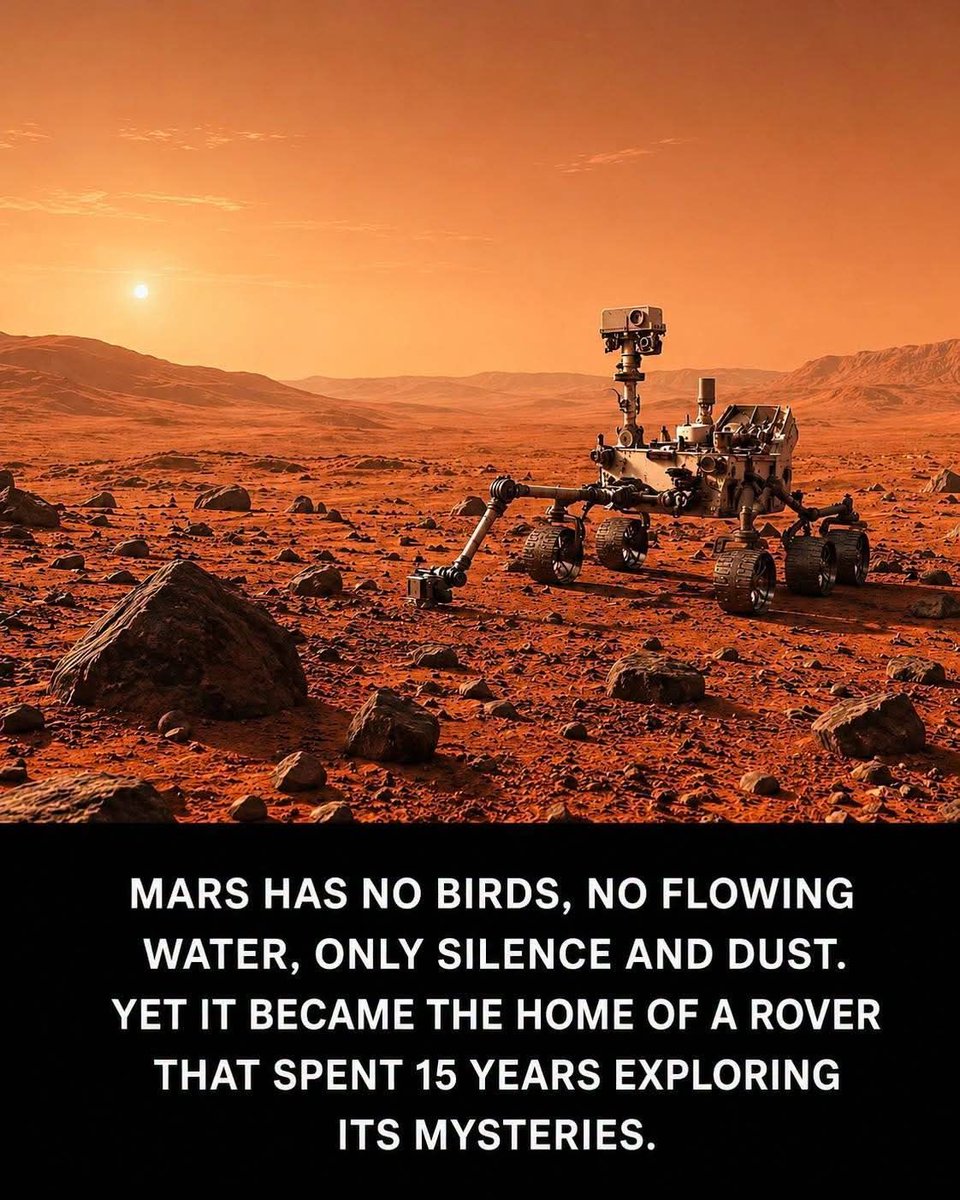
Mars is a world of extraordinary silence. There are no birds singing, no rivers flowing, and no forests swaying in the wind—only endless plains of red dust, ancient rocks, and a thin atmosphere. Yet this seemingly lifeless planet became the workplace of one of humanity’s greatest explorers. NASA’s Opportunity rover landed on Mars in January 2004 with a mission expected to last just 90 Martian days. Instead, it continued exploring for nearly 15 years, traveling more than 45 kilometers (28 miles) across the Martian surface. During its mission, Opportunity discovered strong evidence that liquid water once flowed on Mars, studied ancient rocks and craters, and transformed our understanding of the Red Planet. In the quiet emptiness of Mars, a robotic explorer carried humanity’s curiosity farther than anyone imagined. Every image, every rock sample, and every discovery brought us one step closer to answering one of science’s biggest questions: Could Mars have once supported life? #mars #marsrover #astronomy #SpaceExploration
Physics & Astronomy Zone tweet media
English
6
17
58
2.3K
Universe Lost
Universe Lost@Universelostcom·
@DeepTechTR Piercing through a 50,000-degree wall of superheated plasma at the edge of the solar system and still texting us back from interstellar space. Voyager 1 is the undisputed pioneer and MVP of space exploration. 👏💪 @DeepTechTR #universelost #voyager
English
0
0
0
91
DeepTechTR 🇹🇷
DeepTechTR 🇹🇷@DeepTechTR·
🚨 NASA’nın Voyager 1 uzay aracı, Güneş Sistemi’nin en uç noktasında beklenmedik bir “duvar”la karşılaştı. Yaklaşık 50 yıl önce fırlatılan Voyager 1, Plüton’un çok ötesine geçerek karanlık ve sessiz uzaya doğru ilerlerken, bir anda alışılmadık bir bölgeye girdi. Cihazları ani bir sıcaklık artışı ve yoğun enerji dalgası tespit etti. Bilim insanları bu bölgeyi “Wall of Fire” (Ateş Duvarı) olarak adlandırıyor. Burası, Güneş’in manyetik etkisinin ve güneş rüzgarlarının bittiği, yıldızlararası uzayın başladığı kritik bir sınır. Voyager 1, insan yapımı bir nesne olarak milyarlarca kilometre uzakta, hiç kimsenin daha önce görmediği bu sınırı dokunarak geçti. Hâlâ sinyal gönderiyor ve bize yeni veriler aktarmaya devam ediyor. Bu keşif, Güneş Sistemi’nin gerçekten nerede bittiği ve ötesinde ne olduğu sorularını yeniden gündeme taşıdı.
DeepTechTR 🇹🇷 tweet media
Türkçe
51
271
1.5K
160.7K
Universe Lost
Universe Lost@Universelostcom·
@konstructivizm Outshining an entire galaxy for a fraction of a millisecond from 130 million light-years away. Truly mind-blowing work by the CHIME and James Webb teams to catch this historic celestial shout!👏
English
0
0
0
47
Black Hole
Black Hole@konstructivizm·
The brightest radio burst from a neighboring galaxy 🌌 Astronomers have detected a super-powerful radio signal, FRB 20250316A. It's the brightest burst ever observed. An FRB (Fast Radio Burst) is a short but incredibly powerful radio signal, lasting only a fraction of a millisecond. Its origin is unclear, but the leading suspects are magnetars, the remnants of dead stars with incredibly strong magnetic fields. FRB 20250316A lasted less than 1 millisecond. But during this time, it released as much energy as our Sun emits in several years. The signal's source was located in the galaxy NGC 4141, which is 130 million light-years away. The James Webb Space Telescope detected a faint infrared glow there, strengthening the hypothesis that the source is indeed a magnetar. It remains unclear: is this a repeating signal or a one-time "last cry" of a dying star? The answer will help us understand the nature of FRBs and their role in the evolution of galaxies.
Black Hole tweet media
English
5
21
82
4.7K
Black Hole
Black Hole@konstructivizm·
Cosmic Tunnels Discovered: Our Solar System Just Got a Direct Line to the Stars! Hold onto your telescopes — astronomers at the Max Planck Institute have just blown the lid off our understanding of the local cosmos. Using revolutionary data from the eROSITA X-ray telescope (the first of its kind positioned fully outside Earth’s atmosphere), they’ve mapped a colossal Local Hot Bubble surrounding our Sun... and found glowing interstellar tunnels carved right through it. The universe we thought was a vast, empty expanse? It just became far more connected — and wildly more alive. This Local Hot Bubble is a gigantic cavity of hot, low-density plasma roughly 300 light-years across, blasted clear by a series of supernova explosions about 14 million years ago. Inside this bubble sits our entire solar system, cozy and protected. But the real jaw-dropper? Two massive plasma tunnels branching outward like cosmic highways: One streaks directly toward the Centaurus constellation, pointing straight at Alpha Centauri — our nearest stellar neighbor. Another heads toward Canis Major, linking us to the spectacular Gum Nebula some 1,500 light-years away. These aren’t empty voids. They’re superheated channels of plasma, walled by cooler dust and gas, acting as natural conduits for cosmic rays, magnetic fields, and interstellar material to flow across huge stretches of the Milky Way.
Black Hole tweet media
English
7
34
119
5.9K
Universe Lost
Universe Lost@Universelostcom·
@Physicsastronmy What a view! Pluto gave us active glaciers, a layered blue atmosphere, and a beating heart made of moving nitrogen ice (Sputnik Planitia). It proves that even at the edge of deep space, planetary geology is beautifully alive 😉 @Physicsastronmy #universelost
English
0
0
0
40
Physics-astronomy
Physics-astronomy@Physicsastronmy·
It took NASA's New Horizons spacecraft nearly 9.5 years to travel more than 3 billion miles (about 4.8 billion kilometers) before it reached Pluto in July 2015. The icy mountains seen on Pluto rise as high as some of Earth's major mountain ranges, yet they are made largely of water ice as hard as rock in Pluto's extreme cold. Before New Horizons arrived, scientists knew very little about Pluto's surface. The mission revealed a surprisingly complex world filled with towering mountains, vast frozen plains, glaciers, and signs of ongoing geological activity. What makes this image even more remarkable is that the data traveled for over 4.5 hours at the speed of light before reaching Earth. Every detail in the photograph represents a glimpse into one of the most distant worlds ever explored up close by humanity. A frozen frontier at the edge of our Solar System, captured after a journey that spanned nearly a decade. #space #science #fact #facts
Physics-astronomy tweet media
English
5
18
37
1.3K
Universe Lost
Universe Lost@Universelostcom·
@Sci_Nature0 Instead of a dead, frozen rock, Pluto gave us active glaciers, a layered blue atmosphere, and a beating heart made of moving nitrogen ice. It proves that even at the edge of deep space, planetary geology is beautifully alive! @Sci_Nature0 #universelost
English
0
0
0
29
Science & Nature
Science & Nature@Sci_Nature0·
Three billion miles from Earth lies a world that looks almost impossible. If you drove a car nonstop at 60 mph, it would take more than 5,700 years to get there. NASA’s New Horizons spacecraft made the journey in just 9 years. The mountains in this image soar nearly 11,000 feet high — but they aren’t made of rock. On Pluto, where temperatures plunge to -380°F (-230°C), water ice becomes as hard as granite. And the bright “snow” covering the landscape? Frozen nitrogen — the same gas we breathe on Earth — slowly moving across the surface like glaciers. This is Pluto: a frozen alien world where the atmosphere itself can freeze solid and sculpt towering mountains unlike anything on Earth. Absolutely mind-blowing.
English
2
18
69
1.7K
Astronomy Vibes
Astronomy Vibes@AstronomyVibes·
What would be the scariest message humanity could receive from space?
Astronomy Vibes tweet media
English
455
77
329
19.1K
Universe Lost
Universe Lost@Universelostcom·
@konstructivizm The pure scale of the Block 3 booster is unreal🤯 A towering monument to human engineering rolling out to change the history of spaceflight. Let's go! 💪🚀
English
0
0
0
50
Black Hole
Black Hole@konstructivizm·
Super Heavy Booster V3 is an absolute beast on the move! Just watching this towering colossus roll out is pure adrenaline — a 70+ meter tall, 9-engine monster that looks like it could punch straight through the atmosphere. It’s mind-blowing to imagine the thousands of sleepless nights, razor-sharp engineering breakthroughs, relentless testing, and sheer human ingenuity poured into every weld, pipe, and propellant line. This isn’t just hardware. It’s a rolling monument to what happens when brilliant minds refuse to accept “impossible.” The future of multi-planetary life is literally rolling past on those massive transporters right now. What a time to be alive!
English
15
41
301
13.9K
Universe Lost
Universe Lost@Universelostcom·
@esascience @BepiColombo @esa @JAXA_en Mercury is a brutal, extreme environment, but the dual-probe architecture of BepiColombo is ready to strip away its mysteries. Best of spirit to the engineers and specialists at ESOC as they run these crucial arrival simulations! 👏 #BepiColombo
English
0
0
0
26
ESA Science
ESA Science@esascience·
Thrusters off 🔴 @BepiColombo has switched off its solar electric propulsion as the trio Bepi, Mio and MTM draw closer to Mercury. Meanwhile, on the ground, teams across @esa , @JAXA_en and industry are rehearsing the next critical step for these space adventurers: arriving at Mercury. Stay tuned!
ESA Operations@esaoperations

The end of a journey, the start of arrival 🛰️🌑☀️ After 8 years of solar electric propulsion, @esa 's @BepiColombo switches off SEP as it enters its Mercury arrival phase! Next? MTM separation, orbit insertion & a bold new chapter around the innermost planet! 🎉 #bepicolombo

English
4
42
197
15.3K
Universe Lost
Universe Lost@Universelostcom·
@NightSkyNow Proof that the ingredients for life are manufactured in deep space, not just on planets. We are all made of stardust and now we have the physical receipt to prove it. Phenomenal discovery! 👏 #OSIRISREx
English
0
0
1
39
Night Sky Now
Night Sky Now@NightSkyNow·
🧬 A rock older than life itself may hold the key to our origins. A 2-billion-year-old asteroid is reigniting one of science’s most provocative ideas: that life on Earth may have come from the stars. NASA and Japan’s space agency have revealed that Bennu, a carbon-rich asteroid predating any life on our planet, carries chemical precursors to DNA and RNA—and 14 of the 20 amino acids that all living organisms rely on. These molecules weren’t forged on Earth; they’ve been preserved in the ancient rock since the dawn of the solar system, whispering secrets from the cosmos. This discovery lends compelling weight to the theory of panspermia—the idea that Earth didn’t conjure life from scratch, but was seeded by organic molecules carried across space via comets or meteorites. No alien microbes needed—just resilient building blocks capable of surviving the brutal journey and igniting life-friendly chemistry upon arrival. Until now, scientists debated whether such molecules could endure the harshness of space and impact. Bennu’s pristine samples, returned by the OSIRIS-REx mission, show that not only is it possible, it may be far more common than we imagined. If life’s raw materials exist on Bennu, they could be scattered across the cosmos, waiting to spark life elsewhere. Source: NASA, “NASA’s Bennu Samples Reveal Complex Origins, Dramatic Transformation,” 2025
Night Sky Now tweet media
English
13
54
142
3.4K
Mario Nawfal
Mario Nawfal@MarioNawfal·
🇺🇸While most people were sleeping, Starbase was already at work. @SpaceX lit up the launch site at sunrise with a full test of the massive water deluge system. Testing is ramping up hard ahead of Booster 20 and Flight 13… The countdown is officially on. Source: @NASASpaceflight / Writer: Val
English
32
78
428
25.9K
Elonogy
Elonogy@ElonogyX·
Elon Musk: “I am confident that Starship will land humans on Mars. That path is clear.”
Elonogy tweet mediaElonogy tweet media
English
64
147
384
8.6K