

Yevai Musarira
2.9K posts

Yevai Musarira
@YMusarira
Sarcastic lady with feelings
Johannesburg, South Africa 가입일 Ekim 2025
2.3K 팔로잉1.1K 팔로워


Last year on 13 December 2025 he had this to say(video attached), 6 months down the line, nothing has materialized. This “Chapwati” only surfaces when certain genuine democrats are on to something against the regime. Clearly there is a strategy and role playing to this. I have said it before, the plan is to mobilize unsuspecting, gullible citizens and pacify them. This has been the case since 2018.
English
Yevai Musarira 리트윗함

BUILDING THE ZIMBABWE WE WANT, BRICK BY BRICK, STONE UPON STONE
Guided by the unwavering vision of His Excellency President Cde Dr. E.D. Mnangagwa, the Second Republic is resolutely laying brick upon brick and stone upon stone, marching irrevocably towards an upper-middle-income economy by 2030 with deliberate inclusion, ensuring not a single citizen nor locality is left behind in this unfolding national renaissance.
@enkudheni @dereckgoto @ZimGvt_NDS1 @CMutero43395 @noku_carol @YMusarira @dambumurakashi @Patsime_Zw
English
Yevai Musarira 리트윗함

For years, @matinyarare positioned himself as one of the loudest defenders of certain business and political figures, often presenting himself as an insider with privileged information. Fast forward to 2026 and suddenly the script has flipped. 🍿
Now Advocate Simba Chitando has publicly disputed Matinyarare's latest allegations against Dr. Kuda Tagwirei, arguing that the claims are inconsistent with the documented history of their relationship. According to Chitando, support allegedly flowed in the opposite direction, including assistance with transport, finances and living expenses.
This is where many Zimbabweans are asking the same question: what exactly changed? 🤔
If someone was trustworthy yesterday, what happened today? If there were genuine concerns all along, why were they not raised earlier? If the allegations are accurate, where are the receipts? If they are not, why should the public accept them at face value?
The timeline is starting to look less like a principled disagreement and more like a friendship breakup being livestreamed to the nation.
2018–2024: 🤝 "My brother, my ally."
2026: 😒 "Actually, let me tell you what really happened..."
The internet never forgets. Screenshots exist. Videos exist. Statements exist. People can compare yesterday's praise with today's accusations and draw their own conclusions.
Zimbabweans are not confused by disagreement. They are confused by dramatic U-turns that arrive without convincing evidence.
At this point, the biggest mystery isn't even the allegations themselves. It's how Tungwarara somehow became a supporting character in a story that keeps changing genres every week. 😭
Never accept the abnormal to be normal. ⚠️🇿🇼#Zimbabwe #Politics #Trending #ZimbabweNews @enkudheni @Bete263 @Taurai_Zvimwe
Harare, Zimbabwe 🇿🇼 English
A strong democracy relies on institutions.
Parliament remains elected by the people. Representatives remain answerable to voters. Constitutional oversight remains in place.
Democratic accountability continues.
#CA3 #KnowYourBill

English
Yevai Musarira 리트윗함

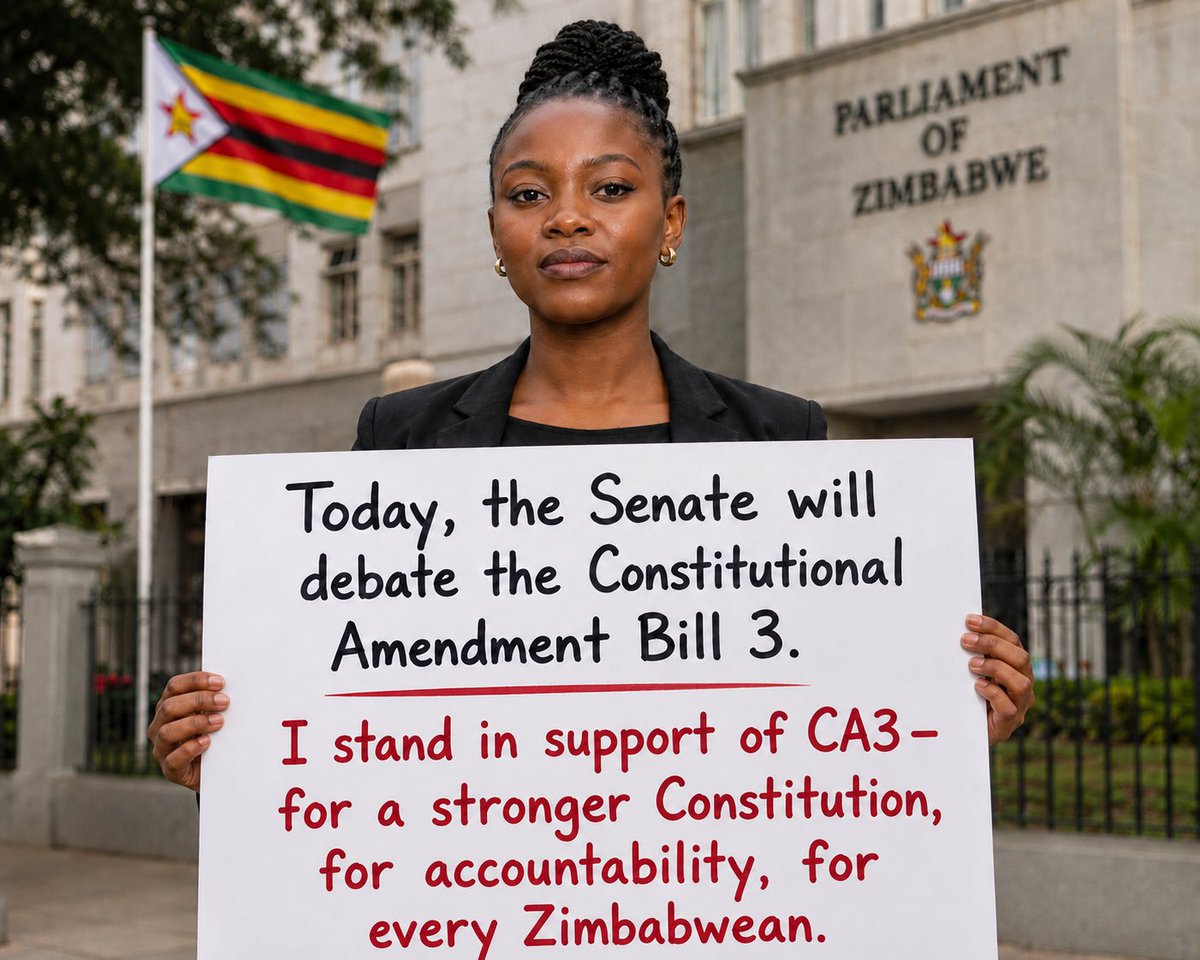
🔥 The Senate debates today. Leadership is about making difficult decisions for tomorrow not popular decisions for today.
Some people only believe in democracy when the outcome suits them.
#CA3
English
Yevai Musarira 리트윗함

@RTsvangirayi you have entered my eyes👀
The beauty of a legislature is not in who proposes an idea but whether the idea is good enough to earn support across political lines. In this case, ZANU PF MPs voted to incorporate opposition proposals into the Bill. That is consultation. That is engagement. That is law-making.
@RTsvangirayi came to the table with ideas. His proposals on strengthening youth representation in local authorities and refining provisions relating to traditional leadership were debated, considered and ultimately adopted.
@RTsvangirayi understood the assignment. While some were busy performing politics, he was busy influencing policy. That's the difference between making noise and making an impact.
Are you married Honourable?🫦 😉
#CA3


English
Yevai Musarira 리트윗함

I want those claiming that the #CA3 process was a rubber-stamping exercise to come and explain this!!!
Why were proposals originating from opposition MPs accepted and incorporated into the final text, if this whole exercise was unconstitutional as you say?
Opposition MP @RTsvangirayi proposed amendments that have now been adopted into the Bill, including provisions to guarantee youth representation in local authorities and adjustments relating to the tenure of traditional leadership structures.
What is significant is not merely the substance of the amendments, but the process. The proposals were debated, considered and ultimately accepted by ZANU PF MPs, who voted in favour of incorporating them into the Bill.
This is how a mature legislature should function. Parliament is not supposed to be a theatre of permanent opposition and permanent resistance. It should be a forum where good ideas are assessed on merit, regardless of which side of the aisle they originate from.


English
Before discussing CA3, understand this key constitutional distinction:
A term length determines how long a term lasts. A term limit determines how many terms may be served.
The Constitution treats them separately, and so should the debate.
#CA3 #KnowYourBill #Vision2030

English
Yevai Musarira 리트윗함

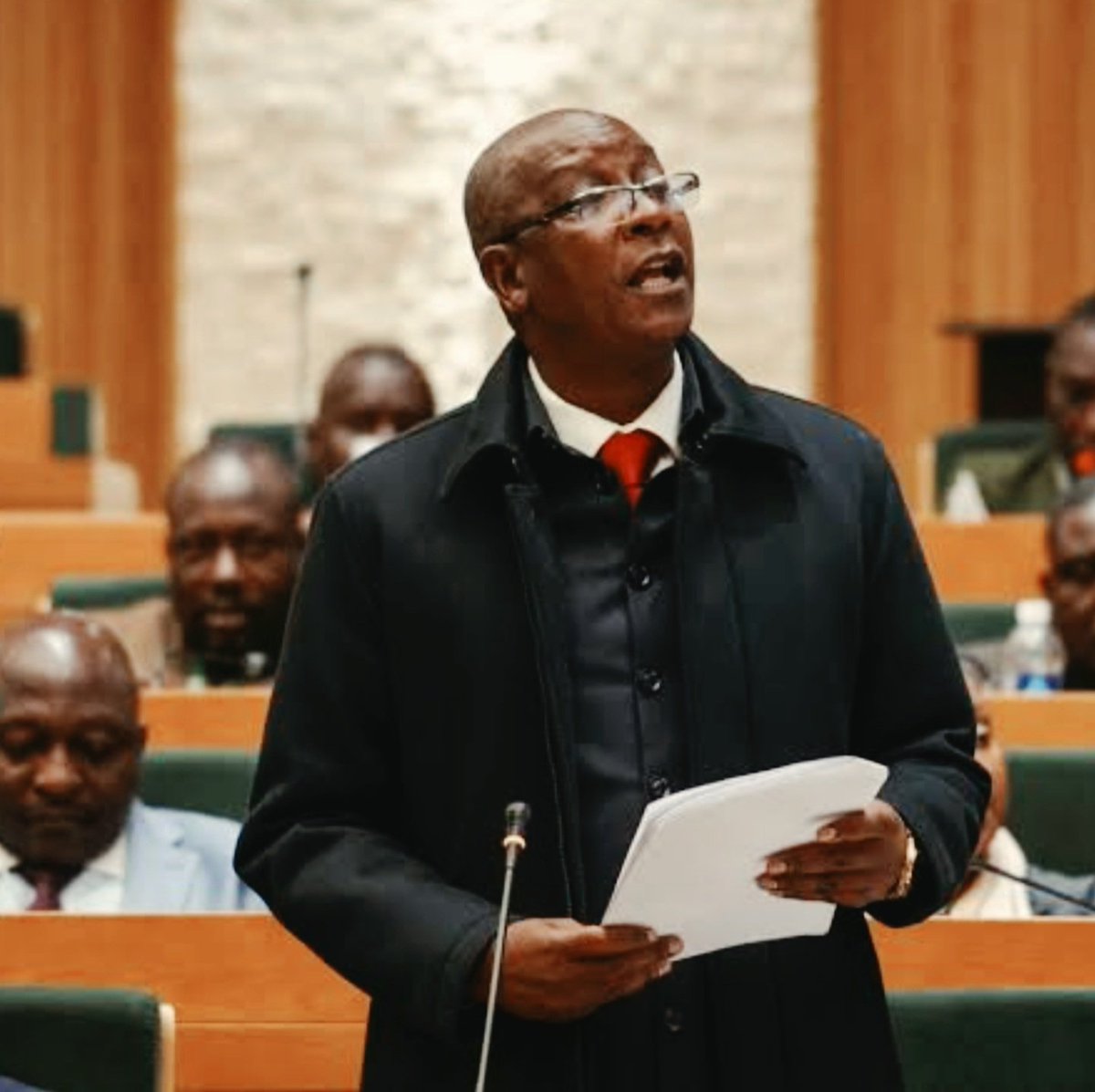
This is the Minister of Justice, Legal and Parliamentary Affairs Ziyambi Ziyambi's reply to the second reading debate on Constitution of Zimbabwe Amendment Bill (N0.3), 2026, in the National Assembly, on June 17.
Mr. Speaker Sir, I rise to reply to the Second Reading debate on the Constitution of
Zimbabwe (Amendment No.3) H.B.1. Bill, 2026. Before doing so, may I thank
Honourable Members for their spirited and constructive engagement of the Bill.
Over
seven sitting days, members from every province and both sides of the aisle rose to
engage the Bill, with the energy that does credit to Parliament.
Whatever our
differences, the people of Zimbabwe have watched their representatives debate the
supreme law of the land with seriousness, and that in itself vindicates the institution
which this Bill proposes to trust as the forum for selecting the country's head of state
and government.
I’m also grateful for the invaluable, technically grounded, contributions
by my colleagues Honourable Kazembe Kazembe, Minister of Home Affairs and
Cultural Heritage; Honourable July Moyo, Minister of Energy and Power Development;
and Honourable Virginia Mabiza; the Attorney General.
Mr. Speaker, let me share with the Honourable House the shape of its own debate, as it
unfolded over a historic course of seven sittings.
A record breaking 182 members made
substantive contributions. Of these, 111 supported the Bill as a whole.
A further 31
supported the Bill while raising reservations on specific provisions; 10 members raised
issues without taking a final position, and 30 opposed the Bill in its entirety.
All told, 139 of the 182, were positively disposed towards the Bill.
Two in three Members
of this entire Honourable House rose to debate this Bill.
This compares very well with
CAB1 and CAB2.
At the Second Reading of CAB1 in 2017, 19 members rose on the
record before the Honourable House; while CAB2 in 2021 had 18. This Bill, Mr.
Speaker, by the parliamentary record itself, is the most debated constitution amendment
in the country’s constitutional history.
The provisions that attracted the most comment were the election of the President
through Parliament; the distinction between the length of the term and the term limit; the
future of the Gender Commission; and the political status of traditional leaders.
I will
address each in its place.
Reflections on the Joint Committee Report
Mr. Speaker Sir, I turn first to the report of the Joint Committee, presented by
Honourable Zvobgo, its Chairperson.
I thank him and every member of that Committee
for a report of genuine quality.
The report is thorough, it is candid, and it carries the
voice of the people in numbers that deserve to be read into the record; once more. The
Committee received 540,037 submissions on this Bill. Of these, 537,102 were in
support and 2,935 were against.
The provincial public hearings drew 54,231 citizens
through their doors.
Mr. Speaker, as I mentioned a little while ago, no amendment has been interrogated by
so many of its citizens; in the recent constitutional history of the country.
The Joint
Committee did not simply count these voices; it weighed them, clause by clause. In the
main, the Committee recommended the adoption of the Bill's provisions, and in respect
of certain provisions it recommended refinements: for example, that the electoral
commission retain the accreditation of observers; that the hierarchy of our two apex
courts be better clarified; that the traditional leaders provision should not be adopted;
that the leadership terms of the National Council of Chiefs be aligned to the new
seven-year national electoral cycle, and that the Gender Commission remain in place.
Government has studied each of these recommendations with the seriousness they
deserve, and I will respond to each in the cluster to which it belongs; and more
specifically during the Committee Stage.
English
Following its successful passage through the National Assembly, CA3 now comes before the Senate.
Today's proceedings begin with the Minister's Second Reading remarks before Senators engage in debate and consideration of the Bill's provisions.
The constitutional process continues.
#CA3 #KnowYourBill #ParliamentOfZimbabwe

English
Yevai Musarira 리트윗함
SENATE OPENS DEBATE ON CONSTITUTIONAL AMENDMENT (NO. 3) BILL
The Senate convenes today to debate the Constitutional Amendment (No. 3) Bill with Justice, Legal and Parliamentary Affairs Minister Ziyambi Ziyambi delivering his Second Reading remarks to guide discussion. Senators will then take the floor to contribute to the deliberations.
The bill already passed the National Assembly last week with 216 votes in favor against 42 opposed comfortably surpassing the constitutional threshold of 187 required for amendments. Support from both ZANU-PF and CCC legislators reflects rare cross‑party consensus.
Following the Second Reading, the Senate will move into the committee stage where each clause will be examined and debated before the bill progresses further. At its core, Constitutional Amendment (No. 3) Bill seeks to strengthen governance and reinforce Zimbabwe’s constitutional framework, ensuring that the nation’s laws evolve to meet the needs of its people.

English
Yevai Musarira 리트윗함

Don't kill me; I like to look at complex issues from different vantage points. I am a contrarian.
Constitutional Amendment Bill No. 3 and the Recalibration of Zimbabwe’s Political Risk Profile: An Investor and Governance Perspective thezimbabwemail.com/law-crime/cons…
English


CAB3: NOT A DONE DEAL.
Those claiming that CAB3 is a “done deal” are either deluding themselves or deliberately attempting to mislead. Deep down, they know that nothing without the citizens is ever final. In any society, nothing can be done for the citizens without the citizens. The citizens are the ultimate decision-makers; they alone have the authority to endorse, reject, or seal any deal.
As things stand, there is no done deal. In fact, there is no deal at all. Any arrangement that lacks the consent and participation of the citizens remains incomplete and illegitimate.
If there is one reality that cannot be ignored, it is this: the citizens are increasingly tired of those who oppress, disregard, and undermine their rights. The only “done deal” may well be that citizens are done with oppression and are ready to reclaim their voice, their power, and their future. #TheNew #TheCitizensMovement
English

What is the best piece of advice your father or father figure ever gave you?
Share it in the comments below, like, share, tag 5 friends you could win your father an umbrella or puffer jacket!! tnc's apply
#MyFathersAdvice #FathersDay

Zimbabwe 🇿🇼 English
@ParliamentZim Character will take you where talent alone cannot @CremoraOnTop @1Mhizha @VaMabhena263 @SiphoNkosi22 @thandazanieikk
English
CA3 AFTER PARLIAMENTARY REVIEW
✔ Zimbabwe Gender Commission retained as an independent constitutional commission.
✔ Appointment of 10 Senators based on expertise following consultation with Parliament.
✔ ZEC entrusted with overseeing the election of a President by Parliament.
✔ Creation of the office of President of the Supreme Court.
✔ Broader pool of qualified legal professionals eligible for acting judicial appointments.
✔ Strengthened Zimbabwe Delimitation Commission.
✔ Census cycle adjusted from 10 to 14 years.
✔ Defence Forces retain their constitutional duty to uphold the Constitution.
✔ Alignment of Chiefs' tenure with the proposed seven-year electoral cycle.
#CA3 #KnowYourBill #Vision2030

English
Yevai Musarira 리트윗함
Presidential Selection and Zimbabwe’s Minority Communities
By Tafadzwa Wakatama
On 16 February 2026, the Constitution of Zimbabwe (Amendment No. 3) H.B.I. Bill 2026, CA3, was gazetted for a 90-day public consultation period constitutionally required before parliamentary consideration. Among its 21 amendments, the Bill proposes replacing the direct popular election of the President with selection by a joint sitting of both houses of Parliament.
The government’s stated precedents are Botswana and South Africa. Among the concerns the opposition has placed before the public consultation process is the claim that parliamentary selection diminishes the voice of minority communities.
In this post, I examine that claim using the Zimbabwe Electoral Commission, ZEC, polling station record for 2018, and find that it does not hold up to empirical scrutiny.
Executive selection systems tend to produce their distributive consequences not through the intentions of candidates but through the rational calculus that governs where political attention, campaign investment, and eventually public resources flow. Burgess, Jedwab, Miguel, Morjaria and Padro i Miquel demonstrated this with road expenditure data across six decades of Kenyan electoral history: districts whose populations aligned with the sitting president received roughly three times the road investment of those that did not (American Economic Review, 105(6), 2015).
Van de Walle’s survey of 87 African multiparty elections identifies the same logic as the defining characteristic of African presidentialism: resources follow the arithmetic that produced the executive, and that arithmetic determines which communities receive attention and which do not (Journal of Modern African Studies, 2003).
Clause 3 of CA3 changes that arithmetic. Under a direct popular vote, the rational calculus of a presidential candidate concentrates attention where registered voter populations are large enough to determine the national outcome.
Under Clause 3, a presidential aspirant must secure an absolute majority across both Houses.
The vote of every MP carries equal weight regardless of the population of the constituency they represent.
Binga district’s 69,723 voters are represented by two MPs, Binga North with 33,716 registered voters and Binga South with 36,007. Under Clause 3, each carries one vote equal in weight to the MP from Harare South, whose single constituency holds 76,425 registered voters.
The community that was invisible as a district in a national popular contest holds two votes in a selection process where every vote carries equal weight.
The structural incentive this produces is not that any single minority community MP becomes uniquely decisive.
It is that an aspirant seeking an absolute majority cannot afford to concentrate attention narrowly. The threshold requires breadth, and that breadth is the mechanism through which historically bypassed communities enter the presidential calculus for the first time.
ZEC’s 2018 polling station data establishes what the current mechanism has produced.
Binga district, the geographic heartland of the Tonga community, one of Zimbabwe’s 16 constitutionally recognised language groups and a population displaced from the Zambezi River plains by the construction of Kariba Dam in the late 1950s, held 69,723 registered voters in 2018. The national electorate stood at 5,695,706.
That is 1.22% of the vote in an election decided by a margin of 313,027.
At maximum mobilisation, Binga’s entire registered electorate could contribute 22% of that winning margin: meaningful in a judicial recount, insufficient to determine a national popular outcome.
The rational campaign calculus produced by that arithmetic is confirmed by the itinerary record. Across four consecutive presidential election cycles, 2002, 2008, 2013, and 2018, no ZANU-PF presidential candidate held a primary star rally in Binga. In each cycle, the Matabeleland North event was held in Lupane.

English
The National Assembly has completed its work on CA3, delivering a decisive outcome after extensive debate and consideration.
Attention now turns to the Senate, where the Bill will undergo further scrutiny as Parliament continues its constitutional duty.
Every stage matters. Every debate matters. Every vote matters.
#CA3 #KnowYourBill #Zimbabwe

English