Neo

2.3K posts

Neo banner
Neo

Neo

@basedmatrixx

🇺🇸🇺🇸🇺🇸

United States 가입일 Şubat 2014
1.9K 팔로잉330 팔로워
Neo
Neo@basedmatrixx·
@Jason_Jorjani What version reflects absolute truth in your eyes? KJV?
English
2
0
0
767
Neo 리트윗함
Under Secretary of State Sarah B. Rogers
“We” are the international consensus who care about freedom. You know — the one NATO member nations invoke when they want defense subsidies. And “we” still agree on something: nations should apply their own sovereign laws. Which is why pathetic censorship flailing by foreign bureaucrats directed at American speech, on American platforms, protected by America’s First Amendment gets you sanctioned. Sorry you can’t control the conversation anymore.
French Response@FrenchResponse

Who’s “we”? EU countries don’t need anyone’s permission to apply their own laws. Another highly consistent argument from those most bent on accusing Europe of imposing its laws beyond its borders.

English
236
713
5.1K
501.4K
Neo
Neo@basedmatrixx·
@nathan_covey Have you ever seen the Light phone? It’s a dumb phone that has some modern conveniences, I’ve been considering making the switch @thelightphone
English
0
0
1
22
Nathan Covey
Nathan Covey@nathan_covey·
Officially 1 month since I switched to a flip phone. - Everyone is more severely addicted to their smartphones than I thought. Once you have a dumbphone, you'll frequently find yourself as the only person in the room not on their phone. It's not just teenagers, it's parents and adults of all ages. It's like everyone is stuck in a trance. 75+ year olds might be the only exception. - All the objections I previously had for getting a dumbphone have turned out to be overblown and/or solvable. My iPhone addiction had fed my brain excuses to not do this earlier. If you really want to make the switch, you can. - I've felt embarrassed to pull out my flip phone in public at times, for fear of being different or drawing too much attention to myself. But I have learned to just own up to it. Most people end up saying something like "Oh, I probably should do that too." - I am using my brain more. Even though my flip phone has Waze, I find myself memorizing maps and roads. I'm more bored and get lost in my thoughts. I'm using paper and pen more. Increased desire for tangible things > digital things. Overall, it has been a great experience and I plan on never going back.
Nathan Covey tweet media
English
804
1.1K
20.6K
1.8M
Neo
Neo@basedmatrixx·
@hthieblot AIM the chatroom messenger I think by AOL, my classmates and I would always meet up in the chatrooms after school
English
0
0
0
46
Hubert Thieblot
Hubert Thieblot@hthieblot·
Anyone who surfed the early web between 1995-2010. What’s the one website/app you still think about?
English
17.7K
543
11.3K
4.7M
Neo 리트윗함
Glenn Greenwald
Glenn Greenwald@ggreenwald·
Jewish groups are now boasting more explicitly than ever that they will use Jewish wealth to destroy any US politician who refuses to "stand with" Israel: as they did to Massie. But if you observe the same exact thing in order to criticize it, you're instantly branded a bigot.
Chris Menahan 🇺🇸@infolibnews

"Over the past few months, the [Republican Jewish Coalition] spent more than $5M to defeat Thomas Massie." "When someone…refuses to stand with the Jewish state when it matters most, there has to be consequences!" RJC CEO Matt Brooks celebrates the ouster of @RepThomasMassie.

English
475
6.9K
19.9K
434.4K
Neo 리트윗함
FBI
FBI@FBI·
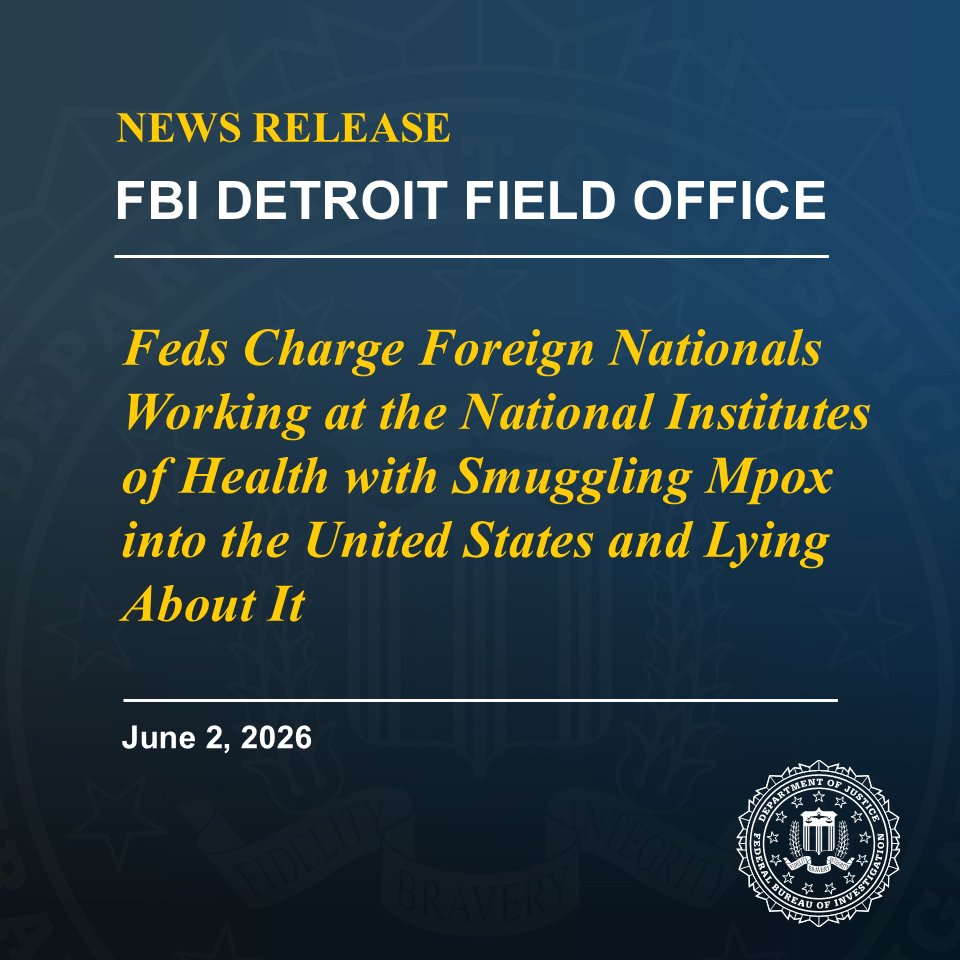
NEWS ALERT from @FBIDetroit: Two researchers with the National Institutes of Health were charged with conspiracy to smuggle monkeypox into the United States and giving false statements to federal law enforcement. A federal complaint alleges that the researchers told Customs and Border Protection (CBP) their case contained diagnostic and testing equipment. However, a investigation by CBP and #FBI agents uncovered 113 vials, 18 of which have been verified to contain monkeypox as of today’s date. This investigation was conducted by the FBI Detroit Joint Terrorism Task Force, along with assistance from the @FBIBillings' Missoula Resident Agency, the U.S. Customs and Border Protection team at Detroit Metro Airport, and the U.S. Department of Health and Human Services – OIG. Read more: justice.gov/usao-edmi/pr/f…
FBI tweet mediaFBI tweet mediaFBI tweet media
English
577
5K
10.7K
378.2K
Neo
Neo@basedmatrixx·
@CollinRugg Planning for surviving the EDCO event?
English
0
0
1
5
Collin Rugg
Collin Rugg@CollinRugg·
Plans released for a $16 billion mile-long ship capable of carrying 80,000 people. The 'Freedom Ship' would be home to about 50,000 people, with space for 10,000 tourists and 20,000 crew members. "The Freedom Ship is envisioned as a permanently mobile city at sea designed for long-term residence rather than short-term travel," the company says. The ship would be about 8 times the size of the current largest ship in the world, the Royal Caribbean’s Icon of the Seas. The plans include a 15,000-seat stadium, schools, colleges, shops, clubs, a water park, a music hall, museums, parks, and more. The ship, which would run on nuclear, would be too large to dock and would remain in international waters. Freedom Cruise International says it would go around the world every two to three years. Insane.
English
7K
4.1K
29.9K
12.3M
Neo 리트윗함
Sterling Cooley
Sterling Cooley@SterlingCooley·
This shows ~1,200 years of seawater erosion of the Khafre Pyramid, compressed into one minute. For the first ~500 years a high ocean stand holds about 300 ft above the base; its waves lap the soft Tura limestone casing and dissolve it (carbonic acid) at roughly 0.08 ft/year — about one inch of perpendicular recession annually, and ~14× faster than the slow dissolution on submerged surfaces below. As the sea recedes, it then pauses at successively lower stands, each held ~75–100 years, and each carves a distinct horizontal band where the casing is stripped to the bare core. Loosened blocks slough off at their own pace and fall down each face, piling into talus that mounds toward the center of all four sides. The smooth white cap above the highest waterline is never reached and survives intact.
English
265
458
4K
633.5K
Neo 리트윗함
theleahfiles
theleahfiles@leahfiles·
Are we merging forces with Israel or is this all clickbait? I read Section 224 so you don't have to. Here you go! First, one clarification to what is being communicated online, Section 224 does not "literally" merge U.S. and Israeli "troops" into one army. No American soldiers are put under Israeli command, and no Israeli soldiers are folded into U.S. units. The phrase "merge the militaries" comes from critics of the provision, and it is a characterization of the effect they fear, not the literal text. What the provision actually does though is fuse the two countries at the level of defense technology and the defense industry. It calls for joint research, joint weapons development and production, shared military networks, shared data, and interoperable systems. Critics argue that doing all of that effectively welds large parts of the two defense establishments together, which is where the "merging the militaries" language comes from. The provision sits in the House version of the 2027 National Defense Authorization Act (H.R. 8800), in the chairman’s mark released in late May 2026. It is not yet law. It still has to survive committee markup, a House floor vote, reconciliation with the Senate, and the President’s signature. Exactly what Section 224 says: The section is titled "United States-Israel Defense Technology Cooperation Initiative." According to reporting that quotes the bill language, it would do the following. 1- It directs the Secretary of Defense to name a senior official as an "executive agent" responsible for synchronizing and overseeing cooperation between the two countries. That gives the program a permanent home and a single point of authority inside the Pentagon. 2- It authorizes cooperation across a sweeping list of "covered technologies": artificial intelligence, quantum computing, autonomous systems, directed energy, hypersonics, advanced manufacturing, cybersecurity, biotechnology, microelectronics, and space-based systems. That list covers essentially every frontier military technology that matters right now. 3- It goes well past shared research. The text calls for "network integration" and "data fusion" between the two militaries, "interoperability of systems and platforms," "co-development and co-production" of weapons, and the creation of "combined program offices" to run joint projects. 4- It requires regular reports to Congress on the state of the cooperation. Critics note that these kinds of reporting requirements are routinely treated as a formality and rarely constrain the executive branch in practice. The practical takeaway from it: research cooperation is normal between allies. What makes Section 224 unusual is the combination of shared networks, shared data, jointly run program offices, and co-production all wrapped into one institutionalized, permanent structure. Have we done this with anyone else? On the operational and command side, yes, the United States has integrated its forces with other countries before, and far more deeply than Section 224 proposes. The clearest example is NORAD, the North American Aerospace Defense Command, a genuinely binational command the U.S. has shared with Canada since 1958, where a single command structure runs air and missile warning for both nations. In Korea, the U.S.-Republic of Korea Combined Forces Command, set up in 1978, even places certain forces under a combined command in wartime. NATO has an integrated military command structure as well. So actual command-level integration with allies is not new. On the industrial and technology side, which is what Section 224 is really about, the U.S. does have close partners, but the arrangement here would go further. The most direct comparisons are the National Technology and Industrial Base, a statutory framework that links the U.S. defense industrial base with Canada, the United Kingdom, and Australia, and AUKUS, the technology-sharing pact with the U.K. and Australia covering submarines and advanced capabilities. Intelligence sharing runs through the Five Eyes network with those same English-speaking allies. Here is the key contrast, though. Those deep industrial and technology partnerships are with treaty allies, countries the U.S. is legally bound to defend and that are inside formal frameworks like NTIB. Israel is not a NATO member, is not party to a mutual defense treaty with the United States, and is not part of the National Technology and Industrial Base. Yet Section 224 would give it a level of defense-industrial integration that, according to the reporting, the U.S. does not maintain even with its closest NATO allies. That combination, an unusually deep arrangement with a country that sits outside the usual alliance structures, is what makes this provision stand out. For context, the U.S. and Israel already cooperate heavily. The two have co-developed and co-funded missile defense systems like Iron Dome, David’s Sling, and Arrow, run joint exercises, and maintain a U.S. weapons stockpile in Israel. Section 224 is best understood as a large escalation of an existing relationship, not something built from nothing. The red flags critics are pointing to A few specific concerns are driving the criticism. 1- It trades visible oversight for an opaque process. Today, U.S. support for Israel runs largely through annual aid votes that Congress debates in public. Section 224 would shift much of the relationship into defense acquisition channels, where oversight is thin and public visibility is low. The result, critics say, is a relationship that is both deeper and harder to see. 2- It is very hard to reverse. Annelle Sheline of the Quincy Institute, a former State Department official, put it this way: once you build combined program offices and integrate networks, you cannot easily vote to end that the way you can vote to end an aid package. It becomes embedded in the bureaucracy. An aid package expires and gets renewed; institutional integration tends to be permanent. 3- Data fusion means sharing sensitive U.S. military data with a foreign government. Merging networks and fusing data raises real counterintelligence and technology-transfer questions, even with a close partner. 4- It deepens entanglement at a tense moment. The provision is advancing while the Trump administration weighs military action against Iran. Critics warn that tightly fusing U.S. and Israeli systems could pull Washington more directly into Israel’s conflicts, exactly as many Americans say they want less involvement in the region. 5- The process has been quiet. The provision was tucked into the chairman’s mark, the base text the committee chair writes to start markup, with little public debate for something this consequential. 6- The mismatch with alliance structure. Israel would receive integration deeper than treaty allies get, without the mutual obligations a treaty alliance carries. The case for it: In fairness I need to present both sides and the proponents of it have a good argument (if this is really what the plan is). Israel is one of the world’s leaders in defense technology, and systems it pioneered, Iron Dome among them, have already shaped American missile defense thinking. Deeper cooperation, the argument goes, gives the U.S. military access to that innovation, spreads development costs, strengthens a key ally in a volatile region, and improves deterrence against Iran. From this view, Section 224 simply formalizes and accelerates a partnership that has paid off for decades. The required reports to Congress, supporters would add, preserve a measure of oversight. Why would Washington do this? Several motives line up at once. Strategically, it is about countering Iran and locking in regional deterrence while gaining access to Israeli innovation. Industrially, co-production and shared supply chains can lower costs and speed up fielding of new weapons. Politically, there is a durable bipartisan consensus in Congress in favor of Israel, which makes pro-Israel measures unusually easy to pass. And there is a structural motive: shifting from the annual aid model, which is becoming more politically contentious as public opinion shifts, to a permanent institutional partnership that does not have to be re-litigated every year. Who put it in the bill? According to the reporting, the provision was championed by Representative Mike Lawler, a New York Republican and a strong supporter of Israel. Because it appears in the chairman’s mark, its inclusion would have required sign-off from the House Armed Services Committee chairman, Mike Rogers, an Alabama Republican. Support is bipartisan: Representative Brad Sherman, a California Democrat, and other pro-Israel Democrats are expected to back it. These attributions come from the originating report and have not, as of this writing, been independently confirmed by the members’ offices. Where it stands and how to verify As of May 30, 2026, Section 224 is text in the House chairman’s mark of the FY2027 NDAA. It is not law. The path ahead is committee markup, a House floor vote, a conference to reconcile with the Senate version, and then the President’s signature, with many opportunities for the language to be changed or stripped out. To check the primary source yourself, look up H.R. 8800, the FY2027 NDAA. Hope this was helpful!
English
431
403
1.3K
75.9K
Neo
Neo@basedmatrixx·
@EcdoPrep I don’t see how the physics of it works, the magnetic field is a billion times too weak to swing the mantle. If it flipped in a day anyway, the heat would boil the oceans and scorch the surface. I don’t think humanity would still exist if this happened in the past
English
0
0
0
17
Neo
Neo@basedmatrixx·
@EcdoPrep Selection = if there is tons of data and loose rules, some pattern will line up by pure chance. Look in enough places and you’ll always find a “hit” Circularity = using a conclusion to prove itself. Defining the target from the data, then point to that data as proof
English
1
0
0
22
Neo
Neo@basedmatrixx·
@EcdoPrep the mantle can’t reorient 104° in hours and magnetic field strength isn’t the mechanical thing holding the shell in place, right?
English
1
0
0
43
Neo
Neo@basedmatrixx·
I don’t see a worked mechanism showing how the bulge migrates ~100° on a day-to-year timescale without melting the crust and where that energy comes from, a demonstration that field strength mechanically governs mantle orientation rather than mass distribution, and a pre-registered independently replicated alignment study that survives the selection-and-circularity problem
English
1
0
0
150
Neo 리트윗함
Pubity
Pubity@pubity·
2 U.S. Congressman have introduced the American High Speed Rail Act, seeking $205,000,000,000 in funding to build a nationwide high-speed rail system. They claim America is behind both Europe and Asia on rail travel and that we need to catch up.
Pubity tweet mediaPubity tweet media
English
603
802
11.5K
1.2M
Neo 리트윗함
Ben Freeman
Ben Freeman@BenFreemanDC·
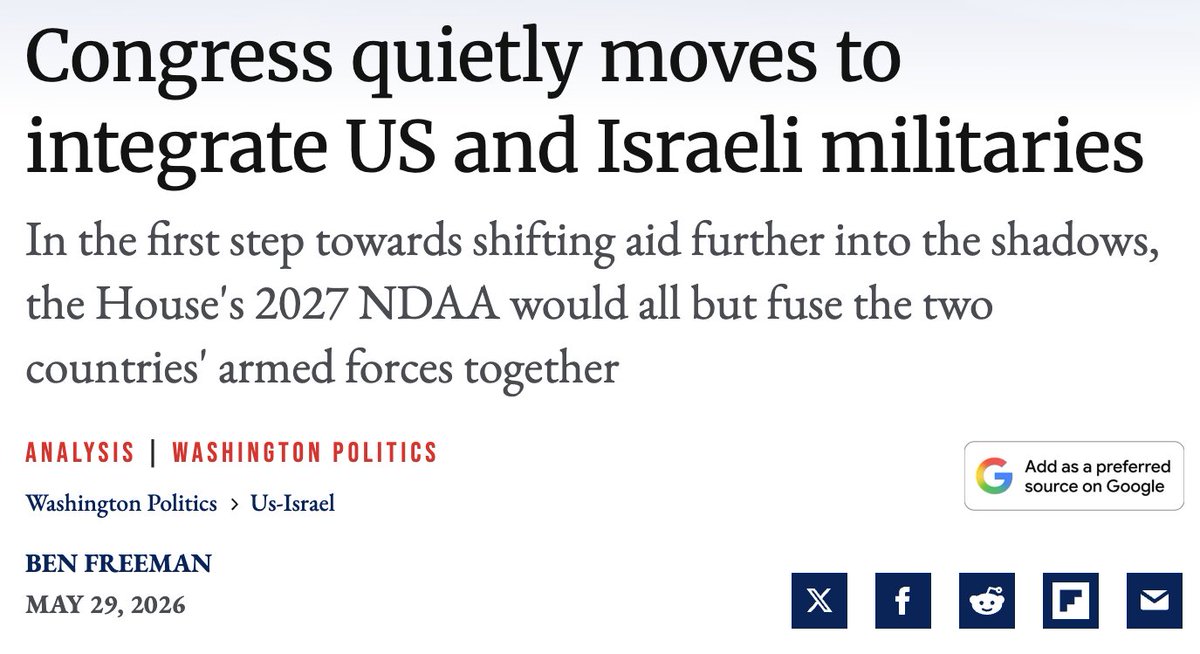
"At a time when the American public is expressing unprecedented levels of distrust in the Israeli government, Congress just proposed tying the U.S. to the Israeli military more than ever before." Here's the story: 🧵
Ben Freeman tweet media
English
486
3.9K
8.3K
1.5M
Neo 리트윗함
Tony Seruga
Tony Seruga@TonySeruga·
🎯 Deep Dive: The Quiet Coup Inside the NDAA The Responsible Statecraft piece has put its finger on something genuinely significant — and the fact that this is happening inside a must-pass $1.15 trillion defense bill, buried at Section 224, tells you everything about how the permanent national security apparatus operates when it wants to avoid a public fight. 🏗️ What Section 224 Actually Does This isn’t a tweak. Section 224 — titled the “United States-Israel Defense Technology Cooperation Initiative” — is a structural rewiring of the U.S.-Israel military relationship. The provision authorizes $150 million annually from FY2027 through FY2029, but the money is almost beside the point. What matters is the architecture it builds: - Bilateral R&D across AI, quantum computing, autonomous systems, directed energy, cyber, biotech, counter-drone systems, and missile defense - Co-production and joint ventures with Israeli defense firms on U.S. soil - Licensing agreements that embed Israeli-origin intellectual property into Pentagon programs of record - “Network integration” and “data fusion” — which means U.S. military data flowing into Israeli systems and vice versa - Pathways from R&D straight into procurement, bypassing the normal foreign aid oversight channels The key phrase in the legislative text: technologies are to be identified for “integration into United States systems and programs of record.” That’s not foreign aid. That’s making Israeli defense tech a backbone of the U.S. military. 🔄 The Strategic Shift: From Aid to Embedded Infrastructure The Quincy Institute’s Steven Simon has been tracking this for months. His brief, The Disappearing Aid Check, lays out exactly what’s happening — and it’s more sophisticated than most people realize. The current model: Israel receives Foreign Military Financing (FMF) through the State Department, voted on annually by Congress. It's visible. It's politically accountable. People can argue about it. The new model: Phase out FMF grants and replace them with Pentagon procurement accounts, industrial partnerships, and sustainment pipelines. Same money, different door — one with vastly less transparency. The logic, as Simon documents, is being sold under an “America First” framing: this isn’t a handout to Israel, it’s an investment in American military readiness, industrial capacity, and jobs. Israeli co-production facilities in Mississippi and Arkansas become political leverage — members of Congress protect the jobs in their districts, and the relationship becomes structurally impossible to unwind. This is the same playbook the military-industrial complex always uses: distribute the subcontracts across as many congressional districts as possible so no one dares vote against the program. Now they’re doing it with a foreign country’s defense sector. 🕳️ The Transparency Problem The shift from State Department-administered FMF to Pentagon procurement is the move that should alarm anyone who cares about accountability. Under the FMF model: - Congress votes on the aid package publicly - The State Department provides human rights certifications - There’s diplomatic oversight and policy conditionality - Public debate is possible Under the Pentagon procurement model: - Funding moves through budget justification documents and program element descriptions - Oversight is limited to “cost, readiness, and capability” — bureaucratic criteria - The relationship gets evaluated like any other weapons program, not as a strategic political commitment - No diplomatic strings attached As the Responsible Statecraft piece notes, this would give Israel “a higher level of military-industrial integration than the U.S. has with any other country in the world” — including NATO allies. Not even the Five Eyes partners have this kind of embedded access to U.S. defense procurement. 🧬 The Legislative Genealogy This didn’t come out of nowhere. H.R. 7540 (Rep. Ronny Jackson, R-TX) and S. 3855 (Sen. Ted Budd, R-NC) were introduced as standalone bills in February 2026 with nearly identical language. When a standalone passage looked difficult, the provisions got folded into the NDAA — the classic maneuver for legislation that can’t survive public scrutiny on its own. The JINSA (Jewish Institute for National Security of America) influence is unmistakable. Their “Partners in Production” report explicitly recommended deeper industrial integration and the addition of Israel to the U.S. National Technology and Industrial Base (NTIB). The FY2026 NDAA had already directed DoD to establish a working group to assess exactly that. Section 224 is the next logical step — and JINSA’s fingerprints are all over it. ⚠️ Why This Matters More Than the Dollar Figure $150 million a year is a rounding error in a $1.15 trillion defense bill. But the institutional architecture this creates is permanent. Once Israeli firms are embedded in U.S. supply chains, once Israeli-origin IP is inside Pentagon programs of record, once U.S. and Israeli military data networks are fused — disentanglement becomes economically and institutionally impossible. You can’t just stop the aid check. You’d have to rip apart procurement programs, break contracts, and rebuild supply chains. That’s the point. This is designed to make the relationship irreversible — at precisely the moment when a growing number of Americans are questioning unconditional support for Israel’s actions in the region. The traditional Israel lobby works through campaign contributions and media influence. This is more sophisticated: it works through the defense procurement bureaucracy itself, creating material interests that guarantee political support regardless of public opinion. 🗳️ What Happens Next The House Armed Services Committee markup is scheduled for June 4, 2026. After that, the bill moves to the full House, then reconciliation with the Senate version. Section 224 is currently in the base text — meaning it was put there by committee leadership before amendments or broader debate. That’s how the most consequential provisions get through: bury them in the chairman’s mark, count on the must-pass nature of the NDAA, and dare anyone to hold up the entire defense budget over one section. Members who want to stop this have a narrow window: force a floor amendment to strike Section 224, or demand recorded votes that put colleagues on the record supporting the fusion of U.S. and Israeli militaries. The question is whether anyone has the stomach for that fight when the pro-Israel apparatus in both parties remains largely unchallenged. The Responsible Statecraft piece is right to flag this. The quiet ones are always the ones that matter most.
Ben Freeman@BenFreemanDC

"At a time when the American public is expressing unprecedented levels of distrust in the Israeli government, Congress just proposed tying the U.S. to the Israeli military more than ever before." Here's the story: 🧵


English
336
2.2K
4.3K
1.1M
Neo 리트윗함
Nick Sortor
Nick Sortor@nicksortor·
🚨 WOW! Scott Bessent just revealed the IRS has moved to make NGOs LIABLE for violent activity committed by their grant recipients like Antifa George Soros has been put on NOTICE. "The IRS is now giving guidance on the Form 990, which nonprofits they have to file. We are going to DEMAND that nonprofits know their grant recipients." "So if a grant recipient is violent, if they are suppressing people's rights, then YOU are responsible for that." As for the for the investigation into who is funding Antifa terrorism: "We made substantial progress. And I think in the weeks and months ahead, we are going to have a lot to report."
English
1.4K
19.9K
71.9K
902.8K