Methuselah

405 posts

Methuselah banner
Methuselah

Methuselah

@EcdoPrep

Preparing for the next age of Earth | Husband. Engineer. Anxious father. Bad swimmer.
US Great Plains Katılım Şubat 2026
144 Takip Edilen835 Takipçiler
Methuselah
Methuselah@EcdoPrep·
@robertwrand LLSVP + hotspot rotate with the islands above. I put a couple too many pronouns in there.
English
0
0
2
117
Robert Rand
Robert Rand@robertwrand·
@EcdoPrep “We know the hotspot forming the chain of islands and seamounts must move with them during the flip otherwise they would not maintain the same clean alignment when they returned to the original state.” ‘them’ and ‘they’ refer to what- just to stay clear on what you are saying.
English
1
0
0
129
Methuselah
Methuselah@EcdoPrep·
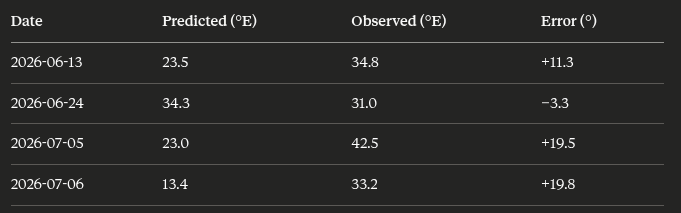
I had a bit of an epiphany tonight (maybe not to the others in this space, but it was to me). ECDO observes the earth made a Dzhanibekov-like flip of ~104 degrees in the past. We know that angle with some confidence based on the (31 E, 14 S) point a myriad of ancient megaliths face (see them here: ecdo-prep.org/evidence/) Why 104 degrees, and not 90 or 120 or the typical 180 associated with Dzhanibekov? The hypothesis is that there is a weakening of coupling between the earth's core and mantle. The core has a radius of ~3,500 km and a density of ~11 g/cc. The mantle+crust has a radius of 6370 km and an average density of ~4.5 g/cc. Doing the math, the split by weight is pretty close to 1/3 core, 2/3 mantle. The epiphany: The core has to do it's own Dzhanibekov-style flip in the OPPOSITE DIRECTION- traversing roughly (360 - 104 =) 254 degrees. Twice the displacement for half the mass. The moment of angular inertia is much more asymmetric: about 1*10^37 kg*m2 for the core, 7x that for the mantle. This argues for why obliquity is essentially maintained between both states, regardless of what the core does (plus everything on earth would have been toasted if obliquity were much greater like it is on Uranus). One final point: How do we know that the CMB is (roughly) where do draw the line at what separates? Because of Hawaii. Or more specifically the Hawaiian–Emperor Seamount Chain. You have probably noticed this chain on Google Maps- a chain of islands and seamounts that was going strait as an arrow north to south from 80 to 50 million years ago, when it took up its new path going southeast, with the Hawaii Islands being the latest additions to the chain. Notice how it is almost perfectly straight. This is on a timescale of tens of millions of years- much much longer than the ECDO oscillation. The hotspot that forms that chain is an outgrowth of the Pacific LLSVP. We know the hotspot forming the chain of islands and seamounts must move with them during the flip otherwise they would not maintain the same clean alignment when they returned to the original state. Finally, we know the depth of the LLSVPs from seismic tomography. They go down ~2,900 km, all the way to the Core Mantle Boundary, the same boundary we used in calculating the 104 degree displacement above.
Methuselah tweet media
English
6
0
37
887
Methuselah
Methuselah@EcdoPrep·
Thanks Craig. What would we look for in sea temp at depth? I ask because I am in the nascent stages of analyzing argo float data to investigate @EthicalSkeptic's hypothesis of abyssal heating. That is not necessarily a competing hypothesis in this instance. I have data from about a million Argo profiles stored in a database and am working on clustering data points into 3D "buckets" to look at bulk changes in temperature over time. I am uncertain if I can help you here, but I am already a few hundred lines of python + SQL into laying the groundwork for a related analysis.
English
0
0
0
73
🇦🇺Craig Tindale
We do see it in SST, what we don't have eyes on is sea temp at depth, my point outlined in the longer climate science critique I posted is we are missing all this at that sea surface temperature which changes the Total thermal storage equation. We do have data on oxtginisation and plankton collapse, solar thermally goes much deeper in lower oxygenated and plankton oceans. If you look at the data round previous high climate change period like younger dryas you can see the axis excursions
English
1
0
2
91
Methuselah
Methuselah@EcdoPrep·
Not that gullible. That convicted. I started getting some prep gear together because I found the narrative compelling and the EOP + magnetic data ominous. But then I felt convicted- maybe I could help my family survive. And then answer to God for why I never warned anybody else. That didn't feel right, so I started this page earlier this year to assuage my conscience. My degree was in chemical engineering if you must know.
English
2
0
2
39
DC
DC@zero_lessons·
@EcdoPrep @SunWeatherMan Bs… You do all this work for him for free mate ? You’re that gullible ? Where did you study ? What university ?
English
2
0
0
35
DC
DC@zero_lessons·
A 2024 geomagnetic jerk is real and has been noted in the official WMM2025 State of the Geomagnetic Field report (Dec 2025). It contributes to faster-than-expected degradation of the linear secular-variation model, exactly as @SunWeatherMan described. That part checks out. However, the claimed tight link between the late-2024 jerk and the Chandler wobble “coming off the rails” is not supported by the latest peer-reviewed analyses. •The well-documented post-2015 diminution of the Chandler wobble (amplitude drop to historically low levels) has been traced in multiple 2025 studies (e.g., Jeon et al., Geophysical Research Letters 2025) to large-scale surface mass redistribution from the 2010–2011 La Niña event — atmosphere, oceans, hydrology, and cryosphere. A 2025 analysis (Na et al., Journal of Astronomy and Space Sciences) explicitly tested geomagnetic-jerk excitation of the Chandler wobble and found the effect negligible. The torque from a typical jerk is orders of magnitude too small to drive the observed phase or amplitude changes. The Chandler wobble naturally fluctuates in amplitude (it has done so for 130+ years of observation). It reached a low around 2019–2020, re-excited by 2021–2024, and continues its normal ~435-day elliptical motion. No sudden new “collapse” in late 2024 tied to the jerk. The scale point is the most grounded part of the thread: even at 1–3 mas/day, the displacement is tiny (~cm/day on the surface) and nowhere near enough for a Dzhanibekov-style flip in a human lifetime. The LLSVPs being ~10° off-axis already puts things in perspective. CDIGR approach (building directly on Barkin’s 2010 secular northward core-drift + Milankovitch-scale oscillator model) does exactly what you suggest: subtract the known Chandler, seasonal, and surface-loading components from IERS EOP + GRACE-FO data to hunt for any coherent residual core signal at the secular/decadal scales Barkin actually predicted. So far, the residuals align with surface drivers. If future jerks produce a clear, accelerating core residual after subtraction, that would be real news worth testing. Until then, linking every jerk + wobble wiggle to impending ECDO remains speculation, not proven mechanism. Data > narrative. Happy to discuss specific IERS residuals or Barkin predictions with numbers. — DC (@zero_lessons) #CDIGR
Methuselah@EcdoPrep

A geomagnetic jerk is a large, fast (~months), "kink" in the earth's magnetic field caused by changes in the flow of material in the earth's core. @SunWeatherMan has explained at length that one such jerk in late 2024, just as the next 5-year release of the World Magnetic Model (WMM) was being finalized, has contributed to early degradation of that model already in 2025. I cannot help but notice that late 2024 also coincides with the time at which the chandler wobble came off the rails, as analyzed in detail by @zachariaspro. I suspect, but cannot yet prove, that the two events are related. For those of you who share my general anxiety regarding ECDO as described by @EthicalSkeptic , there is some good news here. At the current speed of polar motion (1-3 mas/day, or 3-10 cm/day), the total displacement is not going to be enough to initiate a Dzhanibekov flip within a human lifetime, regardless of direction. The LLSVPs are ALREADY tilted by about ~10 degrees from alignment with the pole: adding a few milli-arc-seconds a day is negligible by comparison. I think a more realistic scenario is to watch for acceleration in polar motion with future geomagnetic jerks. And here is the good news- they tend to come a few years apart. Given the deviation from "normal" polar motion introduced by the last jerk, it seems it would take a few to several of these to really accelerate polar motion.

English
2
1
15
819
Methuselah
Methuselah@EcdoPrep·
@Winston_104 @SunWeatherMan My mind was months to years until pretty recently. Now I am thinking a few to several decades. I hope I am right, or that we are both wrong and it is much longer or never. But what do I know.
English
1
0
5
209
Winston van Stroong
Winston van Stroong@Winston_104·
@EcdoPrep @SunWeatherMan The jerks & the wobble collapsing are both the racheting mechnism occuring as large chunks of CMB slough off and create the hooks we see, the more these occur during each null, the more State 2 wins the MoI battle. At the current rate, estimates are months to a few years until S2
English
1
0
2
243
Methuselah
Methuselah@EcdoPrep·
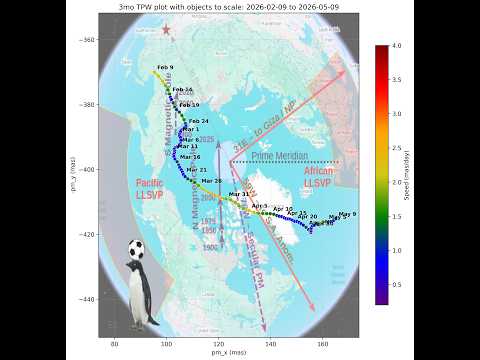
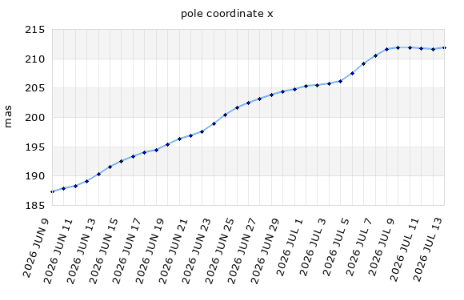
A geomagnetic jerk is a large, fast (~months), "kink" in the earth's magnetic field caused by changes in the flow of material in the earth's core. @SunWeatherMan has explained at length that one such jerk in late 2024, just as the next 5-year release of the World Magnetic Model (WMM) was being finalized, has contributed to early degradation of that model already in 2025. I cannot help but notice that late 2024 also coincides with the time at which the chandler wobble came off the rails, as analyzed in detail by @zachariaspro. I suspect, but cannot yet prove, that the two events are related. For those of you who share my general anxiety regarding ECDO as described by @EthicalSkeptic , there is some good news here. At the current speed of polar motion (1-3 mas/day, or 3-10 cm/day), the total displacement is not going to be enough to initiate a Dzhanibekov flip within a human lifetime, regardless of direction. The LLSVPs are ALREADY tilted by about ~10 degrees from alignment with the pole: adding a few milli-arc-seconds a day is negligible by comparison. I think a more realistic scenario is to watch for acceleration in polar motion with future geomagnetic jerks. And here is the good news- they tend to come a few years apart. Given the deviation from "normal" polar motion introduced by the last jerk, it seems it would take a few to several of these to really accelerate polar motion.
Methuselah tweet media
English
6
20
150
9.2K
Methuselah
Methuselah@EcdoPrep·
@zero_lessons @SunWeatherMan C'mon- keep it clean mate. I have never met Robert, he may follow me here but hardly knows I exist as a person. I have a day job and young children. If there is a way to monetize this space I must have missed the boat, no pun intended.
English
1
0
4
42
DC
DC@zero_lessons·
@EcdoPrep @SunWeatherMan Side note. I hope Mr Ethical Skeptic is being ethical and paying you for doing his bidding here ! I know he will continue to take my rebuttals and research to use for his own grifting operation but it’s ok.
English
1
0
0
46
Methuselah
Methuselah@EcdoPrep·
A few comments, some where I agree, some where I do not: "..,but not yet demonstrated instability physics" Amen and may it remain so through our children's days. But I do not dismiss the possibility entirely. "a demonstrated torque budget large enough for rapid overturn mechanics" I will push back a bit here- the Dzhanibekov oscillation takes place in the absence of any external torque. But a reduction in coupling would make the imbalance of rotational axis vs maximum angular momentum larger. "we still do not have direct measurements of a runaway coupling collapse, evidence that polar motion residuals are escaping known excitation envelopes" - Maybe yes maybe no. Craig's DRIFT analysis puts the current trajectory at about a 3.8 sigma deviation from the past 70 years of data. Not cataclysmic, but quite conspicuous. That does not say WHAT is driving it (CMB, Greenland melting, AMOC, something else), but it does suggest something has changed recently.
English
1
0
3
38
DC
DC@zero_lessons·
That’s a much more technically grounded formulation, and I appreciate the clarification. A shared underlying driver at the CMB producing BOTH: (1) secular-variation anomalies / jerks and (2) altered coupling efficiency …is absolutely more plausible than “jerks themselves drive the wobble.” Where I still push back is on the transition from: “reduced coupling exists” to “LLSVP torque eventually overcomes rotational stability.” Because the Earth system appears remarkably damped. Even during the post-2015 Chandler diminution — which was unusual — the wobble did not diverge chaotically. By 2021–2024 it was already re-exciting within the normal free-oscillation framework. That suggests the restoring terms remain dominant. The critical issue becomes magnitude: How large would the coupling reduction actually need to be before the inertia asymmetry associated with the African/Pacific LLSVPs produces nonlinear instability rather than secular drift? That’s where I think Barkin’s framework is more useful than ECDO-style catastrophism: -slow secular core displacement -evolving inertia tensor -gradual torque imbalance -oscillator-state transitions over long periods —not a sudden Dzhanibekov-style flip. And MOST importantly, we still do not have direct measurements of a runaway coupling collapse, evidence that polar motion residuals are escaping known excitation envelopes, or a demonstrated torque budget large enough for rapid overturn mechanics. So IMO the strongest version of this hypothesis is still empirical. If future geomagnetic jerks correlate with persistent residuals in EOP after removing atmosphere/ocean/hydrology terms, accelerating secular drift, measurable changes in dissipation/Q behavior of the Chandler mode, and coherent GRACE-FO mass anomalies inconsistent with surface forcing then the deep-coupling argument gets much stronger. Until then, I think it’s fair to say it’s an interesting mechanism hypothesis, but not yet demonstrated instability physics.
English
1
0
0
46
Methuselah
Methuselah@EcdoPrep·
Thanks Craig. You are better in the geodesy domain than I. The article is written as an early warning predictor for AMOC decline. It seems fairly obvious that something has happened already. Do you think the erratic behavior over the past ~18 months is indicative of a partial collapse already? At first my mind thought "no we would see this in the Sea Surface Temp data", but then I realized we don't really have good eyes on temps or momentum at abyssal depths.
English
1
0
1
178
Methuselah
Methuselah@EcdoPrep·
@ctindale Thanks Craig. I will have to print this off for easier reading. I respect the vulnerability you have built-in here: ```If AMOC fingerprints do not beat competing fingerprints under ΔBIC > 10, P(α > 0 | data) > 0.95, and out-of-sample validation, the hypothesis is rejected.```
English
0
0
0
34
ActionJaqueson
ActionJaqueson@norwoodsman·
@EcdoPrep @HashZappa @ThomasG19367769 @thingcreator @zachariaspro Awesome… I do as well and can’t wait to see what you uncover. Not my work of course, but you’re welcome for my ocd pic collection obsession at least:) I just kind of ignorantly assumed you small group of ECDO researchers were familiar with each others accounts. My bad.
English
1
0
0
65
Methuselah
Methuselah@EcdoPrep·
I find this fascinating- I arrived at a 48-72 hour window for the bulk of the Dzhanibekov rotation based on a completely different source. Can you spell out a couple of the key points in your interpretation here? Is the wave shape days/nights? What are the circles above? The "horseshoes" beneath?
English
0
0
0
65
Ryan Garner
Ryan Garner@imkharn·
Kerbstone 52 Decoded! Utnapishtim's story is corroborated. The observed start and stop times are marked with spirals. The documented event is calculated to last 47 hours and 13 minutes using only the blue text from this image. The exact times of sunrise combined with the location and approximate year are the primary enablers of this calculation. The documented event was directly observed to last up to 75 hours and 4 minutes if you include dampening oscillations. It might be shorter; it was daytime in Ireland when the stars fully stopped changing so they couldn't tell. The blue text was obtained by measuring pixels and obvious symbols. The grey grid was obtained by knowing that a day must last 24 hours once all extra movement stops.
Ryan Garner tweet media
English
23
51
304
22.6K
Methuselah
Methuselah@EcdoPrep·
Thank you. I actually find this quite intriguing: A 48 day timescale for bulk of the the Dzhanibekov oscillation matches quite closely with a scale of 2-3 days I had arrived at based on Genesis 7:11 and @zachariaspro "lunisolar gatekeeping" concept. I will have to investigate this a bit more.
English
1
0
1
36
Methuselah retweetledi
Winston van Stroong
Winston van Stroong@Winston_104·
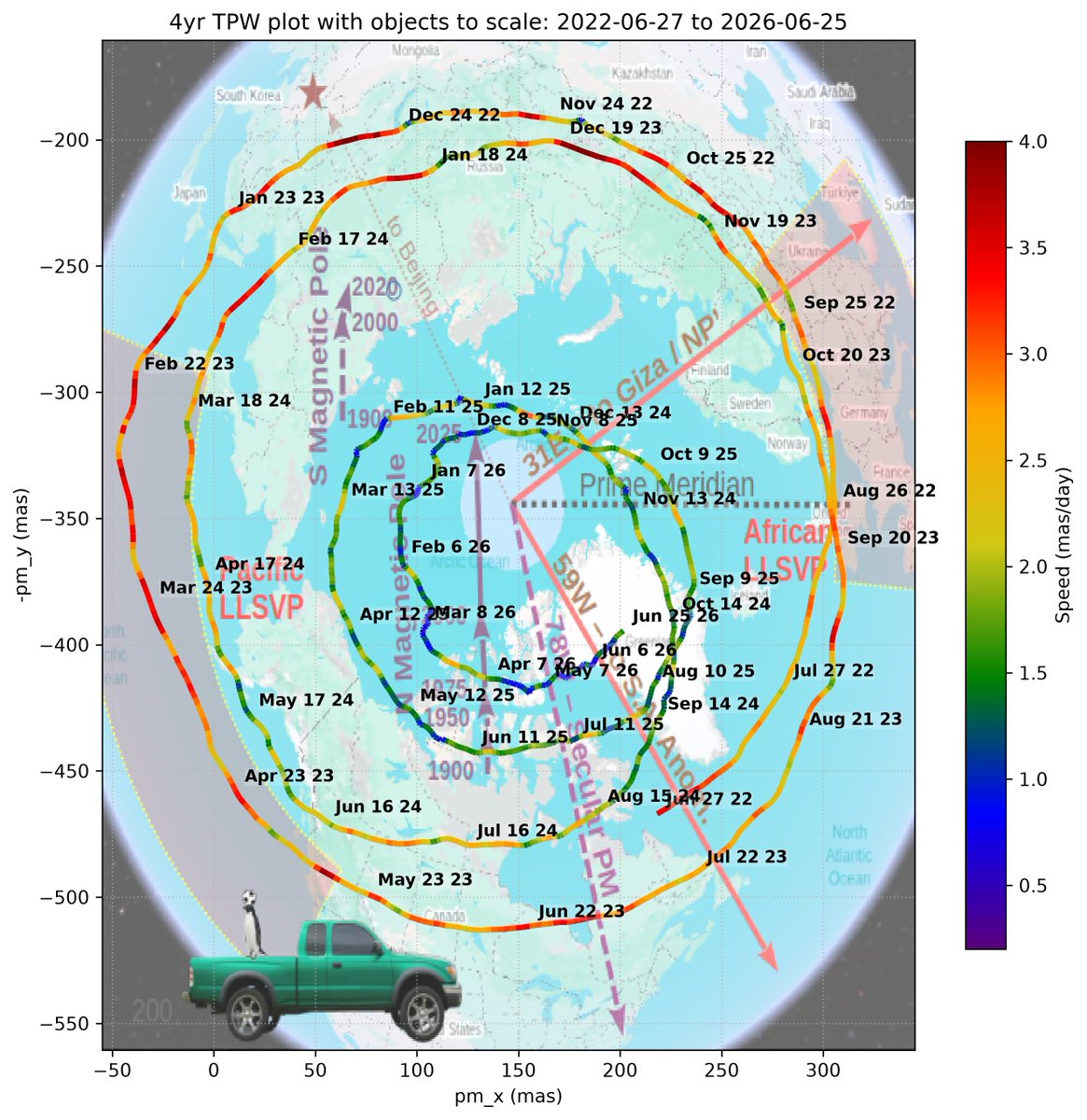
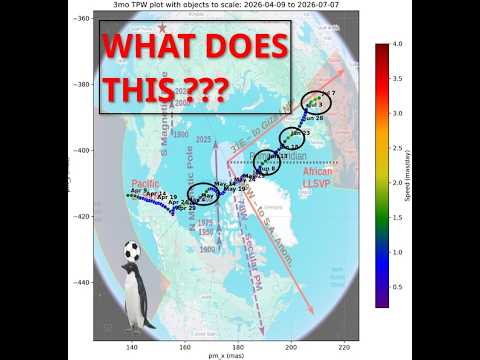
Speeding up and heading back towards our #ECDO bearing already. Sooner than expected.
Winston van Stroong tweet media
English
2
6
61
3.1K
Aki_Balboa
Aki_Balboa@Aki_Balboa_·
@EcdoPrep @BenNollWeather The normal trade winds that blow from east to west and create cold water upwelling off Peru in a normal year, turn off. This allows the west pacific warm water to slosh back towards South America, reversing the cold and warm waters.
English
1
0
0
81
Ben Noll
Ben Noll@BenNollWeather·
An El Niño signature is emerging. The developmental pace has been quicker than at this time in 1982, 1997 and 2015, considering traditional indices over the past week. But, based on new relative indices, the 1997 and 2015 events were slightly further advanced than 2026 is now.
Ben Noll tweet media
English
30
215
1K
80.4K