Jack Ratkovich

983 posts

Jack Ratkovich

Jack Ratkovich

@jackratko_

@plumenetwork. Ex-HashKey Capital. Midcurve degen. Decentralization enthusiast.

가입일 Aralık 2021
841 팔로잉1.1K 팔로워
Jack Ratkovich 리트윗함
Andrej Karpathy
Andrej Karpathy@karpathy·
LLM Knowledge Bases Something I'm finding very useful recently: using LLMs to build personal knowledge bases for various topics of research interest. In this way, a large fraction of my recent token throughput is going less into manipulating code, and more into manipulating knowledge (stored as markdown and images). The latest LLMs are quite good at it. So: Data ingest: I index source documents (articles, papers, repos, datasets, images, etc.) into a raw/ directory, then I use an LLM to incrementally "compile" a wiki, which is just a collection of .md files in a directory structure. The wiki includes summaries of all the data in raw/, backlinks, and then it categorizes data into concepts, writes articles for them, and links them all. To convert web articles into .md files I like to use the Obsidian Web Clipper extension, and then I also use a hotkey to download all the related images to local so that my LLM can easily reference them. IDE: I use Obsidian as the IDE "frontend" where I can view the raw data, the the compiled wiki, and the derived visualizations. Important to note that the LLM writes and maintains all of the data of the wiki, I rarely touch it directly. I've played with a few Obsidian plugins to render and view data in other ways (e.g. Marp for slides). Q&A: Where things get interesting is that once your wiki is big enough (e.g. mine on some recent research is ~100 articles and ~400K words), you can ask your LLM agent all kinds of complex questions against the wiki, and it will go off, research the answers, etc. I thought I had to reach for fancy RAG, but the LLM has been pretty good about auto-maintaining index files and brief summaries of all the documents and it reads all the important related data fairly easily at this ~small scale. Output: Instead of getting answers in text/terminal, I like to have it render markdown files for me, or slide shows (Marp format), or matplotlib images, all of which I then view again in Obsidian. You can imagine many other visual output formats depending on the query. Often, I end up "filing" the outputs back into the wiki to enhance it for further queries. So my own explorations and queries always "add up" in the knowledge base. Linting: I've run some LLM "health checks" over the wiki to e.g. find inconsistent data, impute missing data (with web searchers), find interesting connections for new article candidates, etc., to incrementally clean up the wiki and enhance its overall data integrity. The LLMs are quite good at suggesting further questions to ask and look into. Extra tools: I find myself developing additional tools to process the data, e.g. I vibe coded a small and naive search engine over the wiki, which I both use directly (in a web ui), but more often I want to hand it off to an LLM via CLI as a tool for larger queries. Further explorations: As the repo grows, the natural desire is to also think about synthetic data generation + finetuning to have your LLM "know" the data in its weights instead of just context windows. TLDR: raw data from a given number of sources is collected, then compiled by an LLM into a .md wiki, then operated on by various CLIs by the LLM to do Q&A and to incrementally enhance the wiki, and all of it viewable in Obsidian. You rarely ever write or edit the wiki manually, it's the domain of the LLM. I think there is room here for an incredible new product instead of a hacky collection of scripts.
English
2.2K
5.1K
44.9K
13.1M
Jack Ratkovich 리트윗함
Autism Capital 🧩
Autism Capital 🧩@AutismCapital·
🚨NEW: Starting April 4th, 2026 Claude subscriptions can no longer be used with third-party harnesses like OpenClaw.
Autism Capital 🧩 tweet media
English
45
36
458
69.5K
Jack Ratkovich 리트윗함
Google
Google@Google·
We just released Gemma 4 — our most intelligent open models to date. Built from the same world-class research as Gemini 3, Gemma 4 brings breakthrough intelligence directly to your own hardware for advanced reasoning and agentic workflows. Released under a commercially permissive Apache 2.0 license so anyone can build powerful AI tools. 🧵↓
English
620
3K
20K
7M
Jack Ratkovich 리트윗함
Guri Singh
Guri Singh@heygurisingh·
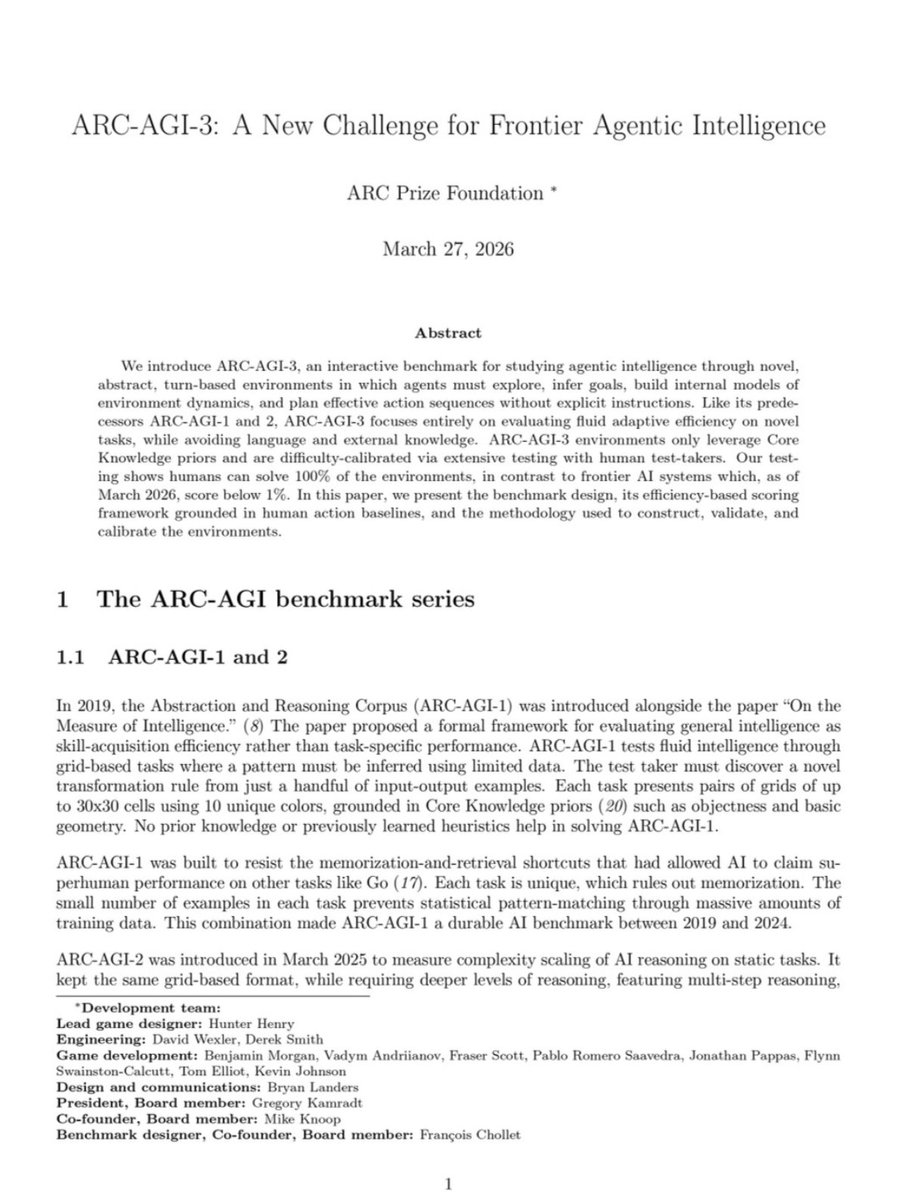
Humans: 100% Gemini 3.1 Pro: 0.37% GPT 5.4: 0.26% Opus 4.6: 0.25% Grok-4.20: 0.00% François Chollet just released ARC-AGI-3 -- the hardest AI test ever created. 135 novel game environments. No instructions. No rules. No goals given. Figure it out or fail. Untrained humans solved every single one. Every frontier AI model scored below 1%. Each environment was handcrafted by game designers. The AI gets dropped in and has to explore, discover what winning looks like, and adapt in real time. The scoring punishes brute force. If a human needs 10 actions and the AI needs 100, the AI doesn't get 10%. It gets 1%. You can't throw more compute at this. For context: ARC-AGI-1 is basically solved. Gemini scores 98% on it. ARC-AGI-2 went from 3% to 77% in under a year. Labs spent millions training on earlier versions. ARC-AGI-3 resets the entire scoreboard to near zero. The benchmark launched live at Y Combinator with a fireside between Chollet and Sam Altman. $2M in prizes on Kaggle. All winning solutions must be open-sourced. Scaling alone will not close this gap. We are nowhere near AGI. (Link in the comments)
Guri Singh tweet media
English
317
1.1K
6.4K
1.3M
Jack Ratkovich
Jack Ratkovich@jackratko_·
@MerlijnTrader Not only would this bill have harmed the current best uses of stablecoins now, as others have mentioned, but it also would’ve hindered one of the best use cases for stablecoins that will be a big reason they grow (passing yield on to users) I’m with Brian
English
2
0
3
120
Merlijn The Trader
Merlijn The Trader@MerlijnTrader·
INSIGHTS: 🇺🇸 The CLARITY Act passed the House 294-134. a16z backed it. Ripple backed it. The White House backed it. The crypto industry spent $149,000,000 to make this happen. Then Brian Armstrong killed it. The night before the Senate vote. Why? Stablecoin yield restrictions would cut into Coinbase's $1,350,000,000 annual revenue. One man. One P&L. One veto. This isn't leadership. It's greed dressed up as principle.
Merlijn The Trader tweet media
Merlijn The Trader@MerlijnTrader

UNREAL: 🇺🇸 Brian Armstrong is blocking the CLARITY Act to protect a 34% commission fee. Not for crypto freedom. Not for retail investors. For his own bottom line. Every time he says "this bill isn't good for crypto." He means "this bill isn't good for Coinbase revenue." People lie. Numbers don't. Remember that next time he plays the hero.

English
198
360
2.2K
616.7K
Jack Ratkovich 리트윗함
Graham Ferguson
Graham Ferguson@grahamfergs·
TLDR: RWAs need to behave more like DeFi-native assets. @Securitize is fixing this alongside partners like @FissionXYZ and @multiliquid_xyz so that @Morpho and other protocols CAN be a great fit for RWAs.
Cain O'Sullivan@cainosullivan

Why Morpho Isn't a Great Fit for RWAs. Morpho is designed around the deployment of immutable markets. A market is defined by its loan token, collateral token, price oracle, and risk parameters; the interest rate model, LTV, and liquidation discount (inferred from the LTV). This is great from a lender's perspective. When you deploy capital to a market, you know exactly what you're lending against and that the terms won't change. But the fundamental problem with this design is that it assumes risk is static, when risk is very much dynamic. What do I mean by this? As a lender, when you deploy capital to a market you have a holistic view of the current world state. You might deploy to a market offering a 91.5% LTV (which infers a 2.62% liquidation discount) where the collateral has plenty of on-chain liquidity available for liquidators. But what happens when that on-chain liquidity starts to disappear? The risk profile of the market has changed, but the parameters haven't. Morpho's solution is to deploy a new market with updated risk parameters that better capture the shift in the external environment. In practice, it's not that simple. If liquidity in the original market is currently being borrowed, borrowers are unlikely to voluntarily migrate their positions to a new market with a lower LTV and a higher liquidation discount. This becomes even more precarious with RWAs, which carry a fundamentally different risk profile from spot tokens. Liquidators go from taking on price risk to taking on duration risk. Let's look at a concrete example. Take the Anemoy Tokenized Apollo Diversified Credit Fund (ACRDX) and assume we deploy a market with an 86.5% LTV, that equates to roughly a 4.22% liquidation discount. ACRDX has quarterly liquidity, so to keep things simple, assume redemptions only occur on the 1st of every quarter. If a position is liquidated on day 1 of a new cycle, the 4.22% discount is probably sufficient to cover the duration risk and opportunity cost of waiting 90 days for the liquidator's redemption to settle. But if the position is liquidated on day 89, the same 4.22% is far more punitive as the liquidator only has to bear one day of duration risk for the same reward. This creates a perverse incentive. Liquidators are encouraged to wait as long as possible before seizing a position, since the longer they delay, the better their risk-adjusted return on the liquidation becomes. By design, this heightens the probability of bad debt accumulating in the market. Risk modelling in a lending market needs to be dynamic. It needs to respond to the specific characteristics of the collateral it's modelling, not treat every asset class as if it carries the same static risk profile. What's good for spot tokens isn't necessarily good for RWA's.

English
10
4
54
6.4K
Jack Ratkovich 리트윗함
Peter Wildeford🇺🇸🚀
Peter Wildeford🇺🇸🚀@peterwildeford·
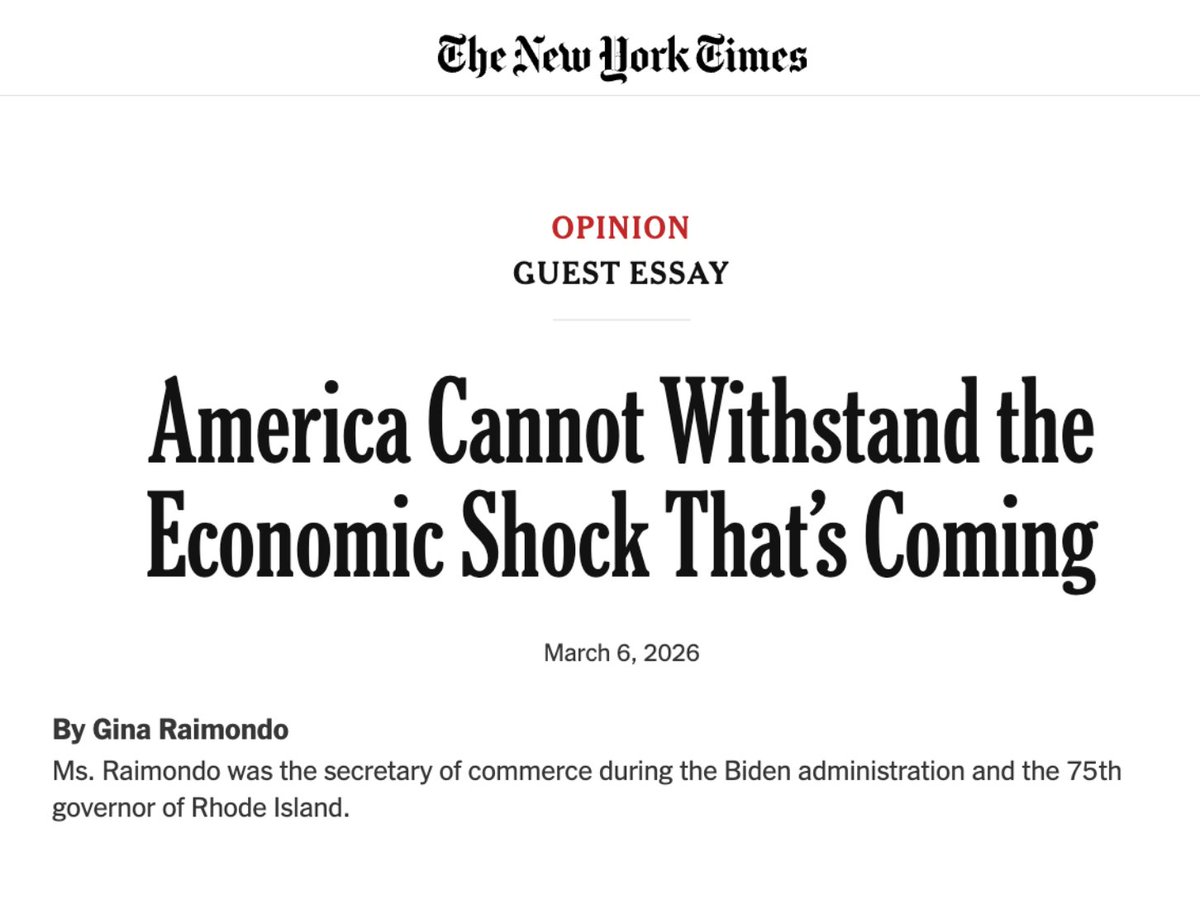
It's great to see @SecRaimondo in the @nytimes talking about how AI will affect employment. She and I agree on the problem - AI will come at us fast and we're not ready. But I disagree with her solution. It's calibrated for a fundamentally different problem than the one she describes. She proposes things like community college certificates, apprenticeships, employer tax credits for retraining... these all assume there's some stable set of destination jobs that AI-displaced workers can be moved into. But the AI displacement she's warning about hits across white-collar work simultaneously. If you're retraining a displaced accountant, what would you retrain them into that AI can't also do? The target keeps moving, and it moves faster than any four-month credential program can help. This reads like someone who sees a 15%+ unemployment scenario but is proposing a toolkit for a 7% one. It will age like "retrain coal miners to code." What happens if comparable replacement jobs simply don't materialize at the needed scale?
Peter Wildeford🇺🇸🚀 tweet media
English
23
24
219
13.9K
Jack Ratkovich
Jack Ratkovich@jackratko_·
Are people using worse grammar intentionally because they're afraid of people thinking they're AI? Not sure how I feel about this. First they came for em dashes. Now they're coming for properly-structured sentences.
English
0
0
2
84
Watcher.Guru
Watcher.Guru@WatcherGuru·
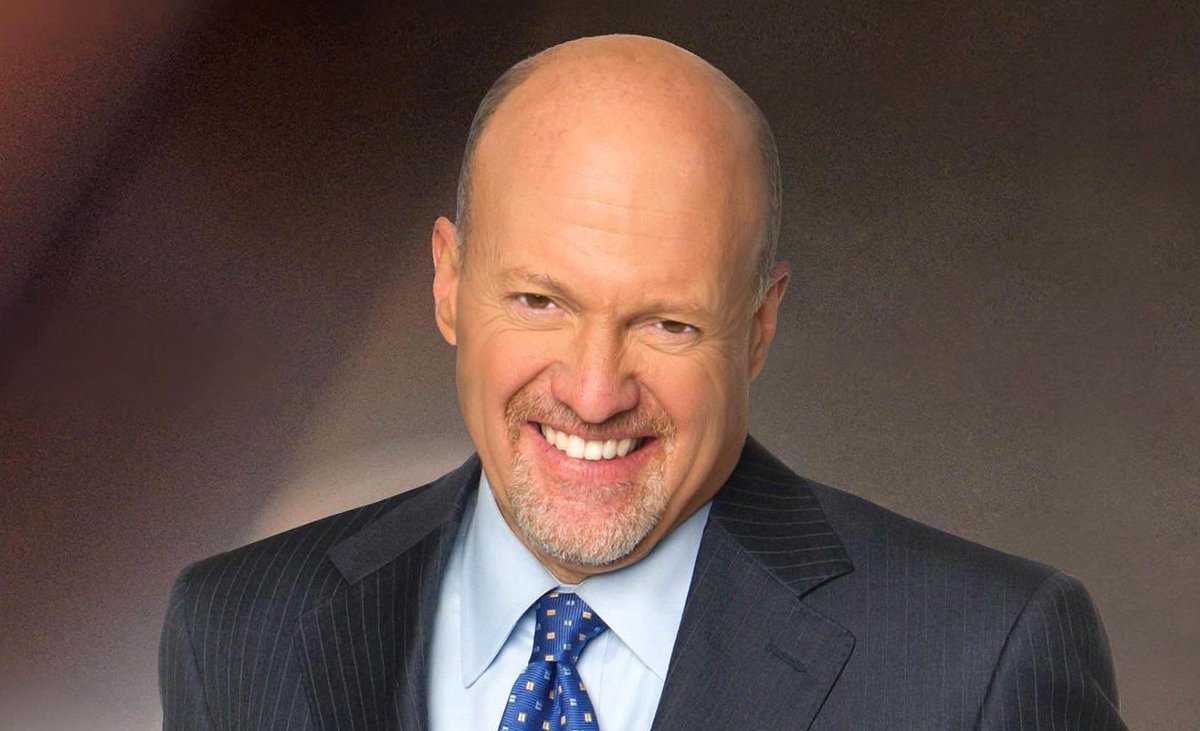
JUST IN: Jim Cramer says now is a "chance for people to sell."
Watcher.Guru tweet media
English
1.6K
825
10K
1.8M
Jack Ratkovich
Jack Ratkovich@jackratko_·
@AutismCapital "First they came for the Frogs and I did not speak out – Because I was not a Frog."
English
1
2
19
357
Autism Capital 🧩
Autism Capital 🧩@AutismCapital·
Where is Alex Jones right now? We can’t even believe our eyes and ears. This is real. It’s not a parody. It’s not a skit. How is this possible? If someone transcribed this word for word and submitted it as a script to Netflix they would think they were an “alt right troll.”
English
10
19
557
31.2K
Autism Capital 🧩
Autism Capital 🧩@AutismCapital·
🚨 NEW: They are trying to make the maps more gay. Lmao WHAT? This is not AI 💀 “We were trying to make the make the maps more gay.” “How do you make a map more gay?” “Since the age of cartography we’ve had good maps but maybe they weren’t gay enough.”
English
470
1.2K
8.9K
697.9K
Jack Ratkovich
Jack Ratkovich@jackratko_·
@matty_ My stance has long been that tokens only make sense if they begin to converge with equities. Tokens need rights to cashflows (in some fashion - buybacks can work). Otherwise they have no value, and they're just a method for value extraction from gamblers and rubes
English
0
0
0
84
Daniel
Daniel@danielgothits·
I have openclaw sending lowball offers on Zillow all day just to make boomers start panicking lol
Daniel tweet media
English
2.4K
4.5K
90.4K
8.1M
Jack Ratkovich 리트윗함
Julen Payne
Julen Payne@jlxpayne_·
RWAs require a more careful hand than classic defi vault products. i am currently researching a more advanced asset-liability management framework for Nest vaults, which are not comprised of fully liquid assets. the big question is: how do you deal with serially correlated short term liability management when earning yield from uncorrelated + illiquid assets? we've had two recent examples of it failing, mF-ONE(onchain) and Blue Owl redemption pauses(offchain). risk factors when running an RWA vault: a big issue you run into is that most onchain RWAs today have extreme depositor concentration. 3-4 wallets make up 80-90% of the TVL, meaning the first individual out the door can eat up the vast majority of a liquidity buffer in a flash. outflows are also not iid! depending on how distributed the depositor base is, they are typically correlated to activity in adjacent rates markets. a rent-seeking depositor will usually withdraw given the availability of another opportunity with a better r/r. high crypto vol may mean that levered spot depositors have to exit their positions to post more spot margin. supply rates are probably the biggest driver for inflow/outflow though, and money market rates can shift rapidly given they run similar liability management risks and outside of Aave, have super concentrated lenders whose withdrawals can spike borrow rates in minutes. given all of these external and crypto market dependent risk factors, internal liquidity management for liquid-withdrawal RWA vaults is a very delicate process. you take on the external risks of defi, yet your yields and available liquidity are completely uncorrelated to defi. this is a ultimately a growing pain for RWAs. so how do you do the balancing act? 1. collect a lot of depositor data. as much as you can get. collect data on investor types, investor stickiness, rent-seeking behaviors, leverage utilization, etc. it really helps to have a lot of users (lfg @NestCredit) 2. learn from those who have done it already. the literature on asset-liability management for banks is actually quite rich given all the research done to set Basel rules. 3. model out stress tests 4. assess your available levers. ex: redemption facilities, repos, fee adjustments, swing pricing, tranching 5. be comfortable with the fact that edge cases are edge cases, and you can't be ready for everything once you take all this into account, allocate accordingly. actively adjust your HQLA buffer to deal with a dynamic market, ladder your liquidity, and work with partners! I'll go more into depth on a more scientific methodology for with my next article/substack so keep an eye out.
Alex Palmer@ThatAlexPalmer

been seeing cool posts about RWA vaults on the timeline, so here are a few words about how @NestCredit works, and the pieces that handle deposits, withdrawals, yield strategies, and security. - core vault contract: smart contract that holds stablecoins and RWAs bought onchain from institutional issuers. it secures everything by restricting all movement into and out of the vault using programmable built-in compliance policies. users can only mint and redeem stablecoins after verification through these policies. - extension contracts: calculate the value of its onchain holdings by asking every RWA inside "how much are you worth today". connects to cross-chain bridges to let users mint/redeem on multiple chains. - manager contracts: run automated strategies, buying RWAs with the vault's stablecoins, adjusting allocations based on the pre-set plan and market conditions. also keeps liquidity for fast withdrawals. enforces management and compliance rules. combined, this gives nest users crypto-native feel for institutional grade RWAs. one number that speaks to that is active holders (i.e. unique wallet that uses nest). we'll explain later why its important to grow that number.

English
3
4
24
3K
Jack Ratkovich 리트윗함
Frank Chaparro
Frank Chaparro@fintechfrank·
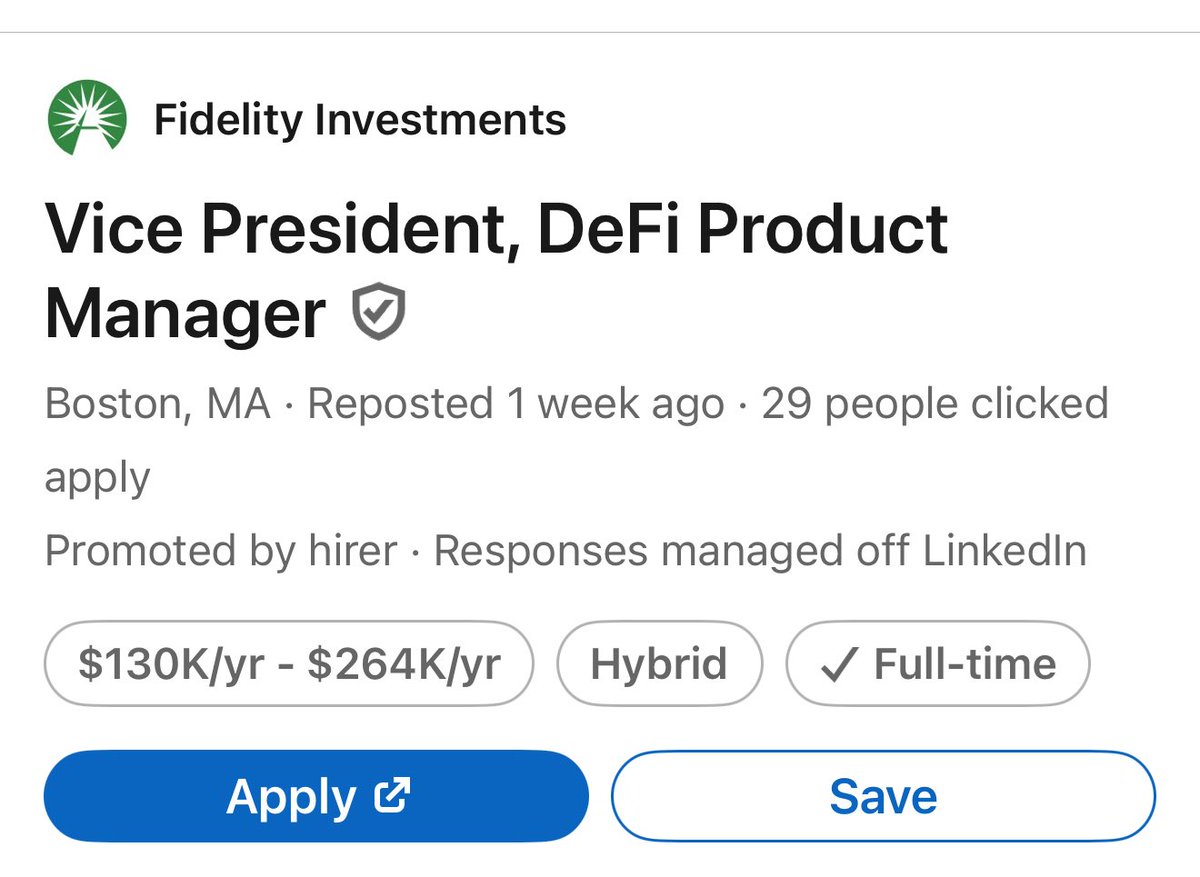
Wow. Fidelity is hiring a defi product manager to design and launch on-chain vaults, structured defi strategies (yield, carry, delta-neutral), and protocol-level risk frameworks. responsibilities include smart-contract architecture, tokenomics, oracle risk, and ongoing vault monitoring.
Frank Chaparro tweet mediaFrank Chaparro tweet media
English
120
111
1.4K
368.3K