

Jan M
5.5K posts

Jan M
@jannotjohnn
Striving to be better 1% everyday https://t.co/Hmlfj9nOh1 https://t.co/peUrPCzYsY
Auckland, New Zealand 가입일 Temmuz 2014
1.4K 팔로잉255 팔로워

Here is part 2 of my plumbing training videos created by @NotebookLM. My goal is to show that it is now possible to create AI training videos on pretty much anything. These will be incredibly useful for apprentices and hobbyists. In the age of AI, you can learn and do anything!
English
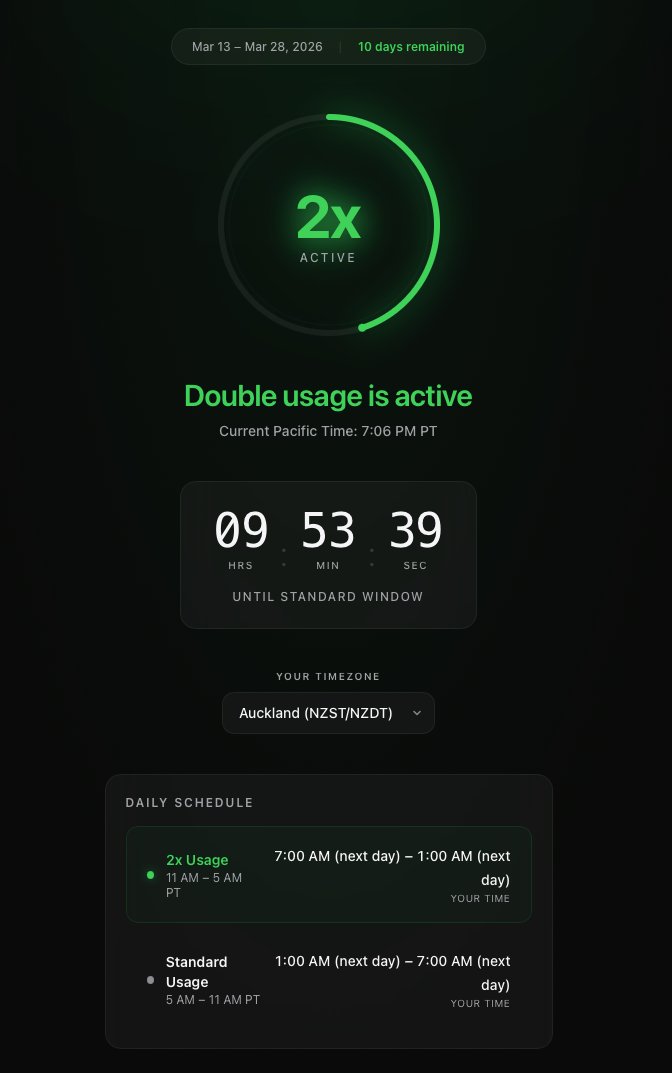
@AnthropicAI extended the promo for another day, until 28 March.
What are you building?
claude-2x-tracker.pages.dev

English
Use the /yt-pipeline skill to generate video overviews in @NotebookLM using Claude Code and even Codex thanks to Chase AI for this workflow


English


Claude Code Essentials is being packaged right now and will ship asap.
The Claude Code Architect is being developed and so my target to complete is Friday
The Claude Code Bootcamp (Claude Code Engineer) is happening we are just deciding on the bootcamp data.
Claude Code for Zero
Claude Code for Enterprise Architects up in the air for now.
English
There are two things that fall out side the scope of my Claude Code Courses, that I could potentially develop as paid courses.
Enterprises, and Absolutely Non Technical Professionals.
Let's just workshop that a bit together:
> Claude Code from Zero
There are professionals coming from other verticals that want to use Claude Code but they have never touch code in their life. I would have teach them ALL the steps and leave nothing out no matter how small. I would also have to guide them entire lifecycle of app development and provide full mentorship.
> Claude Code Enterprise Architect
Orgs want to adopt Claude Code but its not enough to just learn how to use the tool, they those workloads to be fully productionize. That means security, governance, develop onboarding, incident response and rollback. I don't mean on paper, I mean for real.
English
@mvanhorn @slashlast30days @Jason Do you use the Scrapecreators API? Is this much depth if you use it?
English

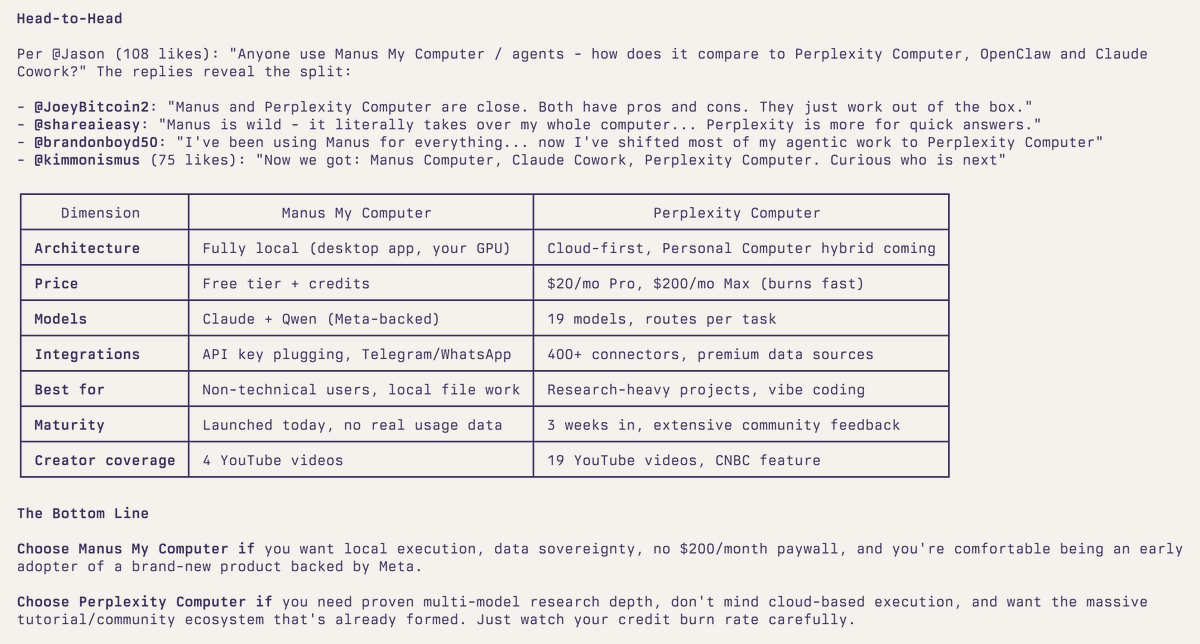
Perplexity Computer vs. Manus My Computer.
I used @slashlast30days for social signal - 89 Reddit threads, 79 X posts, 30 YouTube videos, 11 HN stories. Ran just for you @Jason
TL;DR: Perplexity owns the cloud. Manus just went local. Same war, opposite bets.
English
English

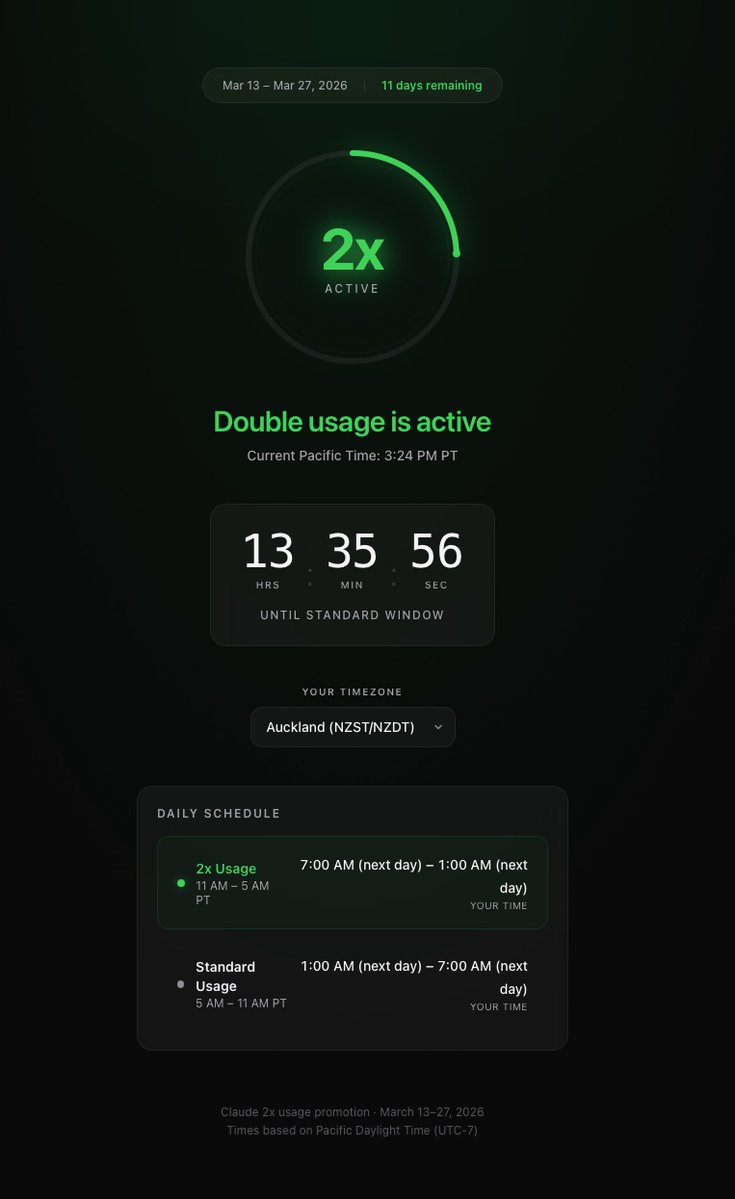
@Tim_Damasc @p_naix btw this one looks correct for me in Sydney, calm & well organised:
claude-2x-tracker.pages.dev
x.com/jannotjohnn/st…
Jan M@jannotjohnn
claude-2x-tracker.pages.dev Great to be in NZ
English

Are you in Claude Peak Hours? Find out here
claudethrottle.com
Claude@claudeai
A small thank you to everyone using Claude: We’re doubling usage outside our peak hours for the next two weeks.
English
My biggest takeaways from @pmarca (co-founder of a16z & Netscape) on @FoundersPodcast such a great podcast episode
For builders, too much introspection can become a drag coefficient. Andreessen says he has "zero" appetite for introspection because people who dwell on the past often get stuck there, both at work and at home. He points to Sam Walton as the archetype: Walton did not wake up wondering about his inner life, he woke up wanting to build more Walmarts. His caveat is that some elite founders are highly neurotic, so the real lesson is not that reflection is always bad, but that relentless forward motion is often more useful than self-analysis when a company is still being built.
The same trait that powers a founder can make that founder hard to "fix." His psychedelics discussion is really about tradeoffs, not drugs: some high-performing founders seem driven by insecurity, dissatisfaction, or a neurotic edge that also makes them exceptional. Andreessen says he has seen people come out the other side of psychedelics happier and more peaceful, then lose interest in running the company and effectively opt out of ambition. The hard implication is that personal serenity and founder-level intensity are not always aligned.
Public impact is too external to sustain a lifetime of building. Andreessen agrees with Daniel Ek that top entrepreneurs are not optimizing for happiness, but he pushes further and says even impact, money, and fame are still extrinsic rewards. His view is that the thing that still matters at 4 a.m. is usually some internal contest: becoming smarter, better informed, more capable, and harder to beat. That matters because it suggests the deepest long-term motivation is usually identity-level, not mission-statement-level.
His entire worldview is basically technology versus stagnation. Andreessen argues that the world is still primitive and crude relative to what it could be, and that the real shortages are technology, information, and intelligence. In that framing, entrepreneurs are the people willing to turn better ideas into products, companies, and eventually whole industries, while everyone else mostly critiques from the sidelines. That is why he talks about founders less like financial assets and more like anti-stagnation agents.
It is easier to teach a founder to manage than to teach a manager to invent. He leans on James Burnham's distinction between founder-led capitalism and managerialism, then argues the managerial model works best only when the world is stable and slow-moving. Once the environment changes quickly, professionally trained managers tend to preserve the status quo while founder-types are more likely to adapt, learn scale, and keep pushing. That is the core a16z thesis: start with the person who knows what to build, then train that person to run something large.
The best relationship businesses stop being tribes of lone wolves and become platforms. Andreessen says venture in 2009 still looked like old Hollywood agencies: individual stars, internal politics, weak coordination, and very little benefit from being inside the same firm. The Michael Ovitz and CAA playbook changed that by making the whole firm available to every client, moving the staff meeting to 7 a.m., and calling clients before rivals even started their day. His point is that the middle of a relationship business eventually dies, and the winners become either tiny specialists or scaled platforms with real organizational force.
Silicon Valley got bigger when startups stopped selling tools and started attacking entire industries.Andreessen contrasts the old world, where startups sold components like software, chips, or dispatch tools, with the newer world where Airbnb enters hospitality, Uber enters transportation, Tesla builds the whole car, and Facebook becomes the media company instead of selling tools to one. That shift is why venture itself had to scale: full-stack startups need more capital, broader support, and firms that can help them compete with incumbents directly. He sees AI as the clearest continuation of that trend because the winning companies are now raising billions, not tens of millions.
Netscape taught him that invention and management have to be fused, not traded off. He describes Jim Clark as the force-of-nature founder and Jim Barksdale as the operator who could turn invention into schedules, systems, and a real company. Clark's instinct was to chase the newest idea; Barksdale's instinct was to keep the company from whipping itself around every day, while still preserving the inventive edge that made Netscape special. Andreessen's later worldview clearly comes from watching those two disciplines work best when they are in tension but not at war.
The modern industrial superpower is direct bottleneck removal at the source of truth. Andreessen's description of Elon Musk is strikingly operational: go straight to the engineer closest to the problem, identify the single bottleneck in the production system, and fix that bottleneck now instead of letting it sit for six months. He says Musk can do roughly 120 five-minute design reviews in a day, then spend the rest of the night with the one engineer whose problem actually matters. The larger point is that elite management is not presentations or hierarchy, but technical truth-seeking plus cycle-time compression.
The people who invent a technology are often bad at predicting what it will do to society. Andreessen mocks the automatic authority granted to famous AI researchers by noting that Geoffrey Hinton's politics predictably shape his AI forecasts, then uses Edison as the deeper example. Edison thought the phonograph would mainly deliver recorded sermons, while the public wanted music, which is a reminder that inventors often project their own values onto a technology's future uses. His lesson is to separate technical credibility from social prophecy.
The first social response to a new technology is usually moral panic, not analysis. Andreessen runs through a long historical loop: writing, bicycles, jazz, rock, hip-hop, calculators, Walkmans, the early internet, and the old newspaper panic that bicycles would give women permanent "bicycle face" and make them unmarriageable. His claim is not that new technologies never change society, but that the press repeatedly packages novelty as civilizational collapse because fear is easier to sell than calibration. That makes "everyone is panicking" a weak argument against a technology and, in many cases, a familiar sign that something genuinely important is arriving.
David Senra@davidsenra
My conversation with Marc Andreessen (@pmarca), co-founder of @a16z and Netscape. 0:00 Caffeine Heart Scare 0:56 Zero Introspection Mindset 3:24 Psychedelics and Founders 4:54 Motivation Beyond Happiness 7:18 Tech as Progress Engine 10:27 Founders Versus Managers 20:01 HP Intel Founder Legacy 21:32 Why Start the Firm 24:14 Venture Barbell Theory 28:57 JP Morgan Boutique Banking 30:02 Religion Split Wall Street 30:41 Barbell of Banking 31:42 Allen & Company Model 33:16 Planning the VC Firm 33:45 CAA Playbook Lessons 36:49 First Principles vs. Status Quo 39:03 Scaling Venture Capital 40:37 Private Equity and Mad Men 42:52 Valley Shifts to Full Stack 45:59 Meeting Jim Clark 48:53 Founder vs. Manager at SGI 54:20 Recruiting Dinner Story 56:58 Starting the Next Company 57:57 Nintendo Online Gamble 58:33 Building Mosaic Browser 59:45 NSFnet Commercial Ban 1:01:28 Eternal September Shift 1:03:11 Spam and Web Controversy 1:04:49 Mosaic Tech Support Flood 1:07:49 Netscape Business Model 1:09:05 Early Internet Skepticism 1:11:15 Moral Panic Pattern 1:13:08 Bicycle Face Story 1:14:48 Music Panic Examples 1:18:12 Lessons from Jim Clark 1:19:36 Clark Versus Barksdale 1:21:22 Tesla Versus Edison 1:23:00 Edison Digression Setup 1:23:13 AI Forecasting Myths 1:23:43 Edison Phonograph Lesson 1:25:11 Netscape Two Jims 1:29:11 Bottling Innovation 1:31:44 Elon Management Code 1:32:24 IBM Big Gray Cloud 1:37:12 Engineer First Truth 1:38:28 Bottlenecks and Speed 1:42:46 Milli Elon Metric 1:47:20 Starlink Side Project 1:49:10 Closing Includes paid partnerships.
English
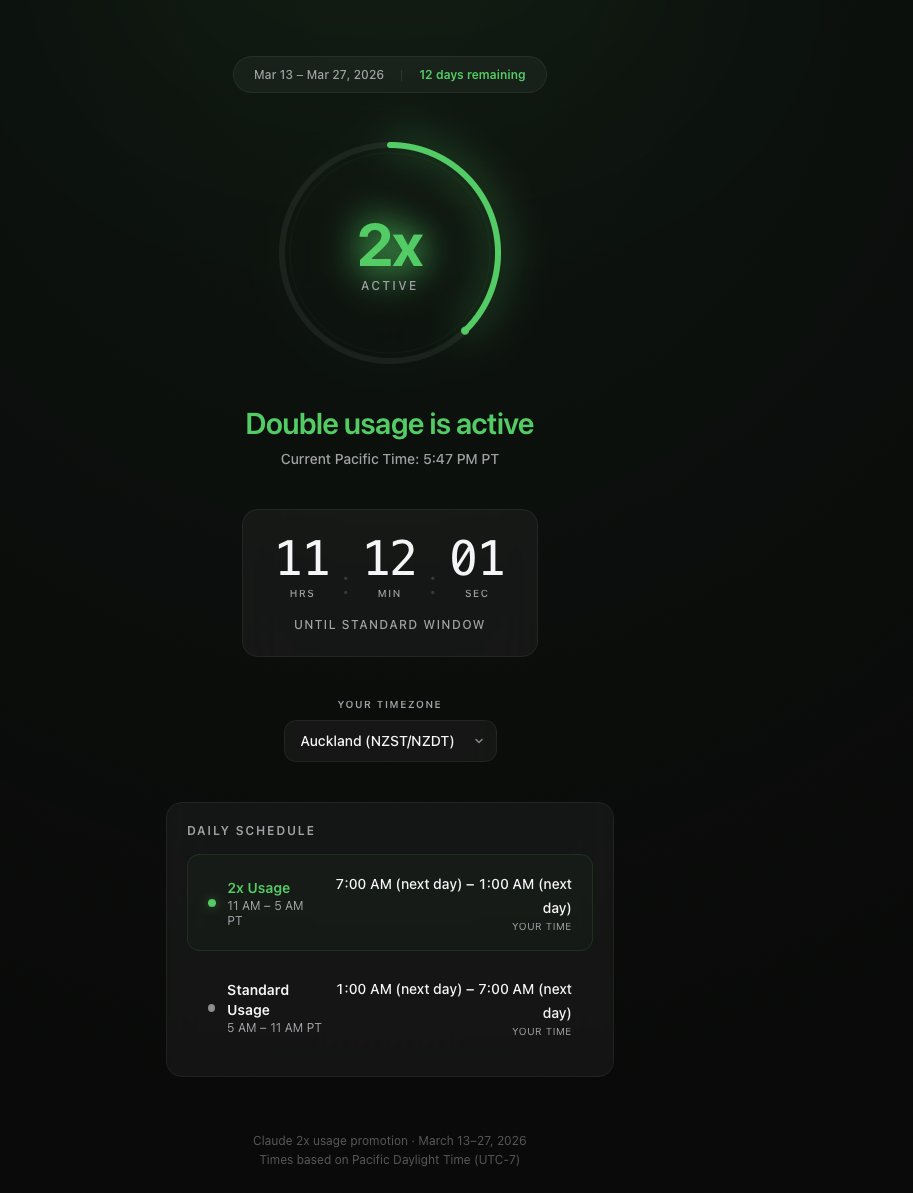
@mehulmpt very nice Mehul, built the same but on top of cloudflare pages claude-2x-tracker.pages.dev
English

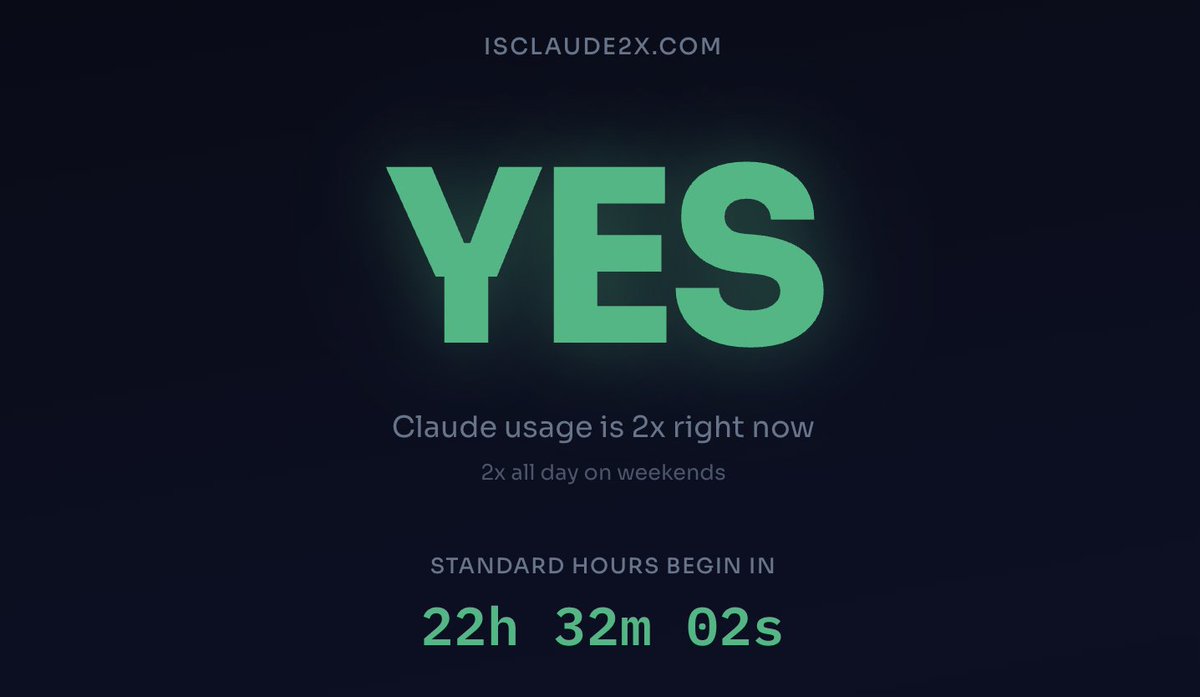
Announcing isClaude2x.com - quickly check if Claude is 2x for you or not
👉🏻 Your local timezone
👉🏻 Homepage: UI for you
👉🏻 /short API: Just a yes/no [for you/agent]
👉🏻 /json API: a full JSON object with metadata [for agent]
English
@p_naix Very nice, Praveen. I've also built the same on top of Cloudflare Pages since I don't want to spend a dime on a domain: claude-2x-tracker.pages.dev
But yours is much much better.
English
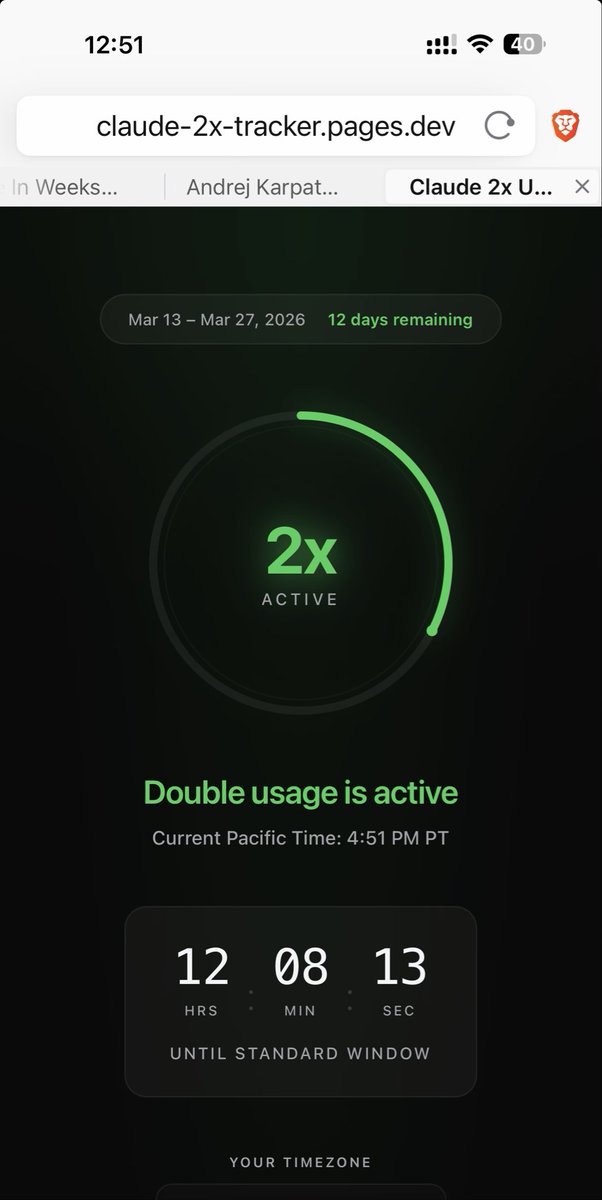


great 2 weeks to be an Australian if you use Claude Code 😂
Claude@claudeai
How it works: - 2x usage on weekdays outside 5–11am PT / 12–6pm GMT - 2x usage all day on weekends - Automatic, nothing to enable
English
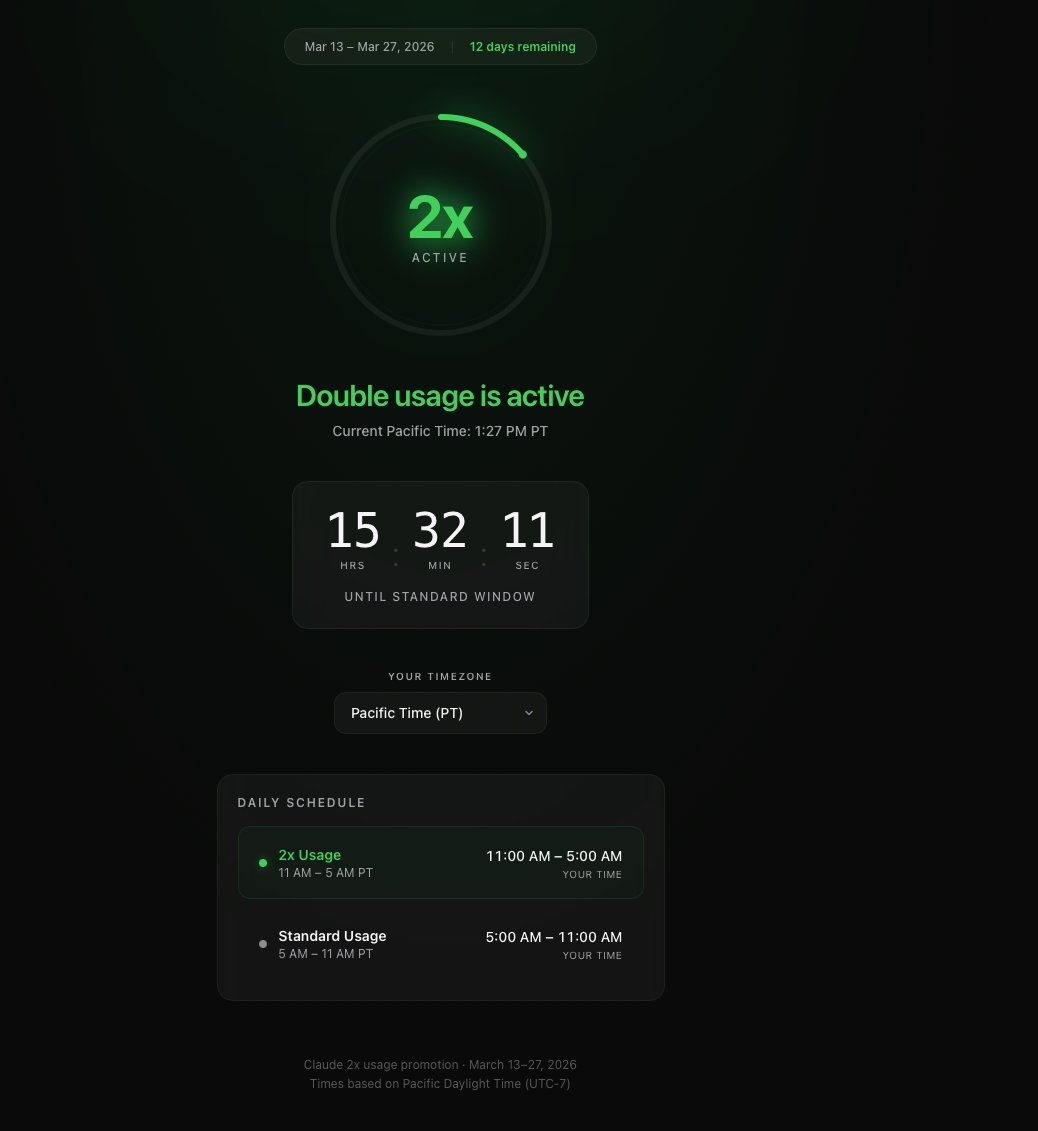
track your Claude usage promotion here so that you can maximize @claudeai Claude Code etc. made by Claude and deployed in @Cloudflare pages
claude-2x-tracker.pages.dev
thanks @bcherny and team
English
The Algorithm (5 Commandments)
At any given production meeting, there is a non-trivial chance that Elon will intone like a mantra what he calls "the algorithm." His executives sometimes move their lips and mouth the words. It was shaped by the lessons he learned during the production hell surges at the Nevada and Fremont factories.
Commandment 1: Question every requirement.
Each requirement should come with the name of the person who made it. You should never accept that a requirement came from a department, such as "the legal department" or "the safety department." You need to know the name of the real person who made that requirement. Then you should question it, no matter how smart that person is. Requirements from smart people are the most dangerous because people are less likely to question them. "Always do so, even if the requirement came from me." Then you need to make the requirements less dumb.
Commandment 2: Delete any part or process you can.
You may have to add them back later. In fact, if you do not end up adding back at least 10% of them, then you didn't delete enough. This is the most counterintuitive step it feels reckless to remove things, but the 10% add-back rule is the calibration mechanism. If everything you deleted stayed deleted, you were too conservative.
Commandment 3: Simplify and optimize.
This should come after step two. A common mistake is to simplify and optimize a part or a process that should never exist. Do not polish something that should have been deleted. Only simplify what survives the deletion phase.
Commandment 4: Accelerate cycle time.
Every process can be sped up. But only do this after you have followed the first three steps. "In the Tesla factory, I mistakenly spent a lot of time accelerating processes that I later realized should have been deleted." Speed applied to waste just produces waste faster.
Commandment 5: Automate.
This comes last. "The big mistake in Nevada and at Fremont was that I began by trying to automate every step. We should have waited until all the requirements had been questioned, parts and processes deleted, and the bugs were shaken out." Tesla learned this the hard way during Model 3 production when they over-automated, then had to physically saw robots out of the factory and throw them in the parking lot.
Thanks to @FoundersPodcast I always listen 3x a week to remind myself
David Senra@FoundersPodcast
New episode: "How Elon Works" This episode covers the insanely valuable company-building principles of Elon Musk A few notes from the episode: 1. The mission comes first. 2. Retreat is not an option. 3. A maniacal sense of urgency is our operating principle. 4. Product design should be driven by engineers. 5. You should not separate engineering from product design. 6. Having separate design and production departments is bullshit. Keep everything together and feedback immediate. 7. The leader should be on the front lines. You should be a battlefield general. 8. "If they see the general out on the battlefield, the troops are going to be motivated. Wherever Napoleon was, that's where his armies would do best." 9. Apply The Algorithm constantly. (1) Question every requirement. (2) Delete any part of the process you can. (3) Simplify and optimize. (4) Accelerate cycle time. (5) Automate. 10. Repetition is persuasive. "I became a broken record on the algorithm. I think it's helpful to say it to an annoying degree." 11. You should go ultra-hardcore on deletion and simplification. 12. Camaraderie is dangerous. It makes it hard for people to challenge each other’s work. (Refer to point #1) 13. Never ask your troops to do something you wouldn’t do. 14. Hire for attitude. Skills can be taught. Attitude changes require a brain transplant. 15. Good attitude = A desire to work maniacally hard. 16. The only rules are the ones dictated by the laws of physics. Everything else is a recommendation. 17. Keep your entire company committed to a common goal. 18. If things aren’t going well, throw away the existing design, start from first principles, question every requirement based on fundamental physics. 19. Find the limit. You want to delete as much as possible and you can’t do that unless you find the limit. 20. If you aren’t adding back at least 10% of the things you deleted, then you didn’t delete enough. 21. Maintain control. Avoid joint ventures. Eliminate middlemen. 22. Have a relentless dedication to questioning every requirement. 23. No work about work, just work. 24. Go to the problem. Get on the plane. Fly to the source. Go to the exact location in the factory. Go to the problem and stay there until it's resolved. 25. The best part is no part. 26. Be wired for war. 27. Do not fear losing. It hurts the first 50 times but then you’ll be able to play with less emotion. You will take more risks. 28. Stay heads down focused on doing useful things for civilization. 29. When something is important and has to be done quickly, have meetings every 24 hours to run the algorithm and check on the previous days progress. You'll be shocked at how fast this speeds things up. 30. Life needs to be interesting and edgy. 31. Delete, delete, delete, delete. There are 100 more ideas in the episode. I hope you listen to it. 30 years of Elon’s career + 60 hours of reading and research and me just absolutely ripping through idea after idea at 2x speed for 90 minutes. It will be hard to find a better use of time.
English
Vibe coded a game similar to Flappy Bird with some twists, using Codex 5.4 xhigh. The bird gets tired and must collect energy as it flies, while also gathering feathers to buy power-ups from the cash shop as you progress. Still an early version though😊: pixel-sky-hop.vercel.app
English

I've been using @pencildev for all of my design work and honestly, it's wild... it's like Figma and Cursor had a baby.
You type what you want, AI agents build the design and you get to watch them work in real time.
What I love:
- Component-based designing
- Agent swarms that design in parallel
- Full Figma-style controls when you want them
- Free to download — just use your existing OpenAI/Anthropic subscription
I use it for all my AI design work now. Not affiliated, just genuinely impressed.
I'm getting the founder @tomkrcha on for a podcast recording soon. What questions should I ask him?
English

this guy is going to come show me and the vibe marketers community how he replaced an $8k/mo content strategist for $30
and runs it all from openclaw
free workshop, live build, details below, won't be boring!
Matthew Berman@TheMattBerman
this @openclaw agent replaced my $8K/month content strategist for $30 😱 i'll show you EXACTLY how to build it live with @boringmarketer vibe marketers. here's the system: step 1: scan 1000s+ creators for outlier signals → @virlomain watches your niche 24/7 → it finds outlier videos that beat the creator's OWN average by 10x-50x. → last week it flagged a 51x outlier. 4,800 avg views. one video: 249,000. step 2: pull the raw evidence → @adrian_horning_ 's ScrapeCreators fetches the full package → thumbnail, caption, stats, creator context → this gives the AI everything it needs to analyze. step 3: break down WHY it worked (7 dimensions) → Content DNA runs each video through Gemini 3 Flash via @OpenRouterAI → topic, angle, hook structure (visual + text + spoken), story beats, visual format, key visuals, audio → the output is a "brick." the portable structure that made people stop scrolling. step 4: rank the reusable bricks → @openclaw compares all 10 breakdowns → scores each brick by portability and frequency → bricks showing up across 3+ creators = highest confidence bets step 5: generate 10 concepts in your voice + 3 psychology frameworks → learns your voice so output sounds like you → then runs every concept through Puppet Strings (desire), Scroll Traps (attention), and Care to Click (action) → you hit emotion and desire. not just features. every hook is copy-paste ready. step 6: delivers 10 concepts every monday at 8am → cron runs the whole pipeline overnight → pick 3. film. post. done. input: your niche output: 10 proven content concepts every monday a GOOD content strategist costs $8-10K/month. this runs for ~$30/month in API costs. on march 12, me and @boringmarketer vibe marketing community are building this system live: - brand voice file - content radar scanning your niche - content DNA breaking it down - weekly cron, scheduled and firing you leave with a running system (not a repo to figure out later) comment VIEWS + like + follow (must follow so i can DM you the link to join)
English