Peter - GZ Budi Industrial Co China

279 posts

Peter - GZ Budi Industrial Co China banner
Peter - GZ Budi Industrial Co China

Peter - GZ Budi Industrial Co China

@peter733

https://t.co/M6YK2TYGn9 https://t.co/A0YuSgNttV https://t.co/3Mpc3TfLAK https://t.co/ZhOV21JVMR
Indonesia USA China 가입일 Temmuz 2007
1.1K 팔로잉84 팔로워
John Roman
John Roman@JohnMRoman·
he did actually share a link on the wallet piece. here is what Claude said: Okay, now the picture is very clear — and it's damning. I pulled the on-chain numbers directly from Polymarket's data API. Quick heads up first: the URL you pasted is one character short (valid Ethereum addresses are 40 hex chars, yours has 39). The real wallet ends in ...d2D0fa. I ran the queries against the corrected address. What the wallet actually looks like: Current portfolio value: $1,219,489.66 All-time realized profit: $429,843.90 All-time traded volume: $29,841,166.94 Last 24 hours P&L: −$1,454.91 (he was down yesterday) So this is a wallet that has cycled ~$30M of volume, holds $1.2M right now, and has banked about $430K of realized profit. It is not "$200 → $14,300 in 27 days." Now the smoking gun. I pulled his earliest trades in ascending-timestamp order. The very first block of trades on the wallet shows these buys happening within the same few seconds: $842, $305, $376, $627, $329, $799, $1,537, $627, $1,076, $7,113, and more — all on BTC price markets, all in one burst. A first-day trader with a "$200 seed" cannot place a $7,113 trade. Or a $1,537 trade. Or, frankly, any of those. The "I started with $200" narrative is demonstrably false against the on-chain record. Either the article is fiction with a marketing number ($14,300 sounds modest and achievable, $430K sounds like a whale you can't touch), or there's some unrelated "demo" wallet that we're never going to see. What his actual strategy is Look at the trade prices. Nearly every buy is between 0.92 and 0.99 on Bitcoin price markets ("will BTC be above $58K on April 4" at 97.7¢, "above $62K on April 3" at 93¢, etc.). He's not finding mispriced crowd-wrong gems. He's buying near-certain outcomes to collect the last 2–5 cents before resolution. This is pennies-in-front-of-a-steamroller arbitrage: Win rate: high (which matches his "74%" claim — it's easy when you're buying at 97¢) Return per trade: tiny (2–5¢ per $1) Capital required: massive (you need seven figures for the absolute dollars to matter) Risk profile: ugly. When you're writing effective insurance at 97¢, a single unexpected move can wipe out weeks of grinds. That −$1,455 yesterday is exactly that pattern. This strategy is completely unreachable with $200. A 3¢ edge on a $200 stake is $6. After gas and slippage you made coffee money. The whole "four free repos and a Claude prompt" framing is fabricated backstory sold on top of a capital-intensive market-making strategy that already requires $100K+ to be worth running. Could you copy his trades? Technically yes — now that we have the real address you can bookmark @0x6e1d5040d0ac73709b0621f620d2a60b80d2d0fa" target="_blank" rel="nofollow noopener">polymarket.com/@0x6e1d5040d0a… and see every move. But here's what actually happens if you try: He's taking 90%+ of the book when he enters these near-certain markets. You follow seconds later, and the remaining book is at 98¢ or 99¢ — your edge shrinks from 3¢ to 1¢ or flips negative. His fills reflect being the first large buyer moving the price. Yours reflect being the second. That delta is structural and permanent. If you size like him (thousands per trade on 97¢ positions), a single bad resolution costs you a year of grinds. If you size small to manage risk, the dollars aren't worth your time. You'd pay Kreo a subscription for the privilege of being the exit liquidity for whatever illiquid positions he can't offload. Summary The wallet is real, the $430K profit is real, the strategy is legible. Everything else in the article — the $200 seed, the "haven't touched it in 27 days," the Claude prompt that magically found 47 smart-money wallets, the $14,300 return number, the idea that this is a weekend project — is marketing fiction wrapped around a real account running a boring, capital-intensive late-expiry arb strategy. This isn't a "build it this weekend" opportunity. It's an ad for a subscription, dressed as a tutorial, using real on-chain numbers from a fund-size account to sell retail on a story that the same account's own history contradicts in the first five trades. Don't subscribe. Don't copy. If you're genuinely interested in Polymarket strategy, the right move is to paper-trade on small markets yourself for a couple of months and see whether you can identify a real, repeatable edge at small size — because if you can't find $20 of edge on your own, you aren't going to safely deploy $10K of copy-trade capital.
English
2
0
7
277
Paul Rees. ex Rucksack.
Paul Rees. ex Rucksack.@HannahIamthest1·
🤣🤣 Why doesn't Tarzan have a beard when he lives in the jungle without a razor? Why do we press harder on a remote control when we know the batteries are flat? Why do banks charge a fee on 'insufficient funds' when they know there is not enough? Why do Kamikaze pilots wear helmets? Why does someone believe you when you say there are four billion stars, but check when you say the paint is wet? Whose idea was it to put an 'S' in the word 'lisp'? What is the speed of darkness? Why is it that people say they 'slept like a baby' when babies wake up every two hours? If the temperature is zero outside today and it's going to be twice as cold tomorrow, how cold will it be? Do married people live longer than single ones or does it only seem longer? How is it that we put man on the moon before we figured out it would be a good idea to put wheels on luggage? Why do people pay to go up tall buildings and then put money in binoculars to look at things on the ground? Did you ever stop and wonder....... Who was the first person to look at a cow and say, 'I think I'll squeeze these pink dangly things here, and drink whatever comes out?' Who was the first person to say, 'See that chicken there... I'm gonna eat the next thing that comes outta it's bum.' Why do toasters always have a setting so high that could burn the toast to a horrible crisp, which no decent human being would eat? Why is there a light in the fridge and not in the freezer? Why do people point to their wrist when asking for the time, but don't point to their bum when they ask where the bathroom is? Why does your Gynaecologist leave the room when you get undressed if they are going to look up there anyway? Why does Goofy stand erect while Pluto remains on all fours? They're both dogs ! If quizzes are quizzical, what are tests? If corn oil is made from corn, and vegetable oil is made from vegetables, then what is baby oil made from? If electricity comes from electrons, does morality come from morons? Why do the Alphabet song and Twinkle, Twinkle Little Star have the same tune? Stop singing and read on...... Did you ever notice that when you blow in a dog's face, he gets mad at you, but when you take him on a car ride, he sticks his head out the window? Does pushing the elevator button more than once make it arrive faster? Do you ever wonder why you followed me? 🤣
English
211
750
3.5K
186.7K
Vultisig
Vultisig@vultisig·
Notifications are now live on Vultisig! With our latest update, initiating a transaction on one device sends a notification to your other devices instantly. Join the signing session with one tap. Huge improvement to the user experience!
English
6
14
81
6.5K
Avy_Libre
Avy_Libre@Amethys797058·
@itsolelehmann You are stupid if you give your biometric ID (face or fingerprint) : Never give your biometric data, you can't never change your finger ou face !
English
1
0
1
649
Ole Lehmann
Ole Lehmann@itsolelehmann·
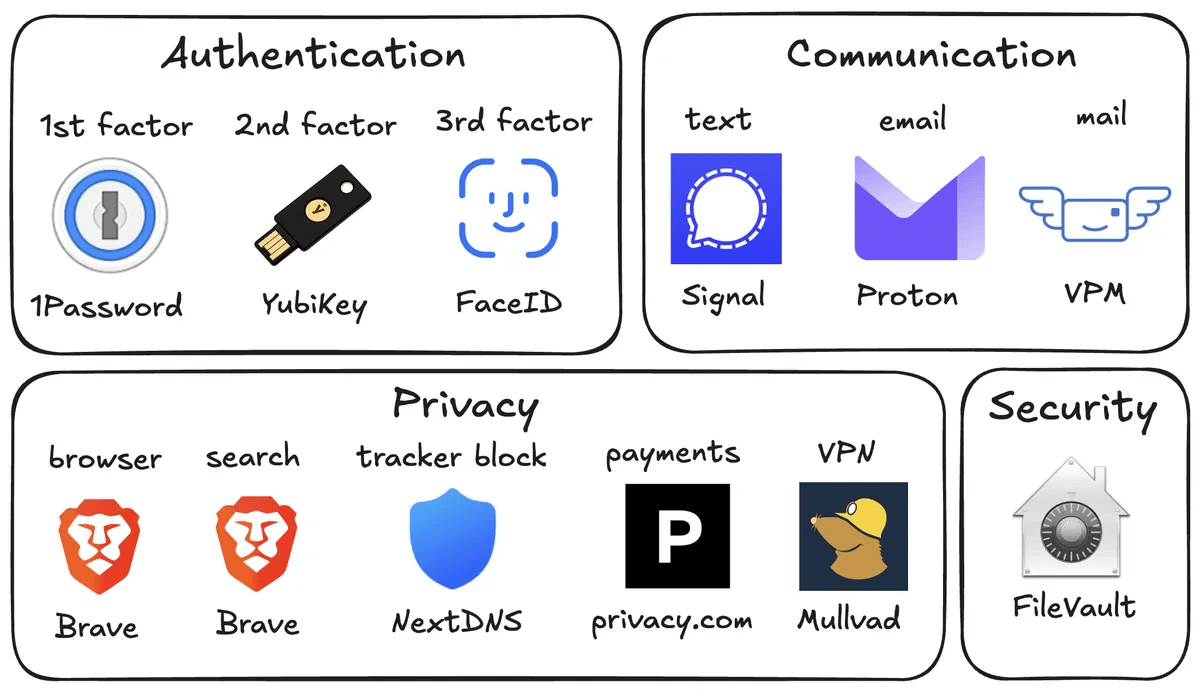
Claude Mythos is like Hiroshima for software. everything you own online, your bank, your email, your photos, your identity, is now dangerously exposed in ways that didn't exist 48 hours ago that's why Karpathy's digital hygiene guide is probably the most important thing you can read this week here's every step to protect yourself in these uncharted times: > use a password manager for every account > set up physical security keys so attackers can't log in > enable face id and fingerprint everywhere > randomize your security question answers > encrypt your hard drive > get rid of unnecessary smart home devices > switch to signal for private messaging > use brave instead of chrome > switch to brave search instead of google > mint virtual credit cards for every purchase > get a virtual mailing address > never click links inside emails > use a vpn on public wifi > block ads and trackers at the dns level > install a network monitor to see which apps are spying on you full breakdown of each step below:
Ole Lehmann tweet media
Ole Lehmann@itsolelehmann

x.com/i/article/2041…

English
119
610
4.7K
693.2K
Ole Lehmann
Ole Lehmann@itsolelehmann·
karpathy just casually described the future of ai and most people scrolled right past it: he's been building what he calls "llm knowledge bases." here's what that means in plain english: you take everything you're interested in. articles, research papers, datasets, images, etc and you dump it all into one folder then you point your ai at the folder and say "read all of this, organize it, and remember it" the ai reads through every single source. writes summaries, groups related ideas together, links concepts across different articles basically builds a personal library that's fully organized and searchable and it maintains the whole thing for you. when you add something new, the ai reads it, figures out how it connects to everything already in the library, and updates automatically. karpathy said he rarely touches it himself once the library gets big enough (~100 articles, ~400k words), you can start asking it complex questions and get answers pulled from across your entire collection > "what are the common themes across these 30 papers" > "what did i save six months ago that connects to this new idea" > "summarize everything i have on topic x and tell me what's missing" and every answer it gives gets filed back into the library. so the system gets smarter every single time you use it. the memory grows from both sides: what you save AND what you ask now think about your own life for a second you probably have > thousands of twitter bookmarks you'll never reopen. > hundreds of saved articles from the last year > podcasts where someone said something brilliant and you can't remember what it was or which episode all dead knowledge. you consumed it once and it disappeared now imagine all of it lives in one system: organized, connected, and queryable. you could ask "what are the best pricing frameworks i've come across this year" and get an answer that pulls from: 1. a podcast you listened to in january 2. a twitter thread you bookmarked in march 3. and a blog post you forgot you even read the ai connects dots across formats, across months, across topics. because it absorbed everything and has photographic memory of all of it that's the dream. and karpathy built it the problem: right now this requires obsidian (a note-taking app built around linked notes), command line tools, custom scripts, and browser extensions just to wire it all together. you need to be quite technical karpathy even said it himself: "i think there is room here for an incredible new product instead of a hacky collection of scripts" i think whoever packages this for normal people is sitting on something massive. one app that syncs with the tools you already use, your bookmarks, your read-later app, your podcast app, your saved threads. it pulls everything in automatically, the ai organizes and connects it over time, and you can ask questions across your entire personal library whenever you want you never manually upload anything. it just learns in the background someone please build this
Andrej Karpathy@karpathy

LLM Knowledge Bases Something I'm finding very useful recently: using LLMs to build personal knowledge bases for various topics of research interest. In this way, a large fraction of my recent token throughput is going less into manipulating code, and more into manipulating knowledge (stored as markdown and images). The latest LLMs are quite good at it. So: Data ingest: I index source documents (articles, papers, repos, datasets, images, etc.) into a raw/ directory, then I use an LLM to incrementally "compile" a wiki, which is just a collection of .md files in a directory structure. The wiki includes summaries of all the data in raw/, backlinks, and then it categorizes data into concepts, writes articles for them, and links them all. To convert web articles into .md files I like to use the Obsidian Web Clipper extension, and then I also use a hotkey to download all the related images to local so that my LLM can easily reference them. IDE: I use Obsidian as the IDE "frontend" where I can view the raw data, the the compiled wiki, and the derived visualizations. Important to note that the LLM writes and maintains all of the data of the wiki, I rarely touch it directly. I've played with a few Obsidian plugins to render and view data in other ways (e.g. Marp for slides). Q&A: Where things get interesting is that once your wiki is big enough (e.g. mine on some recent research is ~100 articles and ~400K words), you can ask your LLM agent all kinds of complex questions against the wiki, and it will go off, research the answers, etc. I thought I had to reach for fancy RAG, but the LLM has been pretty good about auto-maintaining index files and brief summaries of all the documents and it reads all the important related data fairly easily at this ~small scale. Output: Instead of getting answers in text/terminal, I like to have it render markdown files for me, or slide shows (Marp format), or matplotlib images, all of which I then view again in Obsidian. You can imagine many other visual output formats depending on the query. Often, I end up "filing" the outputs back into the wiki to enhance it for further queries. So my own explorations and queries always "add up" in the knowledge base. Linting: I've run some LLM "health checks" over the wiki to e.g. find inconsistent data, impute missing data (with web searchers), find interesting connections for new article candidates, etc., to incrementally clean up the wiki and enhance its overall data integrity. The LLMs are quite good at suggesting further questions to ask and look into. Extra tools: I find myself developing additional tools to process the data, e.g. I vibe coded a small and naive search engine over the wiki, which I both use directly (in a web ui), but more often I want to hand it off to an LLM via CLI as a tool for larger queries. Further explorations: As the repo grows, the natural desire is to also think about synthetic data generation + finetuning to have your LLM "know" the data in its weights instead of just context windows. TLDR: raw data from a given number of sources is collected, then compiled by an LLM into a .md wiki, then operated on by various CLIs by the LLM to do Q&A and to incrementally enhance the wiki, and all of it viewable in Obsidian. You rarely ever write or edit the wiki manually, it's the domain of the LLM. I think there is room here for an incredible new product instead of a hacky collection of scripts.

English
139
141
1.8K
310K
Massimo
Massimo@Rainmaker1973·
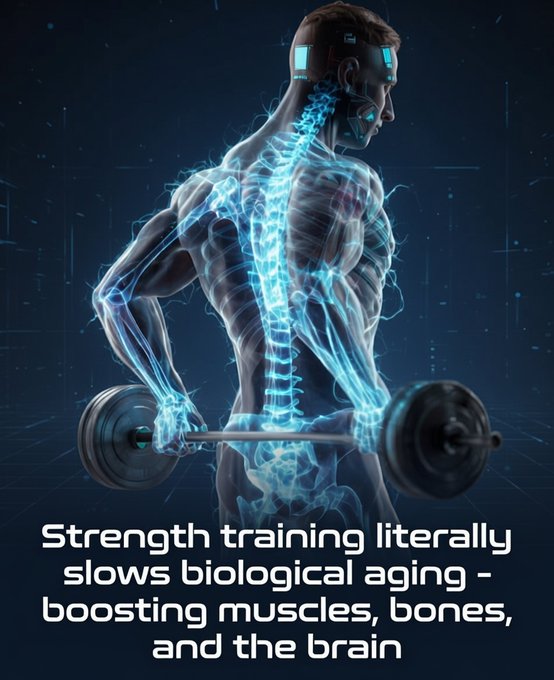
Experts now consider strength training the single most potent habit for aging gracefully and extending lifespan. Far from being just for athletes or bodybuilders, lifting weights—or any form of resistance exercise, including body-weight moves—has emerged as one of the most powerful tools for healthy aging. It does far more than add muscle: it fortifies bones, revs up metabolism, and sharply lowers the odds of diabetes, heart disease, and other chronic conditions. As we get older, strength training switches on bone-forming cells, fights the natural loss of muscle mass known as sarcopenia, and keeps metabolism humming efficiently. For women, it’s especially valuable, helping offset the rapid bone-density decline triggered by menopause. The benefits extend well beyond the physical. Regular resistance work improves balance and coordination, dramatically cutting the risk of falls—the top cause of injury among older adults. It also protects the brain by enhancing insulin sensitivity, dialing down inflammation, and reducing dementia risk. The good news? You don’t need heavy barbells or punishing workouts. Even moderate, consistent strength training delivers profound gains in both quality of life and longevity. In the words of one leading researcher, “Building and maintaining muscle may be the single best investment you can make in your future health and independence.”
Massimo tweet media
English
42
301
2K
88.2K
Impakt CEO (Winston) - Get paid while getting fit.
These 8 simple tests predict how long you'll live: Test #1: Standing on one leg - Stand on one foot without holding anything - Close your eyes - Time yourself A 2023 study found people who couldn't hold this for 10 seconds were nearly twice as likely to die within 10 years.
English
9
41
202
50.1K
Spacesuit
Spacesuit@spacesuit_app·
Introducing Nova. A futuristic canvas for your personal development. Download on macOS, Windows and Linux. nova.lightmode.io
English
313
540
7.8K
19.3M
robert fraser
robert fraser@rcresarf·
@Gaurab Coincidently, Toray recently announced the commercial release of T1200 carbon fiber (1.2 million psi strength) So Toray has come a long way from T300. But matrix materials ( epoxy and other polymers used to bind the fibers) have not improved proportionately !
English
1
0
7
3.4K
Gaurab Chakrabarti
Gaurab Chakrabarti@Gaurab·
Boeing gave a single Japanese company a $6 billion sole-source contract for the material that holds the 787 together. No other supplier on Earth can replace them. Toray Industries began in 1926 by spinning dissolved cellulose into textile fibers through thousands of microscopic nozzles. The physics of forcing polymer through a spinneret and solidifying the filament is identical whether the output is stockings or carbon fiber. The difference is tolerance. A defect in a stocking is invisible. A defect in a wing spar means the fuselage cracks. Toray spent 45 years closing that gap. Their T800S fiber is now the structural backbone of the 787. 35 tonnes of carbon fiber composite per plane. The same fiber Toray once spun for kimono now supports Boeing's commercial aircraft at 40,000 feet.
English
28
349
3K
196.1K
Karl Mehta
Karl Mehta@karlmehta·
A study of 450 centenarians just exposed the genetic code for living past 100. They're NOT just "lucky." They share 2 specific gene variants that protect against heart disease, cancer & Alzheimer's simultaneously. Here's what they found: 🧵
Karl Mehta tweet mediaKarl Mehta tweet media
English
4
30
132
22.7K
Sophia ❣️
Sophia ❣️@KeruboSk·
The most disabling symptom of ADHD is the paralysis. It's the deep, internal shame of knowing exactly what to do... and just sitting there, watching yourself not do it.
English
217
3.9K
31.3K
528.2K
Peter - GZ Budi Industrial Co China
@yvessirae Rocky, Rocky 2, Rocky 3, Rocky 4, Rocky 5. Die Hard, Die Harder, Die Hardest, Die Hardester, Dumb and Dumber, Dumb and Dumberer, Rambo, Rambo 2, Rambo vs Dumbo. yw
English
0
0
0
6
Yves ౨ৎ
Yves ౨ৎ@yvessirae·
please recommend some movies that feel like therapy, pls pls. movies that make you realize so many things in life. movies that make you cry so hard, that are gut-wrenching yet cleansing, and that gently remind you of your most vulnerable side
English
1K
528
6.2K
639.4K
Joey Mannarino
Joey Mannarino@JoeyMannarino·
HOLY CRAP!! Telegram just sent this message to all the users in Spain. The country is on its way to North Korean censorship. ❗️ The government of Pedro Sánchez is promoting new dangerous regulations that threaten your freedoms on the Internet. Announced yesterday, these measures could turn Spain into a surveillance state under the pretext of "protection." Here I explain why they are a red alarm signal for freedom of expression and privacy: 1. Prohibition of social networks for children under 16 years of age with mandatory age verification: This is not just about children - it requires platforms to use strict controls, such as requiring ID or biometrics. ⚠️ Danger: Establish a precedent to track the identity of EACH user, eroding anonymity and opening doors to massive data collection. What begins with minors could be extended to everyone, stifling the open debate. 2. Personal and criminal liability for platform executives: If "illegal, hateful or harmful" content is not quickly removed, those responsible could go to jail. ⚠️ Danger: This will force overcensorship—the platforms will erase anything minimally controversial to avoid risks, silencing political dissent, journalism and everyday opinions. Your voice could be next if you defy the status quo. 3. Criminalization of algorithmic amplification: Amplifying "harmful" content through algorithms becomes a crime. ⚠️ Danger: Governments will dictate what you see, burying opposing opinions and creating state-controlled echo chambers. Free exploration of ideas? Missing—replaced by curated propaganda. 4. Follow-up of the "hateful and polarization": Platforms must monitor and report how they "feed the division." ⚠️ Danger: Vague definitions of "hate" could label criticism of the government as divisive, leading to closures or fines. This can be a tool to suppress the opposition. These are not safeguards; they are steps towards total control. We have seen this script before—governments arming "security" to censor their critics. At Telegram, we prioritize your privacy and freedom: strong encryption, no backdoors and resistance to excess. ✊ Stay vigilant, Spain. Demand transparency and fight for your rights. Share this widely—before it's too late
English
1.8K
10.9K
35.2K
43.3M
apsk32
apsk32@apsk32·
Are we scared?
apsk32 tweet media
English
16
3
84
10.1K
Massimo
Massimo@Rainmaker1973·
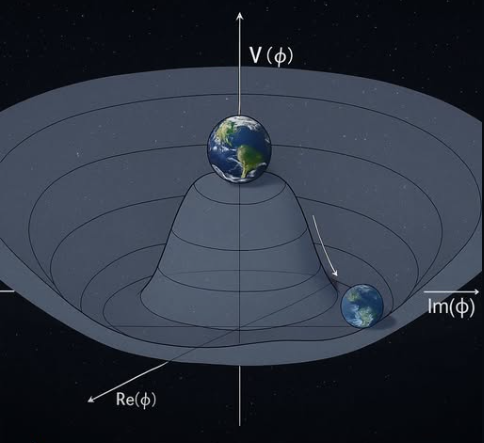
We wouldn’t be here if the universe were even slightly different. This is what scientists call the fine-tuning problem. The more we study the cosmos, the clearer it becomes: the physical laws of our universe are finely tuned – balanced precariously atop a hill. If the strength of gravity were just a fraction weaker, galaxies wouldn’t form. If the strong nuclear force were slightly stronger, stars wouldn’t burn. If the expansion rate of the universe were off by one part in 10⁶⁰, matter would either collapse into a single point or spread so thin no stars could ever ignite.
Massimo tweet media
English
258
198
1.1K
49.1K
nick nick eden
nick nick eden@NickNickEdin·
@soigomaa Movie please - this seems way more exciting than Cinderella
English
1
0
11
372
Pangram Labs
Pangram Labs@pangramlabs·
Announcing an update to Pangram Text, state-of-the-art AI text detection. Pangram Text now officially supports the top 20 languages on the internet, and performs well on many other languages outside of that! See the thread for technical detail on how we did it! 1/5
Pangram Labs tweet media
English
7
6
60
47.8K
Case Bradford
Case Bradford@Casebradford·
@AlpacaAurelius “Armpit sweat from men was applied to women’s lips” “Boosted their mood significantly” 😂
English
4
4
433
21.5K
Carnivore Aurelius ©🥩 ☀️🦙
Men’s sweat soothes a woman’s soul I’m this study, armpit sweat from men was applied to women’s lips. It decreased tension, decreased stress and boosted their mood significantly. It also increased LH, a signal to ovulate. The best part is that every woman guessed the researchers applied cologne or alcohol to their lips. Colognes are beta. Let your natural scent shine.
Carnivore Aurelius ©🥩 ☀️🦙 tweet media
English
152
308
5K
462.3K