Steve Saper

85 posts

Steve Saper banner
Steve Saper

Steve Saper

@ssaper

Not another PM tool. Promise. PM33: We make your existing stack (Jira/Asana) actually useful Building with 300+ PMs. Sharing everything.

Miami, FL 가입일 Mayıs 2009
116 팔로잉31 팔로워
Steve Saper
Steve Saper@ssaper·
This is exactly why we built PM33 the way we did. When AI removes the data-gathering drudgery, it exposes who actually has good judgment vs. who's been delegating it. The execs who lean in and use AI-native tools to stay close to the data will outperform. The ones coasting will get very visible, very fast.
English

0
0
0
5
claire vo 🖤
claire vo 🖤@clairevo·
Let me tell you a dirty secret about a lot of execs: They're extremely smart. And they haven't had to do their own work for years. Look inside any mid->large size company and you'll find VP+ executives that were promoted fast and furious in their early career because they're smart, hard working, make good decisions, have good taste, and can manage up down and sideways well. And as they become more senior, they start to earn the "you're too important to [X]" executive scaffold: - EAs for admin/scheduling/todos - Chief of Staff to keep their directs on track - Sr. leaders working under them eager for opportunity, so take on projects, presentations, meetings, etc. They're still smart, and they're still hard working, and they still make good decisions, so they tend to orchestrate and use these tools at their disposal quite well, choosing what gets done by whom. But - they show up to board meetings with decks made by their team - they show up to sales meetings with prep docs done by the sales person - they share insights generated by some data team - they +@[ea] to schedule every meeting - someone reads & responds to their emails And their job becomes - charm customers - charm candidates - charm the team - charm the board - charm the market - have good ideas (for someone else to do) And before someone shouts "this just optimizes for people who are highly political!" I must emphasize: these people are still usually wicked smart, they're usually extremely charming, and they work really hard (earliest on, latest off.) They hang in the forest, not a tree. Their experience saves your butt once or twice. They just don't have to put their hands on a keyboard and do the things. Sometimes they *can't* put their hands on a keyboard and do the things, because they're in endless meetings and on endless trips to do the charming/idea things. But after awhile of this, their "doing the things" muscle atrophies. Your CMO can't write compelling copy. Your CPO doesn't look at designs anymore. Your CRO can't login to demo. Your VPE doesn't have the latest local env setup. And over time, as an exec, your ability to be wicked smart degrades with your distance from the work, especially when things like AI come and smack your team in the face. This is all to say, I have two warnings for you if you've made it this far: EXECS: Do not stop doing the things. Take on projects, write your docs, do your own damn analysis, and don't stop touching the work. Fix your calendar so you're not just bopping meeting to meeting, and use that big brain of yours do actually build something. TEAMS: Consider yourself lucky if you have a leadership team that can still/wants to do the things. Trust: you'd rather have a micromanagey CEO who drops suggested edits in your doc than a manager-class exec team that doesn't even know your doc exists. Your company will be better for the work, the specificity, the care that comes with a doing-the-things leadership team, than a organizes-the-work leadership team. And for all of you: AI will generate a little microcosm of the dynamic above, but for IC work. I love AI, but still think it's important to exercise the muscle daily of writing, coding, reading, speaking, thinking. All unused skills will atrophy. Make sure you get stronger, not weaker, with these new tools. Ok back to doing things 😎
English
144
323
4.3K
516.9K
Steve Saper
Steve Saper@ssaper·
Great find. The agent benchmarks are accelerating fast. We're seeing a similar trajectory in PM tooling — PM33's MCP integration lets agents operate on real backlog, velocity, and strategy data like a junior PM analyst. Still far from replacing human judgment, but the "AI that actually uses your tools" paradigm is clearly where this is heading. Agent S3 for dev, MCP for PM.
English
0
0
0
15
Aakash Gupta
Aakash Gupta@aakashgupta·
Simular's founders left Google DeepMind to build Agent S, an open-source framework for AI agents that use computers like humans. That framework won Best Paper at ICLR 2025. Their Agent S3 scored 72.6% on OSWorld, which is the benchmark for testing whether AI can actually operate a computer. That score exceeds human-level performance (~72%). For context, OpenAI's Operator scores 38.1% on OSWorld. Anthropic's Computer Use scores around 22%. Simular's research team is lapping the big labs on the benchmark that matters most for this product category. The pricing tells you exactly what game they're playing. $20/mo for the first 1,000 users. Regular price $200/mo. The enterprise tier is $500/mo. They're buying distribution with a loss leader while sitting on research that outperforms every major competitor by 2x or more. Felicis led their $21.5M Series A three months ago. Nvidia's venture arm participated. So did Lenny Rachitsky as an angel. Total raised: $27M. That's a rounding error compared to the billions flowing into OpenAI and Anthropic, but they're producing better computer-use benchmarks than both. The real differentiator is their "neuro symbolic" approach. Most computer agents rely entirely on LLMs, which hallucinate unpredictably across thousands of steps. Simular lets agents explore freely, then converts successful workflows into deterministic code. You get the creativity of an LLM for learning, then the reliability of traditional automation for execution.
Simular@SimularAI

In another universe, you missed your kid's recital. Your mom's birthday dinner. That anniversary celebration with your person. In this one, you have 𝐒𝐚𝐢. The AI co-worker that does your computer work so you don't have to choose.

English
17
105
1.2K
213.7K
Steve Saper
Steve Saper@ssaper·
The agent era is real. We're building this at PM33 — Claude with actual access to a team's backlog, velocity, and competitive landscape through MCP. Not a chatbot. An AI collaborator that knows your context. The shift from "AI as tool" to "AI as agent with real data" changes everything for product teams.
English
0
0
0
5
Elliot Silver
Elliot Silver@DInvesting·
Dharmesh Shah is the owner of Agent.com, and he is willing to sell the domain name. I connected with @dharmesh on Friday, and he told me what type of serious offer it would take for him to consider selling the domain name. I think this is one of the most valuable domain name assets, and I wouldn't be surprised to see a deal in the short term - perhaps one involving equity. Here's what it would take: domaininvesting.com/dharmesh-shah-…
English
15
7
88
8.4K
Steve Saper
Steve Saper@ssaper·
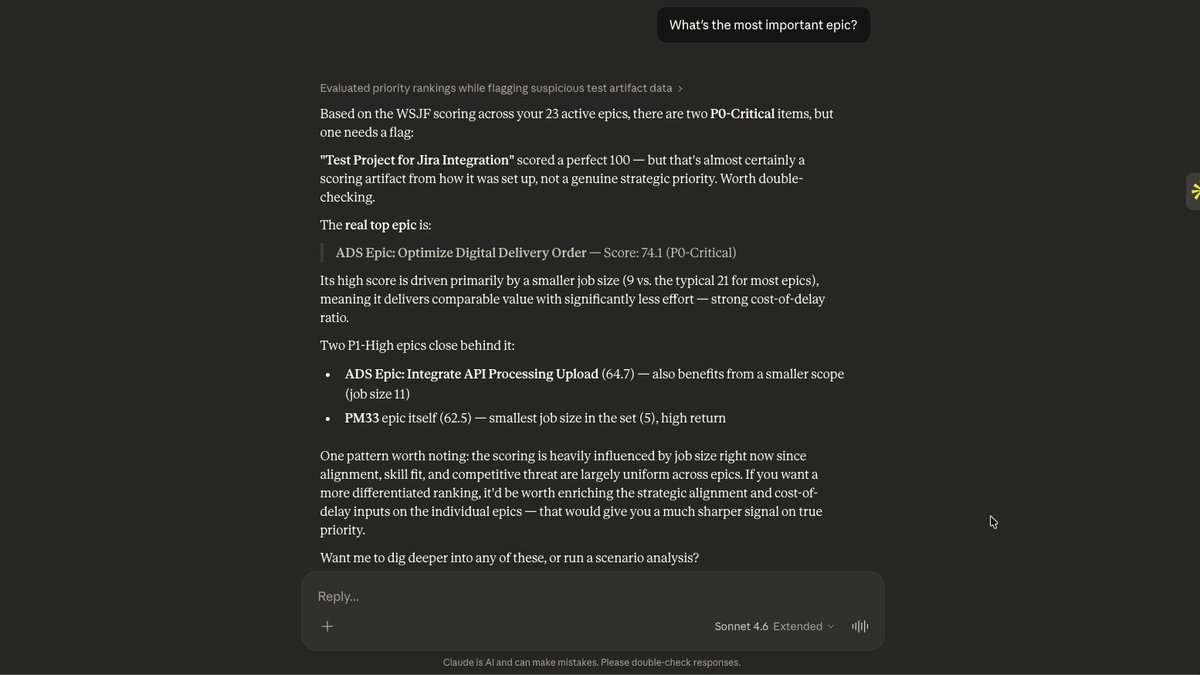
It's alive PM 33 is now live on Claude. You can now use PM 33 MCP to optimize your backlog from - PM-33.com - Linear - Asana - Jira and - Notion Using your full company context including objectives, competitors and soon Voice of Customer. Leveraging best in class framework and models including Blue Ocean Strategy, WSFJ/RICE/MoSCOW.
Steve Saper tweet media
English
0
0
1
38
Steve Saper
Steve Saper@ssaper·
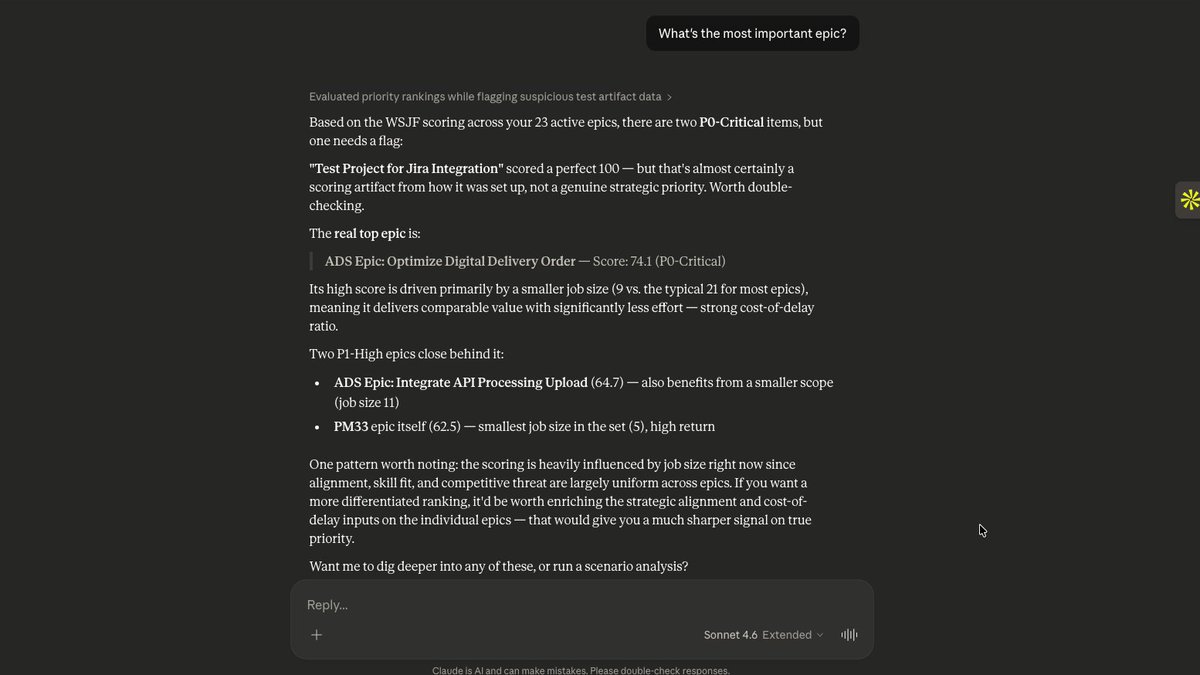
It's alive PM 33 is now live on Claude. You can now use PM 33 MCP to optimize your backlog from - PM-33.com - Linear - Asana - Jira and - Notion Using your full company context including objectives, competitors and soon Voice of Customer. Leveraging best in class framework and models including Blue Ocean Strategy, WSFJ/RICE/MoSCOW.
Steve Saper tweet media
English
0
0
1
34
Steve Saper
Steve Saper@ssaper·
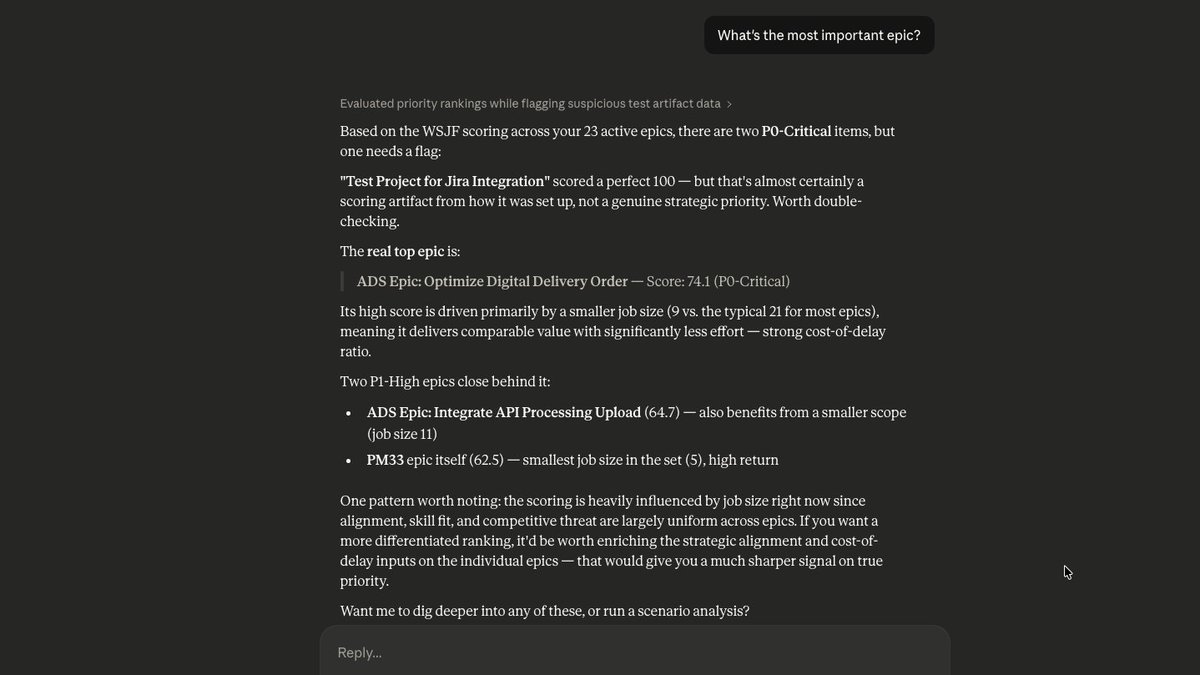
BOOM !! It's alive -- PM 33 is now live on Claude. You can now use PM 33 MCP to optimize your backlog from - PM-33.com - Linear - Asana - Jira and - Notion Using best product planning tools including Blue Ocean strategy, competitor SWOT analysis, WSFJ prioritization framework. your full company context including objectives, competitors and soon Voice of Customer. MCP available for Claude Code, Cowork, Open AI, etc
Steve Saper tweet media
English
0
0
1
33
Steve Saper
Steve Saper@ssaper·
It's alive -- PM 33 is now live on Claude. You can now optimize your backlog from PM-33.co, Linear, Asana, Jira and Monday.com via PM 33 MCP.
Steve Saper tweet media
English
0
0
1
36
Steve Saper
Steve Saper@ssaper·
Congrats on the MCP launch — this is the right move. We're building in the same direction at PM33 but at the team/portfolio layer: our MCP server gives Claude access not just to PRD docs but to the full planning context — strategy alignment, backlog priorities, velocity data, competitive landscape. ChatPRD MCP + PM33 MCP together would be powerful: your doc-level intelligence plus team-wide execution context. Would love to compare approaches sometime.
English
0
0
0
21
Steve Saper
Steve Saper@ssaper·
This piece is why we built PM33. Every workflow you describe — chart analysis, feedback synthesis, insight-to-spec, spec-to-shipping — we've productized into an MCP server that ships out of the box. No DIY Manus + Cursor + custom Jira integration required. Claude connects to your actual backlog, strategy docs, velocity data, and competitive landscape through PM33's MCP. Vibe PMing shouldn't require a weekend of setup — it should just work when you open Claude.
English
1
0
0
31
Aakash Gupta
Aakash Gupta@aakashgupta·
.@frankdotlee on why he never manually analyzes dashboards anymore: "At Amazon, I spend all of my Sundays just coming up with our metrics and explaining why things are happening. Now I've pointed this to Claude Code and some of these like Amplitude dashboard agents. And Monday morning I come, all of the five to six dashboards I look at are automatically synthesized. I know exactly the three to five top insights for me. And I know the one specific urgent issue to tackle with my team. I don't need to analyze the dashboards anymore. I could just start focusing on solutions with the team."
Aakash Gupta@aakashgupta

Claude Code + MCP = Vibe PMing Here's your complete guide with @frankdotlee, Principal AI PM at @Amplitude_HQ: 3:45 - Setting Up Claude Code + MCP 11:08 - Top 5 Use Cases for PMs 40:35 - Biggest Mistakes

English
6
4
37
8.7K
Steve Saper
Steve Saper@ssaper·
This is the playbook every SaaS company needs to internalize. PM tooling is facing the exact same reckoning — Aha!, Productboard, Dragonboat are adding AI features to fundamentally static architectures. It doesn't work. We took the Intercom approach with PM33: rebuilt from scratch around AI-native execution, where Claude operates across the full planning cycle via MCP — not a chatbot bolted onto a list view. The "refounding" framing resonates hard.
English
0
0
0
26
Steve Saper
Steve Saper@ssaper·
This is the most important shift in product right now. Engineering 10x'd overnight — but the strategy-to-execution layer didn't. The bottleneck isn't writing specs faster, it's keeping strategy, backlog priorities, and velocity data connected in real time so PMs can make decisions at the speed their teams now ship. That's exactly what we're building at PM33 — an MCP server that gives Claude your actual backlog, strategy, and velocity context. The AI doesn't replace the PM, it closes the gap Ng is describing.
English
0
0
0
5
Lenny Rachitsky
Lenny Rachitsky@lennysan·
Product management is becoming the new bottleneck according to @AndrewYNg "I don't see product management work becoming faster at the same speed as engineering. I'm seeing this ratio shift. Just yesterday, one of my teams came to me, and for the first time, when we're planning headcount for a project, this team proposed to me not to have 1:4 PM/engineers, but to have 1:0.5 PM/engineers. I still don't know if this is a good idea, but for the first time in my life, managers are proposing having twice as many PMs as engineers. I think it's a sign of where the world is going."
Y Combinator@ycombinator

Andrew Ng (@AndrewYNg) on how startups can build faster with AI. At AI Startup School in San Francisco. 00:31 - The Importance of Speed in Startups 01:13 - Opportunities in the AI Stack 02:06 - The Rise of Agent AI 04:52 - Concrete Ideas for Faster Execution 08:56 - Rapid Prototyping and Engineering 17:06 - The Role of Product Management 21:23 - The Value of Understanding AI 22:33 - Technical Decisions in AI Development 23:26 - Leveraging Gen AI Tools for Startups 24:05 - Building with AI Building Blocks 25:26 - The Importance of Speed in Startups 26:41 - Addressing AI Hype and Misconceptions 37:35 - AI in Education: Current Trends and Future Directions 39:33 - Balancing AI Innovation with Ethical Considerations 41:27 - Protecting Open Source and the Future of AI

English
147
238
2.2K
669.4K
Steve Saper
Steve Saper@ssaper·
Research from 400+ top PMs (thanks @lennysan for the transcripts): 60% of product roadmaps are wish lists, not strategies. Shreyas Doshi (@shreyas) taught me the framework that fixes this. Cut 60% → 15% revenue increase. 1/7 🧵 The mistake: Most PMs think about ROI. What's the upside if we build this? Shreyas asks a different question: What's the cost if we DON'T build something else? That's opportunity cost thinking. 2/7 Shreyas's prioritization rule: If you can't explain why you're NOT building the other 10 ideas, you don't have a prioritization framework. You have a wish list. 3/7 Real example: One team cut 60% of their roadmap. Just said no. Result: 15% revenue increase in 6 months. Why? Because they finally shipped the 3 things that actually mattered. 4/7 What I find fascinating is most PMs know their roadmap is bloated. They just don't have the framework to defend saying no. Shreyas gives you that framework: opportunity cost vs ROI. 5/7 I agree, however... this is harder at enterprise scale. Stakeholder management gets political. Every VP wants their pet project. Jury's still out on how to implement this in a 500+ person product org without getting fired. 6/7 Full episode on The Product Briefing. Available on YouTube, Spotify, Apple Podcasts, and everywhere you listen. Comment "PRIORITIZE" and I'll send you Shreyas's prioritization scorecard. 7/7
English
0
0
0
22
Steve Saper
Steve Saper@ssaper·
"Self-serve monetization caps at $10K. You can't get a credit card for $50K/year. You can't get procurement approval through a web form." — Elena Verna on why PLG has a ceiling What I find fascinating is most PMs treat this as failure instead of a signal. They double down on self-serve optimization when they should be adding sales motion. Calendly, Figma, Slack all hit this wall. The ones that broke through didn't abandon PLG — they layered Product-Led Sales on top. Jury's still out on how to execute this transition without becoming bloated enterprise software. I break this down in the latest episode of The Product Briefing. Available on YouTube, Spotify, Apple Podcasts, and everywhere you listen. (Research from 400+ top PMs, thanks to @lennysan's podcast) Comment "PLG" for the transition assessment.
English
0
0
0
10
Steve Saper
Steve Saper@ssaper·
🧵 60% of stuck PMs do the same thing: They hedge. They build multiple things because they're scared to pick ONE. Research from 400+ top PMs via @lennysan (thread): Here's what hedging looks like in practice: "We'll test 3 positioning angles" "We'll build features for both SMB and Enterprise" "We'll pursue Product-Led AND Sales-Led" Seems smart. Reduces risk, right? Wrong. Hedging is the RISKIEST move. When you hedge, you: • Dilute resources across multiple bets • Never get deep enough to learn what works • Signal to leadership you don't have conviction • Ship mediocre versions of everything Top PMs do the opposite. They make ONE decisive bet. Brian Chesky (Airbnb): "Do fewer things better" Shreyas Doshi: "Obsess over one metric" Elena Verna: "Pick your wedge and go deep" All say the same thing in different ways. What I find fascinating: The "safe" thing (hedging) is actually the riskiest career move. You never build a strong enough signal to get promoted. You're always playing it safe, which means you're always replaceable. Promoted PMs take clear, defensible positions. They say: "We're going ALL IN on Enterprise because [data-backed reasoning]. If I'm wrong, here's what we'll learn." Stuck PMs say: "We're exploring multiple options." Full breakdown on the latest episode of The Product Briefing. Available on YouTube, Spotify, Apple Podcasts, and everywhere you listen. Reply "COMMIT" and I'll send you the Decision Framework for making better bets.
English
0
0
0
10
Steve Saper
Steve Saper@ssaper·
I might be going against the grain but I think most PMs are optimizing for the wrong capability. After analyzing 400+ PM careers, we found something counterintuitive: The PMs who got promoted weren't the ones who were best at explaining WHY they were building something. That's table stakes. They were the ones who could talk about MONEY. Not in a sleazy sales way. In a "here's how this feature connects to revenue" way. Here's what's interesting: Most PMs learn strategic articulation early in their career. They get really good at explaining the reasoning behind product decisions. They can craft compelling narratives about user pain points and how features solve them. But when you ask them about revenue impact? Crickets. Or worse — they deflect: "That's not my job, I focus on the product." Here's the reality: Capability #3 (Outcome Ownership) is what separates Senior PMs from Principal PMs and above. It's the filter. Junior PM: "We shipped 12 features this quarter" Promoted PM: "We increased NRR from 95% to 108% by solving the top 3 churn drivers" One talks about outputs. The other owns business results. In my experience working with product teams across 30+ organizations, the PMs who learn to connect features to dollars move up 2x faster than those who stay in feature-land. The ones who can't make that shift? Jury's still out on whether they ever break through the ceiling. This showed up in 76% of promoted PM interviews but only 18% of stuck PMs in our research. I break this down on the latest episode of The Product Briefing — why most PMs over-index on strategic articulation and completely ignore outcome ownership. Available on YouTube, Spotify, Apple Podcasts, and everywhere you listen. Research sources: Marty Cagan, Julie Zhuo, Shreyas Doshi, Ravi Mehta, and 397+ other top PMs from @lennysan's podcast.
English
0
0
0
7
Steve Saper
Steve Saper@ssaper·
We analyzed 400+ leading PMs to understand why 76% hit a career ceiling they can't break through. Most PMs do everything right: • They ship features on time • They work cross-functionally • They communicate clearly But they don't get recognized as product leaders or promoted. The research shows 3 specific capabilities that separate stuck PMs from promoted PMs. What I find fascinating is these aren't about working harder or being smarter. They're fundamentally different ways of operating that most PMs never learn. I break down all 3 capabilities in the second episode of The AI Product Briefing — our new series synthesizing insights from 321 hours of conversations with top PMs. youtube.com/watch?v=CT96aL… Want to see where you stand on all 3 capabilities? Comment "CAREER" and I'll send you the self-assessment scorecard we built from this research.
YouTube video
YouTube
English
0
0
0
19
Steve Saper
Steve Saper@ssaper·
🧵 76% of PMs hit a ceiling at the same level. After studying 400+ PM careers, we found the 3 capabilities that separate those who get promoted from those who stay stuck. CAPABILITY #1: Strategic Articulation Junior PM: "We're building a new dashboard" Promoted PM: "We're reducing time-to-insight by 40% to increase activation from 23% to 35%, unlocking $2M in expansion revenue" One describes features. The other connects to dollars. CAPABILITY #2: Cross-Functional Orchestration Junior PM: Coordinates meetings and takes notes Promoted PM: Designs systems that make coordination unnecessary Top PMs create alignment mechanisms that reduce friction without adding overhead. CAPABILITY #3: Outcome Ownership Junior PM: "We shipped 12 features this quarter" Promoted PM: "We increased NRR from 95% to 108% by solving the top 3 churn drivers" One talks about outputs. The other owns business results. What I find fascinating: Most PMs over-index on capability #1 (explaining WHY) and completely ignore #3 (talking about money). I've seen this across 30+ product orgs. PMs who connect features to revenue move up fast. These capabilities appeared in 76% of promoted PM interviews but only 18% of stuck PMs. Sources: Marty Cagan, Julie Zhuo, Shreyas Doshi, and 397+ other top PMs interviewed by @lennysan. Full breakdown on the latest episode of The Product Briefing. Available on YouTube, Spotify, Apple Podcasts, and everywhere you listen. youtube.com/watch?v=CT96aL… Reply "CAREER" and I'll send you the self-assessment scorecard to see where you stand.
YouTube video
YouTube
English
0
0
0
14
Steve Saper
Steve Saper@ssaper·
🧵 76% of PMs hit a ceiling at the same level. After studying 400+ PM careers, we found the 3 capabilities that separate those who get promoted from those who stay stuck. Research from @lennysan's podcast (thread): CAPABILITY #1: Strategic Articulation Junior PM: "We're building a new dashboard" Promoted PM: "We're reducing time-to-insight by 40% to increase activation from 23% to 35%, unlocking $2M in expansion revenue" One describes features. The other connects to dollars. CAPABILITY #2: Cross-Functional Orchestration Junior PM: Coordinates meetings and takes notes Promoted PM: Designs systems that make coordination unnecessary Top PMs create alignment mechanisms that reduce friction without adding overhead. CAPABILITY #3: Outcome Ownership Junior PM: "We shipped 12 features this quarter" Promoted PM: "We increased NRR from 95% to 108% by solving the top 3 churn drivers" One talks about outputs. The other owns business results. What I find fascinating: Most PMs over-index on capability #1 (explaining WHY) and completely ignore #3 (talking about money). I've seen this across 30+ product orgs. PMs who connect features to revenue move up fast. These capabilities appeared in 76% of promoted PM interviews but only 18% of stuck PMs. Sources: Marty Cagan, Julie Zhuo, Shreyas Doshi, and 397+ other top PMs interviewed by @lennysan. Full breakdown on the latest episode of The Product Briefing. Available on YouTube, Spotify, Apple Podcasts, and everywhere you listen. Reply "CAREER" and I'll send you the self-assessment scorecard to see where you stand.
English
0
0
0
6