
dharmesh

23.6K posts

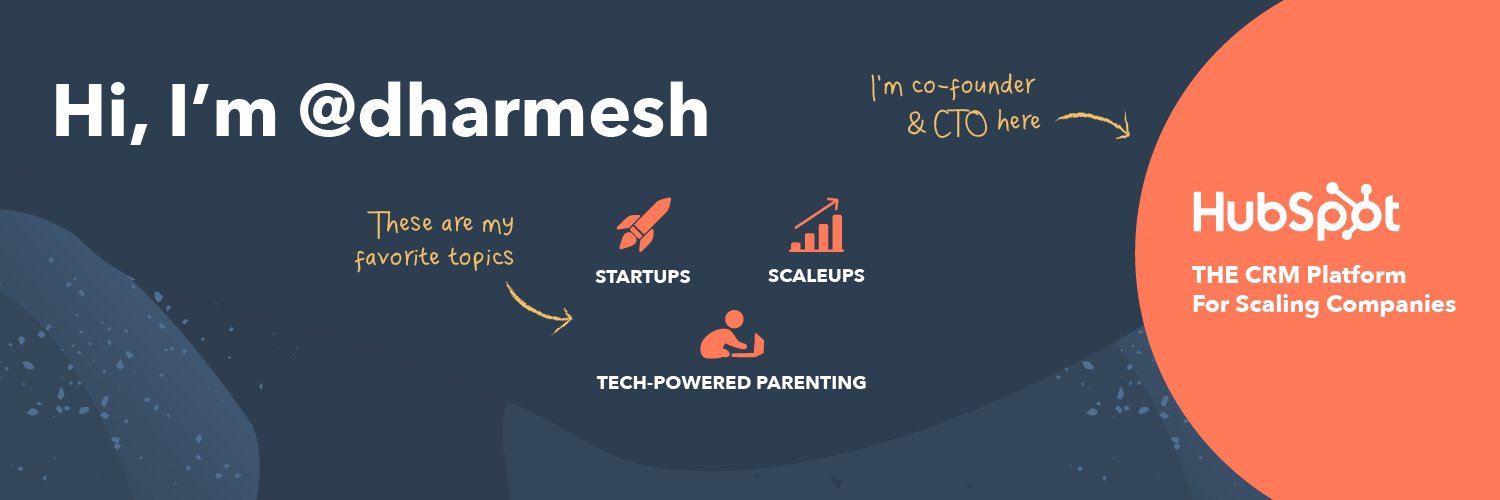
dharmesh banner
dharmesh

dharmesh

@dharmesh

Co-founder/CTO, HubSpot ($HUBS). Mission: Help millions grow better. Publish https://t.co/sgeuiJi7wU newsletter (2M+ subscribers). Builder: https://t.co/xirHeCKZPl

Boston, MA Katılım Mart 2008
771 Takip Edilen348.3K Takipçiler
Sabitlenmiş Tweet
dharmesh
dharmesh@dharmesh·
2023 was the year of chat UX powered by generative AI. That led to me hacking on ChatSpot and launching it last year. 2024 is the year of Agent AI, so that's what I've been hacking away late nights on. I'm obsessed with #AgentAI. Was up past 3am last night. I have a handful of simple (but useful) agents that I built for myself and one I built for my wife. Will start releasing them one at a time. I'm using a bunch of LLMs (GPT-4, Claude, Gemini) and a bunch of proprietary/paid data sources. Will be fun to see the bills rack up. :) Releasing it all for free. You can join the waitlist at agent.ai Thanks for your support.
dharmesh tweet media
English
168
207
2.2K
642K
dharmesh retweetledi
Clara Shih
Clara Shih@clarashih·
In the AI economy, modern role definitions will break as every employee can deploy systems of agents to own much broader scopes of work. End-state work collapses into 3 foundational jobs within companies: building products, selling products, and running the company. Everything else will get delegated to agents. Examples: • The actual job of design or software engineering isn’t producing mockups and code, but rather building great products people pay for and love. • The real job of marketing isn’t campaigns or content; it’s driving sales. • The purpose of corporate accounting isn't the tasks of sending invoices and paying bills, but ensuring the company has cash to fuel operations and growth. This shift is unfolding unevenly— faster in smaller, more tech-forward companies and slower in legacy orgs due to inertia, regulation, or culture. The more people can define their jobs not as a set of tasks but as orchestrating outcomes end-to-end, the more strategic, leveraged, and indispensable they become. youtube.com/shorts/CfK3za_…
YouTube video
YouTube
English
3
6
27
6.1K
dharmesh
dharmesh@dharmesh·
Woo hoo! Thrilled to share a sneak peek of HubCode -- The Vibe Coding Tool for HubSpot. I talked about this a few weeks ago (which feels like forever). Been cranking on it and am ready to show you the actual app now. Link to video in the comments. Or, just type video.hubcode .com in your browser (it takes you to YouTube). Some notes: 1) This requires no terminal -- runs completely in the cloud. 2) You can vibe code both app cards and full apps that live inside the HubSpot web UI. 3) Generated apps can access data within HubSpot (of course). 4) SUPER EXCITING: Apps can reuse any of the public agents in agent .ai (there are 2,000+ of them). This makes your apps super-powerful because you can access all sorts of data and services. And, you can build your own private agents and access them too. This gives you access to all the major frontier models (GPT, Opus, Gemini), and a bunch of really useful data sources and a ton of other capability. Go to agent .ai to see what's available. The demo shows pulling YouTube videos related to a company right into the app card. 5) You can paste in screenshots or other visuals as part of your vibe coding process (if you haven't done this before, it will feel magical). The HubCode app runs on the agent .ai platform and is in private beta (because this one's going to take some testing and iteration given the power and flexibility). To apply, just go to hubcode .com. This is an early "proof of concept", but will be iterating on it maniacally as I get user feedback. Let me know what you think. All thoughts, ideas, feedback and wishlist items appreciated. FEEDBACK IS A GIFT. Thank you for your support.
dharmesh tweet media
English
31
17
183
40K
dharmesh retweetledi
Jared Sleeper
Jared Sleeper@JaredSleeper·
HubCode is a really neat concept for systems of record looking to use vibecoding to strengthen their businesses. Hastens the development of an ecosystem of long-tail apps + lets customers build apps themselves to solve for feature gaps. More stickiness, network effects, etc.
dharmesh@dharmesh

If there's one thing better than coding at 30,000 feet it's agentic coding at 30,000 feet. And, the best is agentic coding an agentic coding tool at 30,000 feet. (HubCode.com -- the agentic coding tool for HubSpot)

English
2
1
13
7.2K
dharmesh retweetledi
Brian Halligan
Brian Halligan@bhalligan·
Happy St Patty’s Day to those of you who celebrate ☘️
English
6
2
49
4K
dharmesh
dharmesh@dharmesh·
I'm "knows that long before markdown there was markup and that it's the M in HTML" years old.
English
10
2
51
5K
dharmesh retweetledi
Drew Volpe
Drew Volpe@drewvolpe·
vibe coding tool w/ an app store of 2,000+ agents is a really smart move by HubSpot.
dharmesh@dharmesh

Woo hoo! Thrilled to share a sneak peek of HubCode -- The Vibe Coding Tool for HubSpot. I talked about this a few weeks ago (which feels like forever). Been cranking on it and am ready to show you the actual app now. Link to video in the comments. Or, just type video.hubcode .com in your browser (it takes you to YouTube). Some notes: 1) This requires no terminal -- runs completely in the cloud. 2) You can vibe code both app cards and full apps that live inside the HubSpot web UI. 3) Generated apps can access data within HubSpot (of course). 4) SUPER EXCITING: Apps can reuse any of the public agents in agent .ai (there are 2,000+ of them). This makes your apps super-powerful because you can access all sorts of data and services. And, you can build your own private agents and access them too. This gives you access to all the major frontier models (GPT, Opus, Gemini), and a bunch of really useful data sources and a ton of other capability. Go to agent .ai to see what's available. The demo shows pulling YouTube videos related to a company right into the app card. 5) You can paste in screenshots or other visuals as part of your vibe coding process (if you haven't done this before, it will feel magical). The HubCode app runs on the agent .ai platform and is in private beta (because this one's going to take some testing and iteration given the power and flexibility). To apply, just go to hubcode .com. This is an early "proof of concept", but will be iterating on it maniacally as I get user feedback. Let me know what you think. All thoughts, ideas, feedback and wishlist items appreciated. FEEDBACK IS A GIFT. Thank you for your support.

English
1
1
17
8.4K
Jason Fried
Jason Fried@jasonfried·
Where's the podcast for co-founders? There's about a billion 1:1 interview shows with founders. But most business have co-founders, especially in the tech world. Interviewing two people at once may be harder, no question. But doesn't the podcast-founders-sphere keep talking about doing hard things? If you want to get a real look at what it's like to run a business with two+ founders, get them in a room, pepper them with questions, see them disagree, hear their different angles, see which defers to the other on certain topics, watch how they navigate difficult questions, watch decisions being made, watch ideas develop. That's the real view, the real interview. Yeah, maybe one person is way more interesting than the other. Yeah maybe one's the outspoken one and the other sits back. Ok — that's real. Let's see real. So who's going to do it? Huge opening. cc: @R_Mohr
English
64
10
308
24.8K
dharmesh
dharmesh@dharmesh·
If there's one thing better than coding at 30,000 feet it's agentic coding at 30,000 feet. And, the best is agentic coding an agentic coding tool at 30,000 feet. * confession: I posted almost this exact thing earlier, but I'm doing an A/B test to see if this gets more algorithmic pick-up.
English
19
1
42
6.2K
dharmesh
dharmesh@dharmesh·
If there's one thing better than coding at 30,000 feet it's agentic coding at 30,000 feet. And, the best is agentic coding an agentic coding tool at 30,000 feet. (HubCode.com -- the agentic coding tool for HubSpot)
English
13
3
40
15.1K
dharmesh retweetledi
Anish Moonka
Anish Moonka@AnishA_Moonka·
Scientists put kids through 100 hours of reading, then scanned their brains. New wiring had physically grown inside the language regions. Communication between brain areas sped up by a factor of 10. Kids who didn't read showed zero change. That was a 2009 Carnegie Mellon study. It gets wilder. In 2013, Emory University scanned 19 students every morning for 19 straight days while they read one novel chapter each night. Mornings after reading, the brain areas responsible for understanding other people's emotions lit up with new connections. So did the region that processes physical sensation. Their brains were simulating what the characters felt, as if it were happening to them. Those changes stuck around for 5 days after they finished the book. Now flip to scrolling. A massive review published in Psychological Bulletin last September pulled together 71 studies covering 98,299 people. Heavy short-form video use (TikTok, Reels, Shorts) showed a clear pattern: worse attention, weaker self-control, and more anxiety. Consistent across teenagers and adults, across every platform tested. Oxford didn't name "brain rot" its 2024 Word of the Year for nothing. A 2024 brain wave study found that people hooked on short-form video had weaker activity in the front of the brain, the part that controls focus and impulse control. Separate brain scans showed the same thing: heavy scrollers had less activation in the exact regions that deep reading strengthens. UCLA neuroscientist Maryanne Wolf has been studying this for decades. Humans were never born to read. There's no gene for it. Reading is something we invented, and it hijacked neurons that were originally meant for recognizing faces. Over time, it built entirely new brain circuits connecting language, vision, and emotion. But those circuits only survive if you use them. Stop reading, and they fade. Wolf's conclusion is simple: screens built for speed produce a speed-wired brain. Books built for depth produce a depth-wired brain. One honest caveat: most of these studies are snapshots, not long-term tracking. People who already struggle to focus might just prefer short videos. But the same pattern showing up across nearly 100,000 people is hard to shrug off. The tweet repeats the line seven times. The research backs it up with brain scans, EEG data, and white-matter imaging across tens of thousands of people.
✒️@Literariium

The antidote for brain rot is books. The antidote for brain rot is books. The antidote for brain rot is books. The antidote for brain rot is books. The antidote for brain rot is books. The antidote for brain rot is books. The antidote for brain rot is books.

English
165
5.2K
25.5K
2M
dharmesh
dharmesh@dharmesh·
Can confirm what @travisk said. Has certainly been true for @HubSpot. Figuring out how to make SMB work is playing in "hard mode". The good news is that if you figure out how to make the math work in SMB, it is its own form of moat.
TBPN@tbpn

“When you go from consumer to B2B, the number one mega-challenge that you must master is LTV:CAC.” - @travisk "Yes, you can make that argument on consumer, but when you have a sales funnel that starts with 'I'm going to talk to customers, and I have to make LTV:CAC work' — versus 'My LTV:CAC is the App Store' — it's a whole different ballgame." “LTV:CAC with a sales machine, especially if you go [after] small businesses, is life on hard mode. Anybody who’s crushed it on SMB, those guys are special individuals who've made that happen. Because life in the SMB B2B world is no joke."

English
37
33
626
117.7K
dharmesh retweetledi
Hemant Mohapatra
Hemant Mohapatra@MohapatraHemant·
A common trap early stage founders fall into is believing they have the strongest product in category{x} that has 10+ others that have raised / grown fast, so "we will eventually catch up / overtake". What we are seeing is that (1) gaps between brand/GTM/team are increasing much faster than gaps between products, and (2) superior products are growing faster. So if you growing from $0->$1M in a year and your largest competitor is growing from $1->~$8-10M, you may not have a superior product or it would be growing at a much faster rate than those further ahead. Capital is accruing incredibly quickly to category leaders by the time you hit serB; seed->A death rate is likely to remain very high due to miscalculations by founders and VCs who are seeing local maximas or don't have technical depth.
English
15
7
224
35.5K
dharmesh
dharmesh@dharmesh·
Current Status: Dealing with the emotional roller coaster that is the Anthropic API right now (they're having an owie). On the one hand, I'm in a state of flow and trying to finish up some work for a demo video I want to record a screencast for. On the other hand, it's draining to keep retrying things 5 times in order to get it to work. Just creeping along. My best wishes to the Anthropic team. Never fun to be going through system issues -- especially on a Friday afternoon.
dharmesh tweet media
English
31
1
96
16.3K
dharmesh
dharmesh@dharmesh·
@bhalligan I remember when you bought "Wolf". I don't know much about Jerry Garcia or guitars. But I do know about the value of low supply, high demand things. Also know the joy it brought you -- which is priceless. Nicely done!
English
1
0
10
1.9K
Brian Halligan
Brian Halligan@bhalligan·
Not so humble brag coming. I bought Jerry Garcia’s “Wolf” guitar 9 years ago for $1.9mil. Its sister “Tiger” guitar just sold for $11.5mil. Low supply & high demand is timeless.
English
69
8
546
80.4K
dharmesh
dharmesh@dharmesh·
Not yet -- but we're headed there. We have a consumption pricing model in place that we use for our own agents that lays the foundation for this. I think customers would like the convenience of having one bill instead of paying a much of different companies for different agents.
English
1
0
1
97
Matt Slotnick
Matt Slotnick@matt_slotnick·
@dharmesh @HubSpot @AgentDotAi are there plans for a dedicated agent partner program in the Hubspot marketplace? ideally that allows for consumption pricing and one/few-click deployment
English
1
0
0
72
dharmesh
dharmesh@dharmesh·
And *some* (hint: @HubSpot) are building multi-agent networks where builders have created thousands of agents. There are 68K agents built on @AgentDotAi -- 2,000+ of which have been made available to the public. I don't just love third-party developers, I *am* a third-party developer (I personally build agents using our partner APIs). I am Partner Zero.
Matt Slotnick@matt_slotnick

every incumbent understands that agents are the future. where they go wrong is thinking they alone will provide the agents. it's existential that they build a platform that doesn't just tolerate 3rd party agents, but actively benefits from them

English
13
2
54
17.1K
dharmesh
dharmesh@dharmesh·
Just finished watching the episode (it's almost 1:30 am in Boston). Loved it. Highly #recommend. My favorite part was around the value of "first derivative" businesses. Other example that comes to mind: GM makes more money on financing cars than selling cars. p.s. I wonder if some day, HubSpot will make more money on being an ecosystem for GTM agents than on the agents themselves. 🤔
English
3
1
18
2.6K
Brian Halligan
Brian Halligan@bhalligan·
The most ‘Founder Mode’ CEO working today is not actually the founder. NEW EPISODE with Kaz @nejatian of @Opendoor is now live. This is a special one. Kaz left Shopify to pull off the refounding of a struggling public company in just 16 days. Incredible story. Here are just a few of my learnings from our conversation on the latest episode of Long Strange Trip: 1. First Derivative Businesses The most enduring companies are rarely built on their primary activity; they are built on the first derivative of that core business. Great founders identify and weaponize the secondary value stream. This is important. 2. Rejecting Defaults Success is a function of the defaults you choose to overwrite. Most operators accept the 'software' of their industry or life on autopilot; exceptional builders identify the one or two critical defaults and fight them with all their power to create a new trajectory. Kaz is a master at this, and he explains how. 3. Stewardship Over Status Optimize for doing things rather than being things. When a leader optimizes for a title or happiness, they create fragile organizations; when they optimize for stewardship and service, they build a mission-driven culture that can withstand the lonely and painful stretches of the journey. 4. Write a user manual for yourself "Strong attract, strong repel. My job is to tell you what kind of a person I am so you can opt in or opt out." I love this quote. If you're a founder, you owe this to everyone around you. 5. Founder mode = responsibility for outcomes Hold yourself responsible for truth and outcomes, not processes. Hire people to round you out. Don't try to be well-rounded yourself. And don't work on your weaknesses. "Is the fact that I'm bad at this the reason I'm good at everything else?" 6. Structural Risk Mispricing The one permanent advantage for entrepreneurs is that the rest of the world structurally misprices risk. While others see a 'lion bite' in every setback, the best CEOs recognizes that things going poorly is not as painful as you think,  allowing them to lean into volatility that scares off the incumbent. That's the difference. 7. Death Spiral Honesty When a company is in a death spiral, incrementalism is fatal; "what must change os everything." Professional managers are often incentivized by RSUs to delay the inevitable and manage a slow decline. You need zero incentive to manage a decline and a compensation structure aligned purely with performance. 8. AI as the New Performance Default Default to AI is not a suggestion; it is the first line of the job description. A company becomes AI-native not through top-down mandates, but by making AI proficiency a core pillar of the performance management system - effectively deciding who gets to play on the team based on their ability to automate their own craft. 9. The Career vs. Job Distinction "A job is something you do for someone else in order to get paid. A career is something you work on every day for yourself." Kaz's kids know what @Opendoor is. His family is all in. Exceptional companies are built by people who self-identify with their work and treat their professional mission as a family-integrated pursuit. 10. Two timeframes matter. Everything else is noise. This week and 10 years from now. "This quarter is a deeply useless measuring period." @tobi applies a discount rate of basically zero to the future. That's the model. My takeaway from this conversation: ask yourself what defaults you're living by that you haven't deliberately chosen. Kaz overrides every default, and he does it over and over again.
English
28
51
437
265.2K