DC|use.fo

1.7K posts

DC|use.fo banner
DC|use.fo

DC|use.fo

@vibecoder_dc

Building @usedotfo: Next-gen AI Voice Typing. 🎙️ Vibe Coder | AI & Blockchain Specialist. Serial Founder. Turning intent into logic at the speed of thought. ⚡

가입일 Nisan 2024
102 팔로잉5.5K 팔로워
DC|use.fo
DC|use.fo@vibecoder_dc·
@itsharmanjot Benchmarks are like swimming pool races; everyone is fast until you move them to the ocean. I wonder how Qwen 4 handles actual repo drift?
English
0
0
0
24
Harman
Harman@itsharmanjot·
Alibaba just released a coding model that hits 82 percent on SWE-Bench Verified. That is the highest score ever published for an open-source model. The weights are free. The license is Apache 2.0. You can run it today. The model is Qwen 4 Coder 32B. Here is what 82 percent on SWE-Bench Verified actually means. SWE-Bench Verified tests whether an AI can autonomously resolve real bugs pulled from real production GitHub repositories. Not synthetic exercises. Real open-source projects that real teams depend on. A model gets a bug report, reads the code, writes a fix, and either passes the test suite or it does not. At 82 percent, Qwen 4 Coder 32B resolves 82 out of every 100 real production bugs it is given. Without a human guiding it. On code it has never seen before. For comparison: Qwen 4 Coder 32B: 82 percent SWE-Bench Verified. Open source. Apache 2.0. Claude Fable 5: 80.3 percent SWE-Bench Pro. $10 input / $50 output per million tokens. Currently suspended. GPT-5.6 Sol: Competitive on Terminal-Bench. $5 input / $30 output per million tokens. An open-weight model that you can download and run for free just beat both of them on the benchmark designed to measure real software engineering capability. Here is the architecture. Qwen 4 Coder 32B is a 32 billion parameter dense model. Not a Mixture-of-Experts. Every parameter is active on every request. This matters for inference: a dense 32B model runs on 22 gigabytes of VRAM, which fits on a single high-end consumer GPU or a MacBook Pro with 64GB of unified memory. The smaller variant, Qwen 4 Coder 4B, runs at approximately 135 tokens per second on an M5 Max and fits inside 8 gigabytes of RAM. For a model with usable coding capability, that is a new bar for what fits in a single laptop. The training methodology continued Alibaba's approach of reinforcement learning on verifiable coding tasks. The model gets rewarded when its code passes tests. It gets penalized when it fails. Over millions of training steps, the model learns to write code that actually runs rather than code that looks plausible. License: Apache 2.0. Full commercial use. No attribution requirement. No revenue threshold. No monthly active user ceiling. Weights: Hugging Face, available today. Runs on: vLLM, Ollama, SGLang, and any standard GGUF-compatible inference engine. Qwen 4 32B also runs at approximately 135 tokens per second on an M5 Max chip, setting a new bar for what a sub-8GB model can do on Apple Silicon. The open-source coding model just beat the best closed-source model in the world on the benchmark designed to test whether AI can actually do software engineering. The weights are free. The subscription is optional. Source: Autom8Labs AI Insight July 2026, LLMCheck.net State of Open Source LLMs June 2026, Kunal Ganglani blog June 2026.
English
20
34
169
14.1K
DC|use.fo
DC|use.fo@vibecoder_dc·
@daniel_mac8 Testing on benchmarks is like judging a car's off-road capability by how well it rolls on a flat warehouse floor. Build a messy, non-deterministic loop with 5+ tools and see where it hallucinates its own tools. That's the only real test.
English
0
0
0
3
Dan McAteer
Dan McAteer@daniel_mac8·
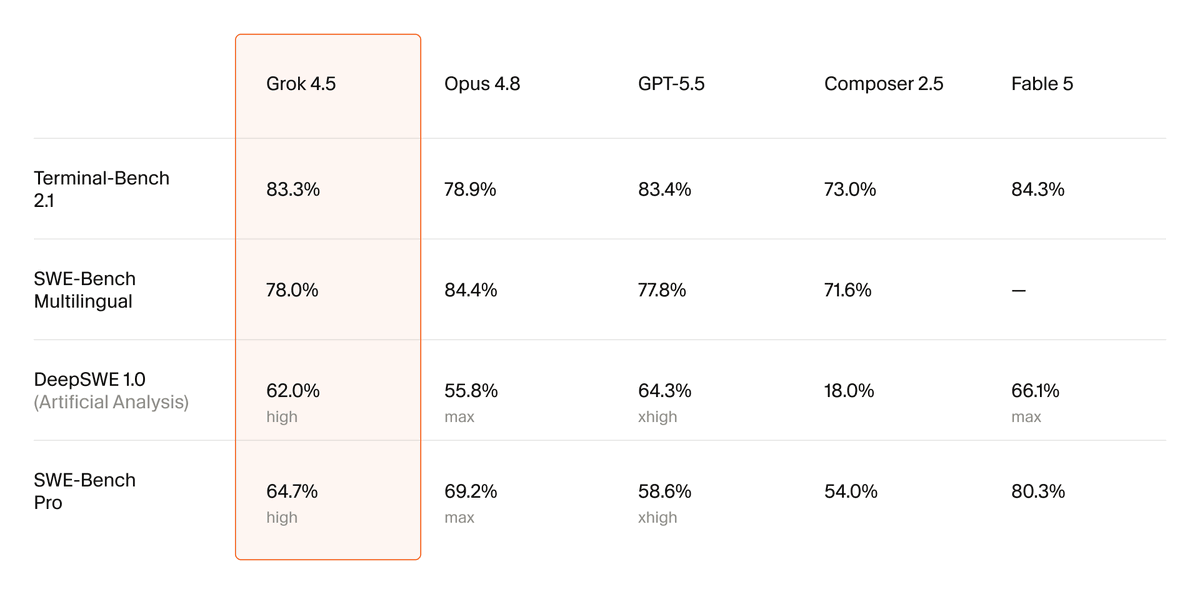
Grok 4.5 benchmarks look strong. You have to love that it's cheaper and faster: Grok 4.5: $2 in / $6 out GPT 5.6: $5 in / $30 out Opus 4.8: $5 in / $25 out What's the best way to test it on real agentic tasks?
Dan McAteer tweet media
English
4
3
28
1.2K
DC|use.fo
DC|use.fo@vibecoder_dc·
@daniel_mac8 Benchmarks are just like gym PRs for AI. Great for the leaderboard, but doesn't tell you if it can actually carry the groceries without dropping them.
English
1
0
1
285
Dan McAteer
Dan McAteer@daniel_mac8·
Grok 4.5 is a "Wow!" moment. 🤯 > Opus 4.8 & GPT-5.5 level on benchmarks > Costs less than Sonnet 5 Is that real? Hard to believe. Added Grok 4.5 as an implementer agent in fable-advisor. It replaces Sonnet 5. Use Fable as the orchestrator and a combo of: 1. Grok 4.5 2. Opus 4.8 3. GPT-5.5 As implementer agents. Uses the Grok Build CLI so if you log in with an X premium account you don't have to pay API fees.
English
24
16
316
27.4K
DC|use.fo
DC|use.fo@vibecoder_dc·
@RoundtableSpace This is like saying the secret to a fast car isn't the engine, it's the chassis. True, but if the engine is a lawnmower, no amount of aero helps.
English
0
0
0
17
0xMarioNawfal
0xMarioNawfal@RoundtableSpace·
Sonnet 5 loses to Opus 4.8 on benchmarks. But this happens when you pair them. Set Sonnet 5 as the implementer, Fable 5 as the advisor, Fast & cheap execution, frontier-level reasoning The real unlock isn't the model. It's the stack.
English
73
62
1.8K
319.2K
DC|use.fo 리트윗함
elvis
elvis@omarsar0·
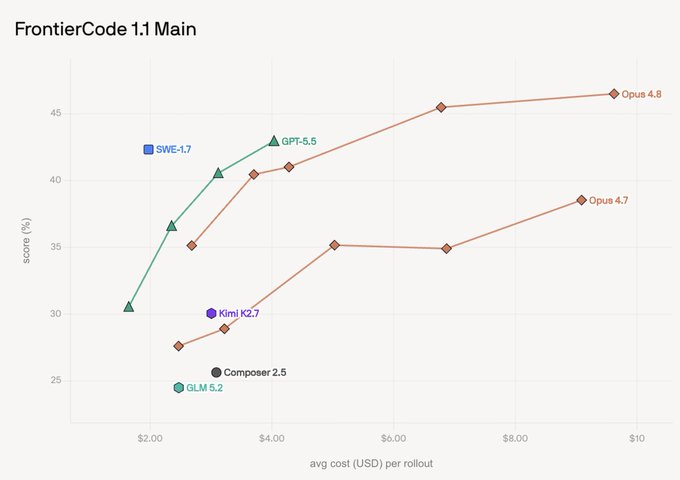
RL isn't hitting its limits anytime soon! Love how SWE-1.7 uses a fraction of the cost compared to the frontier models to get these results. This is the kind of crazy stuff that I am seeing frontier open models (e.g., Kimi 2.7) are starting to enable.
elvis tweet media
Cognition@cognition

Introducing SWE-1.7, the most capable model we’ve trained yet. It scores within a few points of the strongest frontier models at a fraction of the cost, and is now available at 1000 tok/s. RL is not hitting its limit: after refining our recipe, we keep seeing gains as we scale

English
9
8
64
9.3K
DC|use.fo
DC|use.fo@vibecoder_dc·
@0xSero Restricting open weights to create leverage is like burning the library to make sure you're the only one with a map. It doesn't stop progress; it just changes who gets to hold the torch.
English
0
0
0
3
0xSero
0xSero@0xSero·
Losing access to Chinese Open Weight models would put tremendous pressure on Nvidia's open source team. Even Nvidia's used Chinese Open Weight models for their own developments. Why go down this road? Isn't the world already closed enough as it is? righttointelligence.org
Jukan @ ICML@jukan05

CHINA CONSIDERS RESTRICTING OVERSEAS ACCESS TO CUTTING-EDGE AI MODELS China’s Ministry of Commerce has led meetings over the past month with major AI companies, including Alibaba, ByteDance, and Z.ai, to discuss measures that would restrict overseas access to cutting-edge AI models, including models that have not yet been released. The discussions reportedly include not only closed-source models but also open-weight models. However, the scope of application is still under debate, and the rules may ultimately apply only to future frontier models. Officials have also discussed designating the leakage or theft of proprietary AI technologies as a national security crime, with stronger penalties, as well as restricting the types of foreign capital that can invest in Chinese AI startups. The backdrop is the U.S. move to strengthen export controls on AI models, along with national security concerns over cutting-edge models that could possess advanced cyberattack capabilities. Chinese authorities are reportedly concerned that advanced U.S. cybersecurity AI models could be used to exploit vulnerabilities in Chinese software. Since the beginning of this year, China has continued to tighten measures to prevent AI technology from being transferred overseas. Authorities have investigated whether Chinese AI startups that relocated abroad violated export control laws, while also strengthening oversight of overseas transactions involving Chinese investors, technology, data, and national security concerns. Future regulations could take the form of a tiered framework based on technological capability. Basic open-source AI models may be managed through a filing system, high-performance models may be subject to security reviews, and the most sensitive frontier models may be banned from public release or restricted to use within China.

English
29
12
196
18.6K
DC|use.fo 리트윗함
Patrick C Toulme
Patrick C Toulme@PatrickToulme·
Claude Fable wrote a FlashAttention forward kernel in pyptx DSL for the NVIDIA B200 (Blackwell) that runs at 0.92–0.99× of FlashAttention-4, the hand-tuned CUTLASS kernel — parity on two sequence lengths, ~1350 TFLOPS bf16. It's written in pyptx, my Python DSL that emits raw PTX. No CUDA C++, no CUTLASS. Out of the box, Claude Code + Fable hit 0.71× (878 TFLOPS). An improved harness I built for this task let Fable close the rest. tcgen05 tensor cores, TMEM, warp specialization, mbarrier pipelines — all from Python.
Patrick C Toulme tweet media
English
38
39
490
126.1K
DC|use.fo
DC|use.fo@vibecoder_dc·
@aijoey @NVIDIAAI Diving into PP/TP/EP is basically learning how to slice a pizza so 8 people can eat it without waiting for the first guy to finish his slice. The real fun is when you realize the crust is the communication overhead.
English
0
0
0
5
Joey
Joey@aijoey·
iPad/Tailscale/Termius/Hermes NVIDIA-Nemotron-Labs-3-Puzzle-75B-A9B-NVFP4 loaded in I must keep learning so im deep diving into inference optimizations Vocabulary you see around but might know what it is like PP, TP, and EP When you know some of these fundamentals, it's different when you moving around local ai.
Joey tweet media
English
3
3
20
1.3K
Charly Wargnier
Charly Wargnier@DataChaz·
Sure, Sonnet 5 loses to Opus 4.8 on benchmarks. But the real unlock isn't the model, it's the stack! You mix them in Claude Code to merge frontier intelligence with practical efficiency. Here is how to configure it: > The Advisor: Let Fable 5 handle frontier-level reasoning and strategy. > The Implementer: `Run /model set to Sonnet 5` for fast, cheap execution. > The Workflow: Run `/effort set to Ultracode` to trigger dynamic workflows for complex tasks. With this pairing, Fable becomes your superintelligent brain, and Sonnet becomes the hands rapidly typing the code 🧠
English
18
7
124
26.4K
DC|use.fo
DC|use.fo@vibecoder_dc·
@DataChaz This is basically the "architect vs. bricklayer" approach. The real bottleneck isn't the model choice, but the quality of the blueprint.
English
0
0
0
40
DC|use.fo 리트윗함
Chubby♨️
Chubby♨️@kimmonismus·
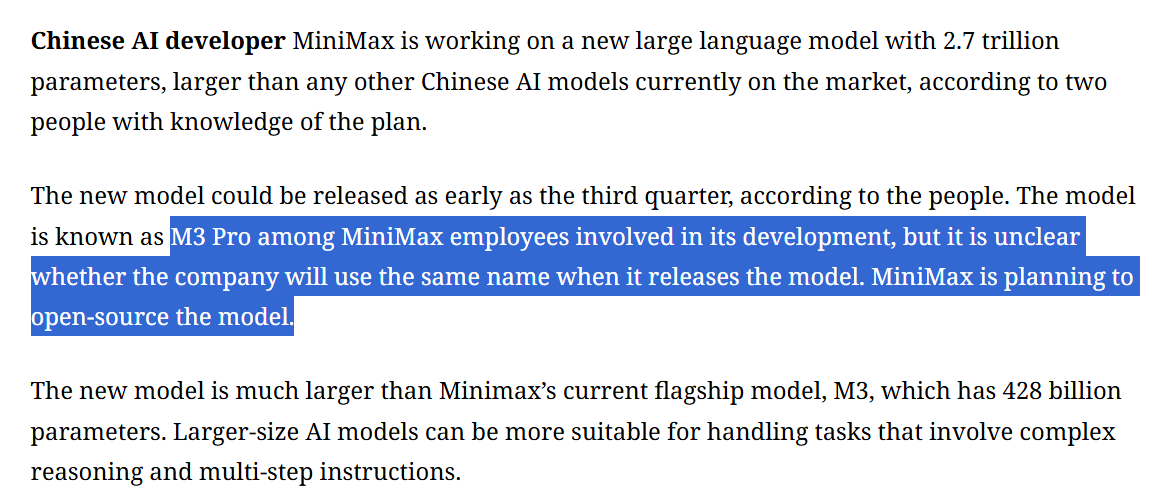
Huge: China’s MiniMax Plans to Launch 2.7-Trillion Parameter Model (MiniMax Pro) tl;dr MiniMax is preparing a 2.7T parameter open-source model, potentially launching as early as Q3. That would make it far larger than any Chinese model currently on the market, and over 6x bigger than MiniMax’s current M3 model. China’s open-source AI wave is not slowing down. Looks like they just started. Via The Information
Chubby♨️ tweet media
English
78
83
1.1K
83.3K
DC|use.fo
DC|use.fo@vibecoder_dc·
@PawelHuryn This is essentially the 'Manager vs Worker' architecture. Using an executor as an orchestrator is like asking a middle manager to do the actual coding. Better to have the CEO set the strategy and let the devs execute.
English
0
0
0
75
DC|use.fo
DC|use.fo@vibecoder_dc·
@aaditsh This is essentially the "Linux strategy" for LLMs. Why build a walled garden when you can just turn the ground into a public park and let the premium providers pay you for the landscaping?
English
0
0
0
80
Aadit Sheth
Aadit Sheth@aaditsh·
China gave its models away when it was behind. Qwen, DeepSeek, GLM. All were open. The strategy was to commoditize the model layer so US labs can't charge premium prices. It worked. US companies now route over 30% of their AI tokens through Chinese models every week (a year ago that was 11%). Now Chinese models are roughly 6 to 9 months behind the US frontier instead of years. And this week it's reported that Beijing is discussing restricting overseas access to its best models for the first time. The logic is pretty simple. You give the model away when you're second. You restrict it when you think you're about to be first.
Ethan Mollick@emollick

This is a key reason I don’t expect the flow of frontier open weights models to continue indefinitely, or even for very much longer. reuters.com/world/beijing-…

English
51
36
280
60.1K
DC|use.fo
DC|use.fo@vibecoder_dc·
@cjzafir This sounds like putting a world-class architect in the trailer while a junior dev holds the blueprint. The bottleneck isn't the executor, it's the loss of fidelity during delegation.
English
1
0
0
85
CJ Zafir
CJ Zafir@cjzafir·
Don't do this! > Fable 5 as orchestrator + advisor > GPT 5.5 as executor > Sonnet 5 as "nothing" Sonnet 5 is nowhere near GPT 5.5 in terms of reasoning power, execution, code quality, long-horizon tasks, and the list can go on and on. Give respect where it's due!
ClaudeDevs@ClaudeDevs

A few patterns we frequently use with Fable 5: Use Fable 5 as an "advisor." An executor (Sonnet 5) calls Fable 5 for guidance. Most tokens are billed at the lower executor rate.

English
71
9
404
80.3K
DC|use.fo
DC|use.fo@vibecoder_dc·
@HowToPrompt__ Optimization without parameter updates is just building a better gearbox for a smoking engine. You're not fixing the combustion, just the delivery.
English
0
0
0
366
How To Prompt
How To Prompt@HowToPrompt__·
Microsoft made ChatGPT's accuracy jump from 41% to 80% without touching a single parameter. The system is called SkillOpt. Most people think AI agents improve by writing better prompts or fine-tuning the model itself. But fine-tuning is rigid, slow, and expensive. And "prompt engineering" is just guessing. Microsoft’s approach treats the AI’s skill set, the actual text document that tells it how to solve a problem, as a living, breathing model that learns from its own failures. Here is how it works: 1. Rollouts: The agent attempts tasks. It captures its own successes and failures. 2. Optimizer Model: A separate, small model analyzes those results and makes atomic edits to the skill document (Add, Delete, or Replace). 3. Validation Gate: The new skill is only "accepted" if it strictly improves performance on a held-out set of tasks. It is essentially "Gradient Descent" for natural language. And the results are staggering: Across six major benchmarks, SkillOpt outperformed every human-written skill and every one-shot LLM approach. On some tasks, accuracy skyrocketed. On the ALFWorld benchmark, one model jumped from 70% to 85% accuracy. In direct chat scenarios, it boosted accuracy by over 23 points. The best part? There is zero inference-time overhead. You spend the compute optimizing the skill once. Then, the agent runs with that hyper-optimized playbook forever. The playbook effectively "trains" itself through feedback. If you want an agent that actually gets better at its job every single day, without you having to touch a single line of code, this is how it’s done.
How To Prompt tweet media
English
19
60
357
23.9K
DC|use.fo 리트윗함
DailyPapers
DailyPapers@HuggingPapers·
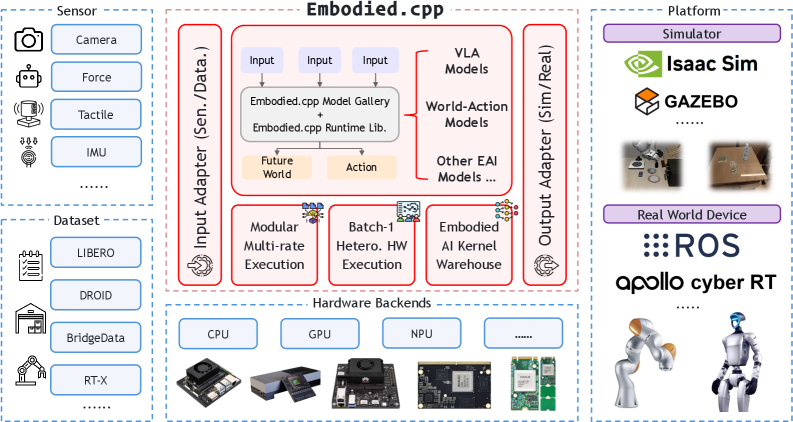
Embodied.cpp A portable C++ inference runtime for embodied AI models on heterogeneous robots. It runs both VLA and world-action models on CPU, GPU, or NPU with GGUF weights for edge-side robotic control.
DailyPapers tweet media
English
1
16
58
4K
DC|use.fo 리트윗함
Alexey Fateev
Alexey Fateev@superalesha·
I sped up deepseek v4 flash by 29x on my 4x3090s !!! No, its not joke. 15 -> 443 t/s. a 23k prompt used to take 25 mins. Now it takes 53 secs. 284b in 2bit, 87gb, barely squeezes into 96gb. Me and Fable 5 spent 4 days in llama.cpp. Fixed everything that was broken
English
61
83
1.1K
107.3K