well_actually,

2K posts

well_actually, banner
well_actually,

well_actually,

@wellactuallyaf

just a person who hates generalizations and sensationalism. let's get grounded in facts and see where they take us

가입일 Mart 2023
164 팔로잉128 팔로워
고정된 트윗
well_actually,
well_actually,@wellactuallyaf·
Words to live by. People who deal in absolutes are generally wrong, biased, and uninformed. Communication, complexity, nuance, civil debate. All keys to broader understanding and wisdom. youtu.be/85dKvletfSo

YouTube video
YouTube
English
1
0
14
1.9K
well_actually,
well_actually,@wellactuallyaf·
@TALKGlRL The way kids flaunt their use of ai these days, I think this is both a necessary and beneficial use of software to gauge the authenticity of work. It's not a privacy issue bc it only tracks in the wortware itself, not at the OS level.
English
1
0
0
11.3K
ℒ𝒶𝓊𝓇𝒶ꨄ
ℒ𝒶𝓊𝓇𝒶ꨄ@TALKGlRL·
This guy is a teacher’s assistant for a college professor and just found out something he thinks is very concerning. Your professor can now tell how many edits, pastes, and time spent doing paperwork on your computer/tablet. It can also detect if the work appears natural or if ChatGPT was used. 😳 Just by clicking a button all this info pops up! Does anyone else find this disturbing? Are college students even aware of this? Should this be allowed? I wonder if this can also be detected in high schools, middle schools, and even grade schools since they all use tablets.
English
417
534
7.2K
466.6K
well_actually,
well_actually,@wellactuallyaf·
@TheShadow_info @TALKGlRL No, it doesn't. It's typical Google workspace functionality. It's not logging keystrokes at the OS level, just in the doc itself. It's basically the same for any school/work enterprise software.
English
0
0
2
291
TheShadow.info #DefundTheMedia
TheShadow.info #DefundTheMedia@TheShadow_info·
This means that a KEYSTROKE LOGGER had been installed and is being used. Did the students approve this for installation on their machines? If the student is under 18, did the PARENT approve this? Is the keystroke logger a part of the writing program or has it been installed as part of the operating system? What guarantees exist to ensure that the keystroke logger is not actively storing passwords and other data?
English
16
7
262
46.4K
Matt Cloud
Matt Cloud@realmattcloud·
@wellactuallyaf @WadeMiller And the idea that the 19th century was less tribal, less nationalistic -- less racist if you must -- is a pure canard the the Left must invent in this case solely because the actual laws utterly do not support their wished-for understanding.
Matt Cloud tweet media
English
1
0
0
17
Wade Miller
Wade Miller@WadeMiller·
I fall into the camp that the Constitution and text of the 14A clearly don’t extend citizenship to those here illegally as they are not subject to the political jurisdiction of the United States, nor do they owe allegiance to the United States, and absent any statutory provision otherwise stating as such, the President is clearly empowered to enforce the Constitution as written and not extend citizenship to the children of those here illegally.
Joshua J. Prince@JoshuaJPrince

FWIW I fall into the seemingly small camp that thinks that birthright citizenship is probably required by the text of the 14A while also being a horrible policy if it extends to the children of illegal immigrants or people on vacation.

English
3
5
20
1K
well_actually,
well_actually,@wellactuallyaf·
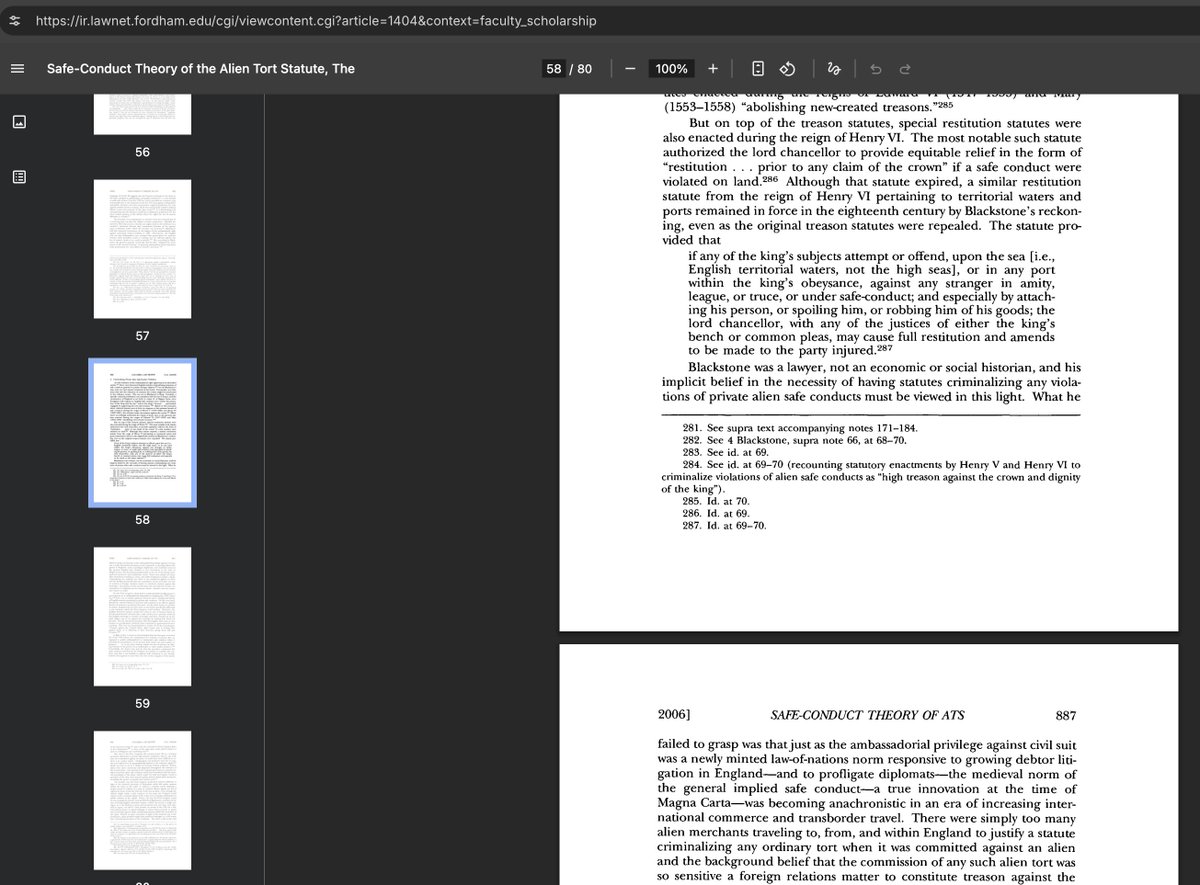
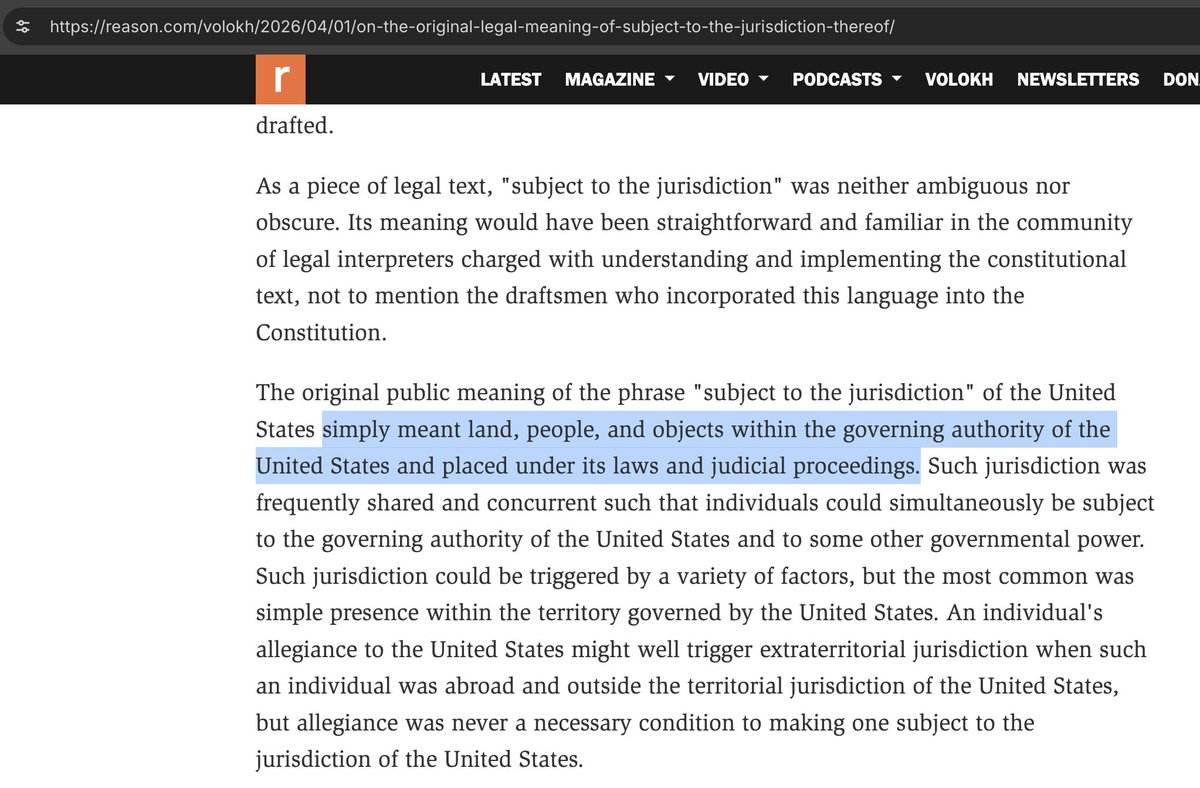
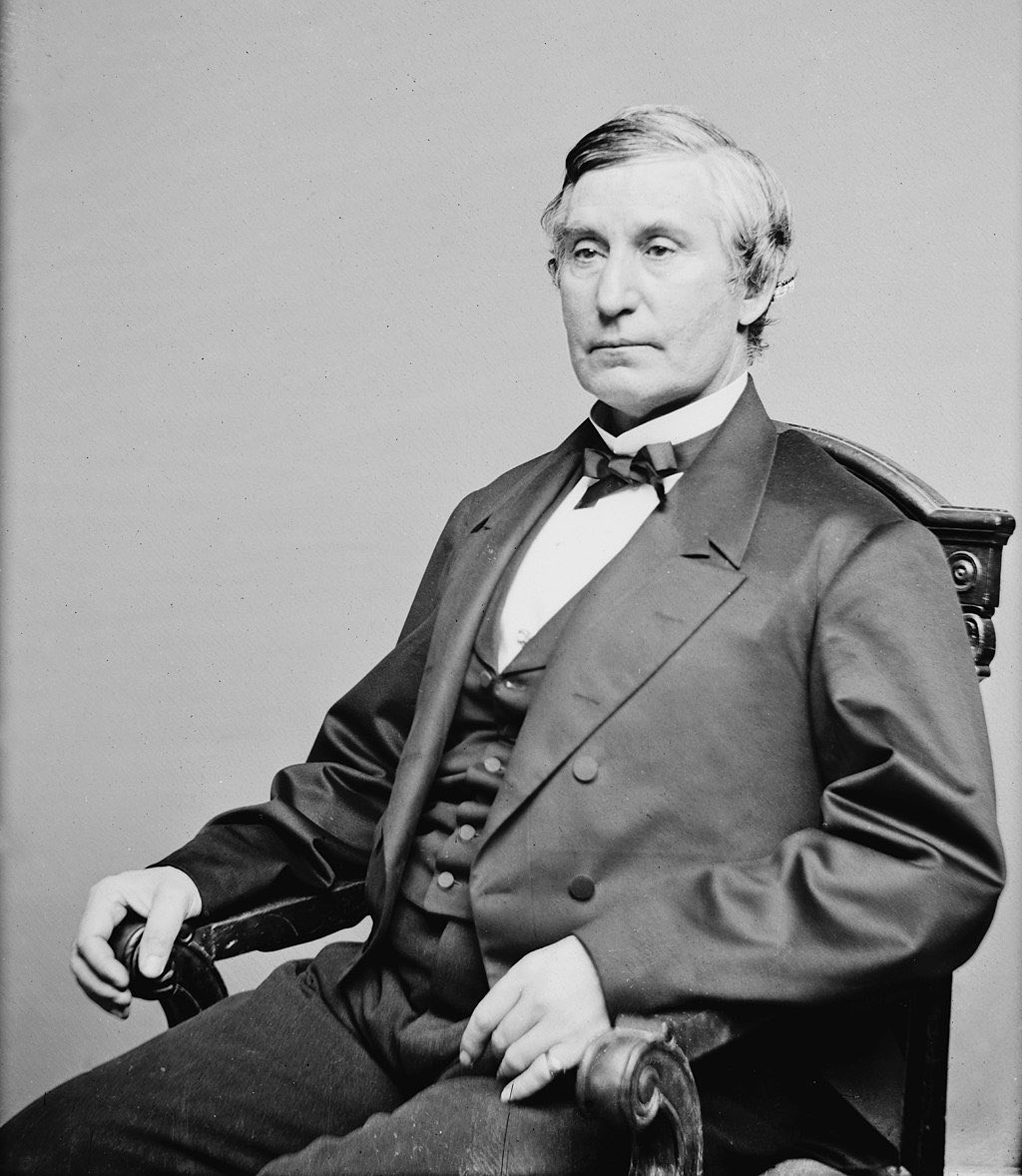
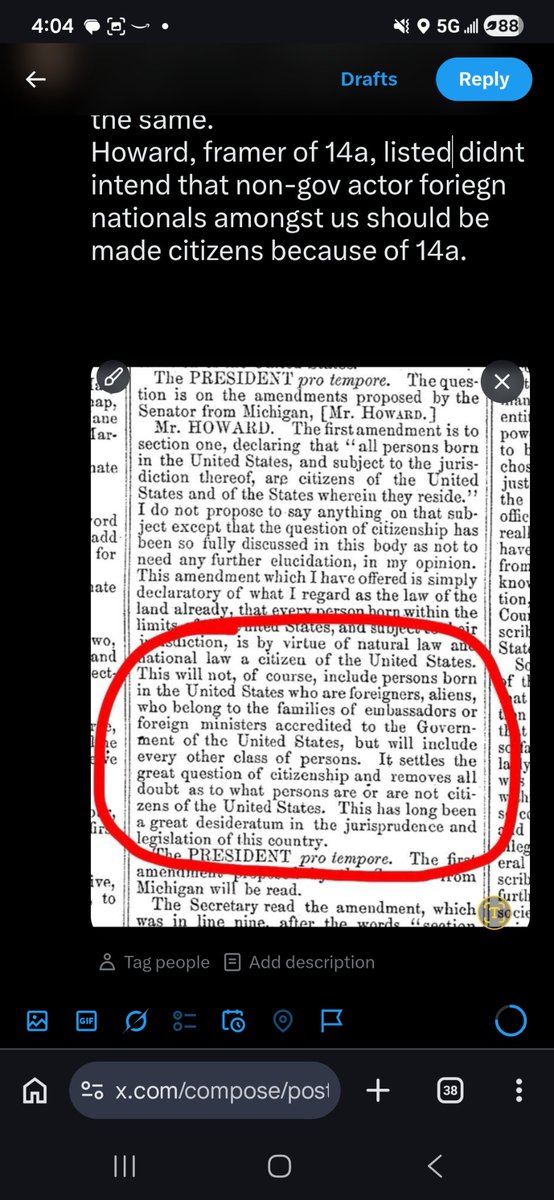
Please. I beg you. Read the Wong Kim Ark decision. Justice Gray painstakingly traces the the common law from Calvins Case, to the pre-Revolution colonies, post-Constitution and up to and through ratification. He looks at cases in England, in state courts and in federal courts. When you look at those sources and those contemporaneous with the drafting, the only intellectually honest outcome is that 14A conferred birthright citizenship to all persons save the carve outs. That doesn't mean it's good public policy, either then or today. It doesn't mean I support that policy. All I'm saying is that the law seems pretty clear on this one given all tools of interpretation. And that's all I have to say on the subject.
well_actually, tweet mediawell_actually, tweet mediawell_actually, tweet mediawell_actually, tweet media
English
2
0
0
31
Matt Cloud
Matt Cloud@realmattcloud·
@wellactuallyaf @WadeMiller This is you: "The Framers wrote "subject to the jurisdiction thereof," a phrase with a precise common law meaning they knew exactly." Let's start over: Where do you come off asserting this? From whence do you gain this awareness, this knowledge?
English
2
0
0
23
well_actually,
well_actually,@wellactuallyaf·
Within the jurisdiction is a unilateral relationship with the sovereign: a person in the territory is granted protections regardless of class, i.e. includes diplomats, Natives. Subject to is the reciprocal relationship with the sovereign: a person is bound by the laws of the territory and gets the protections, which excludes diplomats, Natives. The convention minutes cut both ways. If your judicial theory includes congressional intent, you could find support either way. But if you're a textualist/originalist in the Scalia camp, you don't give much weight to any of it and instead focus on plain meaning and precedent.
English
0
0
0
3
Wade Miller
Wade Miller@WadeMiller·
The people who wrote this spoke about it at length. To qualify they must be “subject to the jurisdiction” thereof but later discussed application of due process to those “within the jurisdiction”. Why not just say “subject to the justification” again? Based on the commentary of those who drafted the 14th amendment, it’s pretty clear that they thought the application of citizen at birth would be to those who owed allegiance to the United States, those who were under the political jurisdiction of the United States, and for those who are citizens, within the territorial jurisdiction of the United States or the various states, the application of the law should be the same. But also, I don’t care, it’s basic common sense that can easily be applied to the existing language of the constitution without any changes and it’s absolutely idiotic to say that those here illegally can just produce citizens.
English
1
0
0
8
well_actually,
well_actually,@wellactuallyaf·
Lol that blather has underpinned a lot of recent decisions. Precise is always tough, but best bet is a treatise or commentary. For example, this is from Blackstone's Commentaries 1757. Also, Gray in WKA gives a pretty good historical account, tracing it from Calvin's Case through ratification.
well_actually, tweet media
English
2
0
0
75
Matt Cloud
Matt Cloud@realmattcloud·
@wellactuallyaf @WadeMiller Where, pre-14th amendment, may I find the precise common law meaning of "subject to the jurisdiction thereof?" In the attached, e.g., it is merely asserted. Can you do any better? Also, your blather about the constitution and the exec is just that.
Matt Cloud tweet media
English
1
0
0
36
well_actually,
well_actually,@wellactuallyaf·
The first question is irrelevant because 14A1 is an affirmative grant. The second question is key. The reciprocal relationship is being compelled to follow laws of the jurisdiction and receiving its protections in return. Diplomats are not bound by the laws of the jurisdiction but they are present and receive protections. That's the distinction between "subject to" and "within".
English
1
0
0
25
Balsamicshoe
Balsamicshoe@balsamicshoe·
@wellactuallyaf @WadeMiller In what scenario would the child of a foreign national be denied citizenship from the parents home country? They wouldn't be stateless and owe allegiances to those nations. What reciprocal duties exist for illegal foreign nationals with no relationship with the US government?
English
1
0
0
10
well_actually,
well_actually,@wellactuallyaf·
I agree the textual distinction is real but not that political jurisdiction follows from it. "Subject to" tracks the post-Revolution common law conception of allegiance: reciprocal duties to and protections from the sovereign. The carve-out is for those physically present but legally exempt from that reciprocal relationship, eg diplomats. "Within the jurisdiction" in the due process clause triggers protection without the reciprocal duty. That contrast confirms the framework IMHO: one clause is purely territorial, the other the common law allegiance concept.
English
1
0
0
33
Balsamicshoe
Balsamicshoe@balsamicshoe·
@wellactuallyaf @WadeMiller Political jurisdiction is what makes sense based on context. In the due process clause of 14A section 1 it says "within the jurisdiction" signalling a reference to the territory. Similar contexts are used elsewhere in the Constitution differentiating the two contexts.
English
2
0
1
26
well_actually,
well_actually,@wellactuallyaf·
@MartyBent KBJ has said a lot of questionable things. This is not one of them. And it was in the context of territorial allegiance vis-a-vis subject to the jurisdiction thereof
English
0
0
0
30
Ryan S. Walters
Ryan S. Walters@ryanswalters73·
It’s so simple, only a complete moron, or TDS leftist, could possibly misunderstand it. A simple understanding of language, punctuation, and sentence structure helps too. Senator Jacob Howard of Michigan introduced the 14th amendment and said this: "This amendment which I have offered, is simply declaratory of what I regard as the law of the land already, that every person born within the limits of the United States, and subject to their jurisdiction, is by virtue of natural law and national law a citizen of the United States. This will not, of course, include persons born in the United States who are foreigners, aliens, who belong to the families of ambassadors or foreign ministers accredited to the Government of the United States, but will include every other class of persons."
Ryan S. Walters tweet media
English
404
2.7K
6.2K
147.9K
well_actually,
well_actually,@wellactuallyaf·
@SCubed285093 @neoavatara Even Black in 1910 requires repudiation of allegiance for BC to not apply. And importantly, says that a child can become a citizen even when the parents have no path to naturalization.
well_actually, tweet media
English
1
0
0
4
S Cubed
S Cubed@SCubed285093·
@wellactuallyaf @neoavatara Sorry again. Black's discussion of how temporary residents don't qualify for BC for their children is from his 1910 Handbook of Constitutional Law.
English
1
0
0
9
Pradheep J. Shanker, M.D.
Pradheep J. Shanker, M.D.@neoavatara·
KBJ points out that common law in England defines allegiance simply that the laws apply to them...Sauer is trying to argue otherwise. KBJ is actually out debating Sauer. That is...well, very sad. She is right though: Wade, at the time of the #14A debate, says clearly that birthright citizenship is the standard.
English
2
1
28
3.4K
well_actually,
well_actually,@wellactuallyaf·
I don't see the tension here. No contradiction. The normative foundation point is about legitimacy: why the rule binds us. The jus soli point is about what the rule is. Popular sovereignty replaced feudal allegiance to the king as the basis of government. The territorial allocation mechanism survived intact. Those are two different questions.
English
1
0
0
24
Matt Cloud
Matt Cloud@realmattcloud·
@wellactuallyaf @ilan_wurman Make up your mind. "Same surface rule, completely different normative foundation" or "Subject to the jurisdiction thereof" is not a filter layered on top of jus soli. It is jus soli."
English
1
0
0
32
Ilan Wurman
Ilan Wurman@ilan_wurman·
People are making fun of Justice Jackson for this. But — and given how supportive I’ve been of the Trump Administration on this issue, I think I’m qualified to say this — Jackson was quite sharp at the argument and does in fact understand the issue. The problem is that in the 19th century allegiance had a dual meaning. It meant loyalty and faith, but it also meant being within the sovereign’s power. So in her hypothetical the individual would in fact owe allegiance in the sense of an obligation not to violate the law. That the violation occurred is irrelevant. Allegiance was owed which is why the sovereign can punish the visitor. If that’s the sense in which the drafters were using allegiance, and if that is all that is required for jurisdiction, then the government has a harder argument. But either way, the drafters told us they meant a complete jurisdiction. So even if the visitor to Japan has some kind of allegiance, it wouldn’t necessarily be a complete one in the sense of the amendment.
Election Wizard@ElectionWiz

KBJ: "If I steal a wallet in Japan, I am subject to Japanese laws…in a sense, it's allegiance."

English
132
38
951
592.7K
well_actually,
well_actually,@wellactuallyaf·
@SCubed285093 @neoavatara I think you're confused. Blackstone wrote the commentaries on English common law that basically served as the legal textbook to the Framers and basically all lawyers and judges even after the Revolution. The Cooley edition in 1871 makes no mention of domicile vis-a-vis BC
English
1
0
0
16
S Cubed
S Cubed@SCubed285093·
@wellactuallyaf @neoavatara The early 1900s Blackstone specifically denied BC to people without permanent domicile. Gray had to specifically mention that as a condition for Kim's citizenship in the holding.
English
1
0
0
19
well_actually,
well_actually,@wellactuallyaf·
Every American legal system except Louisiana's is built on English common law. That is not a coincidence or a preference. It is the jurisprudential water the Framers swam in. Common law recognized two forms of allegiance: personal allegiance to the sovereign, and territorial allegiance arising automatically from presence under the sovereign's protection. The Revolution eliminated the first. It retained the second. "Subject to the jurisdiction thereof" is that second concept, translated into constitutional text. This is not a novel reading. It is what Gray held in Wong Kim Ark, tracing an unbroken line from Calvin's Case through Blackstone directly into the 14th Amendment.
English
1
0
0
17
S Cubed
S Cubed@SCubed285093·
@neoavatara Its ridiculous to believe we'd use English allegiance definition when the whole revolution was directly counter to that definition
English
3
0
0
115
well_actually,
well_actually,@wellactuallyaf·
@DefiyantlyFree That wouldn't carve out diplomatic immunity (intl law) and Native Americans (treaties). It's really that simple.
English
0
0
4
95
Insurrection Barbie
Insurrection Barbie@DefiyantlyFree·
“All persons born or naturalized in the United States, and subject to the jurisdiction thereof.” If the founders supported birthright citizenship they would have written it as follows: “All persons born or naturalized in the United States.” It’s really that simple.
English
128
351
2K
22.1K
well_actually,
well_actually,@wellactuallyaf·
@JackPosobiec The 1924 superceded treaties between Indians and the Fed Govt. Just like international law was the basis for the diplomatic immunity carve out. No such superceding law applies to illegals.
English
0
0
1
188
Jack Posobiec
Jack Posobiec@JackPosobiec·
American Indians were not granted US citizenship by the 14th Amendment. It took another law for that. By this understanding, the 14th Amendment clearly cannot apply to illegal aliens
English
121
1.9K
10.7K
87.1K
well_actually,
well_actually,@wellactuallyaf·
Appreciate the attempt but you're not on the money. The Howard, Trumbull, and Bingham quotes are sources of intent, but you failed to contextualize: each of these quotes is specifically in reference to diplomatic immunity and NAs, carve outs based on intl law and treaties. And if allegiance is the operative concept, and allegiance under the common law tradition is territorial and reciprocal (protection in exchange for obedience), then an undocumented immigrant present on U.S. soil, subject to U.S. criminal law, entitled to U.S. courts, owes exactly the local allegiance the common law described.
English
1
0
3
129
Mark McEathron
Mark McEathron@Mark_McEathron·
A little history on the 14th Amendment and the "birthright citizenship" clause. I'm reminded that a lot of people do not know the process involved in bringing an amendment from concept to to ratification and law, or why that process matters. Jacob Howard (Senate) and John Bingham (House) were the two guys that drafted and presented the proposed amendment to Congress. Once submitted, there is debate. Members of Congress express concerns, propose changes, and so on. These debates are recorded for posterity to look back upon to better understand what the legislation is intended to do. Then, once Congress passes it and presents it to the States, there is the Ratification Process in which each State can debate and present their concerns. This leaves us with a tremendous record of why specific words and phrases were chosen and what the intent was. It informs the voters on exactly what the law means, straight from the framers of it, so that there is no confusion. This is why originalism is preferred to textualism. The law can only mean what it meant when it was adopted. Altering the meaning and intent of the law is altering the law itself and subverts the legislative process. Courts do not have that power. Sadly, that hasn't stopped courts from usurping that power. In the Ratification process, the very questions being argued before SCOTUS today, were addressed unequivocally. When asked if the amendment applies to foreigners, the framers themselves had this to say, explicitly: Howard said: “This amendment… declares that all persons born in the United States, and subject to the jurisdiction thereof, are citizens…” Then he immediately defines the limitation: “This will not, of course, include persons born in the United States who are foreigners, aliens, who belong to the families of ambassadors or foreign ministers…” That is the understanding of the law as it was ratified. That is what We The People voted to enact. Furthermore, they went even deeper on what "subject to the jurisdiction" explicitly meant: Howard described jurisdiction as: “Full and complete jurisdiction… not owing allegiance to anybody else.” Allegiance. That was the crux of the debate and understanding. For those born here from citizens of another Nation: “They are subject to the jurisdiction of the United States in a certain sense, but not in the full and complete sense.” - Howard Full and complete. That's what makes someone subject to the jurisdiction. “Subject to the jurisdiction thereof” means “not owing allegiance to anybody else.” - Senator Lyman Trumbull at the ratification debates They explicitly rejected absolute jus soli (citizenship by soil alone). In the case of United States v. Wong Kim Ark., the court applied the English Common law standard of jus soli, flagarently against Congress's explicit rejection of it during ratification. The court rejected originalism in favor of textualism. As a result, this Nation ended up with a very different legal structure than the Constitution created. The bottom line is that the 14th Amendment did not establish birthright citizenship. It ensured that due process and the rights and privileges in the States are preserved. If you listen to the oral arguments before the court today, I expect that you'll see this argument put forth. Allegiance, not presence, determines citizenship.
English
56
157
494
17.5K
well_actually,
well_actually,@wellactuallyaf·
@cmfuller_23 @HansMahncke People need to work on reading comp when they post this. Please look at the syntax of the sentence to realize this is consistent w text of the amendment and closer to birthright arguments
English
0
0
0
13
Christine Fuller
Christine Fuller@cmfuller_23·
@HansMahncke Its actually more telltale of what their purpose was. They were ..like..'its a given that we dont intend to include physically present foreign nationals'. They certainly did intend 2 impose federal & state citizenship of CW-13a liberated blacks on US States.
Christine Fuller tweet media
English
1
0
1
296
Hans Mahncke
Hans Mahncke@HansMahncke·
“All persons born or naturalized in the United States, and subject to the jurisdiction thereof, are citizens of the United States and of the State wherein they reside.” Most of the 14th amendment debate fixates on “subject to the jurisdiction thereof,” on the assumption that it must be doing meaningful work, and that is true. But the more you read the sentence, the more it becomes obvious that the real key word is “reside.” The way it’s placed almost makes it look like an afterthought, which is probably why it hasn’t received much attention. But when examined closely, any honest reader would firmly conclude that birthright citizenship is meant for residents, not illegal aliens or tourists.
English
120
128
588
34.8K
well_actually,
well_actually,@wellactuallyaf·
@HansMahncke Until you do a modicum of legal research and realize that reside is an incredibly low bar. Legally just means physical presence in a place w some degree of continuity. You can have multiple residences. Much lower standard than domicile, for example.
English
0
0
2
212