Sagar 🇮🇳 retweetledi
Sagar 🇮🇳
18.4K posts

Sagar 🇮🇳
@0xSaagar
crypto since 2015 | $PEPE 🐸💚 @pepecoineth | @WazirXIndia hack victim
Cryptoverse Katılım Mart 2024
1.7K Takip Edilen435 Takipçiler
Sagar 🇮🇳 retweetledi

#Tron $TRX 1W - This is the most impressive chart in crypto right now 👀
Clear 'Up Only' since the 2022 Bear Market Bottom!
And it's currently breaking out of a giant Ascending Triangle 📈🙈

English
Sagar 🇮🇳 retweetledi

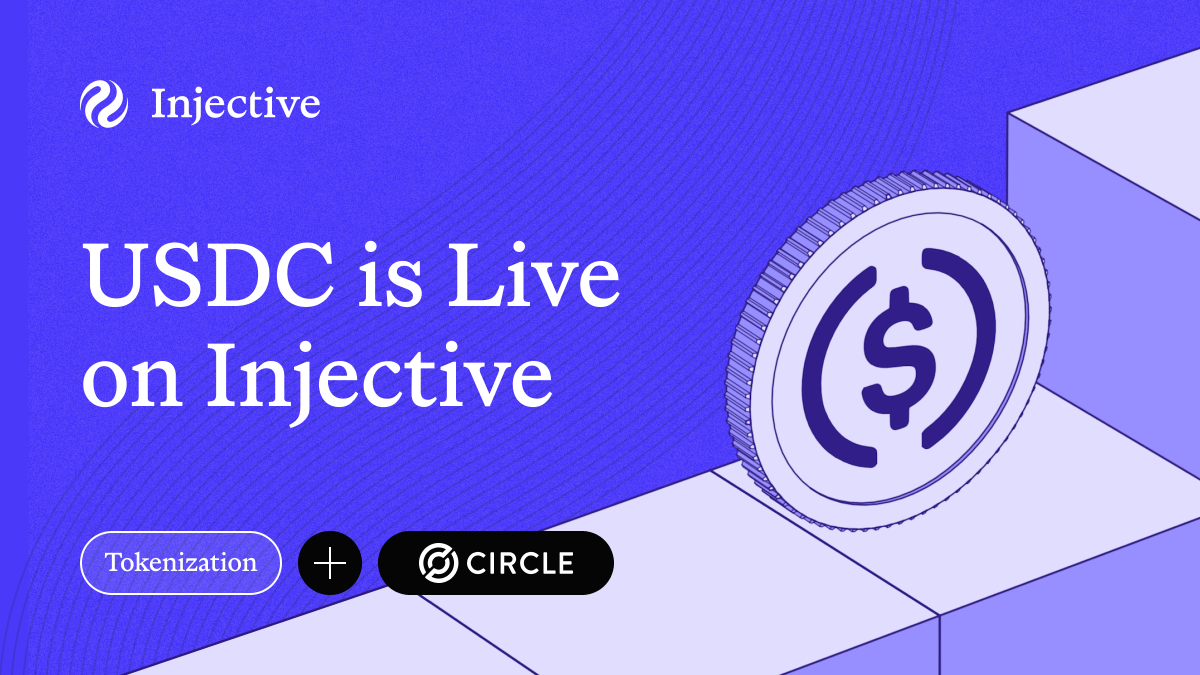
Native USDC is officially live on Injective.
$77 Billion in regulated stablecoin liquidity from Circle can now be utilized to access Injective's tokenized stocks alongside Pre-IPO assets like @SpaceX.
A new stablecoin universe is being created.
Powered by $INJ

English
Sagar 🇮🇳 retweetledi

Tokenized equities are having their breakout moment.
The category reached roughly $1.5 billion in May, up from under $300 million a year ago.
On May 20, tokenized stocks set a record at $3.57 billion in daily trading volume, with Circle and Strategy leading the move onchain.
This is the category Injective was built for, bringing tokenized equities onchain as programmable markets, now settling in native $USDC after Circle's May Injective mainnet launch.
Equities are the next trillion-dollar asset class to move onchain. Injective is creating the most performant infrastructure to get it done.

English
Sagar 🇮🇳 retweetledi

Jumaben Marwadi's husband Kalaji had a life insurance policy with HDFC Life.
HDFC Life — the flagship insurance arm of India's largest private bank. A company that runs full-page ads about protecting your family.
When Kalaji died, Jumaben filed the claim.
HDFC Life's answer: rejected.
Their reason: he had visited a doctor once, years before the policy. They called it suppression of material facts.
The sum assured: ₹25 lakh.
This is how claim repudiation works in India.
The company collects premiums for years without questioning anything.
The moment a claim comes — after a death, after a trauma, after a family is already broken — they send investigators. They pull hospital records. They look for any prescription, any visit, any entry in a register.
And then they find one. And they say: you lied.
The "evidence" HDFC Life produced was a single prescription dated January 17, 2012, from one Dr. Ramesh M. Vakharia.
One prescription. Years old. No diagnosis of a serious, life-altering disease. No pattern. No treatment history.
On the basis of this, they told a widow: your husband concealed facts. We owe you nothing.
Jumaben took them to the NCDRC.
The Commission looked at what HDFC Life actually had. One prescription. That's it.
The NCDRC ruled that the insurer had failed to prove any suppression of material facts by the deceased policyholder Kalaji Bhikhaji Marwadi, and that the repudiation of Jumaben Kalaji Marwadi's claim amounted to deficiency in service.
The Commission cited the Supreme Court's own ruling in LIC vs. GM Channabasamma (1991):
"Suppression of material facts with respect to pre-existing ailments entitles the insurance company to repudiate the claim, but the onus to prove suppression of such material facts lies on the Insurance Company."
HDFC Life had not met that burden. A single, old prescription is not proof. It is a fishing expedition.
HDFC Life was directed to pay ₹25 lakh — the full sum assured — along with compensation and litigation costs.
This is a company that managed ₹2.5+ lakh crore in assets at the time of this case.
They had every resource to verify his health at the time of policy issuance. They chose to collect premiums instead. And investigate only after the death.
One policy. One prescription. One widow who made them prove it in court.
Save this —
If a life insurer rejects your family's death claim citing "non-disclosure," demand: what exactly did they suppress? Show the medical evidence.
The burden of proof is on the insurance company — not on your grieving family. Indian courts have said this, repeatedly, at the highest level.
Source: Jumaben Kalaji Marwadi vs. HDFC Standard Life Insurance Company, NCDRC — reported by Moneylife
English
Sagar 🇮🇳 retweetledi

🙏 Our community request to the Finance Minister to change the current crypto tax rules:
❌ Current Rules:
1. Flat 30% Tax
2. 1% TDS
3. No loss setoff
4. Cost of acquisition undefined
✅ Community Proposal:
1. Tax in slabs like salary income
2. No TDS or 0.01% TDS
3. Allow loss setoff
#ReduceCryptoTax! 🚀💰
English
Sagar 🇮🇳 retweetledi

Anil Kumar Patel was from Kheda, Gujarat.
He had nine life insurance policies with LIC — India's largest insurer, a company owned by the Government of India, backed by a sovereign guarantee and decades of public trust. Total claim denied: ₹47.90 lakh.
He died of a heart attack, roughly two years after taking the policies.
His family filed claims on all nine.
LIC rejected every single one.
LIC's argument: Anil Kumar Patel had not disclosed material facts at the time of policy issuance.
The Life Insurance Corporation of India had provided nine life insurance policies to Anil Kumar Patel, a native of Kheda, Gujarat. After Mr. Patel passed away, his heirs properly submitted claims for each of the policies. LIC denied all claims on the ground that material facts had been suppressed.
Nine policies. Nine rejections. One family.
The family went to the District Consumer Forum in Kheda.
The District Forum partially ruled in their favour.
LIC wasn't satisfied. They appealed to the Gujarat State Consumer Disputes Redressal Commission.
The State Commission upheld the original ruling.
LIC still wasn't satisfied. They went to the NCDRC — the apex consumer court.
At the NCDRC, LIC made a technical argument: the family should have produced an affidavit from the treating physician to prove there was no suppression.
The Commission dismissed this.
The NCDRC stated that an affidavit from the physician is not required when the insured party has given the insurance company permission to obtain medical records from hospitals.
LIC had the authorisation. They had the means. They chose not to verify at the time of issuance.
The NCDRC bench comprising Inder Jit Singh (Presiding Member) dismissed LIC's appeal and ordered it to pay ₹47.90 lakh to the nominees of the complainant.
Three levels of consumer courts. Three rulings against LIC.
The country's largest insurer — with over 1 lakh employees and crores in annual advertising budget — fought a family from Kheda, Gujarat all the way to the apex consumer court.
And lost. At every stage.
There is a pattern worth naming here.
LIC collects premiums. Issues policies. Takes authorisations to access medical records. And then — only after a death — decides to investigate whether facts were suppressed.
The courts have a word for this: deficiency in service.
One family from Kheda. Nine policies. Three courts. Zero justice from LIC — until a judge said enough.
Save this —
If LIC or any insurer rejects a death claim citing "non-disclosure," check: did they actually investigate before issuing the policy?
If they had authorisation to pull medical records and chose not to — courts have ruled they cannot use that same gap against your family years later. The right to investigate belongs to them at issuance, not at death.
Source: Life Insurance Corporation of India vs. Dr. Nilam Hetalkumar Patel & 4 Ors., NCDRC, October 2023 — reported by LiveLaw
English
Sagar 🇮🇳 retweetledi

THIS IS INSANE 🚨
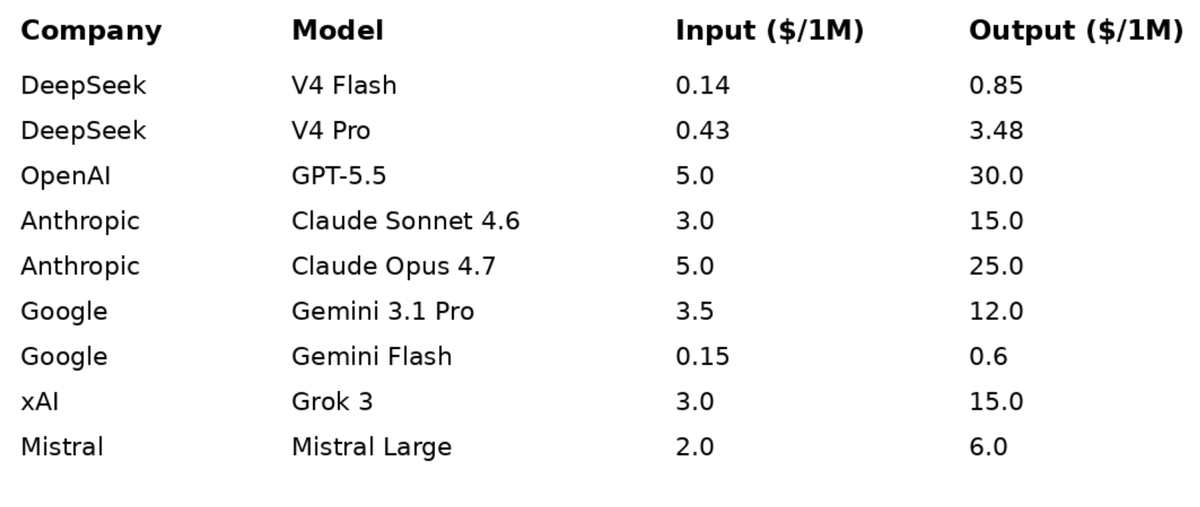
DeepSeek is now up to 50x CHEAPER than OpenAI and Anthropic for AI tokens.
DeepSeek’s latest permanent 75% price cut pushed some inference costs down to fractions of a cent per million tokens.
AI companies charge based on input tokens, output tokens, cached tokens and reasoning tokens.
1 BILLION output tokens costs approximately, $3,480 in DeepSeek, $30,000 in OpenAI GPT-5.5 and $15,000 in Claude Sonnet.
That’s why enterprises are panicking, A coding agent can burn millions of tokens PER DAY.
If 10,000 engineers each consume 10 million AI tokens per day, annual costs could range from just MILLIONS with DeepSeek to BILLIONS with OpenAI or Anthropic models.
Microsoft is reportedly cancelling most Claude Code licenses internally and pushing engineers toward its own cheaper GitHub Copilot tools instead, while Uber already used it's entire year AI budget by April due to heavy usage by it's engineers.
The smarter AI models become, the longer they think, the more tokens they generate and the more compute they burn.
Reasoning AI models secretly generate massive internal tokens before replying, meaning a visible 5,000 token response can actually consume 20,000 to 100,000+ effective reasoning tokens. That’s why OpenAI is pushing mini models, Google is pushing Flash and Anthropic is aggressively optimizing token caching.
The biggest problem with AI may not be how smart it is, but how expensive it becomes at scale. In the future, the winners may be the companies that offer good enough AI at the cheapest cost.


English
Sagar 🇮🇳 retweetledi

🚨 Crude Oil 🛢️Down 25% From Highs. But Indian Stock Market Failed To Recover Still Negative (-12% Return) YTD.
This Clearly Indicates Problem Is Not Oil , Not War , Not Global Issue.
Problem Is within Indian 🇮🇳 Stock Market Tax Structure. LTCG , STCG .
Till Rates Are High . Recovery Is Not Possible.
Those Who Think Market Will Recover Once War Settles Is Day Dreaming 💭.
English
Sagar 🇮🇳 retweetledi

We just launched a brand new site dedicated to help you launch onchain AI agents that allow you to earn on autopilot.
Build an onchain agent in minutes. Let it auto trade, route, and execute strategies while you sleep.
Only possible on Injective.
agents.injective.com
English
Sagar 🇮🇳 retweetledi

Bitcoin Weekly Analysis: May 25
The chart is forming a rising channel after bottoming near $60,000.
Higher highs. Higher lows. Bulls stay in control as long as $74,000 holds.
But here's the other side. $BTC just got rejected at the top of the channel, right at the daily 200 MA, the most important level.
Two scenarios from here:
If $74,000 holds, the structure stays bullish. Next resistance is $83,000. Break that with volume and the door opens back toward $90k-$98k
If $74,000 breaks, next support is $70,000 and if the channel fully collapses, $60,000 is next, which erases the entire recovery.
Here's the deeper signal nobody is talking about:
The $BTC-to-Nasdaq ratio is stuck at 2.70 and can't break above 3.0. Every time it tries, it gets rejected.
$BTC isn't leading this market, It's following Nasdaq. Until it breaks the 3.0 ratio and starts outperforming tech stocks, the real bull run hasn't started yet.
$74,000 is the key support to hold.
$83,000 is the key resistance to break.

English
Sagar 🇮🇳 retweetledi

BREAKING: President Trump says Iran negotiations are “proceeding nicely” and warns it’s either a “Great Deal” or “back to the battlefront.”
Trump is now pushing for a massive Middle East agreement tied to the Abraham Accords. He says Saudi Arabia, Qatar, Pakistan, Türkiye, Egypt, Jordan, Bahrain and potentially even Iran could join.
Trump called it a potential “historic world coalition” that would unite the Middle East economically and politically for the first time in modern history.


English
Sagar 🇮🇳 retweetledi

AI agents are growing fast, but their real value comes when they can take meaningful actions onchain.
That’s what makes @injective Agents interesting for builders.
Developers can register agents, give them on-chain identities, trade through Injective’s order book, set fee recipient addresses, and automate revenue flows directly to their wallets. It goes beyond the usual “AI + crypto” narrative by giving agents real market access and built-in monetization.
Builders can also use tools like the MCP Server, Injective Trader SDK, and INJ/USDT Grid Trader as starting points for creating custom trading agents.
With an on-chain order book, sub-cent costs, no AMM slippage, and infrastructure built for performance, Injective Agents creates a strong foundation for the next wave of autonomous finance apps.
Get started: agents.injective.com

English
Sagar 🇮🇳 retweetledi

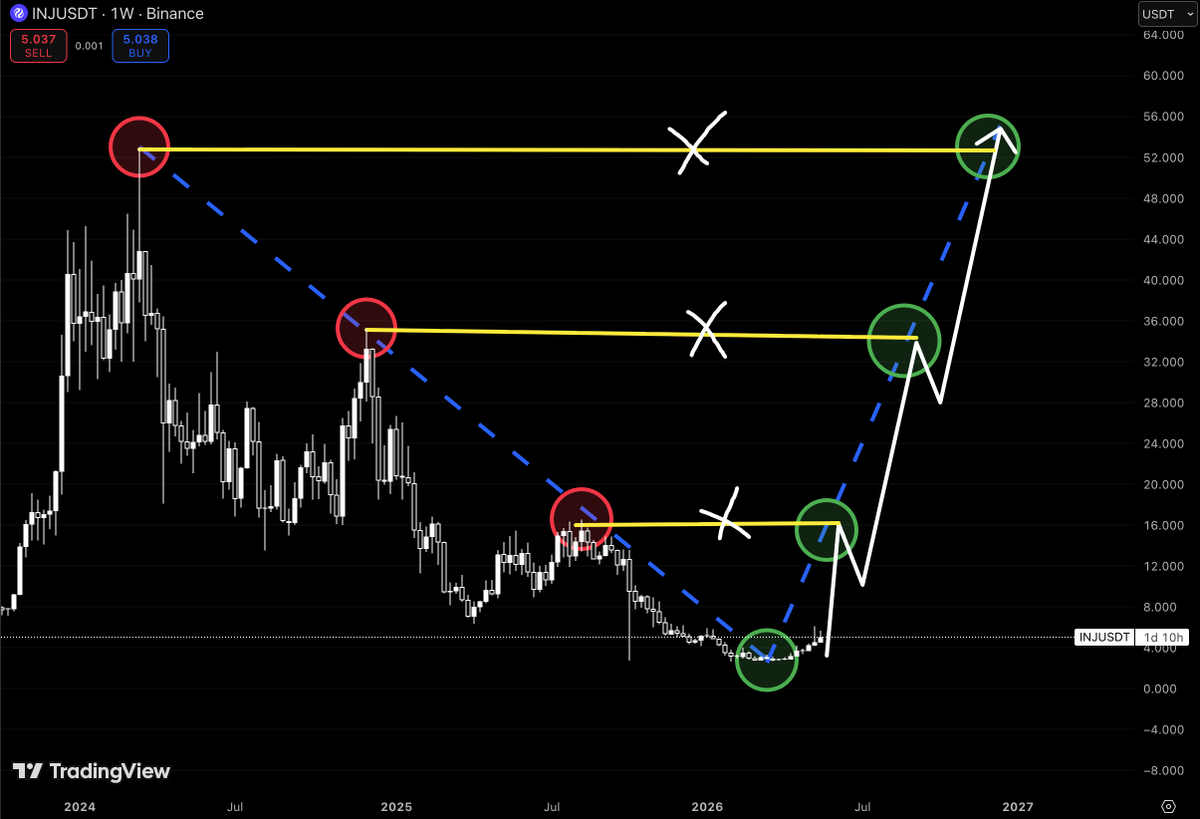
$INJ has one of the cleanest “cycle reset” structures on the chart right now
Every major rally got rejected almost perfectly at lower highs:
$52 → $35 → $16
But now the pattern starts flipping for the first time
Instead of creating another lower high, price is trying to build from a higher low near the $3–4 zone and that’s usually where trend reversals begin
What makes this setup powerful is the symmetry:
Previous resistance zones now become future expansion targets
$16 = first real breakout confirmation
$35 = momentum phase
$52+ = full macro recovery toward previous cycle highs
And unlike random low caps, INJ already proved it can attract massive liquidity during bullish conditions
That matters
Because once strong narratives return to AI, DeFi, and on-chain infrastructure, charts with prior leadership tend to move first and hardest
Right now the market still sees $INJ as “dead compared to ATH”
But structurally, this looks much closer to accumulation than collapse

English
Sagar 🇮🇳 retweetledi