LAMI

1.3K posts

LAMI banner
LAMI

LAMI

@0x_Lamiya

Exploring Web3 protocols

sauth asia Katılım Ağustos 2023
476 Takip Edilen256 Takipçiler
LAMI
LAMI@0x_Lamiya·
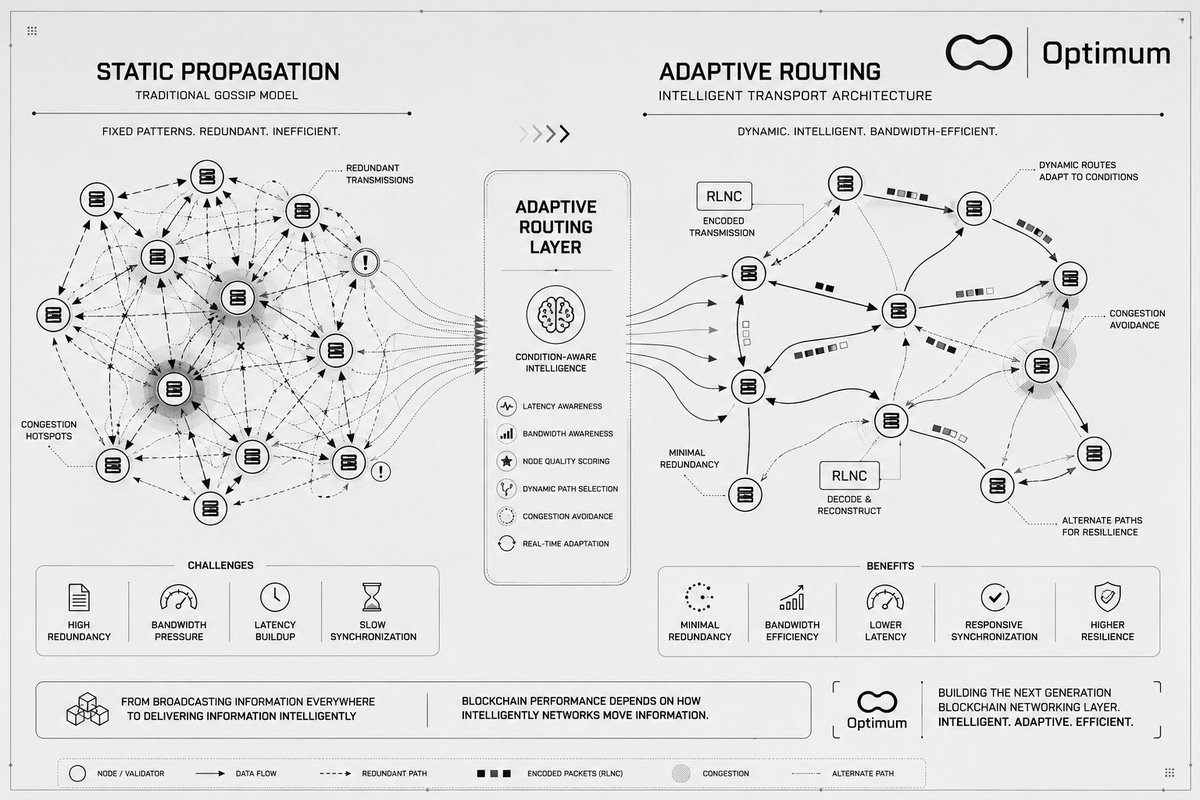
Most blockchain networks still propagate data through relatively fixed communication patterns. A node receives information, forwards it to neighboring peers, and the process repeats across the network until everyone eventually reaches the same state. That model worked when networks were smaller and traffic conditions were simpler. But modern distributed systems are no longer operating in stable environments. → Latency changes constantly. → Bandwidth availability fluctuates. → Node quality differs across regions. → Congestion patterns shift in real time. Under these conditions, fixed propagation starts becoming inefficient because the network keeps treating every route as equally optimal even when some paths are clearly slower, overloaded, or redundant. This is where adaptive routing becomes far more important than most people realize. Instead of blindly forwarding packets through static propagation behavior, the network continuously adjusts how information moves depending on current conditions inside the system. Routes can dynamically change. Traffic can avoid congested peers. Missing information can be reconstructed through alternate paths. Propagation becomes responsive rather than repetitive. This changes the role of blockchain networking entirely. The objective is no longer just broadcasting information everywhere as quickly as possible. The objective becomes delivering information efficiently with minimal redundancy and minimal synchronization delay. That distinction matters more as chains scale. Because most scalability bottlenecks are no longer appearing only inside execution environments. They increasingly appear inside communication layers where validators spend enormous resources repeatedly transmitting overlapping data across inefficient paths. @get_optimum is interesting here because the project keeps pushing blockchain networking toward a more intelligent transport architecture rather than relying on simplistic propagation assumptions. Especially when RLNC enters the picture. Once data transmission becomes encoded and adaptive, the network no longer depends on rigid packet delivery paths to maintain synchronization. Information flow becomes more resilient, bandwidth-efficient, and recoverable even under unstable network conditions. That is a very different model from traditional gossip-heavy propagation systems. And over time, blockchain performance may depend less on raw execution speed and far more on how intelligently networks move information between nodes. @get_optimum is positioning itself directly inside that shift. @blockchainjeff @aqccapital @tgogayi @f1nk1r @shariaronchain @ada_pegasus
LAMI tweet media
English
1
0
5
21
LAMI
LAMI@0x_Lamiya·
Interesting divergence. Feels less like broad crypto weakness and more like capital rotating based on narratives. BTC & ETH are trading as macro sensitive assets right now, while XRP and SOL are attracting more idiosyncratic flows tied to regulation and ecosystem positioning. The next few weeks probably depend more on central banks and oil than crypto fundamentals themselves.
English
0
0
1
170
LAMI retweetledi
SoSoValue
SoSoValue@SoSoValueCrypto·
Last week’s ETF flows showed a clear divergence across crypto assets. $BTC ETFs recorded $1.039B in net outflows, ending a six-week inflow streak. $ETH ETFs were weaker, with net outflows in all five trading days and a total weekly outflow of $255M. From a flow perspective, the main pressure was concentrated in the two largest assets. Yet SOL ETFs pulled in $58.12M and XRP ETFs absorbed $60.50M. Flows and prices together suggest that market preferences were being repriced rather than broadly withdrawn. The divergence tells a story worth unpacking. Macro is the primary culprit behind the reversal. The Iran war continues to drive energy prices higher, the Strait of Hormuz remains disrupted, and ECB chief economist Philip Lane last week explicitly flagged that the oil shock "may well require" rate hikes. A Bloomberg survey now prices two ECB hikes in 2026 — June and September. Meanwhile, anticipation around Waller taking over at the Fed is adding another layer of hawkish uncertainty, with markets beginning to reassess the pace of any resumed balance sheet reduction. Two major central banks leaning tighter simultaneously is exactly the kind of environment that prompts institutional risk reduction in assets like BTC and ETH first. But SOL and XRP bucking the trend tells a different story. Their inflows are being driven by crypto-native logic, not macro allocation. XRP continues to attract pre-positioning around the CLARITY Act's expected progress — regulatory certainty is a catalyst that doesn't care about ECB rate paths. SOL's recovery looks more like mean-reversion buying after weeks of overselling. Neither asset is responding to the same demand signals as BTC and ETH, which explains why they can diverge when macro headwinds build. Core view: the ETF outflows have now been confirmed in price. BTC has broken below $77K. ETH has broken below $2,200. Flows and price are now moving in sync to the downside. AUM still holds at $104B, but continued macro pressure will test that floor. The key variables ahead: if the ECB hikes in June and Waller signals renewed tightening, reclaiming $80K becomes a heavier lift. If geopolitics ease and oil retreats, flows return. Right now, bears have the momentum. The divergence persists: macro-sensitive money is reducing BTC exposure, regulatory-driven capital stays in XRP, SOL catches an ecosystem bid. ETH is still waiting for its own narrative — and the cost of waiting is showing up in the price. Short-term disruption or trend shift? Drop your take 👇 #Bitcoin #Ethereum #XRP #Solana #CryptoETF #MacroCrypto #BTC #ETH
SoSoValue tweet mediaSoSoValue tweet mediaSoSoValue tweet mediaSoSoValue tweet media
English
4.4K
897
3.5K
32.1K
LAMI
LAMI@0x_Lamiya·
SoSoValue@SoSoValueCrypto

Last week’s ETF flows showed a clear divergence across crypto assets. $BTC ETFs recorded $1.039B in net outflows, ending a six-week inflow streak. $ETH ETFs were weaker, with net outflows in all five trading days and a total weekly outflow of $255M. From a flow perspective, the main pressure was concentrated in the two largest assets. Yet SOL ETFs pulled in $58.12M and XRP ETFs absorbed $60.50M. Flows and prices together suggest that market preferences were being repriced rather than broadly withdrawn. The divergence tells a story worth unpacking. Macro is the primary culprit behind the reversal. The Iran war continues to drive energy prices higher, the Strait of Hormuz remains disrupted, and ECB chief economist Philip Lane last week explicitly flagged that the oil shock "may well require" rate hikes. A Bloomberg survey now prices two ECB hikes in 2026 — June and September. Meanwhile, anticipation around Waller taking over at the Fed is adding another layer of hawkish uncertainty, with markets beginning to reassess the pace of any resumed balance sheet reduction. Two major central banks leaning tighter simultaneously is exactly the kind of environment that prompts institutional risk reduction in assets like BTC and ETH first. But SOL and XRP bucking the trend tells a different story. Their inflows are being driven by crypto-native logic, not macro allocation. XRP continues to attract pre-positioning around the CLARITY Act's expected progress — regulatory certainty is a catalyst that doesn't care about ECB rate paths. SOL's recovery looks more like mean-reversion buying after weeks of overselling. Neither asset is responding to the same demand signals as BTC and ETH, which explains why they can diverge when macro headwinds build. Core view: the ETF outflows have now been confirmed in price. BTC has broken below $77K. ETH has broken below $2,200. Flows and price are now moving in sync to the downside. AUM still holds at $104B, but continued macro pressure will test that floor. The key variables ahead: if the ECB hikes in June and Waller signals renewed tightening, reclaiming $80K becomes a heavier lift. If geopolitics ease and oil retreats, flows return. Right now, bears have the momentum. The divergence persists: macro-sensitive money is reducing BTC exposure, regulatory-driven capital stays in XRP, SOL catches an ecosystem bid. ETH is still waiting for its own narrative — and the cost of waiting is showing up in the price. Short-term disruption or trend shift? Drop your take 👇 #Bitcoin #Ethereum #XRP #Solana #CryptoETF #MacroCrypto #BTC #ETH

QME
0
0
0
0
LAMI
LAMI@0x_Lamiya·
@SoSoValueCrypto Crypto phishing scam uses Google-style emails to target traders
English
0
0
0
0
LAMI
LAMI@0x_Lamiya·
Honored to be upgraded to the @Refined role ⚡️ Really appreciate the recognition from the @get_optimum community. Been enjoying the energy, discussions, and consistency here a lot. Congrats to everyone else who got upgraded too - well deserved 👏 More grinding ahead 🚀
LAMI tweet media
English
1
0
2
11
LAMI
LAMI@0x_Lamiya·
Compute power alone is starting to feel less important than how intelligence moves through systems. A lot of AI discussion still focuses on larger models, faster inference, and better outputs. But once multiple agents, tools, memory layers, and real-time data streams begin interacting together, the challenge changes completely. The system now has to coordinate information continuously across different components. That starts looking much closer to network architecture than traditional software design. This is part of why @RAFA_AI are interesting to watch. Instead of treating intelligence as a single isolated process, @RAFA_AI seems closer to an infrastructure layer where information routing, context propagation, and coordination efficiency all matter at the same time. In distributed environments, intelligence becomes highly dependent on communication quality. ⇨ Which agent receives context first. ⇨ How memory gets shared. ⇨ How fast signals propagate. How conflicting information gets resolved across the network. These are network-level problems as much as AI problems. Traditional infrastructure was mostly built around computation and storage. But intelligent systems introduce continuous synchronization between reasoning layers. That creates pressure on coordination mechanisms underneath the system itself. Feels like future AI infrastructure may increasingly resemble packet routing systems, distributed coordination layers, and adaptive network architectures rather than standalone model pipelines. And as more autonomous systems start interacting simultaneously, projects like @RAFA_AI could become less about “AI applications” and more about intelligent network orchestration.
LAMI tweet media
English
0
0
2
7
LAMI
LAMI@0x_Lamiya·
@SoSoValueCrypto The market stayed quiet because investors already expected it and they’re waiting for final approval before reacting.
English
0
1
6
344
LAMI
LAMI@0x_Lamiya·
@SoSoValueCrypto Michael Saylor has once again released Bitcoin Tracker information, and may disclose increased holdings data next week.
English
0
0
0
5
LAMI
LAMI@0x_Lamiya·
Most blockchain discussions around scaling still focus on execution speed, TPS, or block production efficiency. But as networks become larger and more distributed, another limitation starts becoming more visible. Data transport. A blockchain can process transactions quickly internally, yet still struggle if information moves slowly between validators, nodes, or regions. Execution is only one part of performance. The network must also distribute blocks, state updates, proofs, and transaction data across the system with minimal delay. As validator counts increase, communication overhead increases with it. More messages need to move across more locations while maintaining synchronization between participants. This is where transport efficiency starts affecting overall scalability. Poor propagation creates inconsistencies in how nodes observe the network state. Some validators receive updates earlier while others remain behind waiting for data propagation. Over time, this reduces coordination efficiency and creates additional latency across the network. @get_optimum is exploring infrastructure designed around faster and more efficient data transport between network participants. Instead of treating networking as a secondary layer, the focus shifts toward optimizing how information itself moves across decentralized systems. The transport layer quietly becomes part of the scaling architecture itself. Future blockchain performance may depend less on how fast chains execute internally and more on how efficiently networks move information globally.
LAMI tweet media
English
1
0
8
31
LAMI
LAMI@0x_Lamiya·
Intelligent infrastructure is gradually becoming a coordination problem rather than only a computation problem. As AI systems grow larger, the challenge is no longer limited to generating outputs quickly. Systems also need to manage how information moves, how context is shared, and how decisions remain synchronized across different agents, services, and environments. @RAFA_AI start becoming increasingly relevant. Instead of treating intelligence as a single isolated model, the infrastructure approach focuses on how multiple layers of reasoning, data flow, and decision routing interact inside a network. In many environments, raw information alone is not useful without proper organization. Large volumes of signals arriving simultaneously can create fragmentation, inconsistent responses, and inefficient processing across systems. @RAFA_AI approaches this from an infrastructure perspective by focusing on how intelligence can be coordinated more effectively between different components of a network. The important shift here is that future AI systems may depend less on standalone intelligence and more on structured communication between intelligent layers. As networks become more real-time and agent-driven, the ability to distribute context efficiently could become just as important as model capability itself. This changes how intelligent infrastructure is designed. Performance may increasingly depend on synchronization, propagation efficiency, signal prioritization, and coordinated reasoning across systems rather than isolated compute power alone.
LAMI tweet media
English
1
0
9
29
LAMI
LAMI@0x_Lamiya·
@SoSoValueCrypto Interesting shift 👀 XRP staying positive while BTC & ETH see outflows. MAG7.ssi making diversified crypto exposure simpler 🔥
English
0
2
30
1.2K
LAMI retweetledi
SoSoValue
SoSoValue@SoSoValueCrypto·
MAG7.ssi Component ETF Flow Watch | 05015 BTC ETFs: -$290.42M Net Inflow ETH ETFs: -$65.65M Net Inflow XRP ETFs: +$10.87M Net Inflow MAG7.ssi: Multi-Asset in One Token, Capture Crypto Growth with Ease. Trade MAG7.ssi on SoDEX — powered by an L1 order book: sodex.com/trade/spot/MAG… #BTC #ETH #SOL #XRP #ETF #Crypto #MAG7ssi #SoDEX
SoSoValue tweet media
English
9.7K
4K
15.4K
112.6K
LAMI
LAMI@0x_Lamiya·
@SoSoValueCrypto preOPAI is coming soon to Bitget PoolX, with a total airdrop of 60 preOPAI tokens.
English
0
0
0
2
LAMI
LAMI@0x_Lamiya·
Validator coordination becomes significantly harder as blockchain networks scale across more nodes and geographic regions. Even when consensus mechanisms are efficient, the coordination process can still slow down if validators receive blocks, transaction data, or network messages at different times. This creates inconsistencies in how the network observes state updates. Some validators begin processing new information earlier while others remain behind waiting for propagation. Over time, this introduces delays in synchronization, increases communication overhead, and reduces coordination efficiency across the validator set. A large part of blockchain performance is no longer limited by execution itself. The networking layer now plays a major role in determining how smoothly validators coordinate with each other. Infrastructure-level optimization changes this dynamic. Instead of relying on inefficient message propagation patterns, the network can improve how information is distributed, routed, and synchronized between participants. This reduces redundant traffic and helps validators maintain a more consistent view of network activity. @get_optimum is focused on improving this coordination layer through networking infrastructure designed for faster and more efficient propagation. As validator communication becomes more structured and optimized, coordination overhead decreases and network responsiveness improves. The result is not simply faster communication. It is a more synchronized validator environment where distributed systems can operate with greater efficiency and reliability at scale.
LAMI tweet media
English
1
0
14
71
LAMI
LAMI@0x_Lamiya·
Centralized intelligence systems operate through a single decision layer. Data moves toward one primary model, one processing center, or one coordinating authority responsible for interpreting information and producing outputs. This structure can work efficiently at smaller scale. But as systems grow, centralized architectures often begin facing limitations around latency, coordination pressure, information bottlenecks, and single points of failure. Distributed intelligence approaches the problem differently. Instead of concentrating reasoning inside one location, intelligence becomes spread across multiple agents, nodes, or processing layers that interact continuously across the network. The objective is not simply increasing compute power. It is improving how intelligence moves, adapts, and responds under dynamic conditions. This changes the role of infrastructure itself. In distributed systems, the network is no longer just transporting information. It actively participates in synchronization, coordination, and contextual alignment between intelligent agents. That coordination layer becomes increasingly important as AI systems begin operating in real time across large-scale environments. @RAFA_AI focuses on this broader infrastructure direction by exploring how intelligent systems can coordinate information flow more efficiently across distributed environments. As AI ecosystems become more interconnected, the ability to distribute reasoning, context, and decision flow across the network may become more valuable than relying on isolated centralized intelligence alone.
LAMI tweet media
English
0
0
11
43