maib

1.6K posts

maib banner
maib

maib

@0xmeitb

penciling @PinkBrains_io | @shefiorg | FLock it nothing serious here 💜

on the beach Katılım Haziran 2021
1.8K Takip Edilen253 Takipçiler
maib retweetledi
Didi
Didi@DidiTrading·
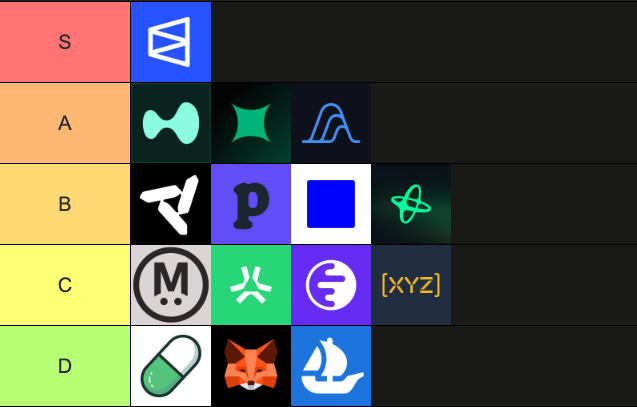
Day 517: my current airdrop tier list
Didi tweet media
English
93
8
461
37.6K
maib retweetledi
FLock.io
FLock.io@flock_io·
FOMO Reward Season 1 is live. AI inference now fuels an onchain reward loop on @base. Rewards are now open for users to earn and claim — through real AI usage. This is not an incentive program for speculators, but real AI users.
English
3
9
48
10.5K
maib
maib@0xmeitb·
@iamasoothsayer Someone pls tells me he didnt die of covid in 2022
English
1
1
2
100
soothsayer
soothsayer@iamasoothsayer·
2023: Corona ended 2026: Hantavirus
Català
30.1K
93K
412.9K
0
maib retweetledi
Pink Brains
Pink Brains@PinkBrains_io·
Worth noticing ecosystems that are making radical changes in tokenomics to route more value to the native token. Next on this list is @FlareNetworks. FIP-16 just renewed $FLR tokenomics to reflect more network activity instead of emissions. Some changes in inflation: - Inflation cut from 5% -> 3%, hard cap dropped from 5B to 3B $FLR - Base gas fee 20x ((still cheaper than ETH/BNB), pushing annual burn from ~7.5M to ~300M $FLR. Net inflation now 2.66% instead of 3% That's not everything. This is why you should care about Flare's new tokenomics: 1. Flare is one of the first general-purpose L1s to enshrine MEV capture at the protocol level. Liquidations, arbitrage, JIT liquidity - all the value normally extracted by external searchers gets routed back to the network. 2. The new treasury, FIRE (Flare Income Reinvestment Entity) FIRE will take revenue from FAssets, FDC attestations, Smart Accounts, Confidential Compute, MEV, and use it to buy back & burn $FLR on the open market. Primary purpose: reduce supply. Secondary purpose: fund asset issuers, dApp liquidity, and the Foundation. 3. Locked $FLR on P-Chain will earn you more benefits than C-Chain Before, voting power of locked $FLR on P-Chain and liquid $WFLR delegations were roughly equal. In the new tokenomics, P-Chain lock-up gets 5x weight than C-Chain delegation. This means: - $FLR stakers on P-Chain earn a bigger share of protocol rewards - The reward gap will push more $FLR into lockup rather than staying liquid in WFLR - More locked supply = better network security + less float on the market - Validator node size cap rises from 200M to 300M $FLR to absorb the inflows Why the new tokenomics matters: Flare gains $400M TVL, 880k+ active addresses, 150M $FXRP minted with 85% deployed in DeFi. The activity is real. But $FLR didn't capture any of it. Now it does. Value capture phase begins, starting with emissions cut in mid-May.
Pink Brains tweet media
Flare ☀️@FlareNetworks

FIP.16 update: The emissions-related changes are currently targeted for mid-May. The burn-related changes are expected toward the end of June. In parallel, we’re working on the implementation of FIRE. Under the proposal, FIRE is designed to accrue network revenues from multiple sources across the network, with its impact growing as activity expands and MEV capture comes on-chain and becomes increasingly visible over time. We’re also preparing an $FLR tokenomics dashboard on @DefiLlama, allowing the community to track these changes transparently as they go live. More details will be shared as each step is finalized.

English
10
14
66
7K
maib retweetledi
Ignas | DeFi
Ignas | DeFi@DefiIgnas·
$10 million MegaETH-Aave commitment that pays for itself in ~2.5 years if Megaavethena scales. Foundation's real out-of-pocket is ~$6.5M, mostly year 1. Loop currently at ~$180M USDM borrowed vs ~$450M target. Btw, USDe borrow rate just 0.02% Intern cooked
Pink Brains@PinkBrains_io

MegaETH committed $10M to the Aave DAO over 5 years. How are they going to pay? Aave earns from reserve factors: 10% on USDM and USDT0, 15% on WETH, 25% on USDe. If revenue is below $2M a year, MegaETH pays the gap If it’s above, the excess rolls forward Let's look at the current numbers: 1. USDM market: $599.97M supplied (cap maxed). $180M borrowed at 1.34%. At 10% reserve factor, that’s about $241k/year. 2. USDe market: $200M supplied (cap maxed). $1M borrowed at 0.02% x 25% RF = $50/yr 3. WETH and USDT0 are still small Total current earnings is around $241k/year. Gap to the $2M floor is about $1.76M. So the heavy lifter is Megaavethena, which is now underperforming. Loop works when loopers' income on $USDe (3.08% APY) exceeds $USDm borrow cost x LTV. At optimal utilization (85%), borrow rate is around 4% APY, but the looping is already unprofitable by then, meaning the system must rely on non-loop borrowers to sustain demand. At target $500M USDe supply cap (current $200M), USDM borrowable at 90% LTV = ~$450M. - Conservative case (~3% borrow rate, where looping still works): $450M x 3% x 25% RF = $3.375M/year - High utilization case (~4% borrow rate): $450M x 4% x 25% RF = $4.5M/year Looks clean, but there is also additional cost: the Foundation is also paying Merkl incentives in $MEGA. 5.12% on $600M USDM supply = $30.72M/yr minus Aave's native interest rate (0.32% APY) = $1.92M/yr minus USDM's T-Bill (~4% APY) = $24M/yr Emissions burn $4.8M at the current rate (numbers can change as Aave native rate increases). Net sell pressure on $MEGA depends on how much loopers hold vs dump rewards. The team thought about this. That's probably why they've launched the $MEGA locking program to hold things up in the early stage. You can lock MEGA to receive more MEGA when KPIs hit. 53% of the total MEGA supply is gated behind KPI achievement. Delays emissions until growth metrics are met. A deflation mechanism while the chain finds its feet. Most likely 5-year roadmap for MegaETH: Year 1: With the current earnings at ~$241k, the foundation pays ~$1.76M + $4.8M $MEGA emissions. Loop is still small. Incentives do the work. Year 2: USDe supply cap raised toward $500M. USDM borrow cap raised proportionally. Loop scales to ~$450M USDM borrowed. Megaavethena saves the game with enough roll-forward credits for the next few years. Year 3-5: Loop reaches max utilization. Non-loop borrow demand kicks in (WETH/USDT0/wstETH), adding more $500k-1M+ to MegaETH's revenue. MegaETH clears the $10M commitment in roughly 2.5 years, making the back half of the deal pure profit. Total Foundation economic cost: ~$6.5M, mostly front-loaded in year 1. The money might come from the same treasury that funds $MEGA buybacks: - USDtb T-Bill yield (~$24M/yr on $600M USDM circulation) - $50M from the October token sale - Other Foundation reserves The liquidity bribe is a 5-year bet on: - Megaavethena works with incentives - ETH stays productive for leveraged borrowing - Fed not cutting hard enough to compress T-Bill margin - $MEGA holds its price There is no onchain escrow, no upfront collateral on the Aave guarantee. If MegaETH fails to commit, the DAO will become an unsecured creditor. Unclear whether there's a binding legal contract behind the scenes. TLDR: MegaETH's $10M Aave commitment is mostly self-funding if Megaavethena scales as planned. Now growth looks slow, but time will tell.

English
29
10
127
20.4K
maib retweetledi
Pink Brains
Pink Brains@PinkBrains_io·
MegaETH committed $10M to the Aave DAO over 5 years. How are they going to pay? Aave earns from reserve factors: 10% on USDM and USDT0, 15% on WETH, 25% on USDe. If revenue is below $2M a year, MegaETH pays the gap If it’s above, the excess rolls forward Let's look at the current numbers: 1. USDM market: $599.97M supplied (cap maxed). $180M borrowed at 1.34%. At 10% reserve factor, that’s about $241k/year. 2. USDe market: $200M supplied (cap maxed). $1M borrowed at 0.02% x 25% RF = $50/yr 3. WETH and USDT0 are still small Total current earnings is around $241k/year. Gap to the $2M floor is about $1.76M. So the heavy lifter is Megaavethena, which is now underperforming. Loop works when loopers' income on $USDe (3.08% APY) exceeds $USDm borrow cost x LTV. At optimal utilization (85%), borrow rate is around 4% APY, but the looping is already unprofitable by then, meaning the system must rely on non-loop borrowers to sustain demand. At target $500M USDe supply cap (current $200M), USDM borrowable at 90% LTV = ~$450M. - Conservative case (~3% borrow rate, where looping still works): $450M x 3% x 25% RF = $3.375M/year - High utilization case (~4% borrow rate): $450M x 4% x 25% RF = $4.5M/year Looks clean, but there is also additional cost: the Foundation is also paying Merkl incentives in $MEGA. 5.12% on $600M USDM supply = $30.72M/yr minus Aave's native interest rate (0.32% APY) = $1.92M/yr minus USDM's T-Bill (~4% APY) = $24M/yr Emissions burn $4.8M at the current rate (numbers can change as Aave native rate increases). Net sell pressure on $MEGA depends on how much loopers hold vs dump rewards. The team thought about this. That's probably why they've launched the $MEGA locking program to hold things up in the early stage. You can lock MEGA to receive more MEGA when KPIs hit. 53% of the total MEGA supply is gated behind KPI achievement. Delays emissions until growth metrics are met. A deflation mechanism while the chain finds its feet. Most likely 5-year roadmap for MegaETH: Year 1: With the current earnings at ~$241k, the foundation pays ~$1.76M + $4.8M $MEGA emissions. Loop is still small. Incentives do the work. Year 2: USDe supply cap raised toward $500M. USDM borrow cap raised proportionally. Loop scales to ~$450M USDM borrowed. Megaavethena saves the game with enough roll-forward credits for the next few years. Year 3-5: Loop reaches max utilization. Non-loop borrow demand kicks in (WETH/USDT0/wstETH), adding more $500k-1M+ to MegaETH's revenue. MegaETH clears the $10M commitment in roughly 2.5 years, making the back half of the deal pure profit. Total Foundation economic cost: ~$6.5M, mostly front-loaded in year 1. The money might come from the same treasury that funds $MEGA buybacks: - USDtb T-Bill yield (~$24M/yr on $600M USDM circulation) - $50M from the October token sale - Other Foundation reserves The liquidity bribe is a 5-year bet on: - Megaavethena works with incentives - ETH stays productive for leveraged borrowing - Fed not cutting hard enough to compress T-Bill margin - $MEGA holds its price There is no onchain escrow, no upfront collateral on the Aave guarantee. If MegaETH fails to commit, the DAO will become an unsecured creditor. Unclear whether there's a binding legal contract behind the scenes. TLDR: MegaETH's $10M Aave commitment is mostly self-funding if Megaavethena scales as planned. Now growth looks slow, but time will tell.

Pink Brains tweet mediaPink Brains tweet media
English
11
3
61
25.5K
maib retweetledi
The Smart Ape 🔥
The Smart Ape 🔥@the_smart_ape·
aave: yo arbitrum, send back the $71m you get from the hacker, we need it arbitrum: chill, we’re voting on it, you’ll have it in a few days. defi united, remember? aave: bet. love that for us (suddenly, american lawyers show up) plaintiffs: stop right there. that $71m is ours now aave: excuse me?? plaintiffs: we have old judgments against north korea. the hacker was lazarus group. lazarus is north korea. therefore the funds belong to north korea. therefore we seize them aave: wait. do you have proof it was north korea? plaintiffs: yeah, tweets aave: …tweets plaintiffs: and a news article aave: but even if it was them, holding stolen funds for 5 minutes doesn’t make you the owner?? plaintiffs: yes it does aave: so if i smash a tiffany’s window, grab a diamond, and a bystander grabs it back from me, your creditor friends can seize the diamond? plaintiffs: correct arbitrum: uhh… what are we supposed to do here plaintiffs: don’t move. everything’s frozen aave: but the funds belong to my innocent users?? plaintiffs: not our problem aave: if i lose this, nobody will ever stop a hacker again. why would they? the reward becomes a legal war with the thief’s creditors plaintiffs: not our problem aave: and sanctioned states will have an incentive to hack more, since stolen funds can pay off their old debts plaintiffs: still not our problem aave: (turns to the judge) your honor, either vacate this now, or make them post a $300m bond. we have days before the entire defi ecosystem cascades judge: (tbd)
Aave@aave

Aave LLC has filed an emergency motion to vacate a restraining notice served on Arbitrum DAO on May 1, 2026 that attempts to seize approximately $71 million in ETH belonging to victims of the April 18 exploit. A thief does not gain lawful ownership of stolen property simply by taking it, and the law is clear on this. Those assets were recovered to be returned to users victimized in the April 18, 2026 exploit. Freezing them harms the very people this recovery effort is designed to protect. We’ve asked the court for an expedited hearing and a temporary vacatur, and we are continuing to work alongside the Arbitrum community and DeFi United to make affected users whole.

English
111
235
1.8K
379.6K
maib retweetledi
Pink Brains
Pink Brains@PinkBrains_io·
Kelp's rsETH case updates: From $292m gross exploit to $13m residual uncovered, entirely through united DeFi response rather than law enforcement. This is the "Avenger assemble" moment we've first seen since Luna/FTX A thread of all relief efforts so far 🧵
English
6
7
22
2.6K
maib retweetledi
Josh
Josh@devjoshstevens·
This is my 3rd week as VP of Engineering DeFi at @Polymarket , and I'm going to be straight: the traction @Polymarket has seen has massively outpaced our infrastructure, and we haven't done nearly enough to scale to keep up. I hear you, and fixing this is our entire focus. We're a major company now, and we need to engineer like one. Here's exactly what we're doing: - Onchain data latency. We're working on making this near-instant so the experience is incredible. - Chain migration. We need more block space, cheaper gas and much smaller block times so settlement is instant. - Transactions are getting cancelled. We understand this is one of the most frustrating issues right now, and we have a complete fix coming very soon. - Massive focus on the website to make it faster, more responsive, and with better UX. - We added observability everywhere. Proper alerting so we catch issues ourselves, market makers should not be the ones telling us something is down. That's been unacceptable, and we know it. - E2e tests throughout, starting with the CLOB, so issues get caught in CI before anything ships. - CLOBv2 is not a rewrite. It won't improve performance or stability on its own; it's an upgrade that unlocks us to move fast right after. We'll do better with communication next time. - We are rebuilding the CLOB from the ground up. Most important thing we're doing. Without it, we can't be the best DeFi exchange in the world. We know it, we're on it, it's mission critical. - Unified TypeScript SDK for all APIs, which is shipping soon. - Unified API. One WS connection for everything, with a schema that's actually readable. - New Polymarket contract in the works that unlocks things that are simply impossible on the current protocol. - New hires: Head of QA Automation, Head of Dev Tooling, Head of Internal Tooling, Head of Data Engineering. - Smaller, dedicated teams. Fewer focus points per person, clearer ownership. People do what they're good at and are accountable for it. - Working closely with customer support to give them real debugging tools so any user issue gets properly diagnosed, not lost. - Proper communication with marketing and market makers so everyone knows what's coming and when, and MM can submit feature requests with a clear path to get them into engineering and shipped. - Working with 4 security teams daily to ensure we're super secure and that funds are always safe. - Perps incoming. Brand new contracts and a backend built from scratch in Rust. We're proud of this one. - A lot of other fixes are running in parallel right now. Starting next Friday, I will be posting weekly engineering updates. I joined because I genuinely believe in what @Polymarket is trying to do. @shayne_coplan built this so the world has somewhere to go to find out what's actually going to happen, not what the media thinks, not what a pundit says, but what thousands of people are willing to put money on. But right now, our engineering isn't living up to that. We've let people down, and I'm not going to dress that up. I came here to fix it, and that's exactly what we're going to do. The next few months are going to speak for themselves. Stay with us.
English
878
262
2.5K
1.2M
maib retweetledi
Michael Egorov
Michael Egorov@newmichwill·
KYC checks are no more. CeFi is cooked
English
19
14
164
37.7K
maib retweetledi
MegaETH
MegaETH@megaeth·
MEGA TGE APRIL 30, 2026
Eesti
871
787
5.3K
847.7K
maib retweetledi
Sam
Sam@0xCryptoSam·
Some interesting (and a few contrarian) liquid ideas I haven't seen heavily discussed that could play out in 2026: - Long AERO Short UNI: aero adding mainnet (competing with UNI), i predict many LPs shift from Uniswap to Aero post-UNI fee switch. internalizing MEV capture is another tailwind. - Long Securitize SPAC: the face of tokenization, works with blackrock, apollo, and kkr, $1.2b is a digestible val to launch at. could see it getting a stronger bid bc easier to buy. - Long POLY: $20b prob gets sold off initially since VCs in crazy profit, everyone else thinks it's overvalued. but 10% of OI is in the US presidential election, 50% in politics. that probably grows into 2028. midterms also a tailwind + eventual fee expansion to politics. - Long CARDS: insanely cheap for how much revenue they generate (altho tokenomics weird), TCG is a bet on Gen Z + alpha consumerism increasing. - Long MAPLE: the best underwriter in tokenized private credit, short-duration loans, good team, proven demand. clear path to scaling via "earn" products on CEXs, neobanks, and lending protocols. tough to say it's super undervalued here, you're betting on growth from a proven operator.
English
12
7
114
9.3K
maib retweetledi
Pink Brains
Pink Brains@PinkBrains_io·
Keep your X feed clean and crypto maxxed by following these 99 DeFi influencers. Real people with real insights. They're writing daily, so you can learn and earn from crypto and DeFi. There are hundreds more worth following, let us know your favorites 🧠
Pink Brains tweet media
English
22
9
51
10.6K
maib retweetledi
Pink Brains
Pink Brains@PinkBrains_io·
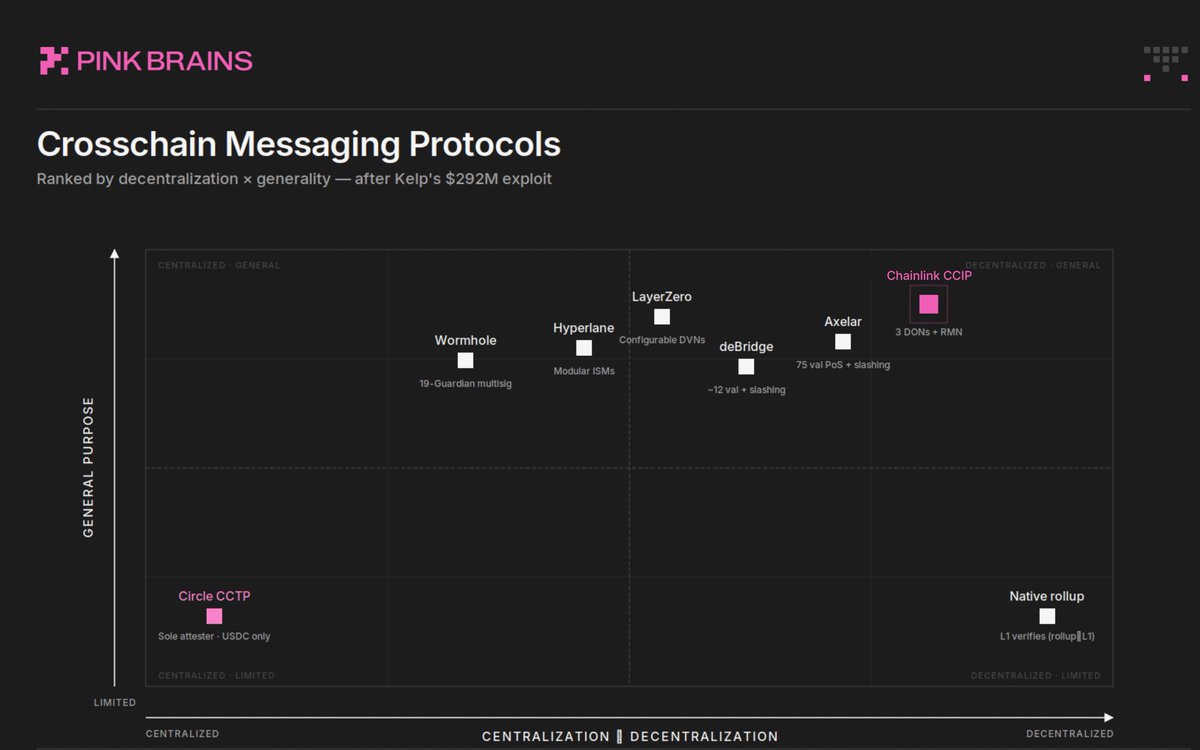
Crosschain messaging protocols, how competitors compare after Kelp’s $292M exploit 🧠 ↓ 1. Native rollup messaging (Arbitrum's native bridge messaging, OP Stack's CrossDomainMessenger, Linea/zkSync messaging) - The L1 itself is the verifier - Trust inherits entirely from Ethereum consensus - Zero extra committee - The caveat is scope. Canonical bridges only connect a rollup to its L1, not arbitrary chain pairs - The 7-day challenge window is the key UX tradeoff. Most users move to faster options, shifting security from L1 consensus to entity-based quorums → Higher security, often slower, lower liquidity, and limited token support 2. @chainlink CCIP: Separated committees with multiple independent networks cross-check each other - 3 independent oracle networks per transfer: Committing DON, Executing DON, and the Risk Management Network - RMN is built in Rust by a separate team, runs distinct operators, and can halt the system via “curse” transactions - Uses N-version programming (borrowed from aerospace safety) - v1.5 (Jan 2025) added the self-serve CCT standard, so any token issuer can now onboard with their own pool logic and rate limits - No protocol exploits since 2023 If Kelp had been on CCIP, the RMN likely would have caught the supply invariant, even if the primary DONs were compromised by an RPC-poisoning attack. → Chainlink is arguably the most hardened architecture in production today. 3. Single verifier set + economic security (slashing) @axelar - Cosmos SDK-based PoS chain. 75+ validators, DPoS with $AXL staking. Slashing is applied (2% for double-sign, 0.01% for downtime) - Staking concentration in the top 10 validators is a mild concern - Axelar uses Quadratic Voting (shipped in the Maeve upgrade, August 2022) specifically for cross-chain message validation, making it harder for large stakers to unilaterally approve forged messages. - Connects 55+ chains via threshold cryptography - General Message Passing is the messaging layer. ITS is the bridge built on top. @debridge (DMP) - Elected validator set with delegated staking and slashing - Signatures saved to Arweave for verifiability - The validator set is small (historically ~12) and governance-permissioned, which limits decentralization - Unlike Kelp's incident, where LayerZero Labs' DVN relied on compromised third-party RPC providers, deBridge validators run their own full nodes of every supported chain, eliminating the upstream RPC poisoning vector entirely - Battle-tested since 2022 with zero messaging-layer exploits. Sits higher than you'd think because the slashing is real, full nodes are dedicated, and the validator set is actively monitored → Less decentralized, but stronger operational control and economic penalties 4. @wormhole: Multisig-based messaging. Collusion is the risk - 19 Guardian nodes, 13-of-19 multisig quorum. The set is expected to grow over time - Guardians are reputable firms (Jump, Figment, Chorus One, P2P Validator, etc.) running full nodes of all connected chains - After the 2022 $320M exploit: hardened by the Global Accountant (supply-invariant monitoring) and Governor (rate limits +24hr delay on large flows) If Kelp had been on Wormhole, the Global Accountant would likely have flagged $292M in unbacked rsETH before the drain completed → Strong defense-in-depth, but trust ultimately sits with the multisig 5. Modular security frameworks. Safety is configurable @hyperlane - Modular ISMs (apps choose validators + quorum). - Default ISMs on major chains are thin multisigs (2-of-5 on Base, 3-of-7 on Ethereum) - $HYPER token staking via Symbiotic vaults added an economic security layer in April 2025, but application-level ISMs still dominate. 140+ chains, 5 VMs - As safe as whoever wires it up. Renzo adds extra multisig on top of the default ISM for ezETH, which is the right thing to do @LayerZero_Core - DVN-based modular security. Each OApp picks its DVN set, theoretically from 1/1 (trust one entity completely) to 8/12 (institutional grade) - The protocol allowed 1/1 as the quickstart default, which is how Kelp ended up with a single point of failure - Post-Kelp, LayerZero is refusing to sign for any 1/1 configuration, forcing migration. The protocol is technically flexible, which makes the product a footgun → Flexible, but easy to misconfigure. Security depends on apps. 6. @circle's CCTP: Centralized attestation. You trust the protocol entirely. - Circle is the sole attester for USDC burns. There is no multi-sig, no validator network, no cryptographic light client - Works because (a) Circle is a regulated, liability-bearing stablecoin issuer and (b) the burn-and-mint model leaves no honeypot to exploit - As a messaging mechanism in isolation, it's the most centralized thing on this list - For USDC only. Not usable as general-purpose messaging → Most centralized, but effective within its narrow scope Crosschain messaging is a spectrum. On one end: Centralization with restrictions. On the other: fast, flexible systems with added trust assumptions. Other techniques built on top of messaging protocols like cryptographic proofs (@PolyhedraZK, @SuccinctLabs) can eliminate the consensus attack surface, while intent-based bridges shift user risk to solvers. Both can make interop trust-minimized and safer to use.
Pink Brains tweet media
English
3
3
8
1.1K
maib retweetledi
Dwarkesh Patel
Dwarkesh Patel@dwarkesh_sp·
The Jensen Huang episode. 0:00:00 – Is Nvidia’s biggest moat its grip on scarce supply chains? 0:16:25 – Will TPUs break Nvidia’s hold on AI compute? 0:41:06 – Why doesn’t Nvidia become a hyperscaler? 0:57:36 – Should we be selling AI chips to China? 1:35:06 – Why doesn’t Nvidia make multiple different chip architectures? Look up Dwarkesh Podcast on YouTube, Apple Podcasts, Spotify, etc. Enjoy!
English
533
1.1K
8.5K
6.1M