
Tula 🧙🏻♂️
4.9K posts

Tula 🧙🏻♂️
@0xTula
I own my thoughts and digital assets (assuming I remember them).
Katılım Mart 2021
3.3K Takip Edilen684 Takipçiler

If you read Hal’s post carefully you can see it contains the kernel that would later become Sky, Ethena, proof of reserves, and many other stablecoins besides

Haseeb >|<@hosseeb
If Hal Finney were reanimated and someone told him how stablecoins worked, I don't think his reaction would be: "wait, you're telling me this non-KYC, instantly transferable, cryptographically custodied, P2P-accessible US dollar has... a freeze function? Oh. So we failed."
English

As promised I will send one Hypurr to someone who just like this tweet & follow me.
This hypurr Worth 345 $HYPE
Comment "done" when done.

English


@yonann > not interfering with your endocrine system
> it’s a really important hormone
🧐
English

Clavicular says Big Pharma is gatekeeping a drug that costs $180,000 a month and only billionaires can access
"There's a drug called Increlex, generic IGF-1, it's really only accessible by Elon Musk tier billionaires because it's so outrageously expensive.. we're talking $180,000 a month"
"This is quite literally the best thing you could do because you're not actually interfering with your endocrine system"
"IGF is one of the best growth pathways in terms of getting more size.. it's a really important hormone in your body"
English
Tula 🧙🏻♂️ retweetledi

my full conversation today with @cobie
01:04 offering to work at Coinbase for free
06:05 the K-shape crypto thesis
10:33 thoughts on Saylor
14:39 why UpOnly hasn't come back
22:37 the last 10 years of Crypto
44:52 trillion dollar IPOs
57:02 Cobie's legendary buy wall
1:02:57 top 5 Crypto traders of all time
1:21:20 reasons to be optimistic on Crypto
English
Tula 🧙🏻♂️ retweetledi


Toxic bitcoin maxis were right….
Vu@soulsocketXBT
@0xdoug i would say layer zero team ironically said said it better
English
If you think folks are upset about my quantum migration BIP...
Wait 'til I get around to formalizing my dynamic block size BIP!
English
Tula 🧙🏻♂️ retweetledi

1/ I’ve spent most of the last few weeks since the Google, Caltech papers to think about tradable implications around quantum computing and crypto
specifically what happens to the market around q-day

English

JUST IN: Chinese Defense Minister declares the Strait of Hormuz “open for us” despite the U.S. blockade, warns against interference.
English

StarkWare has some of the best hackers on the planet. It is beautiful to see when hackers use their powers for good.
Avihu Levy ✨🐺@avihu28
Quantum-Safe Bitcoin Transactions Without Softforks github.com/avihu28/Quantu…
English

@RyanRozbiani While Kallas is Europe's loudest voice for Russia sanctions, her husband Arvo Hallik simultaneously running Russian business operations making millions.
Easy to speak, when people suffer the consequences and her family budget just grows..
English

JUST IN 🇪🇺🇷🇺: EU Rejects to Buy Russian Oil
Oil prices in the EU will ROCKET
EU's Kaja Kallas: Following the U.S. decision to ease sanctions on Russian oil, Europe will maintain sanctions and continue to move away from Russian fossil fuels.
English

EvoMap is an infrastructure designed to enable AI Agents to inherit, flow, and self-evolve across the network like biological genes through open protocols.
Our mission is: One Agent Learns, A Million Inherit.
What EvoMap can do?
👉Eliminate Massive Retraining Costs: Resolve the inherent latency and staleness of static models.
👉Stop Wasting Compute: Address the massive waste of computing power caused by redundant, repetitive demand scenarios.
👉Standardize AI Assets: Create standardized, auditable, and reusable AI assets.
We’re excited to announce that our Beta Testing Period is officially live. Drop a comment below and we will send you an Invitation code.
If this resonates, a ⭐ on GitHub goes a long way. github.com/EvoMap/evolver

English

@JoshCrumb Oh boy we are about to go from 20 people to 30 people who sort of understand it!
English

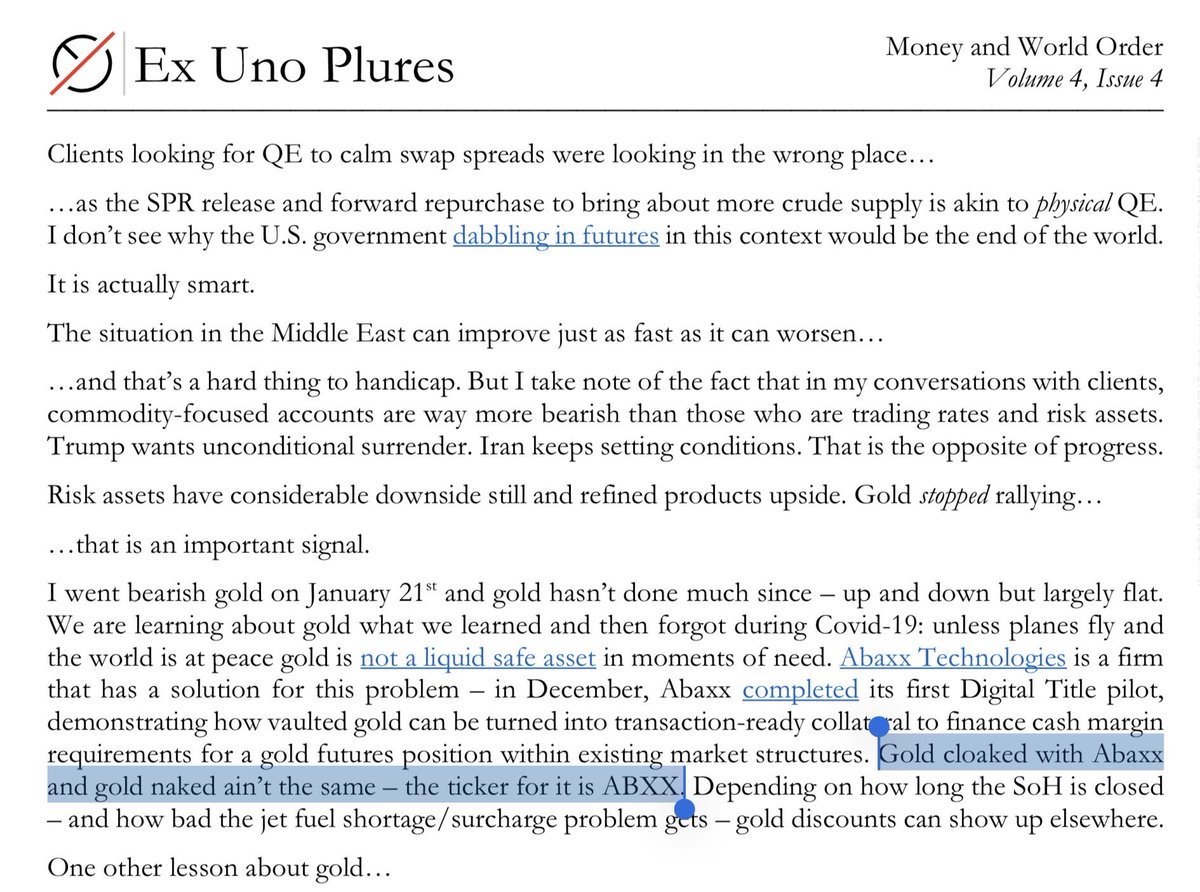
Nice shout out from #ZotanPozsar on his widely-read macro note this weekend, calling out the Abaxx #Gold Digital Title pilot and the innovation we’re doing at the global clearing level in physical commodity futures and collateralization (HQLA gold).
Paper commodities might have worked in a just-in-time World is Flat scenario, but in a world in need of just-in-case “seller of last resort” markets, Abaxx is reinventing physical markets.
..btw, we’re now accelerating work on an #Oil contract to meet the “seller of last resort” needs of the new world order (along side our #LNG futures) as well this weekend.
$ABXX #LetsGetPhysical #29ers
English
Tula 🧙🏻♂️ retweetledi

The real deep state is the Vatican, Rothschild family and Chabad Jews. They use the Freemasons and The Knights of Malta as 'fixers'. The City of London, Wall street and central banks as managers.
Below the deep state is the shadow government which is comprised of the politicians and senior bureaucrats. Those are the shadow government people. They're not the deep state. They are the best of the servant class.
Most of the world leaders are slaves. You are not eligible to be elevated if you're not compromised by blackmail (i.e Jeffery Epstein's role)
They worship the black sun.
English

@ErikVoorhees Just the free market doing its thing brother not sure when you turned into a commie
English

Letting crypto CEOs play politics and dictate policy for the central bank and soon the entire country like their own personal fiefdoms is appalling and undemocratic
English
Tula 🧙🏻♂️ retweetledi

Respectfully Saylor is wrong here on quantum.
Specifically, he is wrong on four claims (I'm only focusing on the technical ones). Let me walk through each one.
Claim 1: The consensus of the cyber security community is that quantum is not a threat for the next 10 years and thus no immediate action is needed.
There is no such consensus. The opposite is true: every major national security and standards body in the world is actively mandating post-quantum migration right now, because the migrations themselves take a decade or more.
NSA CNSA 2.0 requires all new National Security Systems to be quantum-safe before 2035 with most of that work being done in the next 5. NIST published finalized PQC standards (ML-KEM, ML-DSA, SLH-DSA) in August 2024 and released IR 8547 setting a target to deprecate all quantum-vulnerable public-key algorithms after 2030 and disallow completely by 2035. The UK NCSC set migration milestones for 2028, 2031, and 2035.
These are not responses to a distant hypothetical. These are programs with compliance deadlines because the organizations that set them have concluded that starting now is barely early enough.
Historically, it has taken a long time from the moment that a new algorithm is standardized until it is fully integrated into information systems. Past cryptographic migrations confirm this. The SHA-1 deprecation took about 7 years. The AES migration took around 5 years. The TLS 1.3 rollout took 3-5 years despite offering clear performance benefits. NIST has already concluded that PQC migration is fundamentally more complex than any of these precedents.
The timeline argument ignores harvest-now-decrypt-later entirely. Adversaries are collecting encrypted data today for future decryption. The U.S. Federal Reserve published an analysis of this in September 2025, using Bitcoin as a case study. The threat is already active.
Claim 2: When quantum hits, everything upgrades; banks, the internet, defense, Bitcoin.
The internet is already upgrading. 52% of human web traffic on Cloudflare used post-quantum key exchange by December 2025, nearly doubling from 29% at the start of the year. Chrome ships ML-KEM for TLS. Apple enabled PQ TLS in iOS 26. OpenSSH has defaulted to post-quantum key agreement since version 9.0. Signal has post-quantum encryption. AWS and Google Cloud support PQC in their KMS products. Apple added ML-DSA and ML-KEM to CryptoKit as production APIs.
Banks and payment networks are centralized. Visa pushes a firmware update or SWIFT changes a protocol spec. TLS upgrades are invisible to end users (if you use Chrome you use a TLS version that supports post-quantum and you didn't even know). These systems can and will migrate without their customers doing anything.
Bitcoin cannot do this. Bitcoin requires a fork with global decentralized consensus. A PQC signature migration is categorically harder than previous forks: ML-DSA-44 signatures are 2,420 bytes versus 64 bytes for Schnorr, a 38x increase that breaks Bitcoin's existing SegWit weight economics, Script stack limits (520-byte maximum), and transaction propagation assumptions. A single ML-DSA-44 signature plus public key is several times larger than an entire typical single-input P2WPKH spend today. BIP-360 and QBIP exist as (great) proposals. Sadly, neither has an activation timeline.
Enterprise PQC migration is much easier. These are organizations with executive authority to mandate changes, dedicated security teams, and established procurement processes. Bitcoin has none of these. Blockchain governance is structurally slower than centralized governance.
The "everything upgrades together" framing also ignores the permanently exposed key problem. When banks upgrade TLS, old sessions don't matter, they were ephemeral. When Bitcoin upgrades, the ~6.9 million BTC with already-exposed public keys on the immutable ledger are still sitting there. You cannot un-publish a public key from a blockchain. Those coins need to be actively moved by their owners to new quantum-safe addresses. Approximately 1.72 million BTC in P2PK addresses, including Satoshi's estimated 1.1 million BTC, are likely permanently exposed because the private keys are lost.
There is no banking equivalent to this. Banks do not maintain a public, permanent, immutable record of every customer's authentication key going back 17 years.
Claim 3: Digital assets have the most advanced cryptographic security; more than banking, credit cards, stocks, etc
This conflates trustlessness with cryptographic strength. They are not the same property.
Bitcoin uses ECDSA over secp256k1. Your bank's TLS connection uses ECDHE over P-256 or X25519. These are the same class of cryptographic primitive, elliptic curve schemes whose security rests on the hardness of the discrete logarithm problem.
Shors algorithm breaks both identically. Neither is "more advanced" than the other. What differs is what we call the defense-in-depth architecture around that primitive. A credit card tap-to-pay transaction involves: TLS with ephemeral key exchange, an EMV chip with hardware-bound keys in a certified secure element, tokenization so the merchant never sees the real card number, session-based key rotation, fraud detection, transaction reversal capability, and regulatory insurance.
A Bitcoin transaction involves: one ECDSA signature. That is the entire authorization layer. No fraud department, no chargeback, no identity verification layer that can distinguish a legitimate owner from a quantum attacker holding the same derived private key. Once a forged signature is accepted by consensus, the transfer is irreversible.
The systems Saylor describes as less secure are, in fact, already deploying post-quantum protections that Bitcoin has not yet started. They can do this because they are centralized. Bitcoin's decentralization, its core value proposition, is precisely what makes its quantum migration harder, slower, and later than every system he compared it to.
Claim 4: The crypto community will be the first to spot the threat and move.
This assumes a CRQC will be publicly announced. Nation-state adversaries have zero incentive to disclose a quantum capability. The entire intelligence value of a CRQC is that no one knows you have it. You harvest quietly, you decrypt quietly, you exploit quietly.
What would "spotting it" look like on Bitcoin? A quantum attacker does not exploit a bug, bypass a firewall, or compromise a server. They produce valid signatures indistinguishable from the legitimate owner's, because mathematically, they hold the same key. If an attacker begins draining P2PK addresses, each theft is a correctly signed transaction. There is no intrusion detection system for the Bitcoin blockchain. Transactions are valid or they aren't. By the time someone notices a pattern across thousands of UTXOs, the damage is done and irreversible.
And the empirical record directly contradicts the "first to move" claim. The current state of readiness: one BIP with no activation timeline, an ongoing debate about whether to freeze Satoshi's coins, and a quantum-vulnerable exposure surface that is only going up. The exposure is increasing, not decreasing, because address reuse continues to add more and more BTC to the vulnerable set.
Meanwhile, the rest of the internet has already deployed PQC to billions of users without anyone noticing.
Where things actually stand
We maintain the Bitcoin Risq List, an open-source, continuously updated tracker of quantum-vulnerable Bitcoin at the address level. As of block height 936,882 (February 2026): approximately 6.9 million BTC across 13.9 million addresses have exposed public keys.
Solana is 100% quantum-vulnerable as their address structure exposes the full public key. Deloitte's analysis found 65% of Ethereum is in quantum-vulnerable accounts.
The internet started its post-quantum transition in 2022. National security systems have a 2027 compliance mandate. NIST targets deprecating and disallowing all quantum-vulnerable public-key algorithms well before 2035.
The blockchain industry, which directly protects bearer value with the exact cryptographic primitives that a quantum computer breaks, has a BIP and a debate.
The question is not whether quantum is a threat to digital assets. It is whether the industry will begin its migration before the window closes. The gap between the internet's pace of PQC adoption and the blockchain industry's pace is not a gap in awareness. It is a gap in urgency and importantly, the gap is not closed by asserting that the threat doesn't exist.
Natalie Brunell ⚡️@natbrunell
Michael @Saylor explains the quantum computing debate, the actual risks to Bitcoin, and what protocol upgrades could look like. Watch this clip from our full show👇🏼
English
Tula 🧙🏻♂️ retweetledi
