
Sabitlenmiş Tweet
TánMoN
756 posts


TánMoN
@10maym1
❤️ Parenthood ❤️ LinkedIn: https://t.co/beMqlStACX YouTube: https://t.co/97Sqq4DPr3 GitHub: https://t.co/mpPDdAtWyP
Indore, India Katılım Mart 2016
65 Takip Edilen22 Takipçiler

Visuals from #NarmadaGhat, Narmadapuram. Please do the needful to create a system & fix this forever.. 🙏
@mppcb_official @CPCB_OFFICIAL @CMMadhyaPradesh @SwachhBharatGov @moefcc
#SaveNarmada #CleanNarmada #SwachhBharat



English
Omkareshwar Temple on Weekend: 4‑hr jammed queue, unsafe for kids/elderly, no security/water/food, narrow passage, poor crowd control. Need better management. Very high probability of stampede. @OmkarJyotirling @DM_Khandwa @MPTourism @KhandwaSp @nvdamp @CMMadhyaPradesh
English

YouTube
English


The Only AI That Reads Huge, Complex PDFs — Fully Offline and Private.
#RAG #OfflineAI #PrivateAI #LocalLLM #AIEngineering #Java #SpringBoot #FullStack #CUDA #VectorSearch #DocumentAI #PDFIntelligence #AIDev #SearchEngineering #Microservices #LLM #ConfidentialComputing #AIInfra
English
TánMoN retweetledi

get into FPGAs.
they’re not as hyped as AI or robotics, but they’re the hidden backbone of both.
you want speed? determinism? ultra-low latency? hardware-level parallelism?
that’s FPGA territory.
every serious system; autonomous vehicles, defense tech, high-frequency trading, industrial control; runs faster because some engineer somewhere mastered reconfigurable logic.
software gives you flexibility.
hardware gives you performance.
FPGAs give you both.
learn VHDL or Verilog.
build a simple CPU.
implement a PID controller.
accelerate an ML inference.
you’ll suddenly see how computing really works; not just in code, but in electrons.
FPGAs are the bridge between hardware and software thinking. and if you can master that bridge, you become dangerous.

English
TánMoN retweetledi


TánMoN retweetledi

A drone that flies, drives, and… switches modes in 0.1 seconds! ⬇️ Build it yourself:
[📍 Bookmark for CAD + parts]
No extra actuators, no deformation, just clever mechanics and full control.
DUAWLFIN is a ground-aerial robot with unified actuation:
flying like a quadcopter, rolling like a car, and transitioning seamlessly between modes.
✅ Climbs 30° slopes
✅ Hits 2 m/s on wheels with just 15W
✅ Only 3% added energy in flight mode
✅ Mode switch in 0.1s
✅ Fully open-source and 3D-printable
Perfect for urban logistics, indoor nav, or just rethinking what drones can be.
Thank you, Ruiqi Zhang, for sharing!
Paper: arxiv.org/pdf/2505.13836
Website: sites.google.com/view/duawlfin
Build it yourself: CAD + parts list in the paper
📍 BOOKMARK FOR LATER
This is how you merge air and ground without compromise.
English
TánMoN retweetledi

TánMoN retweetledi

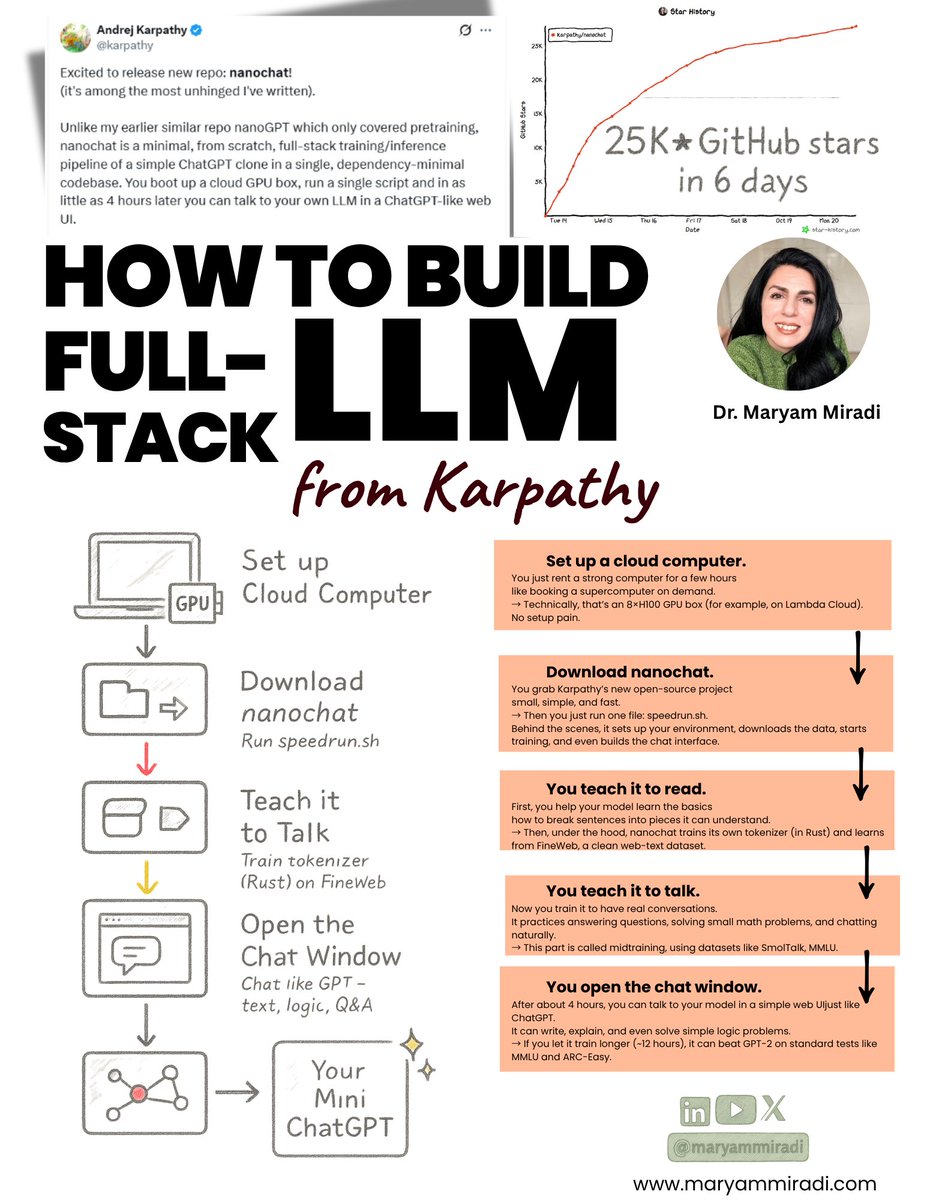
I love when Karpathy drops something new!
This time it’s NANOCHAT.
This is how to build a full LLM for ~$100 with a simple 5-step process in one evening. 👇
What is the Value?
Right Now:
Too many tools. Too many buttons.
Ideally:
You just want a bot that talks back —
without 100 dependencies.
Karpathy’s 5-Step Blueprint Solve this:
1️⃣ Set up a cloud computer.
You just rent a strong computer for a few hours
like booking a supercomputer on demand.
→ Technically, that’s an 8×H100 GPU box (for example, on Lambda Cloud).
No setup pain.
2️⃣ Download nanochat.
You grab Karpathy’s new open-source project
small, simple, and fast.
→ Then you just run one file: speedrun .sh.
Behind the scenes, it sets up your environment, downloads the data, starts training, and even builds the chat interface.
3️⃣ You teach it to read.
First, you help your model learn the basics
how to break sentences into pieces it can understand.
→ Then, under the hood, nanochat trains its own tokenizer (in Rust) and learns from FineWeb, a clean web-text dataset.
4️⃣ You teach it to talk.
Now you train it to have real conversations.
It practices answering questions, solving small math problems, and chatting naturally.
→ This part is called midtraining, using datasets like SmolTalk, MMLU, and GSM8K.
5️⃣ You open the chat window.
After about 4 hours, you can talk to your model in a simple web UIjust like ChatGPT.
It can write, explain, and even solve simple logic problems.
→ If you let it train longer (~12 hours), it can beat GPT-2 on standard tests like MMLU and ARC-Easy.
AI Community Loves it!
25K+⭐ GitHub stars in 6 days.
It opens a thousand doors.
Because once you get nanochat running,
you can turn it into:
- a new experiment,
- a new skill, or even
- a new AI Agent.
7 Experiments You Can Try:
① Train deeper.
Change one number (--depth=26) to see reasoning improve.
→ Watch your chatbot get smarter.
② Swap data.
Use your own text — finance, medical, or research.
→ Build a model that speaks your language.
③ Tweak the tokenizer.
Add code tokens or symbols.
→ See how language compression really works.
④ Test tool use.
Hook it to a Python sandbox or API.
→ Turn chat into action.
⑤ Add memory.
Wrap it with LangChain or CrewAI.
→ Get a goal-driven, multi-step agent.
⑥ Benchmark fast.
Run ARC-E, GSM8K, HumanEval.
→ Learn what truly moves performance.
⑦ Log everything.
Edit the report. md with notes or charts.
→ Track your runs like real experiments.
nanochat: github.com/karpathy/nanoc…
≣≣≣≣≣≣≣≣≣≣≣≣≣≣≣≣≣≣≣≣≣≣≣≣≣≣
⫸ꆛ Want to build Real-World AI Agents?
Join My 𝗛𝗮𝗻𝗱𝘀-𝗼𝗻 𝗔𝗜 𝗔𝗴𝗲𝗻𝘁 𝟱-𝗶𝗻-𝟭 𝗧𝗿𝗮𝗶𝗻𝗶𝗻𝗴 — trusted by 1,000+ builders worldwide!
✔ Only basic Python required.
➠ Build Agents for Healthcare, Finance, Smart Cities & More
➠ Master 5 Modules: 𝗠𝗖𝗣 · LangGraph · PydanticAI · CrewAI · OpenAI Swarm
➠ Includes 9 Real-World Projects
👉 𝗘𝗻𝗿𝗼𝗹𝗹 𝗡𝗢𝗪 (𝟱𝟲% 𝗢𝗙𝗙):
maryammiradi.com/ai-agents-mast…
English
TánMoN retweetledi

Now anyone can pre-train your own model in 4 hours. Incredible work by @karpathy to open source and democratize some of the most important educational resources in the AI Era. The “Eurekas Per Second” in nanochat is something you must experience.
The NVIDIA Brev team has created a launchable (see below) for you to try!
Simply click “Deploy Launchable” and a GPU will be provisioned in the cloud, and nanochat will begin training!
The first 10 developers to deploy will be able to train their own GPT 2 style model completely for free. Happy hacking!

Andrej Karpathy@karpathy
Excited to release new repo: nanochat! (it's among the most unhinged I've written). Unlike my earlier similar repo nanoGPT which only covered pretraining, nanochat is a minimal, from scratch, full-stack training/inference pipeline of a simple ChatGPT clone in a single, dependency-minimal codebase. You boot up a cloud GPU box, run a single script and in as little as 4 hours later you can talk to your own LLM in a ChatGPT-like web UI. It weighs ~8,000 lines of imo quite clean code to: - Train the tokenizer using a new Rust implementation - Pretrain a Transformer LLM on FineWeb, evaluate CORE score across a number of metrics - Midtrain on user-assistant conversations from SmolTalk, multiple choice questions, tool use. - SFT, evaluate the chat model on world knowledge multiple choice (ARC-E/C, MMLU), math (GSM8K), code (HumanEval) - RL the model optionally on GSM8K with "GRPO" - Efficient inference the model in an Engine with KV cache, simple prefill/decode, tool use (Python interpreter in a lightweight sandbox), talk to it over CLI or ChatGPT-like WebUI. - Write a single markdown report card, summarizing and gamifying the whole thing. Even for as low as ~$100 in cost (~4 hours on an 8XH100 node), you can train a little ChatGPT clone that you can kind of talk to, and which can write stories/poems, answer simple questions. About ~12 hours surpasses GPT-2 CORE metric. As you further scale up towards ~$1000 (~41.6 hours of training), it quickly becomes a lot more coherent and can solve simple math/code problems and take multiple choice tests. E.g. a depth 30 model trained for 24 hours (this is about equal to FLOPs of GPT-3 Small 125M and 1/1000th of GPT-3) gets into 40s on MMLU and 70s on ARC-Easy, 20s on GSM8K, etc. My goal is to get the full "strong baseline" stack into one cohesive, minimal, readable, hackable, maximally forkable repo. nanochat will be the capstone project of LLM101n (which is still being developed). I think it also has potential to grow into a research harness, or a benchmark, similar to nanoGPT before it. It is by no means finished, tuned or optimized (actually I think there's likely quite a bit of low-hanging fruit), but I think it's at a place where the overall skeleton is ok enough that it can go up on GitHub where all the parts of it can be improved. Link to repo and a detailed walkthrough of the nanochat speedrun is in the reply.
English
TánMoN retweetledi

Stay tuned with @NVIDIARobotics folks, we’re expanding @LeRobotHF’s sim capabilities! I can train & teleop my SO-101 from real → sim, drop custom assets, and collect data from home (or HF office). finally making progress on the robotics dataset problem. Project launches soon 👀
English
TánMoN retweetledi

karpathy speaks like someone who’s running a mental compiler in real time with minimal interpretive latency & almost zero runtime garbage. he’s not verbose. he just threads complexity into compressed lossless statements.
most smart people can be dense, but they lose clarity. karpathy keeps clarity while cranking the bitrate like an llm tuned with perfect temperature control.
it’s so beautiful to listen to that i had to hear this three times already. i might add a fourth.
Dwarkesh Patel@dwarkesh_sp
The @karpathy interview 0:00:00 – AGI is still a decade away 0:30:33 – LLM cognitive deficits 0:40:53 – RL is terrible 0:50:26 – How do humans learn? 1:07:13 – AGI will blend into 2% GDP growth 1:18:24 – ASI 1:33:38 – Evolution of intelligence & culture 1:43:43 - Why self driving took so long 1:57:08 - Future of education Look up Dwarkesh Podcast on YouTube, Apple Podcasts, Spotify, etc. Enjoy!
English
TánMoN retweetledi

For anyone wanting to start from the basics. Get a copy.
(I don’t do paid promotions. I got my copy and found the text to be something I’ll save for the next generation)
Let me know if you have other recommendations.

English