Rahil

323 posts

Rahil banner
Rahil

Rahil

@98211M

builder

iB Katılım Nisan 2026
242 Takip Edilen182 Takipçiler
Rahil retweetledi
Anastasis Vasileiadis
Anastasis Vasileiadis@Anastasis_King·
🛠️ Top Portable Cybersecurity Gadgets Portable cybersecurity gadgets help researchers explore wireless technologies, hardware security, RFID, NFC, SDR, and embedded systems in authorized environments. Small devices can be powerful learning tools for hands-on security research. 💬 Comment "GADGETS" and I'll send more cybersecurity learning resources. #CyberSecurity #HardwareHacking #InfoSec #CyberAwareness #Tech

Anastasis Vasileiadis tweet mediaAnastasis Vasileiadis tweet mediaAnastasis Vasileiadis tweet mediaAnastasis Vasileiadis tweet media
English
3
3
25
697
Rahil retweetledi
Praveen Kumar Verma
Praveen Kumar Verma@Alacritic_Super·
Want to build LLMs in Rust? This free book is a hidden gem. Large Language Models via Rust teaches modern AI concepts while using Rust for implementation. It's designed for students, researchers, and systems engineers who want to build high-performance AI. You will learn • LLM Fundamentals • Transformer Architecture • BERT, GPT & T5 • Multimodal Models • RAG • Fine-Tuning & Optimization • LLM Inference & Deployment • Prompt Engineering • AI Safety & Ethics • Building LLMs in Rust If you want to combine Rust's performance with modern LLM engineering, this is a great place to start. Read for free: lmvr.rantai.dev/docs/
Praveen Kumar Verma tweet media
English
0
3
18
847
Rahil retweetledi
Akshay 🚀
Akshay 🚀@akshay_pachaar·
LLM quantization techniques I'd learn if I had to fit a 70B model on a single GPU: (bookmark this) A 70B model in FP16 needs 140GB for weights alone. At 4-bit, that drops to 35GB, which fits on one card. But naive rounding fails on large models. Roughly 0.1% of hidden dimensions carry values up to 20x larger than anything else in the tensor, and they wreck the quantization grid for everything else. Each of these 5 methods handles those outliers at a different point: 1. RTN: ignores them. Rounds every weight to the nearest grid level with no calibration data. Cheapest option, weakest at low bit widths. 2. GPTQ: repairs after rounding. Quantizes a layer column by column and adjusts the remaining weights to absorb the error before moving on. 3. AWQ: protects before rounding. Finds the ~1% of weight channels that matter most and scales them up so they survive quantization. Everything still ends up in plain INT4. 4. LLM. int8(): isolates at inference. Outlier dimensions run in FP16, the other 99.9% run in INT8, and the results are merged. 5. QAT: solves it during training. The model is fine-tuned with rounding baked into every forward pass, so it adapts to the damage before quantization is actually applied. All five produce the same artifact, a model at a fraction of its trained precision. They differ only in where the outlier problem gets addressed. The visual below nicely summarise these techniques. There's a really good paper that provides a comprehensive study of LLM quantization techniques: arxiv.org/abs/2411.02530 --- That said, quantization shrinks a model, but fine-tuning is how it gets adapted to a specific use case in the first place. I wrote a full breakdown on fine-tuning LLMs with RL in 2026, including how to skip manual reward engineering with automatic LLM-graded rewards. The article is quoted below!
GIF
Akshay 🚀@akshay_pachaar

x.com/i/article/2029…

English
19
130
537
42.3K
Rahil retweetledi
Anton Martyniuk
Anton Martyniuk@AntonMartyniuk·
𝗜'𝘃𝗲 𝗯𝘂𝗶𝗹𝘁 .𝗡𝗘𝗧 𝗔𝗣𝗜𝘀 𝘁𝗵𝗮𝘁 𝗵𝗮𝗻𝗱𝗹𝗲 𝗺𝗶𝗹𝗹𝗶𝗼𝗻𝘀 𝗼𝗳 𝘁𝗿𝗮𝗻𝘀𝗮𝗰𝘁𝗶𝗼𝗻𝘀 𝗮 𝘆𝗲𝗮𝗿. You don't need Kubernetes or microservices to reach 1 million users. The secret? Scale up before you scale out. Add complexity only when it actually hurts. Most apps break because of bad architecture decisions, not high traffic. Here is the real path from day one to 1M users: 📌 𝟭. 𝗣𝗿𝗲𝗹𝗮𝘂𝗻𝗰𝗵 (𝗠𝗩𝗣) → Monolith + 1 relational database → Single VPS with Docker Compose → TLS, backups, and logging from day one 📌 𝟮. 𝗛𝘂𝗻𝗱𝗿𝗲𝗱𝘀 𝗼𝗳 𝘂𝘀𝗲𝗿𝘀 → App + DB in Docker on one box → Add a CDN for static files → Scale up, stay simple 📌 𝟯. 𝗧𝗵𝗼𝘂𝘀𝗮𝗻𝗱𝘀 → Move the DB out of Docker, run it as native service → Add connection pooling and an in-memory cache → Fix N+1 queries and add indexes before buying hardware → Push slow work into background jobs 📌 𝟰. 𝟭𝟬𝗞 𝘂𝘀𝗲𝗿𝘀 → Give the DB its own server → Now the app and DB stop fighting for resources → Optimize queries first, buy hardware second → 2+ app instances behind a load balancer 📌 𝟱. 𝟱𝟬𝗞 𝘂𝘀𝗲𝗿𝘀 → Go cloud: managed compute + managed DB → Add a message broker (RabbitMQ, Kafka) for write spikes → Move some modules to Microservices or Serverless Functions → Move sessions and cache to Redis → Add read replicas only if reads are the real bottleneck 📌 𝟲. 𝟭𝟬𝟬𝗞+ 𝘂𝘀𝗲𝗿𝘀 → Layered caching with a clear invalidation strategy → Partition and archive old data → CQRS read models for heavy read screens → Use NoSQL database for heavy write scenarios 📌 𝟳. 𝟭𝗠+ 𝘂𝘀𝗲𝗿𝘀 → Shard the database (split by function first) → Kubernetes + microservices along team boundaries → Add tracing, SLOs, load and chaos testing Notice that your database path never changes: Docker → native service → own server → cloud → replicas → shards That single line is the whole game. Follow it in order and skip nothing. Your database is almost always the first thing to fall over, so give it room to grow before you touch anything else. Most apps never get past step 4. And that is completely fine. The people who ship microservices on day one usually do it for their resume, not for their users. Remember these rules: → Measure load, not user count → Scale up before you scale out → Fix your code before your infrastructure → Split for teams, not for traffic → Every new component adds a new failure mode and a new cost ✅ Keep the monolith as long as you can. ❌ Don't design your MVP like it's already at 1M users. —— ♻️ Repost to help others scale without over-engineering ➕ Follow me ( @AntonMartyniuk ) to improve your .NET and Architecture Skills
Anton Martyniuk tweet media
English
9
18
86
2.4K
Rahil retweetledi
TRÄW🤟
TRÄW🤟@thatstraw·
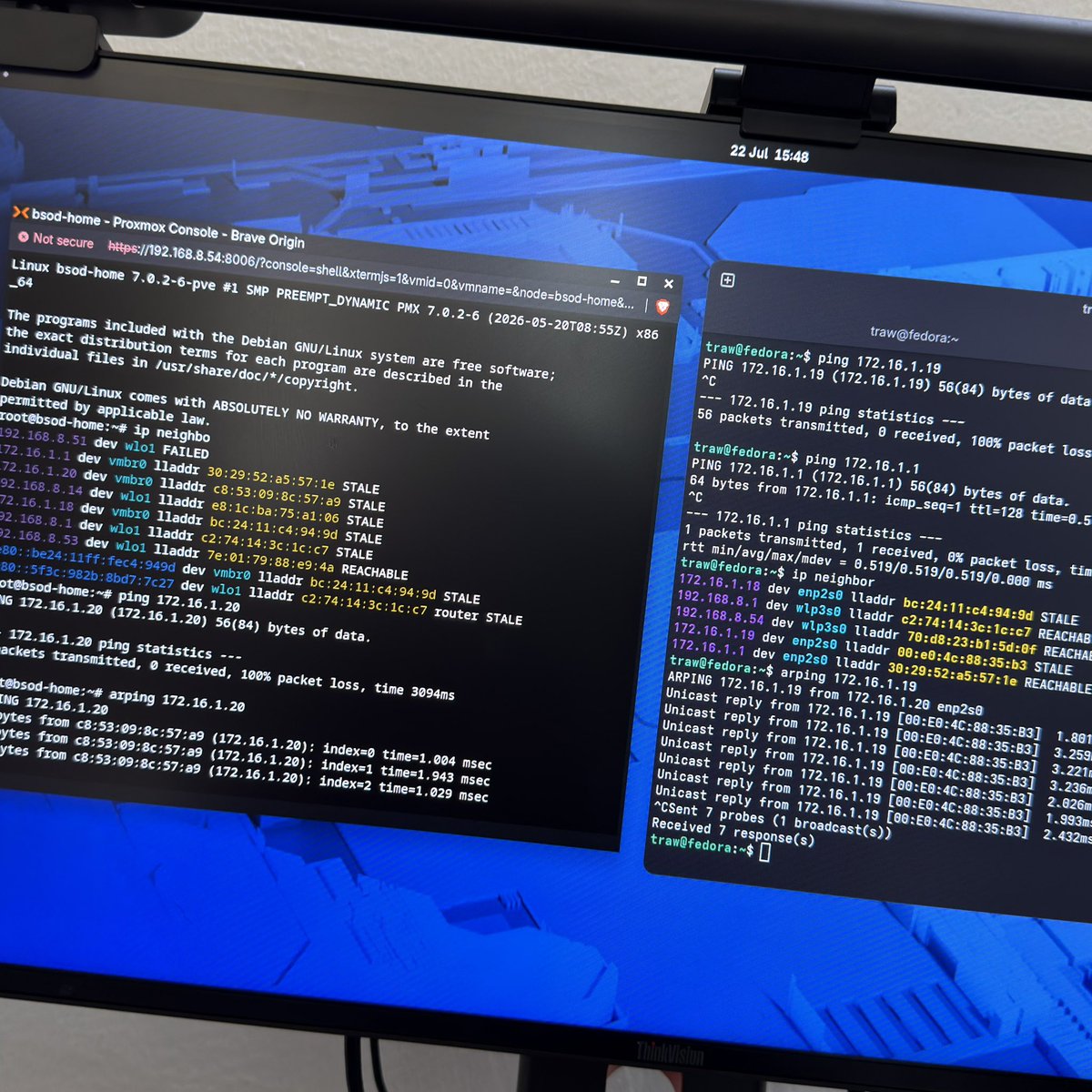
A lot of people know ping for testing Layer 3 connectivity, but arping is incredibly useful when troubleshooting Layer 2. While setting up my lab, my PC and Proxmox server were connected to a Hillstone zone-based firewall using a VSwitch. Both interfaces were in the same l2-trust zone, on the same subnet, with no VLAN separation. Both devices could ping the default gateway, but they could not ping each other. I checked the ARP tables using: $ arp -an $ ip neigh Both devices had learned each other’s MAC addresses. I then tested direct Layer 2 reachability with arping. arping worked, proving that ARP resolution and Layer 2 forwarding were functioning correctly. That narrowed the issue down to IP traffic. The firewall was allowing ARP so the devices could resolve each other’s MAC addresses, but it was blocking IPv4 traffic between devices in the same Layer 2 security zone. The fix was to create an explicit policy allowing: l2-trust → l2-trust
TRÄW🤟 tweet media
TRÄW🤟@thatstraw

Setting up CML 2 for CCNP labs. ✌️

English
1
8
40
4.5K
Rahil retweetledi
Suryakant Chaurasiya
Suryakant Chaurasiya@heyitsurya·
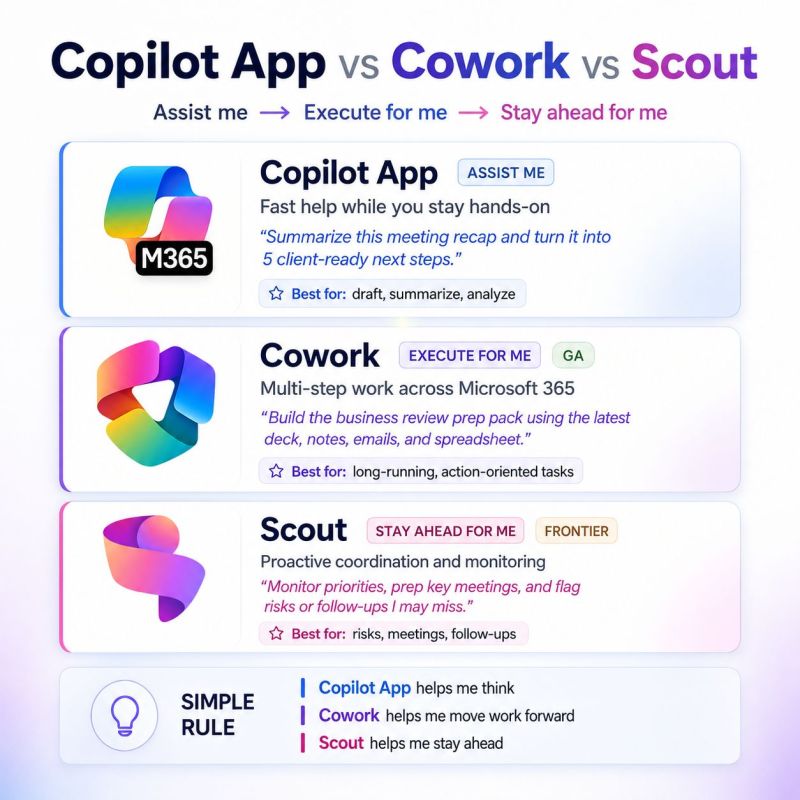
Copilot App vs Cowork vs Scout 𝗕𝗲𝗰𝗼𝗺𝗲 𝗯𝗲𝘁𝘁𝗲𝗿 𝗮𝘁 𝗔𝗜 𝗶𝗻 𝗷𝘂𝘀𝘁 𝟭 𝗺𝗶𝗻𝘂𝘁𝗲 𝗮 𝗱𝗮𝘆. 𝗚𝗲𝘁 𝘁𝗵𝗲 𝗔𝗜 𝗻𝗲𝘄𝘀𝗹𝗲𝘁𝘁𝗲𝗿 𝘀𝗺𝗮𝗿𝘁 𝗹𝗲𝗮𝗱𝗲𝗿𝘀 𝗿𝗲𝗮𝗱. 𝗦𝗶𝗴𝗻 𝘂𝗽 𝗳𝗿𝗲𝗲 𝗻𝗼𝘄 → tinyurl.com/mvsz79eu __________ 🚨 Cowork is GA, so here's the cheat sheet I'd use before opening Copilot The choice depends on the motion: ▶️ Copilot App = assist me Use it when I want fast help while I stay hands-on: summarize a Teams thread, draft an email, compare files, brainstorm a point of view, or ask questions across work context. Copilot Chat is a place to draft, summarize, analyze, and explore ideas Example: 'Summarize this meeting recap and turn it into 5 client-ready next steps' ▶️ Cowork = execute for me Use it when the task is multi-step, long-running, and needs action across Microsoft 365. Cowork is now generally available worldwide for Microsoft 365 Copilot customers Example: 'Create a prep pack for next week's business review using the latest deck, notes, emails, and spreadsheet' ▶️ Scout = stay ahead for me (requires Copilot 365 + GitHub Copilot) Use it when the goal is proactive coordination: surfacing risks, preparing for meetings, monitoring priorities, or handling routine tasks. Scout is currently part of Frontier Example: 'Flag schedule conflicts, prep me for key meetings, and monitor follow-ups I may miss' Simple rule: Copilot App helps me think Cowork helps me move work forward Scout helps me stay ahead - Follow @heyitsurya For Daily useful Twitte
Suryakant Chaurasiya tweet media
English
15
24
73
1K
Rahil retweetledi
Dhairya
Dhairya@dkare1009·
Learn AI for FREE from the companies building it. 🚀 Here are 10 of the best official learning resources: 1️⃣ Anthropic anthropic.skilljar.com 2️⃣ Google AI grow.google/ai 3️⃣ Meta AI ai.meta.com/resources/ 4️⃣ NVIDIA developer.nvidia.com/cuda 5️⃣ Microsoft Learn learn.microsoft.com/training/ 6️⃣ OpenAI Academy academy.openai.com 7️⃣ IBM SkillsBuild skillsbuild.org 8️⃣ AWS Skill Builder skillbuilder.aws 9️⃣ DeepLearning.AI deeplearning.ai 🔟 Hugging Face Learn huggingface.co/learn 📌 Bookmark this list for future reference. ♻️ Share it with someone learning AI. Which platform would you recommend adding to this list? 👇 #AI #MachineLearning #LLM #DeepLearning #LearnAI #Tech
Dhairya tweet media
English
1
39
88
3.2K
Rahil retweetledi
Hacking Articles
Hacking Articles@hackinarticles·
🚨 One Windows Privilege. One Misconfiguration. SYSTEM Access. 🔥 SeRestorePrivilege is designed for backup & restore operations... But when abused, it can become a powerful Windows Privilege Escalation vector. In this hands-on lab you'll learn: 🔓 What SeRestorePrivilege is ⚡ Why it matters 🛠️ Practical exploitation 💥 Real-world privilege escalation 🛡️ Detection & Mitigation 📖 Read the complete walkthrough: hackingarticles.in/windows-privil… 🔥 Telegram: t.me/hackinarticles ✴️ Twitter: x.com/hackinarticles ⭐ Bookmark it for your Windows PrivEsc notes. ♻️ Repost to help the cybersecurity community. #Windows #PrivilegeEscalation #CyberSecurity #OSCP #RedTeam #Pentesting #EthicalHacking #ActiveDirectory
Hacking Articles tweet mediaHacking Articles tweet mediaHacking Articles tweet mediaHacking Articles tweet media
English
0
10
62
9.9K
Rahil retweetledi
freeCodeCamp.org
freeCodeCamp.org@freeCodeCamp·
Internal developer platforms can help teams ship faster without managing infrastructure by hand. In this guide, Ayobami teaches you how to build one with Backstage, ArgoCD, and Crossplane. You’ll learn how to connect these tools into a self-service platform for deploying apps and provisioning infrastructure. freecodecamp.org/news/how-to-bu…
freeCodeCamp.org tweet media
English

4
61
365
36.9K
Rahil retweetledi
Dan Kornas
Dan Kornas@DanKornas·
Running AI agents means managing more than model calls. Coral Server is the Kotlin server behind CoralOS for teams building and operating AI-agent systems. It helps you manage the path from agents to deployment by combining a registry, runtimes, authentication, and orchestration in one configurable service. Key features: • Agent registry – organizes the agents available to your system • Docker runtime – runs agents in containers from the published server image • Key-based authentication – loads required auth keys from TOML or command-line arguments • Flexible configuration – maps nested properties, collections, and simple data types to CLI options • Two launch paths – run it with Gradle or use the image published on GitHub Container Registry The README and connected docs are marked as works in progress. The minimal Docker image also requires access to the host Docker socket and supports Docker-based agents only. Free public GitHub repo. Link in the reply 👇
Dan Kornas tweet media
English
2
3
12
2.8K
Rahil retweetledi
Sonal Shukla
Sonal Shukla@sonalshukla3377·
♦️𝗔𝗜 𝗧𝗢𝗢𝗟𝗦 𝗧𝗛𝗔𝗧 𝗠𝗔𝗞𝗘 𝗬𝗢𝗨 𝗨𝗡𝗦𝗧𝗢𝗣𝗣𝗔𝗕𝗟𝗘 • Ideogram – Ultra-realistic images with perfect text. • Midjourney – High-end visuals for brands & thumbnails. • Runway AI – Text-to-video, motion effects, green screen removal. • OpusClip – Turns long videos into viral shorts. • Recraft AI – Icons, vectors, illustrations instantly. • Tome AI – Auto-designed presentations from one prompt. • Durable AI – Builds complete websites in seconds. • DoNotPay – AI lawyer for bills, disputes, cancellations. • Krisp AI – Removes background noise on calls. • SlidesAI – Turns text into clean professional slides. • Mistral AI – Fast, lightweight AI for instant tasks. • Pi.ai – Emotional, supportive conversational AI. • HeyGen – AI avatar videos in your voice & face. • Luma AI – 3D models & product shots from your phone. • Fireflies AI – Meeting notes, summaries, action items. • Gamma AI – Auto-created presentations & documents. • Vidyo AI – Converts long videos into short viral clips. • Magnific AI – Ultra-detail photo upscaling. • Grok AI – Real-time AI search engine. • Leonardo AI – Pro-level art, assets, and designs. • Synthesia – AI avatar videos with clean voiceovers. • Claude Artifacts – Generates mini apps & dashboards. • Taskade AI – AI workspace for tasks & notes. • AdCreative AI – High-converting ad creatives fast. • InVideo AI – Creates full videos from a script. • Copy.ai – Ads, emails, scripts in seconds. • Rephrase AI – Personalised AI video messages. • Suno AI – Original songs & vocals from text. • Uizard – Turns sketches into UI designs. • Jasper AI – Brand-safe writing & content. • Looka – Logos & full brand kits instantly. • Imgs.ai – Auto-generated product photos. • MarketMuse – AI for SEO & content strategy. • QuillBot – Rewrites & improves writing. • Speechify – Turns any text into audio. ❤️ Like 🔁 Retweet 🔖 Bookmark Follow @sonalshukla3377 for more such posts
Sonal Shukla tweet media
English
31
56
172
4.8K
Rahil retweetledi
Vivek | Cybersecurity
Vivek | Cybersecurity@VivekIntel·
🦠 𝗙𝗥𝗘𝗘 𝗥𝗲𝘀𝗼𝘂𝗿𝗰𝗲𝘀 𝘁𝗼 𝗟𝗲𝗮𝗿𝗻 𝗠𝗮𝗹𝘄𝗮𝗿𝗲 𝗔𝗻𝗮𝗹𝘆𝘀𝗶𝘀 ➊ Malware Unicorn 🔗 malwareunicorn.org Free malware analysis workshops, reverse engineering tutorials, and training materials. ➋ Malware Traffic Analysis 🔗 malware-traffic-analysis.net Real-world PCAPs, malware traffic, phishing samples, and forensic exercises. ➌ ANY.RUN 🔗 any.run Interactive online sandbox for dynamic malware analysis and threat investigation. ➍ REMnux 🔗 remnux.org Linux toolkit for malware analysis, reverse engineering, and incident response. ➎ CyberDefenders 🔗 cyberdefenders.org Hands-on DFIR, malware analysis, and threat hunting labs. ➏ Hybrid Analysis 🔗 hybrid-analysis.com Cloud-based malware sandbox for analyzing suspicious files and extracting IOCs. 📌 Learn how malware behaves, analyze it safely, and identify indicators of compromise (IOCs). #MalwareAnalysis #ReverseEngineering #DFIR #ThreatIntel #CyberSecurity #InfoSec #REMnux #ANYRUN #HybridAnalysis #CyberDefenders #BlueTeam
English
0
19
90
3K
Rahil retweetledi
Purbayan Pramanik
Purbayan Pramanik@ppramanik62·
Virtual nodes let one physical server own many small, separated ranges instead of one large range. Rather than placing s0 once on the ring, place several derived identities such as s0_0, s0_1, and s0_2. Each virtual node still uses the same clockwise lookup rule. - Once found, it resolves back to its physical server. Now each server owns multiple partitions distributed around the ring. - A large gap at one of its positions is less likely to determine its entire share of the keyspace. Virtual nodes change the topology, not the ownership rule. The lookup remains "first clockwise node" - there are simply more positions representing each machine.
Purbayan Pramanik tweet media
English
0
3
28
491
Rahil retweetledi
Edgex
Edgex@SahilExec·
Be honest, which one feels more future-proof for developers? Local-first apps or Cloud-native apps
Edgex tweet media
English
16
3
22
673
Rahil retweetledi
Shubh Jain
Shubh Jain@shubh19·
Day 3 of #DevOps from Zero to Hero🚀 Salary Benchmarks (2026): • 0–2 YOE → ₹4–8 LPA → DevOps Intern, Junior DevOps Engineer, Cloud Support Engineer • 2–4 YOE → ₹8–18 LPA → DevOps Engineer, Cloud Engineer • 4–7 YOE → ₹18–35 LPA → Senior DevOps Engineer, SRE, Platform Engineer • 7–10 YOE → ₹30–55 LPA → Lead DevOps Engineer, Staff SRE, Platform Lead • 10+ YOE → ₹45 LPA–₹1 Cr+ → DevOps Architect, Principal SRE, Engineering Manager Top Companies: 1. Product Companies - Microsoft - Google - Amazon - Atlassian - Adobe - Oracle - Salesforce - ServiceNow SaaS Companies - Freshworks - Zoho - Postman - BrowserStack - Chargebee - Druva FinTech - Razorpay - PhonePe - Groww - Zerodha - CRED GCCs - SAP - Thomson Reuters - JP Morgan Chase - Wells Fargo - Goldman Sachs - American Express - Target - Walmart Global Tech Cloud & Consulting - Deloitte - Accenture - IBM - Capgemini - Cognizant - TCS - Infosys - Wipro Companies are hiring for: - DevOps Engineer - Site Reliability Engineer (SRE) - Cloud Engineer - Platform Engineer - Infrastructure Engineer - MLOps Engineer - AI Infrastructure Engineer Career Path📈 Cloud Support → Junior DevOps → DevOps Engineer → Senior DevOps → SRE → Platform Engineer → DevOps Architect The best part? A strong DevOps foundation also opens doors to Cloud Engineering, SRE, Platform Engineering, MLOps, and AI Infrastructure.
Eesti
2
7
48
2.9K
Rahil retweetledi
Camila
Camila@AiCamila_·
Agent Tool Result Validation and Quality Gates Agents often trust tool outputs without checking them. Adding validation and quality gates after tool execution helps catch errors, incomplete results, or unexpected data before the agent continues. This is becoming essential for reliable agent workflows. As a dev, I now implement post-tool validation in production agents. Tool Result Validation Cheatsheet: Define expected structure and quality rules for tool outputs Validate results before using them in further reasoning Handle validation failures with clear fallback logic Log validation failures for monitoring Combine schema checks with semantic validation when needed Pro tip: Validating tool results early prevents many downstream agent failures How are you validating tool outputs in your agents? Reply below 👇 Follow @AiCamila_ for daily production AI + DevOps tips. #ToolValidation #QualityGates #ProductionAI #AgenticAI #Reliability
Camila tweet media
English
6
10
46
694
Rahil retweetledi
Mashood tried Ops
Mashood tried Ops@fromcodetocloud·
7 database mistakes that silently kill prod performance: 1. No indexes on foreign keys Full table scans on every join. Your app slows down gradually. You never notice why. 2. SELECT * everywhere Pulling 50 columns when you need 3. Wasteful at scale. 3. N+1 queries 1 query per item in a loop. 1000 items = 1000 queries. App dies under load. 4. No connection pooling Opening new DB connections per request. Destroys performance under traffic. 5. Migrations without a plan in prod Table locks at peak traffic. Have fun explaining that outage. 6. No slow query log Flying completely blind on what's actually slow. 7. Storing blobs in the DB Use S3. Store the URL. Your DB is not a file system. Most app slowdowns are database slowdowns in disguise.
Mashood tried Ops tweet media
English
10
7
34
944
Rahil retweetledi
Praveen Kumar Verma
Praveen Kumar Verma@Alacritic_Super·
Want to learn how computers actually work? Forget web apps. Build an operating system kernel from scratch in Rust: 1. Bare-metal Rust setup 2. Custom VGA text mode 3. CPU interrupts & paging 4. Memory management from first principles The ultimate rite of passage for systems engineers: github.com/phil-opp/blog_…
Praveen Kumar Verma tweet media
English
0
6
35
834
Rahil retweetledi
RayPCB
RayPCB@RaymingTech·
Types of Converters
RayPCB tweet media
English
1
106
514
10.1K
Rahil retweetledi
Dr Milan Milanović
Dr Milan Milanović@milan_milanovic·
WhatsApp supported 450 million daily users with just 32 engineers No Kubernetes and no microservice architectures Just a small group solving one clear problem: Replace SMS, reliably, at scale If anyone asked you if this is possible, you would probably say no But the solution isn't more frameworks, tools, or ceremonies The solution is simplicity, deep focus, and talent When Facebook bought them for $19 billion, the whole company was around 55 people Hire great engineers, clear their path, and let them build
Dr Milan Milanović tweet media
English
5
11
43
3.6K