ACINT Rider

2.3K posts

ACINT Rider banner
ACINT Rider

ACINT Rider

@ACINTRider

Retired Navy Master Chief. Cold Warrior, intell guru, collector of rare and unusual submarines. I know a thing or two, because I’ve heard a thing or two.

Oregon, USA Katılım Ocak 2019
890 Takip Edilen959 Takipçiler
ACINT Rider retweetledi
Chris Rollins
Chris Rollins@ThePowerAudit·
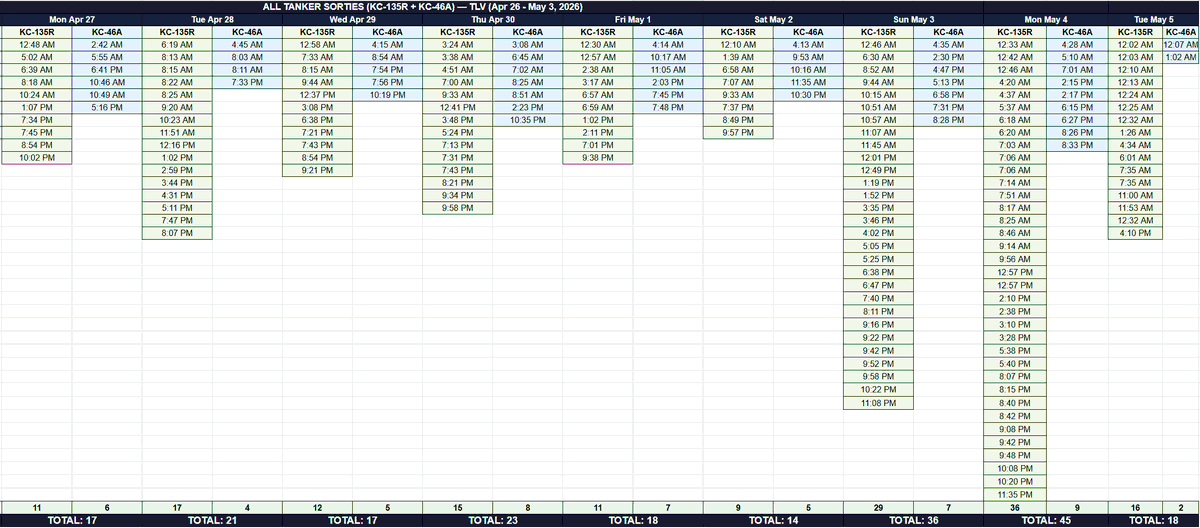
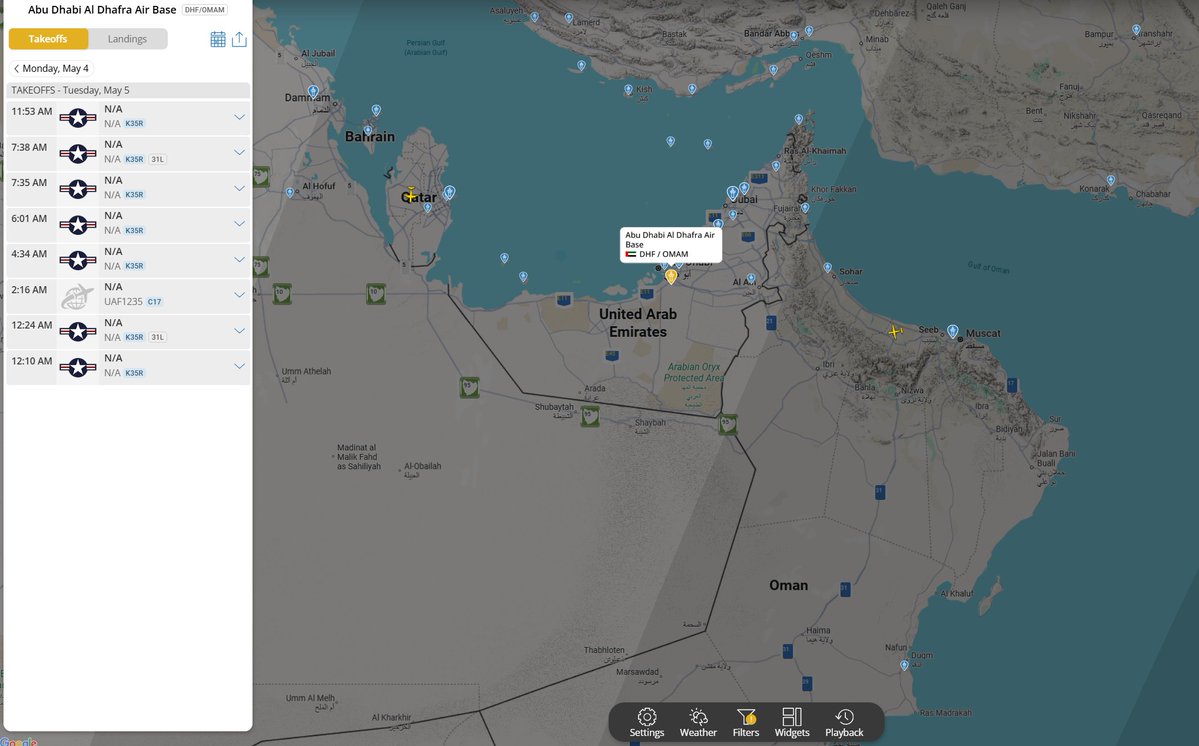
Tanker operations transitioned overnight from Tel Aviv to Al Dhafra Air Base in UAE. Closer to the operational area, and a faster turnaround. There are still a few out of Tel Aviv but I have updated the tracker to include both, which doesn't change the numbers on previous days. 18 takeoffs is above the baseline but below the Sunday/Monday surge, while admittedly there could be other locations or dark takeoffs not visible.
Chris Rollins tweet mediaChris Rollins tweet media
English
4
9
72
8K
ACINT Rider retweetledi
Chris Rollins
Chris Rollins@ThePowerAudit·
US Navy confirmed inside the IRGC "Red Line" Satellite confirmation of US Ships inside the Persian Gulf by @tom_bike WSJ reported that Project Freedom would not involve US Navy escorts entering the Gulf. CENTCOM's own announcement laid out the real picture: guided-missile destroyers, over 100 land and sea-based aircraft, multi-domain unmanned platforms, and approximately 15,000 service members. This morning Hegseth described it as a "red, white, and blue dome" over the Strait. The ships are exactly where CENTCOM said they would be. Coordinates place them 55km off Dubai covering the anchorages where hundreds of trapped commercial vessels are waiting to transit.
Tom Bike@tom_bike

Two US 🇺🇸 destroyers confirmed to be inside Persian Gulf after transiting Strait of Hormuz by satellite image TODAY 👇 Spotted doing UAE 🇦🇪 ship anchorages missile defense at 25.4042, 54.7606 25.4562, 54.7382

English
8
32
153
24.5K
Chris Rollins
Chris Rollins@ThePowerAudit·
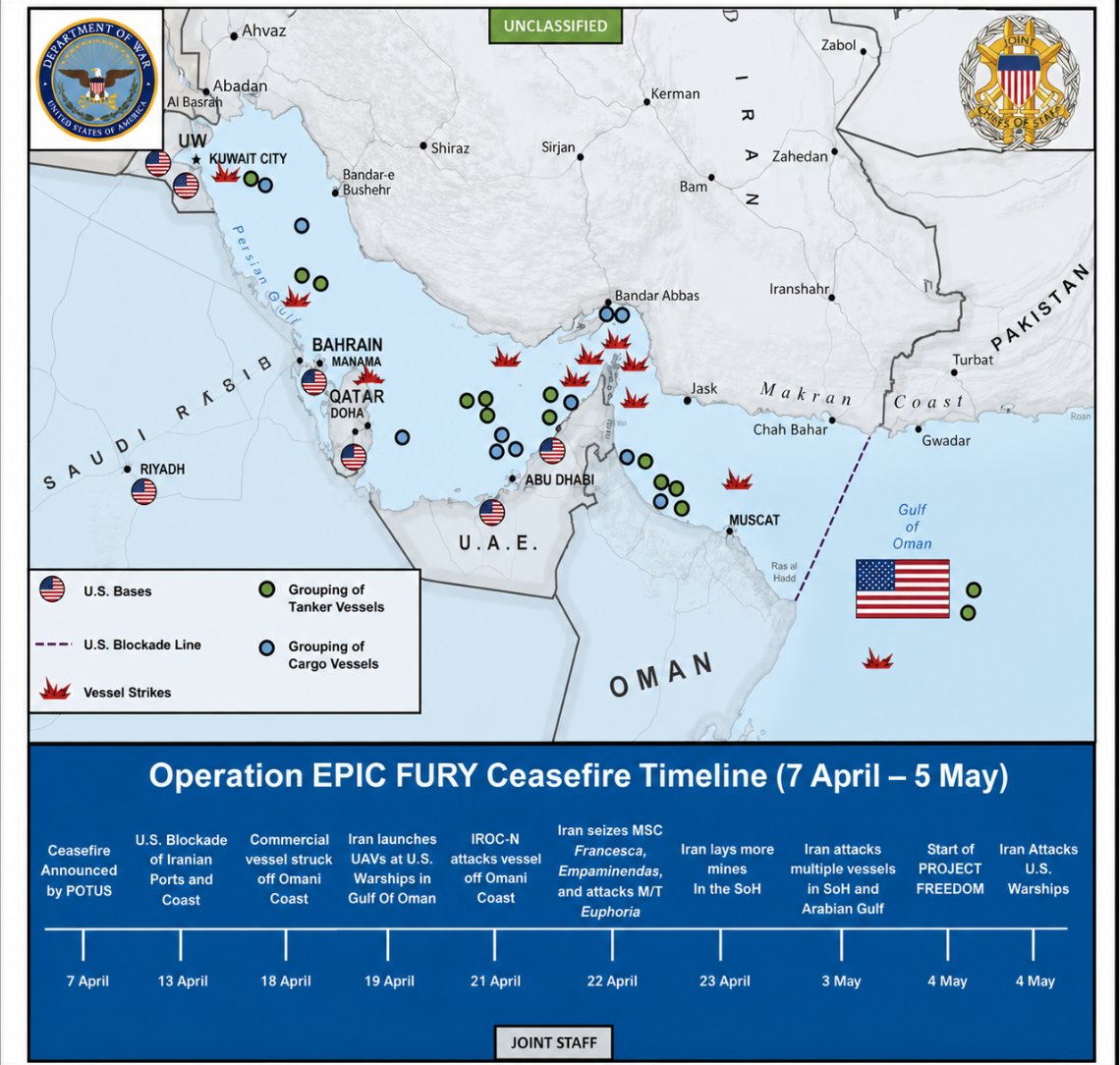
Hegseth/Caine presser recap and analysis: The Joint Staff displayed an official ceasefire violation timeline on screen. Every Iranian escalation since April 7 documented in sequence: blockade, vessel strikes off Oman, UAVs at US warships, mine-laying, ship seizures, and culminating with the attacks on US warships May 4. That is a legal presentation at the Pentagon podium with DOW and JOINT STAFF stamped on it. They are building the public record for whatever comes next. Worth noting: Iranian accounts tracked increased US fighter activity over Iraq on April 23. The Joint Staff timeline shows Iran laid more mines in the Strait that same day. Iran may have been reacting to what they assessed as pre-strike positioning. Key numbers from Caine: 6 ships tried to run the blockade out of Iranian ports during Project Freedom launch. All turned around. 22,500 mariners on 1,550+ commercial vessels remain trapped. Iran fired at commercial vessels 9 times and seized 2 container ships. Iran attacked US forces more than 10 times. Small coastal cruise missiles were shot down in addition to fast boats and drones. Iran attacked Oman yesterday. Separately from the UAE strikes. Oman has served as the neutral back-channel mediator throughout this conflict. Iran is now attacking its own diplomatic lifeline. That is a strategic miscalculation that should not be overlooked. On the threshold for restarting major combat operations, Caine said Iran's attacks are currently "below the threshold." When asked what that threshold is: "That's a political decision above my pay grade." Hegseth: "The President retains more capabilities than we had at the start of this to restart major combat operations if necessary." The ceasefire "certainly holds" but the US is "locked, loaded, and ready to go" in a "three-point stance." Caine on Iran's military: "Their command and control structure remains very fractured. They're struggling to maintain control down echelon at the edge." This again is key, because if you consider peaceful options on the table, let's realistically play out how that eventually goes with the IRGC? Someone with a missile or weapon won't like it regardless of whatever could get signed or agreed upon unless it was a victory for the IRGC which won't happen. My read here is that the IRGC at this point cannot be negotiated with and kinetic action is likely, not in the form of say traditional US middle east wars, the US proved with Venezuela with the power of our tech/intel and AI we are capable of more deliberate and well planned targeted operations. The people in Iran will play a part of this eventually. They bled in the streets for change in January, the US just has to set the right conditions and they are prepared on the strike side and legal side when that happens.
Chris Rollins tweet media
English
16
84
287
22.1K
ACINT Rider
ACINT Rider@ACINTRider·
@ThePowerAudit Thanks for your frequent updates. I’m a retired intell guy and I really appreciate your sourcing and your analysis. Keep up the good work.
English
1
1
7
209
ACINT Rider
ACINT Rider@ACINTRider·
@DaleStarkA10 We weren’t born in Oregon, but we got here as quick as we could. Found our forever home in Roseburg. Love it.
English
0
0
1
29
Dale Stark
Dale Stark@DaleStarkA10·
Lived all over the world, had a great adventure, but always felt like a visitor anywhere else. Never leaving the Oregon coast.
English
60
10
742
14.4K
ACINT Rider
ACINT Rider@ACINTRider·
@MikeyDiMercurio Shipmate, you’re a submariner, a member of an exclusive group that very few aspire to, let alone excel at as you have. As shipmates, we all care for each other, as our very lives depend on one another. You inspire us with your daring tales. Keep it up.
English
0
0
0
10
ACINT Rider
ACINT Rider@ACINTRider·
@grey4626 Or, just crater the highways. Jack is a serial thinker in a parallel world.
English
0
0
0
138
LHGrey™️
LHGrey™️@grey4626·
TIME TO FUCK UP THE BRIDGES! The hour for elegant, surgical annihilation has arrived. Pakistan just flung open six gleaming overland transit corridors from Karachi and Gwadar straight into Iran’s waiting arms at Gabd and Taftan. Trucks rolling third-country cargo under the thin veil of “customs rules,” supposedly to unstick 3,000+ containers strangled by the Hormuz naval choke. Cute. Predictable. And catastrophically shortsighted. This isn’t trade policy. This is logistical betrayal dressed in diplomatic silk. Tehran, bleeding from naval pressure it cannot match, has found its terrestrial artery: highways slicing through Balochistan’s jagged passes, numbered routes engineered for heavy haul, now repurposed as a sanctions-evasion superhighway for machinery, components, industrial inputs, and whatever else keeps the regime’s war machine breathing. Pakistan just handed the mullahs a bypass valve precisely when the maritime noose was tightening. Classic multipolar chess from Islamabad...hedging bets, cashing in on chaos, and daring the real players to notice. Wrong move. Bridge Day demands precision, not petulance. We are not talking indiscriminate mayhem. We are talking calibrated, psychology-shredding disruption executed with the cold elegance of a master strategist. Target the chokepoints: the bridges spanning those high-altitude passes, the narrow defiles where a single precision strike turns a six-lane artery into a parking lot of twisted rebar and stranded tonnage. Deny the flow without flattening cities. Collapse the logistics backbone so thoroughly that every trucker from Karachi to Taftan recalculates risk in his bones. Make the cost exponential...insurance premiums through the roof, security detachments bled dry, Baloch insurgents suddenly finding new purpose and fresh incentives. Geopolitically, this is pure oxygen to a regime already gasping. Cut it off and you don’t just slow Iran; you humiliate the enablers. Pakistan’s generals will feel the tremor in their command bunkers: the realization that their shiny new corridors are now high-value, low-defense targets in a theater where air superiority and standoff munitions laugh at ground patrols. The psychology is delicious...nothing breaks an adversary’s will faster than watching their “clever workaround” become the very symbol of their vulnerability. Every burned-out truck, every cratered overpass, every convoy turned into a smoking monument sends the same venomous message: Your pivot failed. Your sanctuary is a shooting gallery. There is no escape hatch we cannot weld shut. This is not rage. This is doctrine. Sun Tzu would approve; Clausewitz would call it the continuation of policy by other, far more honest means. Maintain the maritime pressure on Hormuz, then surgically cauterize the land bridge. Force the enemy into the open sea where they are weakest or starve them on land where they think they are safe. Either way, the regime’s lifeline becomes its noose. Bridge Day is now. Let the routes burn with clinical ferocity. Let the message echo from the Gulf to the Hindu Kush: attempt to circumvent the inevitable and you will be met with lethality wrapped in sophistication. No mercy for logistical traitors. No sanctuary for the desperate. Only the elegant, final mathematics of superior strategy. The bridges await. Time to teach them the true cost of choosing the wrong side of history.​​​​​​​​​​​​​​​​​​​​​​​​​​​​​​​​​​​​​​​​​​​​​​​​​​ 💀⚖️🗡️
Jack Prandelli@jackprandelli

🇵🇰Pakistan just opened 6 land corridors to Iran. 6 overland routes from Karachi and Gwadar straight to the Iranian border Gabd, Taftan, multiple variants. 3rd country goods can now transit Pakistan to Iran by truck under customs oversight. 3,000+ containers were sitting stranded in Karachi, unable to sail because of Hormuz. They now have a road. Pakistan presents this as trade policy. The effect is strategic: it punches a hole in the economic logic of the US naval blockade. The blockade controls the sea not the Karakoram Highway. Oil and bulk energy flows are still choked trucks can't replace tankers at that scale. But machinery, consumer goods, industrial inputs, and 3rd-country cargo can now reach Iran overland. These corridors can carry Chinese or other foreign goods into Iran under Pakistani transit rules. Every country that trades with Iran and doesn't want to pick a side is watching. The naval blockade is still the dominant pressure. But it just got flanked.

English
108
577
1.8K
75.7K
ACINT Rider retweetledi
Acting Secretary of the Navy Hung Cao
We are a maritime nation, bordering on both the Atlantic and the Pacific. Our commerce depends on safe and secure sea lanes of communication. President Trump’s commission to our military is simple: to achieve Peace Through Strength. The USS Idaho joins the fleet ready to answer the call to action, in any ocean, at any time.
English
331
2.5K
15.8K
491.4K
🇺🇸𝗢𝗹𝗱 𝗦𝘂𝗯𝗺𝗮𝗿𝗶𝗻𝗲𝗿⚓️
Today, the last 700 series hull enters the fleet as Idaho SSN-799 is commissioned. The first, Dallas SSN-700, was commissioned 45 years ago. 94 boats in the series (744-749) reserved for Ohio-class boomers that were cancelled.
🇺🇸𝗢𝗹𝗱 𝗦𝘂𝗯𝗺𝗮𝗿𝗶𝗻𝗲𝗿⚓️ tweet media🇺🇸𝗢𝗹𝗱 𝗦𝘂𝗯𝗺𝗮𝗿𝗶𝗻𝗲𝗿⚓️ tweet media
English
9
42
361
46.1K
ACINT Rider retweetledi
MoniqueforCongress
MoniqueforCongress@MoniqueforOR·
I’m standing in Eugene, Oregon — a city with the highest homelessness rate per capita in the United States. While Congresswoman Val Hoyle has accumulated extraordinary wealth during her three years in Congress, the neighborhoods she represents have fallen deeper into crisis.
English
85
439
1.4K
23.2K
ACINT Rider retweetledi
U.S. Central Command
U.S. Central Command@CENTCOM·
U.S. forces have now redirected 33 vessels since the start of the blockade against Iran.
U.S. Central Command tweet media
English
230
1.2K
5.8K
271.2K
ACINT Rider retweetledi
Gary Brode
Gary Brode@Gary_Brode·
The Strait of Hormuz Reverse Uno Card When Raji Khabbaz and I were running Silver Arrow Investment Management, whenever we were trying to figure out why something happened, he was unsatisfied the explanation that people are sometimes stupid and institutions are often stupid. He correctly thought that people usually have a good reason (at least to them) for doing something even if it appears to make little sense to an outsider. More importantly, he thought that “sometimes people are stupid” was a lazy answer that was dismissive. As investors, it was our goal to understand what was happening, not to ignore it. Recently, I’ve written that many of President Trump’s critics are making the same error. When Iran closed the Strait of Hormuz, the narrow waterway that previously transported 20% of the world’s oil supply, the price of oil rose. Gas prices in the US have risen in response. Many screamed that this was an obvious move by the Iranian regime and insisted President Trump should have known it was something they’d do. How could he not know?! In 2002, the US Navy conducted war games they called the Millennium Challenge. One side represented Iran. The other represented the technologically superior US Navy and included an aircraft carrier, warships, and cruisers. The US Navy side had a substantial advantage in firepower. Retired Marine Corps Lieutenant General Paul K. Van Riper used asymmetric warfare tactics to wipe out the US side in one day. Had this been a real fight, the US would have lost 20,000 servicemen. The result was such an embarrassment that the Navy re-floated the sunk ships, changed the rules of engagement to ensure a US victory, and started the challenge again. These games were not a secret. They have been widely covered in the mainstream media and have been the subject of a New York Times documentary. Over the past two decades, I have seen the Millennium Challenge discussed in my daily financial news reading at least a dozen times. The event has its own Wikipedia page. Regardless of your opinion of President Trump, do you really believe that neither he, nor anyone in the White House, nor any of his military advisors, nor Secretary of War, Hegseth knew about this? I realize that many of you reading this have strong negative emotions regarding President Trump. I’m not asking you to like or respect him. I’m just suggesting that “he’s stupid and has no idea what he’s doing” is not good analysis. This is a point I’ve made in this space in the past. Early in the war, Iran closed the Strait which placed economic pressure on the rest of the world. Despite the fact that it was Iran mining the Strait and shooting at the ships that attempted to navigate it, many countries expressed anger at the US and Israel. This was the outcome Iran wanted. Then, the regime decided to allow friendly ships to pass if they paid a fee. The fees were about $1/barrel of oil, or about $2MM per large container vessel. (Many of these fees were paid in Bitcoin, something macro analyst, @peruvian_bull, explained in an excellent post within the past week.) This looked like worst-case scenario for the US. Iran succeeded in closing the Strait and causing economic problems all over the world, then found a way to profit from their own actions. Then, President Trump played his “reverse uno” card. He correctly realized that it wasn’t just the rest of the world that depended on free passage through the Strait of Hormuz, and that it was Iran that had the most exposure. Iran is a big oil producer, and oil exports account for 80% of Iran’s exports, 60% of government revenue, and 25% of its GDP. It turns out that Iran has more economic exposure to this narrow waterway than anyone else. President Trump sent the US Navy to form a blockade. He closed the Strait himself ensuring no more $2MM/vessel charges and an inability for Iran to export oil. Iran is close to filling its own storage. Once its oil tanks are full, the regime has two choices, either capitulate and come to an agreement with the US, or to stop producing from its own wells. The problem with the second choice is that it’s difficult to reverse. Stopping production on an active oil well tends to damage it and it’s hard to re-start later. Iran now has a limited amount of time to find a course of action before 25% of its GDP becomes permanently(ish) impaired. While no one in the US likes paying more for gas, prices were much higher just four years ago in 2022 and around $4/gallon in 2008, 2011, and 2012 when $4 had more purchasing power than it does now. The US is a net energy exporter with an economy that has survived higher prices in the past. Foreign ships are turning away from the Strait of Hormuz and sailing to Texas and other southern US ports to fill up at premium prices. I’m not suggesting that this is great for the US; but rather, that the US is well-suited to manage the situation while Iran is about to be faced with a massive long-term problem. Finally, Iran maintains control of the country using extensive human infrastructure. There are police everywhere monitoring protests, internet usage, the attire of citizens, and the hair of Iranian women. That level of control is expensive and the government just lost 60% of its revenue. I’m wondering how long they’ll keep doing their jobs without paychecks. I don’t know how this conflict will end. What I do know is that President Trump and the US Navy have turned Iran’s biggest strategic strength into a giant weakness. Sometimes people do stupid things. And sometimes, we just aren’t seeing the reasoning behind those actions. Last week, one of DKI’s interns wrote, ”The bottom line is that (financial analysis) can tell you what the market’s pricing in, but it’s your job to figure out why”. Right now, the mullahs are facing a difficult decision. It will be interesting to see what comes next.
English
120
279
1.4K
590.9K
ACINT Rider retweetledi
Apple Lamps
Apple Lamps@lamps_apple·
ABC News aired what looks like blatant Iranian state propaganda on U.S. television. The footage is clearly staged... cinematic and likely AI-generated... and yet viewers are given no warning or context. ABC needs to address this IMMEDIATELY and issue a retraction.
Apple Lamps@lamps_apple

x.com/i/article/2045…

English
168
915
3.7K
172.3K
ACINT Rider retweetledi
U.S. Central Command
U.S. Central Command@CENTCOM·
U.S. forces have directed 29 vessels to turn around or return to port as part of the U.S. blockade against Iran. Over past 24 hours, media reports have alleged that several commercial ships evaded the blockade, citing M/V Hero II, M/V Hedy, and M/V Dorena as examples. These reports are inaccurate. Hero II and Hedy did not sail past the blockade as part of a flotilla that “ferried” millions of barrels of oil to the market. In fact, the Iranian-flagged tankers are anchored in Chah Bahar, Iran, after being intercepted by U.S. forces earlier this week. Dorena has been under the escort of a U.S. Navy destroyer in the Indian Ocean after previously attempting to violate the blockade. The U.S. military has global reach. American forces are operating and enforcing the blockade across the Middle East and beyond.
U.S. Central Command tweet media
English
938
6.1K
25.8K
1.8M
ACINT Rider retweetledi
Nick shirley
Nick shirley@nickshirleyy·
🚨 Here is 10 minutes of me confronting the California politicians who authored the "Stop Nick Shirley Act"... When confronted about AB 2624: - Lied about authoring the bill - Couldn't justify the bill - Acted like they didn't know about the bill This bill will CRIMINALIZE exposing fraud, violates the 1st Amendment, protects NGOs from disclosing taxpayer dollars, and these politicians see no problem with it. The fraud is now exposed and they need new laws to hide it. EXPOSE ALL THE FRAUD.
English
2.8K
28.5K
112.4K
2.1M
ACINT Rider
ACINT Rider@ACINTRider·
@Osint613 MV Touska track appeared headed into Chabahar. Intercept was about 48 nm from port.
ACINT Rider tweet media
English
0
0
0
230
Open Source Intel
Open Source Intel@Osint613·
MUST WATCH 🔴 CENTCOM: On April 19, U.S. forces in the Arabian Sea enforced the blockade by intercepting the Iranian flagged M V Touska heading to Bandar Abbas at 17 knots. USS Spruance (DDG-111) issued repeated warnings over 6 hours. After non compliance, the crew was ordered to clear the engine room, which was then disabled by 5 inch MK 45 fire. Marines from the 31st Marine Expeditionary Unit boarded the vessel. It is now in U.S. custody. CENTCOM says the action was deliberate and proportional. 25 vessels have been turned back since the blockade began.
English
57
255
1.7K
134.2K