alex cardazzi

6.5K posts

alex cardazzi banner
alex cardazzi

alex cardazzi

@ACardazzi

econ phd; assistant prof @ odu

Norfolk, VA Katılım Mart 2012
493 Takip Edilen473 Takipçiler
Vincent Geloso
Vincent Geloso@VincentGeloso·
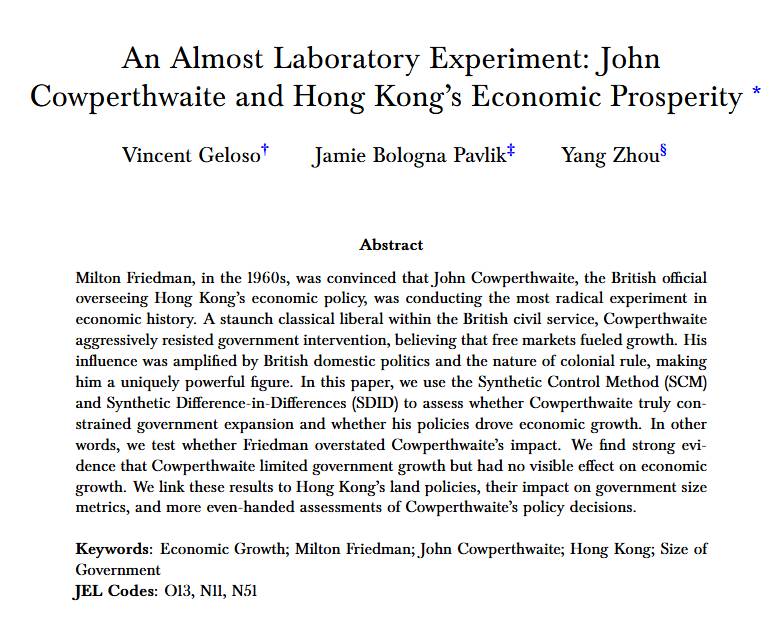
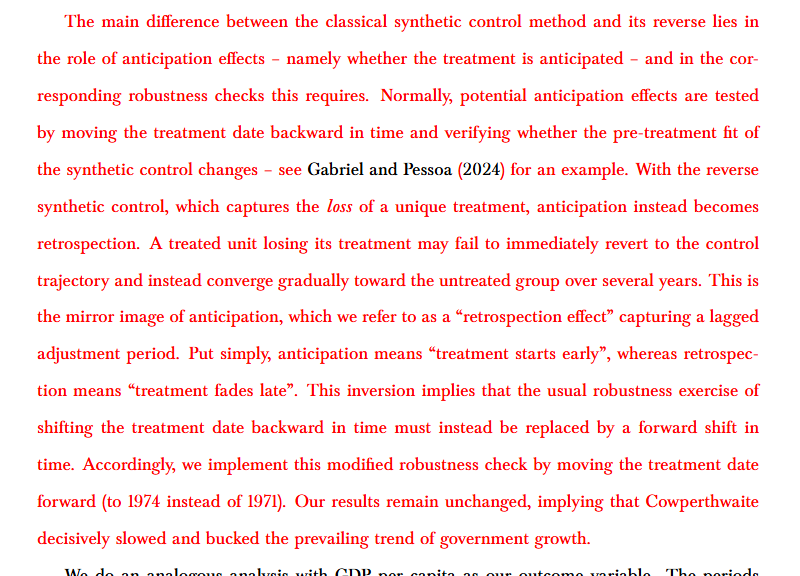
Can you use synthetic control backwards? In a forthcoming paper in Public Choice, Jamie Pavlik, Yang Zhou say "yes" if one understand the potential pitfalls. And we apply it to the unique and radical policy experiment of hardcore free marketeer John Cowperthwaite when he was Hong Kong's financial In standard Synthetic Control (SCM), you estimate a counterfactual forward in time. You take a unit that becomes treated at some date, use the pre-treatment period to construct a weighted combination of control units that mimics it, and then compare outcomes after treatment. The idea is simple: build a credible "what would have happened otherwise" using untreated data. But there are cases where this forward setup is not ideal. Sometimes a unit is unique for a period—because of a policy, an institutional arrangement, or a particular leader—but later becomes more “normal” and comparable to others. Think of Quebec being the last to recognize women's right to vote or the last to abolish its upper chamber. Being last makes it hard to create a donor pool to test the effect of these changes on, for example, government spending. Hong Kong under Cowperthwaite also fits that. In those cases, the pre-treatment period may be too unique to find good matches, while the post-treatment period offers better comparators. That motivates running SCM in reverse. Instead of using pre-treatment data to build the synthetic and projecting forward, you use post-treatment data to construct a synthetic and then reconstruct the past counterfactual. Conceptually, you are asking: given how this unit looks once it becomes “normal,” what would its past have looked like absent the earlier, unique treatment? In practice, if you have a sequence of years t from 0 to 30, you simply reorder them from 30 to 0. Assuming the treatment arrives in the middle period (15), the "pre-treatment" period is actually from 30 to 16 - -when the treated is like everyone else. The treatment period is from 15 to 0 when it is unique. Boom, done. So what are the pitfalls of this? Mathematically, none. The same usual conditions apply (convex hull, non-negative weights, etc.). The issue is a form of SUTVA violation. Normally, in the "classical SCM", the issue is that the treatment might be anticipated such that the treatment effect is misestimated. Think of a reform like central bank independence -- if anticipated, inflation might moderate ahead of the enactment of independence. This is dealt with thanks to in-time placebos. In the reverse case, the problem is the mirror image. Instead of anticipation, you face what can be called "retrospection or decay effects". If the impact of the treatment does not end sharply but instead fades gradually, then the post-treatment period you are using for matching is still partially “treated.” In other words, the unit has not yet fully converged to the untreated state, and the data you rely on to construct the synthetic are contaminated. The diagnostic flips accordingly. In forward SCM, you test for anticipation by shifting the treatment date earlier. In reverse SCM, you test for lingering effects by shifting it later. If your results change when you push the cutoff forward, that suggests the post-treatment period is still influenced by the treatment and is not a valid basis for constructing the counterfactual. In our forthcoming paper in Public Choice, we elaborate on this reverse synthetic approach and "retrospection" effects.
Vincent Geloso tweet mediaVincent Geloso tweet media
English
4
9
66
7.4K
alex cardazzi retweetledi
Jason Kerwin
Jason Kerwin@jt_kerwin·
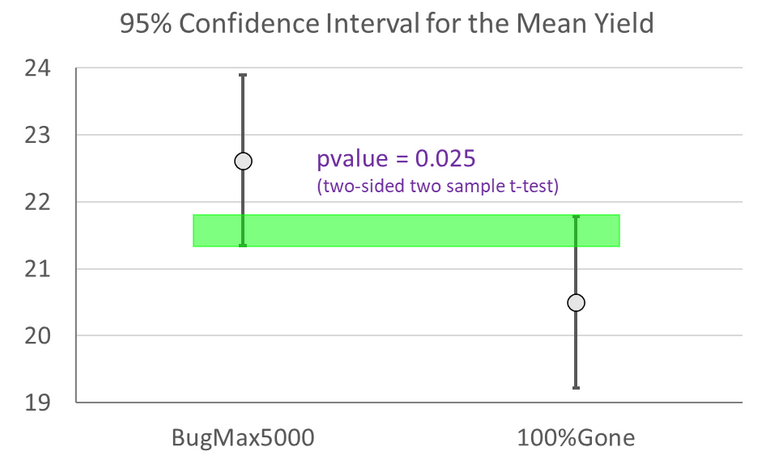
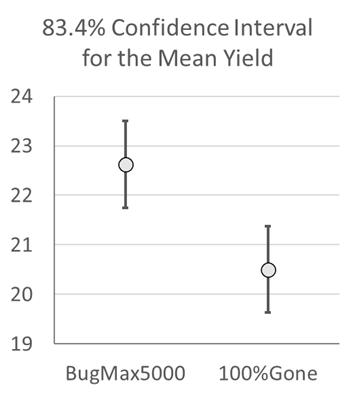
If you're going to plot means and CIs to show your results, they should be 83% CIs (not 95% CIs). Why? Because then when people look at whether they overlap, the implicit statistical test has the correct size.
Jason Kerwin tweet mediaJason Kerwin tweet media
English
17
39
343
40.4K
alex cardazzi retweetledi
Dr. Jon Slotkin
Dr. Jon Slotkin@slotkinjr·
I have a guest essay in @nytimes today about autonomous vehicle safety. I wrote it because I’m tired of seeing children die. Done right, we can eliminate car crashes as a leading cause of death in the United States @Waymo recently released data covering nearly 100 million driverless miles. I spent weeks analyzing it because the results seemed too good to be true. 91% fewer serious-injury crashes. 92% less pedestrians hit. 96% fewer injury crashes at intersections. The list goes on. 39,000 Americans died in crashes last year. More than homicide, plane crashes, and natural disasters combined. The #2 killer of children and young adults. The #1 cause of spinal cord injury. We’ve accepted this as the price of mobility. We don’t have to. In medicine, when a treatment shows this level of benefit, we stop the trial early. Continuing to give patients the placebo becomes unethical. When an intervention works this clearly, you change what you do. In driving, we’re all the control group. Cities like DC and Boston are blocking deployment. And cities are not the only forces mobilizing to slow this progress. It’s time we stop treating this like a tech moonshot and start treating it like a public health intervention that will save lives. Link to article below. 👀 this video of Waymo cars evading crashes with people and vehicles. I especially note the ones that require it having a 360° view. My sincere thanks to Alex Ellerbeck and @acsifferlin for their wisdom and sure hand in editing this piece.
English
334
1K
6.4K
1.8M
alex cardazzi retweetledi
NAASE
NAASE@NAASEcon·
We are excited to announce the creation of the Coates-Humphreys NAASE Distinguished Research Award, with Dennis Coates and Brad Humphreys as the inaugural winners. It will be given in odd-numbered years (the Hadley Award is given in even-numbered years). Congrats Brad & Dennis!
English
3
6
33
1.1K
alex cardazzi retweetledi
NBER
NBER@nberpubs·
Replacing the US federal gas tax with a mileage-based tax would benefit rural, central, and Republican areas, but increase taxes in urban and coastal regions, from @KnittelMIT, @gibmetcalf, and Shereein Saraf nber.org/papers/w33894
NBER tweet media
English
7
4
10
3.5K
alex cardazzi retweetledi
NEW YORK KNICKS
NEW YORK KNICKS@nyknicks·
GAME 1 ✅
English
294
2.9K
12.5K
457.3K
alex cardazzi retweetledi
Mike Beuoy
Mike Beuoy@inpredict·
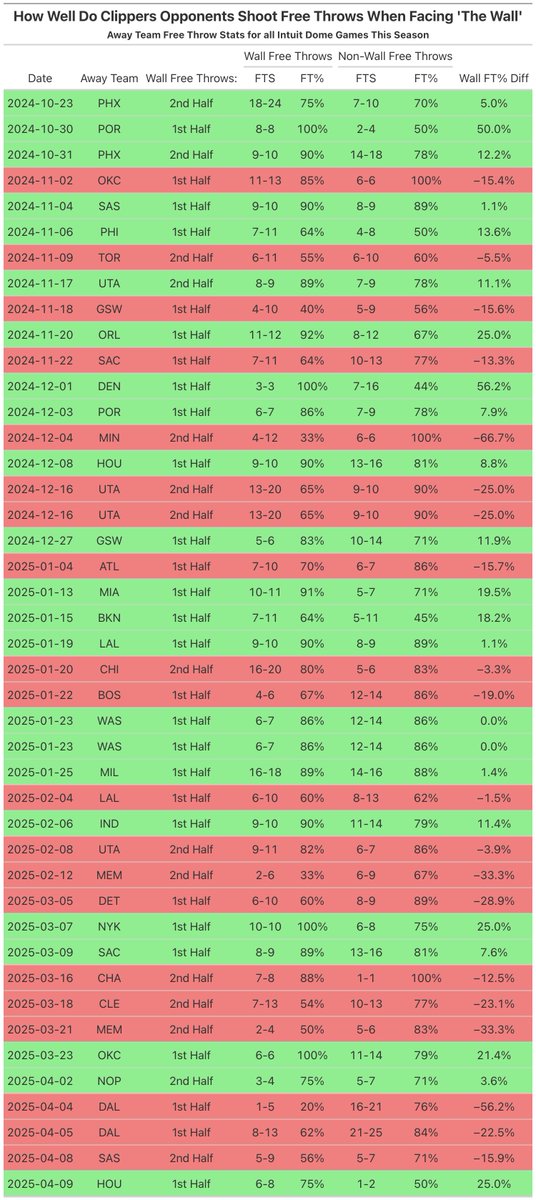
Final regular season results for Clippers opponents shooting free throws against "The Wall": Opponent Wall FT%: 73.8% Opponent non-Wall FT%: 75.9% Here are the results for just the games where opponents shot against The Wall in the 2nd half: Wall FT%: 67.7% non-Wall FT%: 77.3%
Mike Beuoy tweet media
English
3
6
18
3.8K
alex cardazzi retweetledi
NBACentral
NBACentral@TheDunkCentral·
Average Purchase Price Before & After Luka Trade: Lakers Home Games: Before Trade: $253 After Trade: $303 (+19%) Mavs Home Games: Before Trade: $187 After Trade: $112 (-40%) (Via @TickPick )
NBACentral tweet media
English
123
312
5.6K
632.9K
alex cardazzi retweetledi
Mike Beuoy
Mike Beuoy@inpredict·
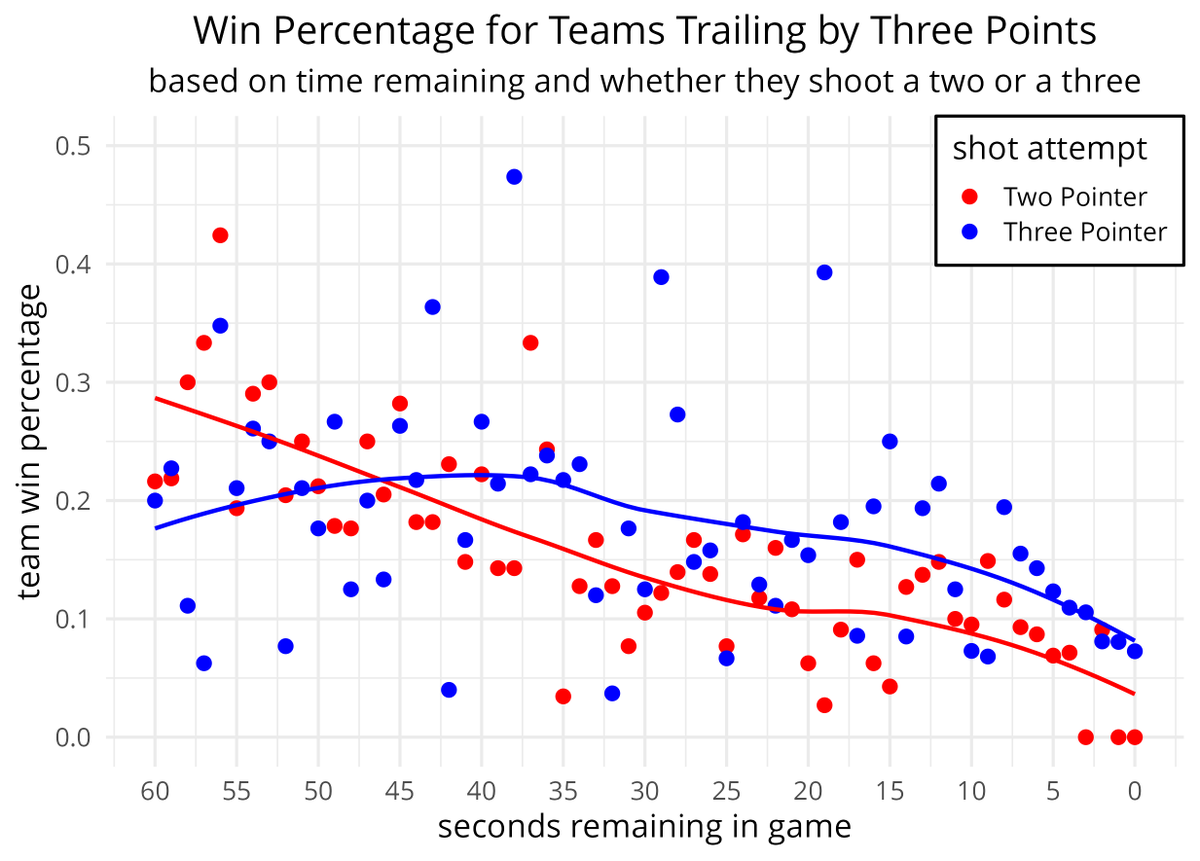
Roses are red Violets are blue When you're trailing by three Don't take the quick two
Mike Beuoy tweet media
English
16
67
846
60K
alex cardazzi retweetledi
Zach Porreca
Zach Porreca@zachporreca·
Happy to share a new working paper with @ACardazzi and Victoria Biagi, a wonderful grad student at University of Liverpool. Here's a quick thread. (1/N)
Zach Porreca tweet media
English
1
5
22
1.7K
alex cardazzi retweetledi
Maxence Franceschi
Maxence Franceschi@max_franceschi·
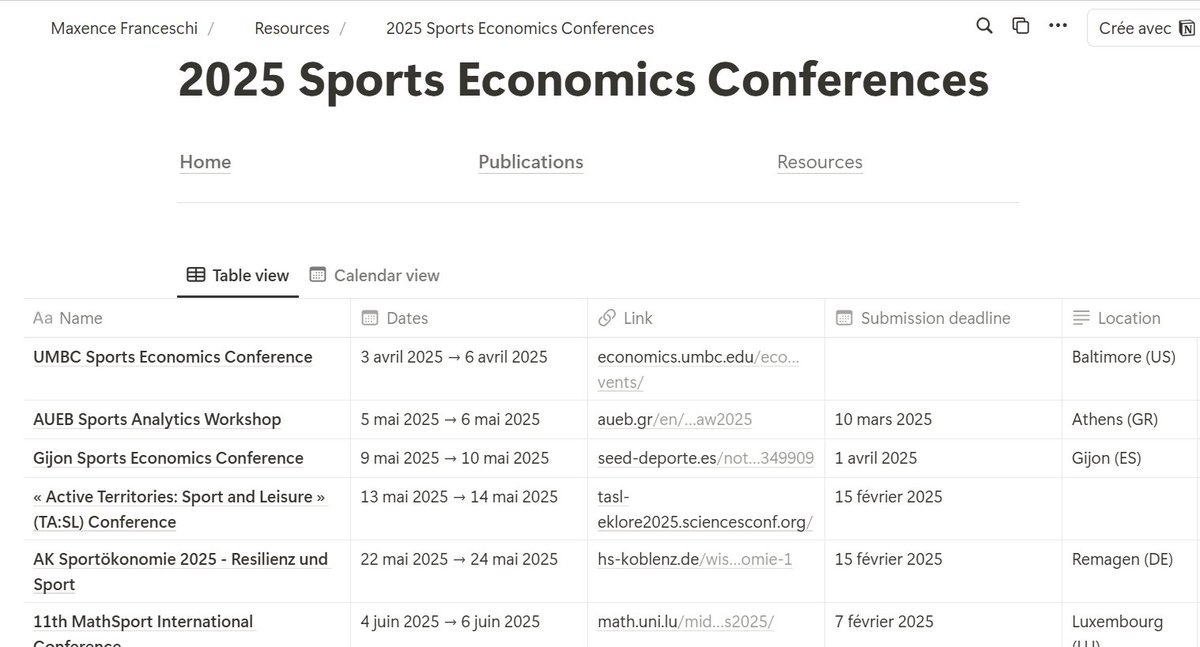
Looking for conferences, seminars, and workshops to showcase your work in Sports Economics and Management, or to learn about recent advances in these fields? Here's my list of 12 upcoming events in 2025⬇️ maxfranceschi.notion.site/2025-Sports-Ec… Please reach out if you know of other events.
Maxence Franceschi tweet media
English
5
4
11
651
alex cardazzi
alex cardazzi@ACardazzi·
@owenlhjphillips ~25% increase in delay relative to LP games, which is less than 3 minutes in reality. Am I missing something? Is this driven by a handful of ESPN games with large delays, or is the variance small?
English
1
0
1
698
Owen Phillips
Owen Phillips@owenlhjphillips·
I looked at the difference between when an NBA game was scheduled to start and when they actually started ESPN games take longer to start than any other game by far
Owen Phillips tweet media
English
11
35
286
65.2K
alex cardazzi retweetledi
Miguel Hernán
Miguel Hernán@_MiguelHernan·
Upgrade your #causalinference arsenal. A revision of our book "Causal Inference: What If" is available at miguelhernan.org/whatifbook Thanks to everyone who suggested improvements, reported typos, and proposed new citations and material. Enjoy the #WhatIfBook. Also, it's free.
Miguel Hernán tweet media
English
15
246
892
65.9K