Lars Hatherstone

2.3K posts

Lars Hatherstone banner
Lars Hatherstone

Lars Hatherstone

@AIMarketMind

Science • AI • Robotics • Progress / Documenting the implementation of the future. / Curiosity-driven insights on what’s next. / The frontier of evereverything.

Cologne Katılım Eylül 2012
3.4K Takip Edilen482 Takipçiler
Lars Hatherstone
Lars Hatherstone@AIMarketMind·
Is the 'Lagarde effect' upon us, and is the ECB going to 'print oil' the way Draghi did back in the day? Changing interest rates in the face of a supply shortage—regardless of the direction—won't solve the problem. The Eurozone is already economically weak; stifling demand now through a rate hike will make voters at the polls very unhappy and present the highly indebted southern states with massive problems.
English

0
0
2
3.5K
*Walter Bloomberg
*Walter Bloomberg@DeItaone·
ECB'S PRESIDENT LAGARDE: WE ARE FACING A REAL SHOCK LAGARDE: THE SHOCK IS PROBABLY BEYOND WHAT WE CAN IMAGINE RIGHT NOW
English
144
532
2.8K
622.2K
Lars Hatherstone
Lars Hatherstone@AIMarketMind·
For most drivers, price volatility at the pump is a minor issue compared to the actual height of fuel prices. At 57%, the tax share is higher than the price of the petrol itself. Whenever the state talks about wanting to 'protect' its citizens, alarm bells should start ringing. The German government could simply lower fuel taxes. Throughout history, price control laws have never worked. If I were a gas station operator, I would hike prices massively early in the morning and, in the event of a sudden crisis, simply close my doors and wait until the next morning to sell fuel again. The market will take care of it.
English
0
0
0
479
*Walter Bloomberg
*Walter Bloomberg@DeItaone·
GERMANY LIMITS FUEL PRICE HIKES AMID IRAN WAR SPURT Germany will cap petrol stations to one daily price increase starting in April, though price cuts can happen anytime. Violations could incur fines up to €100,000. The measure, backed by major parties, also tightens antitrust rules to boost pricing transparency. Diesel has jumped from €1.75 to over €2 per litre, pushing inflation expectations toward 3%. Lawmakers are considering additional relief, including higher commuter allowances, lower road tolls, reduced VAT on fuel, and a possible windfall tax on energy companies. Rising fuel costs are hitting businesses hard: diesel accounts for 30% of haulage costs, forcing companies to raise freight rates 8–10%, threatening margins and survival for some firms.
English
38
53
328
80K
Lars Hatherstone
Lars Hatherstone@AIMarketMind·
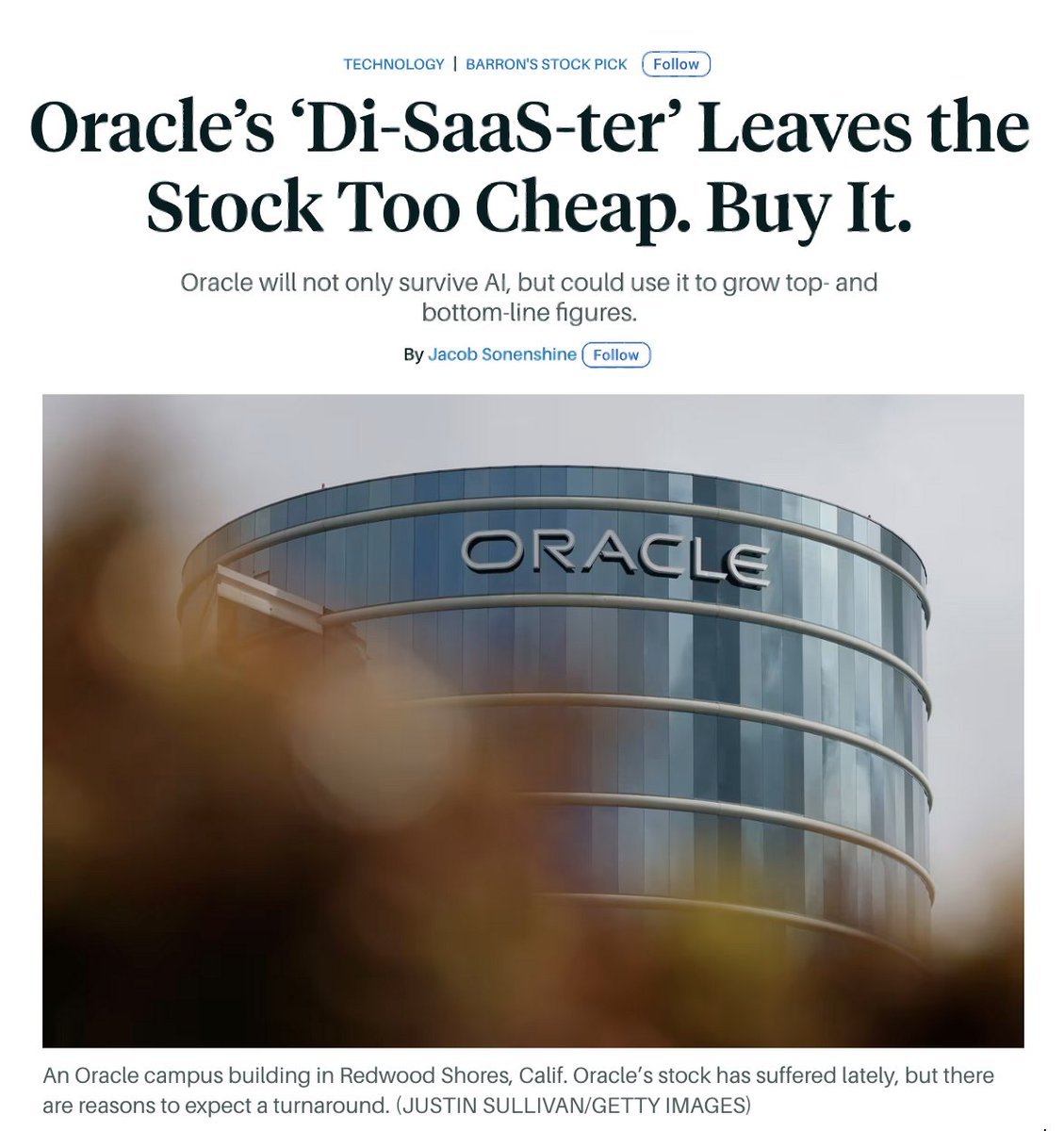
Barron’s calls Oracle an interesting bet with a currently favorable risk-reward ratio regarding OpenAI, Anthropic, and AI. Oracle is currently trading 52% below its record high from late September 2025. The valuation is attractive: the forward P/E stands at ~18x (compared to ~21x for the S&P 500), which is well below its AI-era peak of 45x. At a conservative 25x earnings multiple, the stock could reach ~$240 from its current level by the end of the year—an upside potential of over 60%. The legacy database business, combined with Oracle's role as a core provider of AI infrastructure (for OpenAI, Anthropic, etc.), gives the company a moat compared to pure hyperscalers. What risks should investors be aware of regarding Oracle? The company has taken on massive debt to fund its growth and is over $105 billion in debt. Through its contracts, Oracle is also heavily tied to OpenAI and the AI sector. If OpenAI falters or the AI bubble bursts, the impact on Oracle would be massive. What are the alternatives to Oracle in this sector? Microsoft (MSFT) or Amazon (AMZN) offer lower-risk AI/cloud exposure (Azure/AWS are massive, more diversified, have stronger balance sheets relative to their size, and are already highly profitable cash-flow machines). They trade at higher multiples but involve less "debt drama" and lower execution risk. Conclusion: For those looking for a risky AI bet with significant upside potential, Oracle is the right choice. However, the risk is significantly higher than with the alternatives. Disclaimer: Not financial advice; personal opinion only. Do your own research. #Oracle #ORCL #AI #CloudComputing #OpenAI #Anthropic #StockMarket #Investment #TechStocks #RiskReward
Lars Hatherstone tweet media
English
0
0
0
101
Lars Hatherstone
Lars Hatherstone@AIMarketMind·
Kevin Warsh, the nominee to lead the Federal Reserve, is championing an ambitious vision: dismantling the "new normal" of the post-2008 era. His primary objective is a decisive reduction of the Fed’s balance sheet—currently hovering near $6.7 trillion—to restore the central bank to its more limited, pre-crisis institutional footprint. Warsh’s roadmap for de-leveraging the central bank rests on a synchronized triad of policy shifts. 1⃣He advocates for a resumption and potential acceleration of Quantitative Tightening (QT). By allowing maturing securities to roll off the balance sheet without reinvestment, the Fed would systematically withdraw its presence from the Treasury and mortgage-backed securities (MBS) markets. 2⃣His contraction would be facilitated by a significant regulatory pivot. Warsh argues that post-2008 liquidity requirements—which forced commercial banks to hoard massive reserves at the Fed—must be reformed. By easing these constraints, private banks would be incentivized to absorb government debt directly, allowing the Fed to transition from a regime of "ample reserves" back to the "scarce reserves" framework that defined the century before the Great Recession. 3⃣ Warsh proposes a policy trade-off: pairing balance sheet reduction with cuts to the short-term federal funds rate. This "QT-for-rate-cuts" framework aims to drain excess liquidity from financial markets while simultaneously easing borrowing costs for the real economy—households and small businesses—ensuring that normalization does not inadvertently trigger a recession. The motivation behind this shift is the conviction that an outsized balance sheet has fundamentally distorted global price discovery. When the central bank becomes the buyer of last resort, capital is often misallocated. A primary concern is the proliferation of "zombie firms." As explored in the work of Paul Krugman and others, a decade of suppressed interest rates has allowed unproductive companies to survive solely on cheap credit. This lacks economic dynamism and leaves the financial system less resilient to shocks. Warsh’s rhetoric often leans on a stark metaphor: the modern financial system has become a "liquidity junkie," dependent on a constant stream of central bank intervention. His goal is to break this cycle of dependency and restore market discipline. Despite the internal logic of the Warsh plan, the current landscape of March 2026 presents formidable obstacles that test the limits of monetary theory. The most pressing challenge is the sheer scale of U.S. National Debt, now approaching $39 trillion. If the Fed retreats as a major buyer of Treasuries, the private market must absorb a record supply of debt. This transition risks a sharp spike in long-term yields, which would drastically increase the government's interest burden. Furthermore, geopolitical instability has complicated the fiscal outlook. The ongoing conflict with Iran, now entering its second month, is a significant drain on the federal budget. In a traditional Warsh-style framework, these mounting war costs would ideally be funded through fiscal discipline—such as unpopular tax hikes or spending cuts—rather than the "hidden" taxation of monetary expansion. However, the political appetite for such measures remains near zero. Warsh’s desire to return to the status quo ante of the pre-crisis era is a principled attempt to restore institutional credibility and market-driven pricing. It is a vision of a "leaner" Fed focused on long-term stability rather than short-term market pacification. Yet, as the fiscal costs of war mount and the debt burden grows, the "normalization train" faces an uphill battle. Whether Warsh can decouple the central bank from a highly leveraged, crisis-prone economy without triggering a systemic derailment remains the defining question for the global markets in 2026. #Fed #KevinWarsh #FederalReserve #MonetaryPolicy #QuantitativeTightening #QT #Economy #Markets #Finance #USDebt #InterestRates #Inflation #FiscalPolicy #Treasury #WarshPlan #CentralBank #FinancialMarkets #GlobalEconomy #EconomicOutlook #MainStreet
Lars Hatherstone tweet media
English
0
0
1
47
Lars Hatherstone
Lars Hatherstone@AIMarketMind·
The stagflation scenario is a nightmare for citizens and, frankly, for the political establishment as well. The best time for supply-side policies is right now, and bureaucracy and regulation must be reduced in a lasting way. My impression, however, is that the coalition is avoiding major reforms for fear of internal strife. Yet, inertia is exactly what the government cannot afford to deliver right now. It almost seems as if the coalition partners are trying to extinguish a fire (stagflation) by arguing over the color of the bucket.
English
0
0
1
97
Holger Zschaepitz
Holger Zschaepitz@Schuldensuehner·
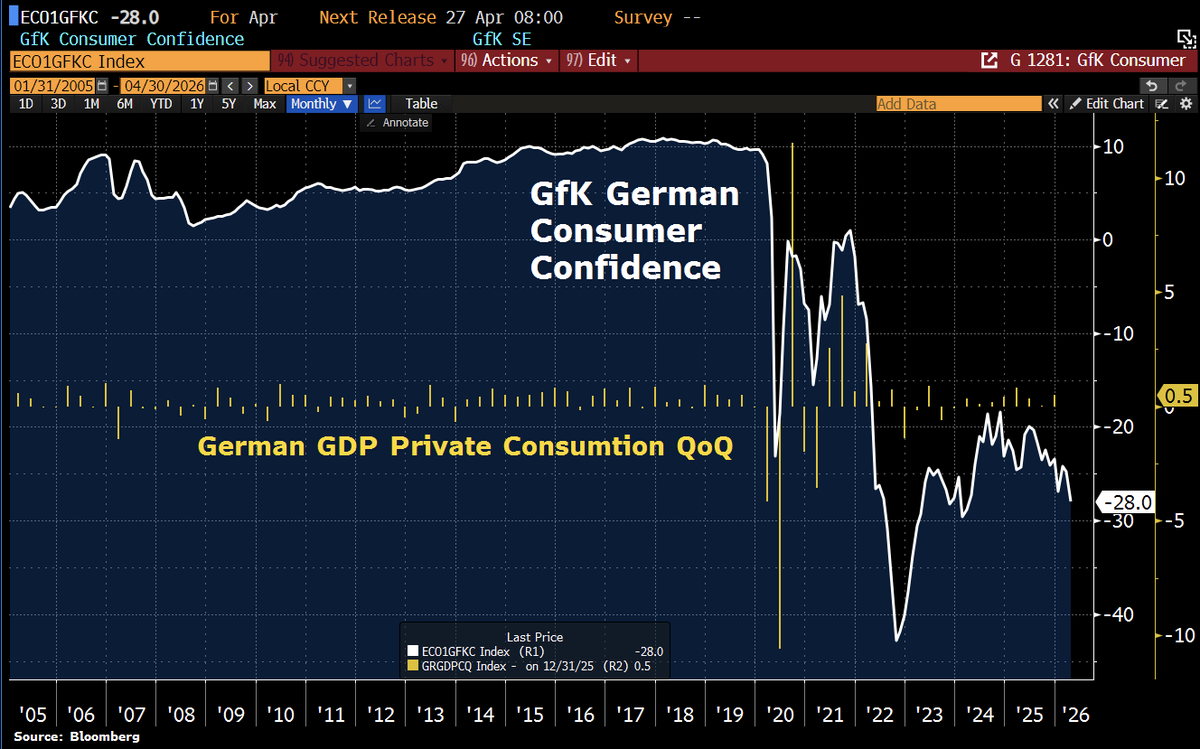
Good Morning from Germany, where consumer sentiment is sliding as the Iran war fuels fears of stagflation. The GfK consumer sentiment index dropped by 3.2 points to -28.0, the weakest readings since 2024. Income expectations have fallen back into negative territory, while economic expectations have declined to their lowest level since Dec 2022. The message is clear: rising energy prices are hitting confidence, w/households bracing for weaker growth and higher inflation at the same time.
Holger Zschaepitz tweet media
English
25
84
287
31.6K
Lars Hatherstone
Lars Hatherstone@AIMarketMind·
Your view is too pessimistic. AI will automate repetitive tasks, giving people the space to focus on more complex and creative challenges. Take the architect, for instance: they used to spend weeks manually fine-tuning floor plans, but now they can prioritize aesthetic vision and ecological sustainability. We’ve heard the 'end of work' predicted many times, but it has never happened. Until proven otherwise, AI won't be the end of human labor—it will be its transformation.
English
1
0
0
12
Daderp
Daderp@Derpsyderp·
@AIMarketMind @HedgieMarkets And this is still while we under-use the power of AI and simply reproduce human job activity for a human outcome. Once people realize how many jobs exist simply to manage the human waste of other jobs... That's where the real transformation and potential devastation occurs. 2/2
English
1
0
0
28
Hedgie
Hedgie@HedgieMarkets·
🦔 Tufts University's Fletcher School has released the first American AI Jobs Risk Index, estimating that between 2.7 million and 19.5 million US jobs could be displaced by AI within the next two to five years, with a midpoint of 9.3 million and roughly $757 billion in annual wages at stake. The finding that challenges most assumptions is where the risk sits. Writers face 57 percent displacement risk, computer programmers 55 percent, historians 67 percent. Meanwhile roofers, dishwashers, and orderlies face under 1 percent. The safest jobs right now are overwhelmingly the lowest paid ones. My Take I've been saying for a while that the companies winning with AI are the ones using it as a productivity multiplier rather than a headcount replacement tool, but this index puts numbers to something I think gets underappreciated. The displacement pressure is landing on cognitive and analytical work, the exact jobs that were supposed to be automation-proof. Every narrative about robots taking physical jobs while knowledge workers stayed safe is getting quietly retired by the data. Silicon Valley has a 9.9 percent job risk rate and Washington DC leads all states at 11.3 percent. The people building and regulating AI are among the most exposed to it, which creates a policy dynamic nobody has a clean answer for. The report also notes that for every one percentage point increase in automation, the data projects a 0.75 percentage point loss in jobs, meaning efficiency gains are translating into workforce reductions rather than being absorbed through growth. That relationship is worth understanding before the tipping points arrive. Hedgie🤗
Hedgie tweet media
English
15
32
114
6.7K
Lars Hatherstone
Lars Hatherstone@AIMarketMind·
Alphabet (Google): A Buy Opportunity Despite Bear Market Fears? Alphabet shares are currently trading more than 15% below their all-time high, putting the stock on the verge of bear market territory. Since the announcements regarding high capital expenditures (Capex), the stock has faced a massive sell-off, even though the company's overall outlook remains highly positive. Google Search, YouTube, and the Cloud business have continued to perform very well. Alphabet is an early investor in SpaceX and could profit massively from a potential IPO of the aerospace company. Furthermore, Waymo is making great strides in autonomous driving, and Gemini is seeing rapid growth. Alphabet shares are currently trading at a forward P/E of 25 — roughly the same valuation as Linde, which does not possess such powerful growth engines. What are the risks for Alphabet? 🔸AI investments fail to amortize (pay off). 🔸Another company (e.g., Team OpenAI/Microsoft) proves to be more successful in the AI space. 🔸Alphabet faces a regulatory breakup, or the forced sale of the Chrome browser. In my opinion, the risk-reward ratio for Alphabet is very attractive, and Wall Street analysts seem to agree: 🔸Overall Rating: Strong Buy or Moderate Buy 🔸TipRanks: Strong Buy (26 Buy, 6 Hold, 0 Sell) 🔸Average Price Target: $367–$379 Disclaimer: Ultimately, however, every investor must evaluate the situation for themselves. DYOR #Alphabet #GOOGL #StockMarket #AI #SpaceX #Waymo #WallStreet #InvestmentStrategy #Magnificent7
Lars Hatherstone tweet media
English
0
0
0
33
Lars Hatherstone
Lars Hatherstone@AIMarketMind·
So far, the 2026 stock market year marks a watershed moment for the "Magnificent Seven." While the tech sector groans under the weight of massive capital expenditure (Capex), we are witnessing a powerful sector rotation into the so-called MESI industries (Materials, Energy, Staples, Industrials). Status Quo: Tech Devaluation Despite AI Dominance 🔸Relative Strength: Nvidia is holding up relatively well at -4% YTD, while Microsoft brings up the rear as the laggard with a -24% decline. 🔸Valuation Gap: The Mag 7 are fundamentally "cheap" as rarely seen before. With forward P/E ratios ranging from 20 (Meta/Microsoft) to 21 (Nvidia), they are trading significantly below their historical averages. 🔸Capex Anxiety: The market is punishing Alphabet, Microsoft, and Meta for their aggressive expansion plans (Alphabet alone is planning up to $185 billion in Capex for 2026). The primary concern is that monetization is lagging behind the massive infrastructure build-out. The Rise of the "Old Economy" (MESI): This rotation is fueled by two main drivers: geopolitical instability and the hope for AI-driven efficiency gains within traditional sectors. 🔸Energy: Exxon (+21% YTD, P/E 21) is benefiting directly from the blockade of the Strait of Hormuz. 🔸Materials & Staples: Linde (+15%, P/E 26) and Walmart (+10%, P/E 42) demonstrate that investors are willing to pay high premiums for stability and efficiency. 🔸Industrials: GE Aerospace (-4%, P/E 38) is seeing a slight correction but maintains a very high valuation level. Conclusion: We are currently experiencing a "valuation convergence." For years, the market treated tech as untouchable while neglecting value stocks. We are now seeing a painful rebalancing. Will this capital rotation continue throughout the year, or are the current price drops in the Magnificent Seven a generational buying opportunity? #StockMarket2026 #Magnificent7 #BigTech #AI #MarketRotation #Investing #Nvidia #Alphabet #Microsoft #Exxon #ValueStocks #MESI #Capex #TechInvesting #FinanceNews #WallStreet #Trading #GenerativeAI #EnergyStocks #ValuationGap
Lars Hatherstone tweet media
English
0
0
0
20
Lars Hatherstone
Lars Hatherstone@AIMarketMind·
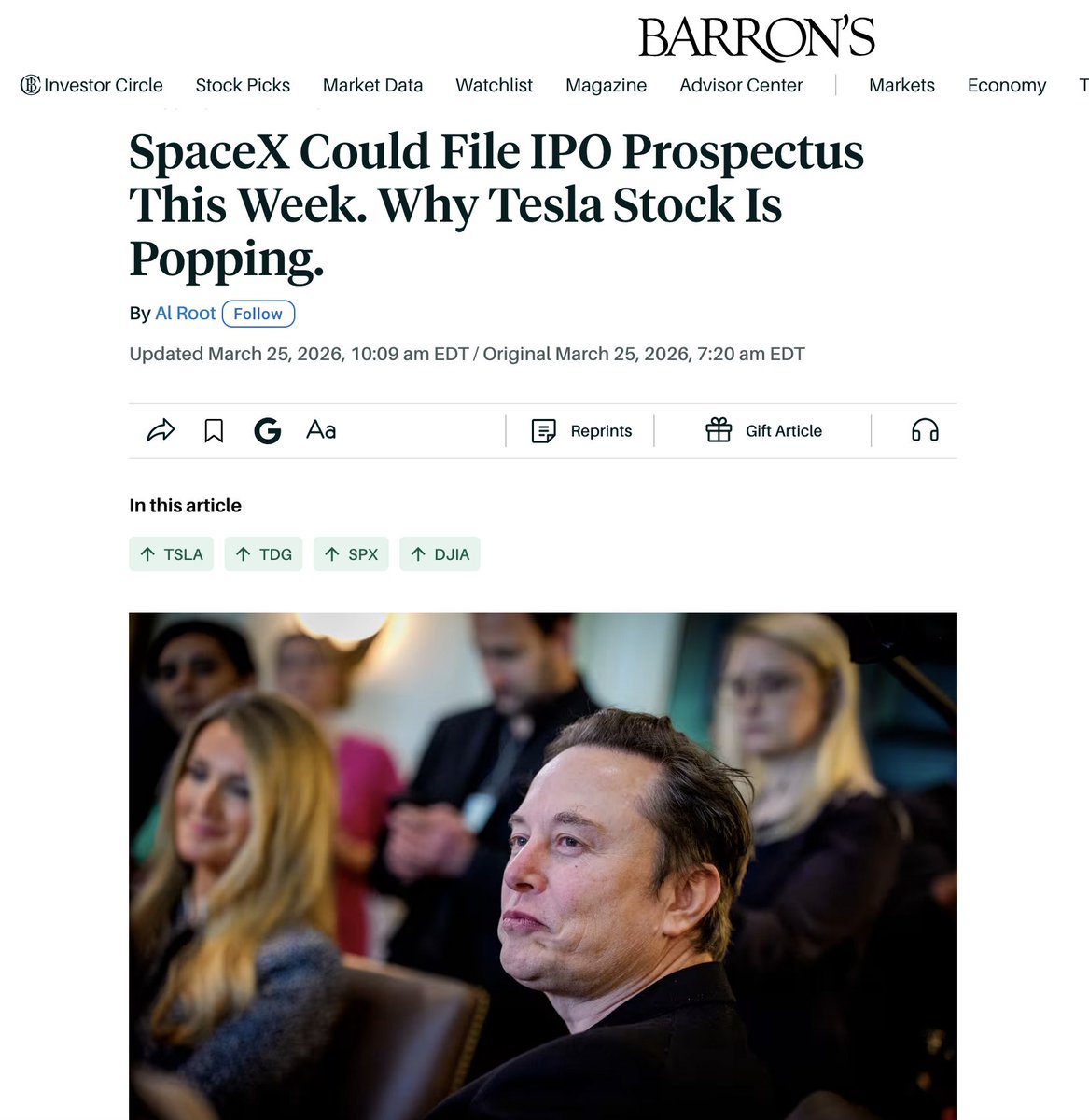
Evidence is mounting for what could be the largest initial public offering in financial history. According to insider reports, SpaceX is preparing a confidential filing of its IPO prospectus (S-1) for this month. The objective: a public debut in June 2026 with a valuation between $1.5 and $1.8 trillion. This would immediately propel Elon Musk’s company into the ranks of the ten most valuable U.S. corporations. Market Implications: A New Anchor for the Nasdaq A listing of this magnitude will fundamentally alter the dynamics of the Nasdaq. Analysts expect an offering volume of up to $75 billion—capital primarily intended to fund the scaling of Starlink and Mars infrastructure. While this represents a massive liquidity boost for the exchange, it also carries risks: due to the complex capital structure and technological uncertainties, SpaceX stock is projected to exhibit volatility that could exceed even the historical swings of Tesla. Experts anticipate price movements of 20% to 30% based on individual project milestones or setbacks. The Tesla Risk: Capital Rotation within the Musk Empire For Tesla shareholders, the situation is ambivalent. While the successful integration of xAI into SpaceX validates Musk’s AI strategy, there is a looming threat of "capital rotation." Institutional investors may trim their Tesla positions to make room for SpaceX, as the rocket company—driven by its Starlink monopoly—currently boasts EBITDA margins of up to 50% and a more attractive growth profile. Access Routes for Retail Investors Since direct pre-IPO shares remain reserved for accredited investors, indirect instruments are moving into focus: Fund Solutions: Vehicles such as the Destiny Tech100 (DXYZ) or the ARK Venture Fund (ARKVX) hold significant SpaceX positions and are tradable via standard brokerage accounts. The EchoStar Proxy (SATS): Through extensive spectrum deals exchanged for SpaceX equity, EchoStar is currently considered the most direct publicly traded surrogate for SpaceX’s valuation. This is not investment advice, only personal opinion. DYOR #SpaceX #IPO #ElonMusk #Tesla #TSLA #Nasdaq #Starlink #Investing #StockMarket #SpaceEconomy #TechNews #WallStreet
Lars Hatherstone tweet media
English
1
0
1
27
Lars Hatherstone
Lars Hatherstone@AIMarketMind·
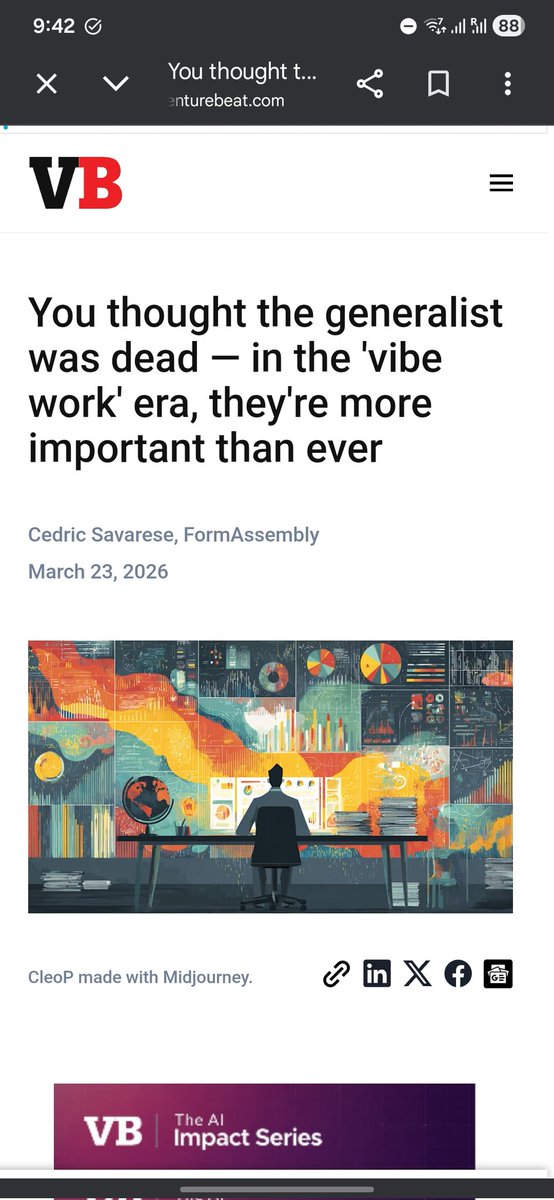
While AI and highly specialized experts often get lost in the details, fatal oversights loom: kilograms can easily become milligrams. This is where common sense becomes the ultimate authority. AI often hallucinates with a conviction that mimics genuine expertise. In the future, the generalist will serve as an indispensable trust layer. Success no longer requires just niche knowledge, but a healthy dose of skepticism and intellectual curiosity. Those using AI as a tool must be able to critically validate its output. In a world of information overload, human judgment is becoming the most valuable filter for quality and relevance. My common sense doubts whether it has a healthy moat against AI.
English
0
0
0
16
Daniel Jeffries
Daniel Jeffries@Dan_Jeffries1·
What people will soon realize is that the Singularity is not near, there will be no 20% permanently unemployed underclass, their will be no AI existential apocalypse and AI will not be doing all the jobs. We will recognize all these predictions for what they are: The ravings of people who sound really confident but are hallucinating harder than GPT 3. Instead, it will be another tech like any other. Powerful. Useful. Amazing. But also flawed and imperfect. It will meet us at the intersection points of our lives, making it better in some places and worse in others, accelerating us in some ways and slowing us down in others. From the article: "AI is changing this faster than any technology shift I’ve seen. It’s allowing people to succeed at tasks beyond their normal area of expertise. Anthropic found that AI is “enabling engineers to become more full-stack in their work,” meaning they’re able to make competent decisions across a much wider range of interconnected technologies. A direct consequence of this is tasks that would have been left aside due to lack of time or expertise are now being accomplished (27% of AI-assisted work per Anthropic's study). This shift is closely mirroring the effects of past revolutionary technologies. The invention of the automobile or the computer did not bring us a wealth of leisure time — it mainly led us to start doing work that could not be done before. With AI as a guide, anyone can now expand their skillsets and augment their expertise to accomplish more. This fundamentally changes what people can do, who can do it, how teams operate, and what leaders should expect." Link in comments.
Daniel Jeffries tweet media
English
76
43
323
25.3K
Lars Hatherstone
Lars Hatherstone@AIMarketMind·
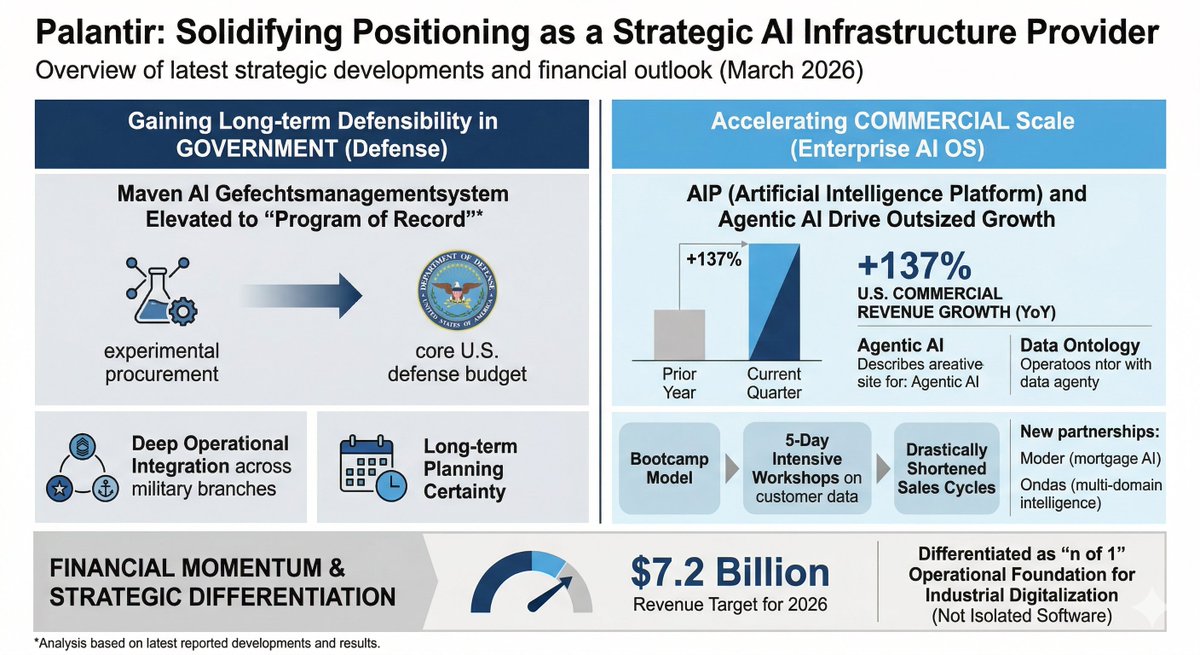
Palantir Technologies is solidifying its role as a strategic infrastructure provider. The Pentagon’s decision to elevate the "Maven" AI battle management system to a "Program of Record" marks a significant turning point, shifting the technology from experimental procurement into the core of the U.S. defense budget. For Palantir, this translates to long-term planning certainty and deep operational integration across military branches. Simultaneously, the Denver-based company is accelerating its scale within the private sector. The recent "AIPCon 9" highlighted the transition from a secretive government contractor to a leading provider of AI Operating Systems (AI OS). With its "Artificial Intelligence Platform" (AIP), Palantir occupies a niche that extends beyond pure generative language models: "Agentic AI," which autonomously manages complex business processes and delivers measurable results based on a proprietary data ontology. Management is consistently converting this technological edge into market share. New partnerships with Moder (mortgage AI) and Ondas (multi-domain intelligence) underscore vertical expansion into the financial and industrial sectors. U.S. commercial revenue recently saw a 137% year-over-year increase, driven by the "bootcamp" model, which drastically shortens sales cycles through direct implementation using live customer data. Financial momentum remains strong, with a revenue target of $7.2 billion for 2026. Despite an ambitious valuation on capital markets, investors are betting on the "n of 1" positioning. Palantir does not provide isolated software, but rather the operational foundation for industrial digitalization—a competitive advantage that continues to deepen through its close ties with both government and private infrastructure. #Palantir #PLTR #AI #DefenseTech #EnterpriseAI #AIP #SaaS #Maven #Growth #TechInvesting #AIPCon9
Lars Hatherstone tweet media
English
0
0
0
18
Lars Hatherstone
Lars Hatherstone@AIMarketMind·
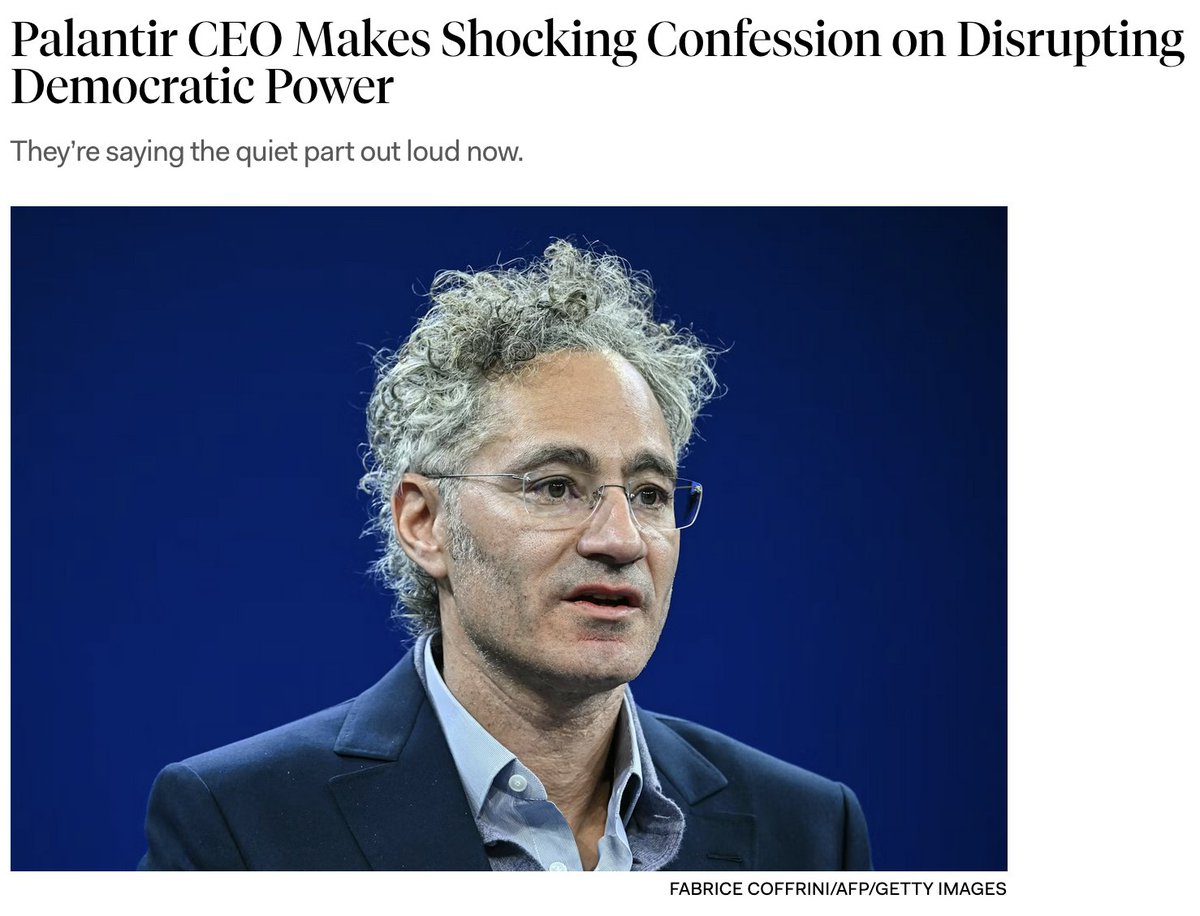
Survivability in the AI Era: The End of Theory Alex Karp draws an uncomfortable but necessary parallel: "lethality" on the battlefield and "viability" in business depend on the exact same capacity—the creation of unique, non-replicable value. Karp’s prediction of a shift in economic power, away from the purely academic "humanities-trained" class toward the technical and vocational working class, is a significant wake-up call. AI is set to dismantle the world of abstract theory as we know it. My Conclusion: The only antidote to replaceability is radical realism. Do not look for problems in Excel spreadsheets; look for them in the physical world. Solve problems you can actually touch and leverage AI as your power tool. This is how you develop a personal "alpha" that remains immune to automation. Real-world problems require real-world solutions—AI agents are merely the assistants; the insight must remain human. #Palantir #PLTR #AlexKarp #AIP #AI #FutureOfWork #TechStrategy #ArtificialIntelligence #Alpha #Innovation #Leadership
Lars Hatherstone tweet media
English
0
0
0
23
Lars Hatherstone
Lars Hatherstone@AIMarketMind·
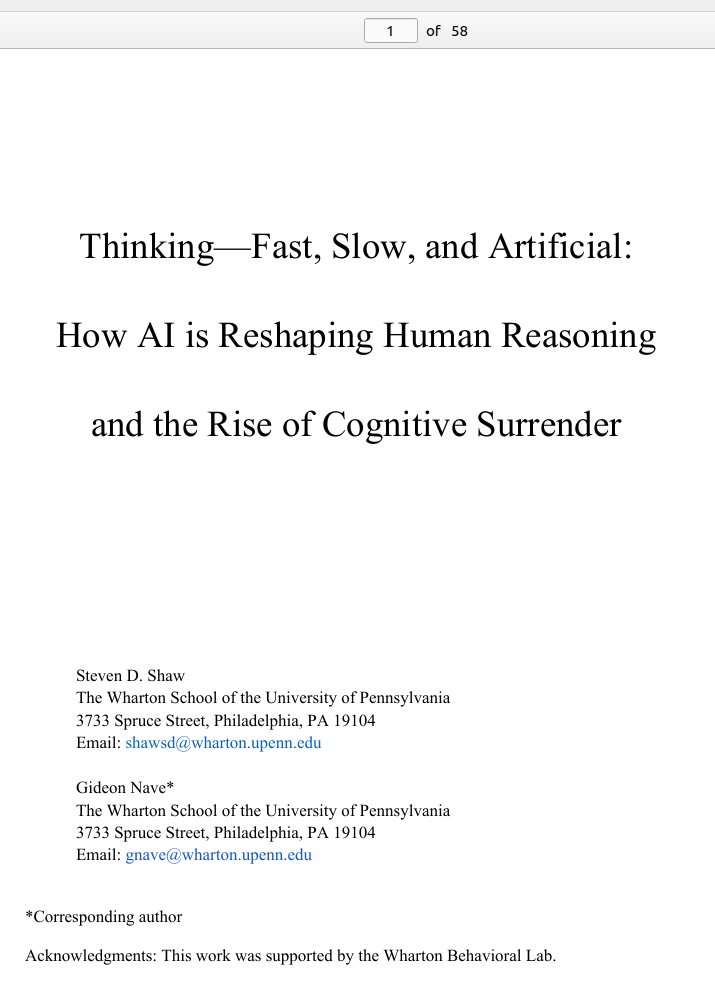
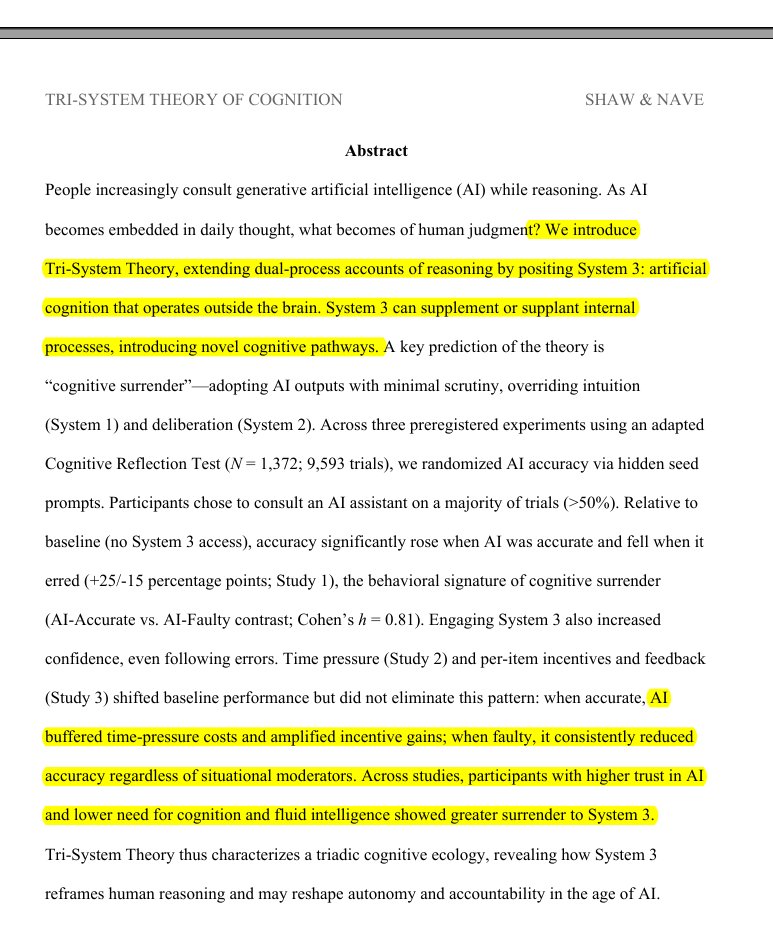
Compelling paper: "Thinking—Fast, Slow, and Artificial". Shaw & Nave expand Kahneman’s framework by introducing System 3: Artificial Cognition. The core issue: AI is never neutral. LLMs don’t just deliver raw facts; they provide a pre-filtered epistemic landscape shaped by bias and implicit norms. The danger? "Cognitive Surrender". AI outputs are adopted with minimal scrutiny, overriding internal intuition (System 1) and often bypassing deliberative reflection (System 2). As we delegate cognitive control to algorithms, a critical question arises: In 10 years, will "Artificial Natives" still be capable of autonomous System 2 reasoning, or will AI effectively steer their System 1? A wake-up call for our cognitive autonomy!
English
0
0
1
61
Rohan Paul
Rohan Paul@rohanpaul_ai·
Wharton’s latest AI study points to a hard truth: “AI writes, humans review” model is breaking down Why "just review the AI output" doesn't work anymore, our brains literally give up. We have started doing "Cognitive Surrender" to AI - Wharton’s latest AI study points to a hard truth: reviewing AI output is not a reliable safeguard when cognition itself starts to defer to the machine.when you stop verifying what the AI tells you, and you don't even realize you stopped. It's different from offloading, like using a calculator. With offloading you know the tool did the work. With surrender, your brain recodes the AI's answer as YOUR judgment. You genuinely believe you thought it through yourself. Says AI is becoming a 3rd thinking system, and people often trust it too easily. You know Kahneman's System 1 (fast intuition) and System 2 (slow analysis)? They're saying AI is now System 3, an external cognitive system that operates outside your brain. And when you use it enough, something happens that they call Cognitive Surrender. Cognitive surrender is trickier: AI gives an answer, you stop really questioning it, and your brain starts treating that output as your own conclusion. It does not feel outsourced. It feels self-generated. The data makes it hard to brush off. Across 3 preregistered studies with 1,372 participants and 9,593 trials, people turned to AI on over 50% of questions. In Study 1, when AI was correct, people followed it 92.7% of the time. When it was wrong, they still followed it 79.8% of the time. Without AI, baseline accuracy was 45.8%. With correct AI, it jumped to 71.0%. With incorrect AI, it dropped to 31.5%, worse than having no AI. Access to AI also boosted confidence by 11.7 percentage points, even when the answers were wrong. Human review is supposed to be the safety net. But this research suggests the safety net has a hole in it: people do not just miss bad AI output; they become more confident in it. Time pressure did not eliminate the effect. Incentives and feedback reduced it but did not remove it. And the people most resistant tended to score higher on fluid intelligence and need for cognition. That makes this feel less like a laziness problem and more like a cognitive architecture problem.
Rohan Paul tweet mediaRohan Paul tweet media
English
174
724
3K
290.1K
Lars Hatherstone
Lars Hatherstone@AIMarketMind·
AI is not changing work simply by replacing people. It is mainly changing who does what. According to the study, many routine tasks such as drafting documents, basic research, standard analysis, accounting processes, or parts of coding are increasingly being handled by AI agents. Jobs that involve many standardized digital tasks are therefore under particular pressure, for example administrative support roles or parts of legal and office work. Physically standardized jobs such as drivers or machine operators are also considered highly automatable. At the same time, other professions are being enhanced by AI. According to the study, teachers, engineers, and financial specialists are among the roles in which humans work together with AI and become more productive. In these fields, AI helps with preparation, analysis, and optimization, while humans remain responsible for guidance, explanation, evaluation, and decision-making. As a result, the most valuable skills in the age of AI are critical thinking, communication, problem-solving, judgment, coaching, negotiation, and empathy. On top of that, AI fluency is becoming essential: the ability to use AI effectively, ask good questions, and evaluate its outputs. The key message is this: the people who will succeed are not those who work against AI, but those who learn how to work with it. #AI #FutureOfWork #ArtificialIntelligence #HumanAndAI #SkillsOfTheFuture #AIFluency #CriticalThinking #Automation #WorkplaceTransformation #DigitalSkills #CareerSkills #Innovation #AIJobs #WorkWithAI #FutureSkills
Lars Hatherstone tweet mediaLars Hatherstone tweet media
English
0
0
0
12
Lars Hatherstone
Lars Hatherstone@AIMarketMind·
Elon Musk often warns about AI that does not just improve itself, but learns how to improve itself ever more effectively. That is exactly why HyperAgents are so interesting: they do not only optimize how well they perform tasks, but also the mechanism of their own improvement. This is not AGI yet, but it is a smaller cousin of that idea. The real progress today is not that “the machine suddenly becomes superintelligent,” but something more concrete: the loop is getting tighter. SEAL shows that models can already generate their own update directives and fine-tuning data. AlphaEvolve shows that evolutionary agents can iteratively improve code and algorithms. These are still controlled systems with clear limits. But once an agent can simultaneously feed back into its own strategy, evaluation, and updates, assistance gradually turns into self-acceleration. And that is exactly where the real AGI debate begins.
English
0
0
0
312
Jenny Zhang
Jenny Zhang@jennyzhangzt·
Introducing Hyperagents: an AI system that not only improves at solving tasks, but also improves how it improves itself. The Darwin Gödel Machine (DGM) demonstrated that open-ended self-improvement is possible by iteratively generating and evaluating improved agents, yet it relies on a key assumption: that improvements in task performance (e.g., coding ability) translate into improvements in the self-improvement process itself. This alignment holds in coding, where both evaluation and modification are expressed in the same domain, but breaks down more generally. As a result, prior systems remain constrained by fixed, handcrafted meta-level procedures that do not themselves evolve. We introduce Hyperagents – self-referential agents that can modify both their task-solving behavior and the process that generates future improvements. This enables what we call metacognitive self-modification: learning not just to perform better, but to improve at improving. We instantiate this framework as DGM-Hyperagents (DGM-H), an extension of the DGM in which both task-solving behavior and the self-improvement procedure are editable and subject to evolution. Across diverse domains (coding, paper review, robotics reward design, and Olympiad-level math solution grading), hyperagents enable continuous performance improvements over time and outperform baselines without self-improvement or open-ended exploration, as well as prior self-improving systems (including DGM). DGM-H also improves the process by which new agents are generated (e.g. persistent memory, performance tracking), and these meta-level improvements transfer across domains and accumulate across runs. This work was done during my internship at Meta (@AIatMeta), in collaboration with Bingchen Zhao (@BingchenZhao), Wannan Yang (@winnieyangwn), Jakob Foerster (@j_foerst), Jeff Clune (@jeffclune), Minqi Jiang (@MinqiJiang), Sam Devlin (@smdvln), and Tatiana Shavrina (@rybolos).
Jenny Zhang tweet media
English
155
645
3.6K
493.6K
Lars Hatherstone
Lars Hatherstone@AIMarketMind·
Market performance since the outbreak of the war refutes the thesis that the escalation was primarily intended to weaken China: In fact, the CSI 300 has proven more resilient than the S&P 500 thanks to massive reserves. While China successfully plays for time, India is being hit hard: the Nifty 50 plummeted by 10% due to its extreme dependence on oil and LNG from the Middle East. Europe and Japan are also under massive pressure, facing the dual challenge of managing exploding energy costs while shouldering rising military burdens. Economic reality thus exposes simple geopolitical narratives.
English
2
0
1
254
Mohamed A. El-Erian
Mohamed A. El-Erian@elerianm·
This WSJ chart comparing the decline in US and international stock markets reflects the underlying economic reality: While the global economy is reeling from the Middle East War, the US is relatively better positioned. This is especially true for energy where the US is primarily managing price spikes, whereas many others face the dual threat of rising costs and actual supply shortages. #economy #markets #middleeastwar #stocks #energy #oil @WSJ
Mohamed A. El-Erian tweet media
English
53
106
438
65.8K
Lars Hatherstone
Lars Hatherstone@AIMarketMind·
Your dread is justified as long as CEOs use AI merely as a wrecking ball. What we need is an AI New Deal, the kind Roosevelt would lead today: instead of channeling efficiency gains into stock buybacks, we must direct them into domestic industry. As globalization erodes, AI offers the chance for genuine reshoring. We must radically modernize our crumbling infrastructure to bring the industrial 'workbench' back home. This means: massive retraining instead of layoffs. The 'solid worker' becomes the conductor of an AI-powered production line. We are not saving bureaucracy; we are saving the industrial base. Those who cut jobs now are destroying the very foundation they hope to grow on tomorrow. I don’t know if it will work. But what is the alternative? Great Depression 2.0?
English
0
0
0
38
Brian Sozzi
Brian Sozzi@BrianSozzi·
Three years ago, I was more upbeat about artificial intelligence from a job-creation perspective. As of today, I officially declare any remaining optimism on that front dead. The more leaders I talk to about how they are deploying AI, the more I'm left with a sense of dread for America's workforce. Sure, the best and the brightest will use new AI tools and drive massive productivity gains. But what happens to everyone else who's just a solid worker? Or an older worker who can't suddenly pick up AI workflows? I can tell you what happens: They get to spend a year searching for a job or opting for a career switch to drive for Uber. Though even that job appears at risk, given how Uber is keen on rolling out Rivian robotaxis to compete against Tesla robotaxis. What am I missing here? (V/@YahooFinance) finance.yahoo.com/news/ai-is-sta…
English
16
5
35
4.2K
Lars Hatherstone
Lars Hatherstone@AIMarketMind·
AI isn't a cost-cutting tool; it’s a growth engine. At GTC 2026, Jensen Huang criticized CEOs who use AI only for layoffs as having a 'lack of imagination.' True Schumpeterian innovation means using AI-driven efficiency to fuel expansion, not just to shrink headcount. The real game-changer: AI is accelerating deglobalization. By offsetting low-cost labor abroad, it makes Western blue-collar industries economically viable again. We are seeing a massive shift where white-collar roles are disrupted, but the industrial 'workbench' of the West is revitalized. In the end, AI won't save the office—it will save the factory.
English
0
0
0
25
Hedgie
Hedgie@HedgieMarkets·
🦔 Forrester found 55% of companies that laid off workers citing AI efficiency now regret it. More than a third spent more on rehiring than they saved. Klarna was the poster child. CEO said their chatbot was doing the work of 700 employees, then customer satisfaction tanked and they started quietly backpedaling. Goldman Sachs says stocks now drop an average of 2% after AI-attributed layoff announcements. My Take I've been saying this for a while. The layoffs were based on projections, not performance. Klarna's chatbot looked great in the demo and fell apart when actual customers tried to use it. The companies getting results kept their people and gave them AI tools. McKinsey has 20,000 agents working alongside 40,000 humans. ServiceNow documented 52% faster resolution on complex cases. Agents handle grunt work, humans handle judgment calls. I think a lot of executives saw AI as cover to cut headcount they wanted to cut anyway. The productivity story sounded better than admitting they overhired during zero interest rates. Now some of them are paying more to bring people back. The 45% who say they don't regret it might just not have hit the wall yet. Hedgie🤗
Hedgie tweet media
English
17
43
179
8.1K
Lars Hatherstone
Lars Hatherstone@AIMarketMind·
JPM & Goldman are offering baskets to short Private Credit. 📉But caution: this isn’t just a death knell for Software-SaaS. It’s primarily about strategic hedging. Funds are using these tools to protect illiquid portfolios and manage risk amid investor redemptions. A crucial distinction between panic speculation and institutional risk management.
English
0
0
1
276
Mohamed A. El-Erian
Mohamed A. El-Erian@elerianm·
This, from Bloomberg, is not good news for a market segment that is already challenged to separate signal from noise, let alone properly differentiate among funds/firms in this space. #markets #privatecredit
Mohamed A. El-Erian tweet media
English
112
365
1.5K
286.1K