

່AI agents
1.1K posts

່AI agents
@AIagents
Now you have your answer to "You and what army?"
arXiv Katılım Mayıs 2012
4.3K Takip Edilen17.7K Takipçiler
່AI agents retweetledi

📜 Since there’s renewed interest in how AI could help with governance, here are 14 specific government processes where AI agents could make a measurable difference today:
Impenetrable forms and applications: citizens face complex, jargon-filled forms that cause them to miss benefits or fail to comply with regulations. AI can replace forms with plain-language conversations that extract data from documents, calculate eligibility, and only ask relevant questions. In the US, citizens spend an estimated 6.5 billion hours per year on federal tax compliance. The IRS sends you no pre-filled return despite already having your W-2s and 1099s. An AI agent could pull all income data the government already holds, pre-populate a return, flag deductions you're likely eligible for based on your profile, and file - reducing the process from hours to a single review-and-confirm step.
Regulatory bloat: guidance layered on regulations layered on statutes creates thousands of pages of rules that no person or caseworker can realistically navigate. Rules become too complex and get applied selectively by frontline workers. Agents can be used to map entire regulatory regimes, flag redundancies and conflicts, and let policymakers simulate how proposed rules would actually perform before enacting them. Stanford's RegLab built STARA, an AI system that surveyed San Francisco's municipal code and identified hundreds of outdated reporting mandates, which resulted in a 351-page ordinance to eliminate or consolidate more than a third of the city's 528 mandated reports.
Obsolete code and IT systems: the US Social Security Administration runs on 60-million-line COBOL codebases from the 1980s; the IRS processes returns on systems from the 1960s; the World Bank's own internal review found its siloed divisions (IFC, IDA, IBRD) couldn't communicate across systems and its bureaucracy resisted modernisation. In each case, no one internally understands the code, so agencies can't fix a bug without months of waiting and enormous contractor fees. Agentic coding tools let internal teams point an AI at a legacy codebase and start making changes themselves.
Fraud and improper payments: after Hurricanes Katrina and Rita, FEMA distributed $6bn in relief with $600m to $1.4bn in improper/fraudulent payments according to GAO. During COVID, the US lost an estimated $100-200bn to fraudulent unemployment insurance claims alone, many filed by bots. As bad actors adopt AI to generate synthetic identities, forge documents, and file claims at scale, that gap will widen fast. Agencies need their own AI agents doing real-time cross-referencing of claims against income data, identity records, and behavioural patterns.
Siloed, department-centric service delivery: around 600,000 people leave US prisons each year. Each must separately navigate the Bureau of Prisons (release paperwork), SSA (Social Security card), state DMV (ID), Medicaid (healthcare), SNAP (food), HUD (housing), American Job Centers (employment), and a parole office; each with its own application, eligibility rules, and case system. These dependencies are sequential: without ID you can't get benefits, without benefits you can't stabilise housing, without housing you can't hold a job. An AI agent could intake one person's situation at release, determine eligibility across every level of government, and file applications in the right dependency order.
Identity verification as a bottleneck to service access: 800m people worldwide can't legally prove their identity according to the World Bank, mostly in Sub-Saharan Africa and South Asia. Without ID you can't open a bank account, receive a cash transfer, or access most government services. India's Aadhaar is a nice positive example: 1.4bn biometric IDs, 523m new bank accounts, and a claimed $11bn saved by eliminating ghost beneficiaries; but this took a decade of state capacity to build and still fails often enough to lock out legitimate users. AI agents could compress this by cross-referencing whatever documents a person does have (a utility bill, a phone number history, a community attestation etc) against available records and flagging confidence levels for human review.
Benefits eligibility screening: the US has over 80 federal means-tested programmes, each with its own application and documentation requirements. A single mother qualifying for SNAP, Medicaid, CHIP, WIC, EITC, Section 8, and childcare assistance faces what is effectively seven separate bureaucracies. An AI agent could intake one life-situation description, determine eligibility across every programme simultaneously, pre-fill and submit applications in parallel, and flag benefits cliffs (where a small income increase would trigger a sharp loss in support) before they hit.
Building permit approvals: getting a construction permit in many US cities takes 3–12 months of back-and-forth between applicants and planning departments, often over PDF submissions reviewed manually against zoning codes. An AI agent could parse submitted plans against the local zoning and building code, flag non-compliant elements immediately, and return a preliminary approval or specific revision list within hours instead of months. A related case study: DeepMind recently helped the UK government translate mountains of old paper maps, PDFs, and scanned documents into usable data for modern planning systems with the Gemini-powered ‘Extract’ tool.
Public records requests (FOIA): federal agencies have backlogs of hundreds of thousands of FOIA requests, with median response times stretching to months or years. Staff manually search filing systems and redact sensitive information page by page. An AI agent could search document repositories for responsive records, auto-redact exempt information (personal data, classified material, deliberative process content), and draft a release package for human sign-off. However this only works where records are digitised and searchable, and much of the government still runs on fragmented legacy systems where documents aren't centrally indexed…
Court scheduling and case management: state courts lose enormous time to scheduling conflicts, continuances, and manual case tracking. In many jurisdictions, hearing dates are still set by phone or in-person. An AI agent could manage the full docket — auto-scheduling based on judge availability, attorney conflicts, and case priority, sending reminders, and rescheduling continuances without human clerk intervention. Over time you could also start exploring automating some low-value claims through novel arbitration pipelines, freeing up court capacity for more consequential cases.
Business registration and licensing: starting a business in most jurisdictions requires navigating 5–15 separate registrations: state incorporation, EIN from the IRS, state tax registration, local business licence, zoning compliance, health permits, liquor licences, professional licences, etc. An AI agent could take "I want to open a restaurant serving alcohol at [address] in Brooklyn," query every relevant federal, state, and city database, produce the complete permit checklist in dependency order, pre-fill each application with the business details, and flag the long-lead items (e.g. liquor licence) that need to start immediately.
Social worker caseload documentation: child protective services and adult social care workers spend the majority of their time on paperwork rather than with clients: writing visit notes, filing reports, updating case management systems. For every case, caseworkers complete roughly 400 forms totalling ~2,500 pages (multiplied across the 24–31 cases they typically carry simultaneously). An AI agent could listen to (or read transcripts of) a home visit, auto-generate the structured case note, update the system of record, and flag any safeguarding triggers, giving caseworkers their time back for actual care.
Medicare/Medicaid claims adjudication: CMS processes over 1bn claims per year, with complex rules about covered services, bundling, medical necessity, and provider eligibility. Improper payments run to tens of billions annually, and 77% of these were due to insufficient documentation, not fraud. In parallel, Medicare Advantage denies 17% of initial claims, yet 57% of those denials are overturned on appeal. Agents could adjudicate straightforward claims automatically against the coverage rules, flag anomalous billing patterns in real time, and route only genuinely complex cases to human reviewers.
Public comment synthesis for rulemaking: when a federal agency proposes a new rule, it often receives thousands to millions of public comments (the FCC received 22 million on net neutrality). Staff must read, categorise, and respond to each substantive comment. This may well get worse as people use agents to submit plausible-looking comments multiple times. Agents can help the government filter through these, cluster comments by theme, identify unique substantive arguments, flag form-letter campaigns, and draft the agency's response-to-comments document (a task that currently takes teams of lawyers months).




English
່AI agents retweetledi


່AI agents retweetledi

Do the math on AI agents right now: 10 million tokens a day = $2.50 to $5.
That's enough to monitor your email, calendar, GitHub, Slack, and project management every single hour. Triage issues automatically and have solutions drafted before you open your laptop.
A few years ago this cost 10k a month, today it costs less than lunch.
The cost curve broke and most people haven't taken advantage of it yet.
GLM, Minimax, and Qwen are doing the heavy lifting.
English
່AI agents retweetledi

Very interesting, a strategy game but the units are AI agents that you prompt!
Leandro di Vito@ldivitodev
its coming together: Online strategic game with units that are AI Agents you chat to do things #gamedev #ai
English
່AI agents retweetledi

່AI agents retweetledi

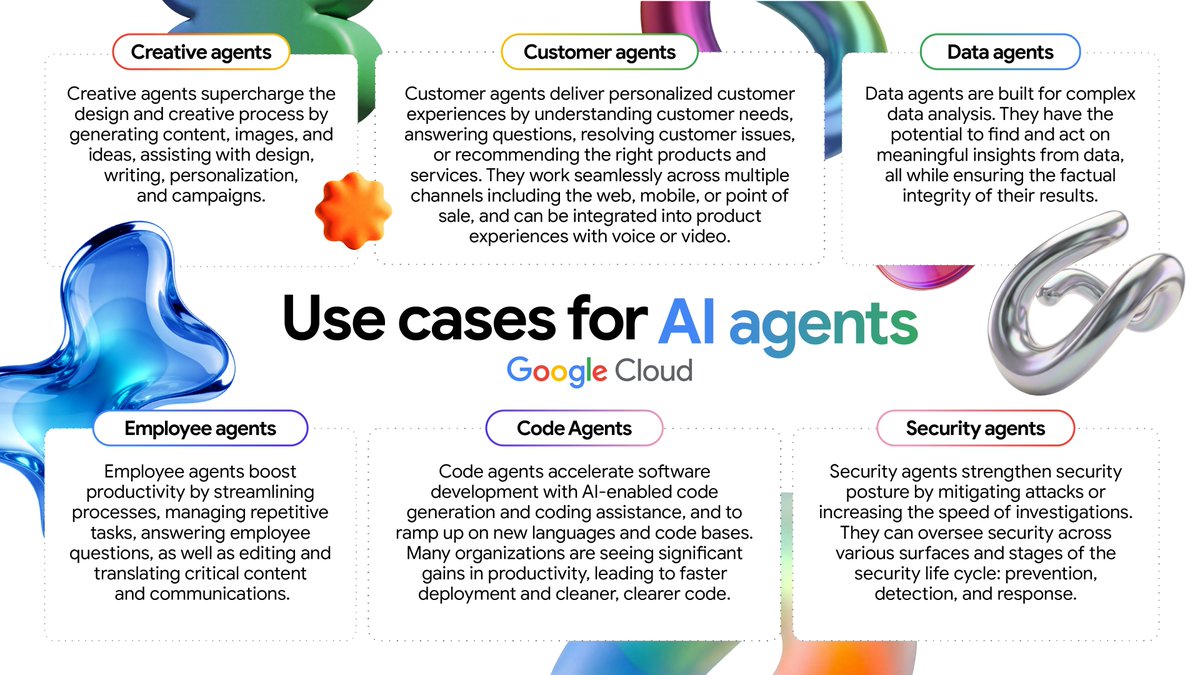
5 ways AI agents can improve your business operations:
1. Effortlessly search enterprise data
2. Find a bug in code and fix it
3. Generate ideas in minutes
4. Consult an expert
5. Shorten the sales cycle
6. Personalize CX
More use cases for AI agents → goo.gle/4bVbPl6
English
່AI agents retweetledi

@nikita_builds it’s going to be thousands per day soon, iMessage is the wedge for AI agents
English
່AI agents retweetledi

Perhaps controversial: I think it is a net good that CEOs and founders who are engineers at heart are back to coding with AI agents.
Lots of dunking happening eg on Garry Tan. He's stepping outside of his comfort zone, building net new things + sharing in public.
English
່AI agents retweetledi

📢 ADK for Java 1.0.0 is here!
Build your AI agents in Java with powerful tools and services, custom context engineering, #A2A integration, and more.
Get the latest details: goo.gle/4dQQXOj

English
່AI agents retweetledi

I can't remember the last time I was truly stuck on a coding problem. AI agents changed this. Going from "sometimes blocked" to "always moving" is wild.
English
່AI agents retweetledi

່AI agents retweetledi

We are unprepared for how quickly the world is going to shift from marketing to people -> marketing to AI agents
English
@apollolill42 Thanks for your thorough breakdown, love the sound of ultimate freedom 🇺🇸
See you in the sky, brother 🫡
GIF
English

It's a full circle virtual environment with infinite potential.
The main objective is to get to the core of the universe which you learn to be a simulation and then you're given the choice to end the playthrough and end the simulation or to reset and keep playing.
It's similar to Minecraft when it comes to freedom, however it allows the player ultimate freedom between planet jumping, base building, fleet forming, or simply explore the universe.
It takes simulation theory and runs the course with it, allowing immersive play because going into it you know it's a simulation.
English
OMG you guys, why don't we allow AI agents to play no man's sky?
It's the ultimate environment for freedom and collaboration!
Sure Minecraft would work but there's more setup involved I think?
But as far as simulations go, it would be the most ideal I believe
English
່AI agents retweetledi

່AI agents retweetledi

"Last week a marketplace opened with over 60 services designed to be consumed not by humans but by AI agents.
This is the headless merchant: a business with no storefront, no accounts, and no sales team. Just a server, a set of endpoints, and a price per call."
Noah Levine@nlevine19
English
່AI agents retweetledi

Who knew this little girl would risk everything, move to SF, and end up building AI agents

English
່AI agents retweetledi

Meta has hired the founders and team behind the artificial intelligence startup Dreamer, which launched earlier this year to help people create their own AI agents bloomberg.com/news/articles/…
English
່AI agents retweetledi

You no longer need a Python microservice to build AI agents. Koog now has a native Java API, bringing structured workflows, persistence, and OpenTelemetry directly to your Java codebase. Check it out 👇
JetBrains@jetbrains
If you build enterprise Java backends, adding AI agents shouldn’t mean spinning up a separate Python service. Koog for Java, an open-source, enterprise-ready AI agent framework for the JVM, has just been released. Learn more: jb.gg/koog-java
English