Building distributed systems at scale is about assuming that the unlikely will happen - because at scale, it probably will! Great take from Marin Kleppmann:
AJ Welch
90 posts


Building distributed systems at scale is about assuming that the unlikely will happen - because at scale, it probably will! Great take from Marin Kleppmann:

Jan Kristof Nidzwetzki: pg_plan_alternatives: Tracing PostgreSQL’s Query Plan Alternatives using eBPF postgr.es/p/7un


Many of you know the Linux #auditd config I’ve maintained for years. It was always meant to be a simplified, detection-agnostic baseline for #Linux 🐧 We’ve now changed the way it works ⚡️ The core idea is: audit.rules should act as the sensor, not the detection engine That means: - generic process_creation - fewer brittle per-binary rules - better portability - CI validation We preserved the old baseline as v0.1.0 and released v0.2.0 as the new streamlined model github.com/Neo23x0/auditd… co-op with @petri_ph


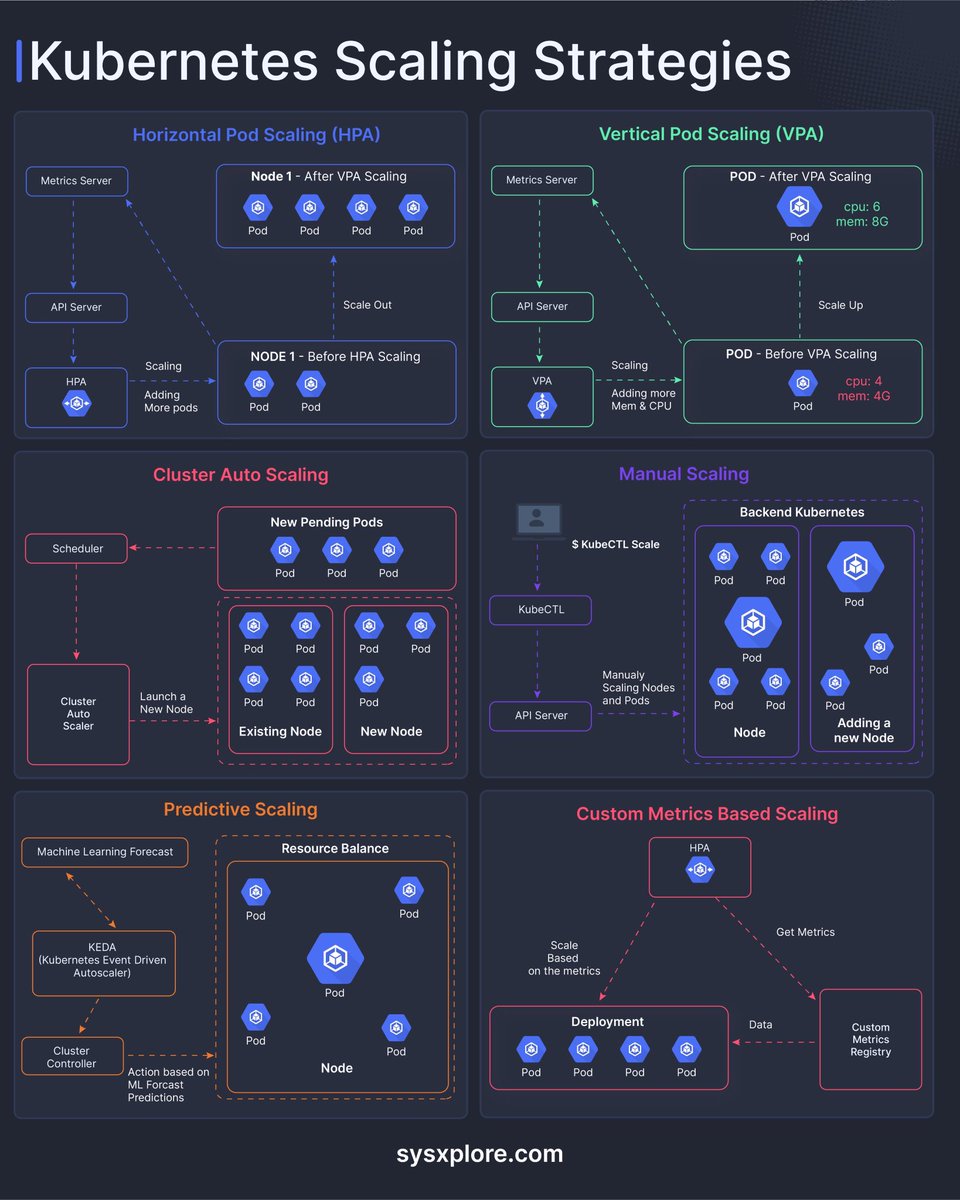
🚀 Kubernetes Scaling Strategies - Beyond Just “Add More Pods.” Scaling in Kubernetes isn’t one-size-fits-all. It’s a toolkit of strategies, each solving a different problem depending on workload patterns, resource constraints, and business needs. Here’s a quick breakdown of the key approaches: 🔹 Horizontal Pod Autoscaling (HPA): Scale *out* by adding more pods based on metrics like CPU or memory. Ideal for handling traffic spikes and stateless applications. 🔹 Vertical Pod Autoscaling (VPA): Scale *up* by adjusting CPU and memory for existing pods. Useful when workloads are stable but resource needs are unpredictable. 🔹 Cluster Autoscaling: Automatically adds or removes nodes based on scheduling demands. Ensures your cluster always has the right capacity—no more, no less. 🔹Manual Scaling: Still relevant for controlled environments or predictable workloads. Gives full control, but requires active management. 🔹 Predictive Scaling (KEDA, ML-based): Move from reactive -> proactive. Anticipate demand using historical data and event-driven triggers. 🔹 Custom Metrics Scaling: Go beyond CPU/memory. Scale based on business metrics like queue length, request rate, or user activity. Key takeaway: The real power comes from combining these strategies- not choosing just one. Smart scaling = better performance + optimized cost. How are you handling scaling in your Kubernetes workloads today? Are you still reactive, or moving toward predictive systems?

Amit Gupta, Senior Product Manager at Nutanix, presents a collaborative technical networking piece along with Jaspal Singh Dhillon and Deepankur Gupta from Nutanix Engineering. It covers how Nutanix AHV uses eBPF for vNIC-IP Mapping. nutanix.com/tech-center/bl… #nutanix #ahv #ebpf