

Aarush
89 posts

Aarush
@Aarush1003
Searching for things to retrieve @LightOnIo Masters @DIKU_Institut
Katılım Temmuz 2024
397 Takip Edilen31 Takipçiler

Going to be joining @LightOnIO for the summer!! Will be working on some really cool search tools 🕵️♂️🌐
And thanks @AmelieTabatta & @raphaelsrty for the opportunity :)
Search Models that will be trained by me⬇️⬇️
GIF
English

English

@Aarush1003 @LightOnIO @AmelieTabatta Very happy to work with you @Aarush1003, we will do great things !!! 😁
English
Aarush retweetledi

in case you missed it, OBLIQ-Bench is now on arXiv: arxiv.org/pdf/2605.06235
my hope is that this reduces the frequency of IR or search agents papers that I discard immediately as a reader because in 2026 they’re still evaluating on long-expired MS MARCO, NQ, HotPotQA, BEIR, etc
Diane@dianetc_
We set out to build a better retriever, so we looked for the hardest IR benchmarks. For each, we asked how much headroom remained by running oracle reranking with a frontier LLM. Most had little room left! So we built OBLIQ-Bench to study much harder search queries than before.
English
Won the best poster award @ICBINBWorkshop!! What a great way to end a wonderful week in Rio 🎊

Aarush@Aarush1003
New Pre-Print !! LLMs are not good dataset generators for retrieval tasks...
English
Scaling laws of multi-vector models seem rather different from dense ones
English
I will be in Rio presenting this paper at the @ICBINBWorkshop :)
Aarush@Aarush1003
New Pre-Print !! LLMs are not good dataset generators for retrieval tasks...
English
Aarush retweetledi

I’m so tired of writing rebuttals to this kind of “lack of novelty” review: “This paper trivially combines A, B, and C, so the algorithmic novelty is limited.”
Technically, most (if not all) robotics papers are convex combinations of existing ideas.
I still deeply appreciate A+B+C papers—especially when they deliver:
- New capabilities: the “trivial combination” unlocks behaviors we simply couldn’t achieve before
- Sensible & organic design: A+B+C is clearly the right composition—not some arbitrary A′+B+C′
- Nontrivial interactions: careful analysis of the dynamics, coupling, or failure modes between A, B, C
- Rehabilitating old ideas: A was dismissed for years, but paired with modern B/C, it suddenly works—and teaches us why
- System-level & "interface" insight: the contribution is not any single piece, but how the pieces talk to each other
- Scaling laws or regimes: identifying when/why A+B+C works (and when it doesn’t)
- Engineering clarity: making something actually work robustly in the real world is not “trivial”
- New problem formulations: sometimes the real novelty is in the reformulation—only under this view does A+B+C make sense.
Maybe worth keeping these in mind when reviewing the next A+B+C paper : )
English
@antoine_chaffin @AmelieTabatta Multi-Vector has been making everyone happy Late-ly
English
@AmelieTabatta made me realize I smiled quite a lot during the pod
that's my face when I talk about encoders and late interaction
Weaviate Podcast@weaviatepodcast
Weaviate Podcast #134 is live! Multi-Vector Search! 🎙️💚🔥
English
English

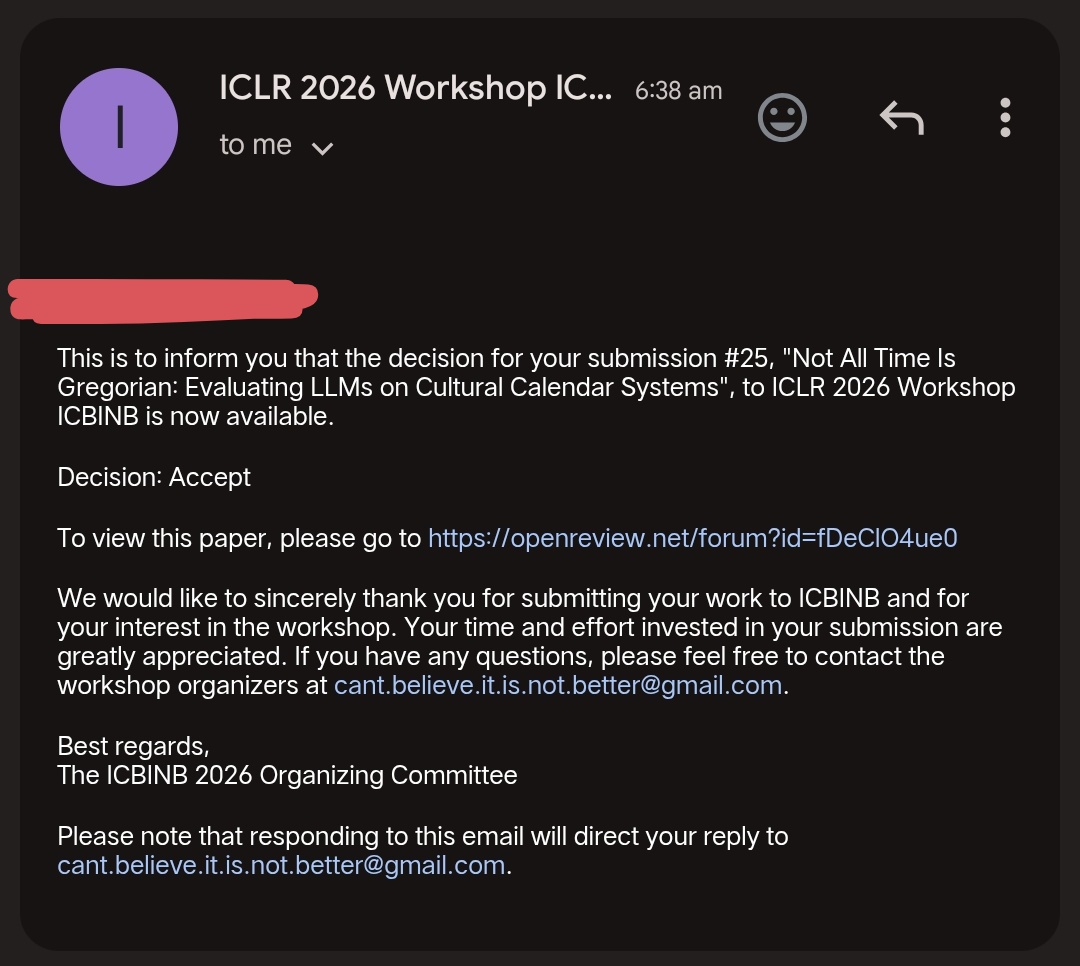
happy to announce that our paper from AI4Bharat has been accepted to the icbinb workshop at ICLR 2026 🎊
work done with @prajdabre @AdishPandya
English
This work has been accepted to the @ICBINBWorkshop at @iclr_conf !! See you in Rio hopefully 🇧🇷🇧🇷
Aarush@Aarush1003
New Pre-Print !! LLMs are not good dataset generators for retrieval tasks...
English
Paper: arixiv.org/abs/2504.21015
HuggingFace: huggingface.co/collections/ch…
English
Combining LLM generated hard-negatives with that of BM25 or cross-encoders improves performance but still can not outperform the baselines. More importantly we find that Phi4 generates data that results in a better retriever than Qwen3-30B a model twice the size of Phi4.
English
