
Sabitlenmiş Tweet
b/acc, context platform engineer
227.8K posts


b/acc, context platform engineer
@AccBalanced
AI Factories. Balanced Accelerationist. WEKA CAIO, CNCF kubernetes founding board, Post-PKI.
Seat 14D Katılım Temmuz 2008
8.1K Takip Edilen8.7K Takipçiler
b/acc, context platform engineer retweetledi

Man, /goal is just AGI if given the right tools..
Like what do you mean you went through all the entire database of 2k+ line items, fixed all the product images, the frontend bugs caused by different images, the descriptions, used browser harness to get real-time info from the web, used web search for fact checking, wrote scripts for all the work you did for the future.. and ran for 2 hours while I met founders for coffee.
I'm just shook 😅
English
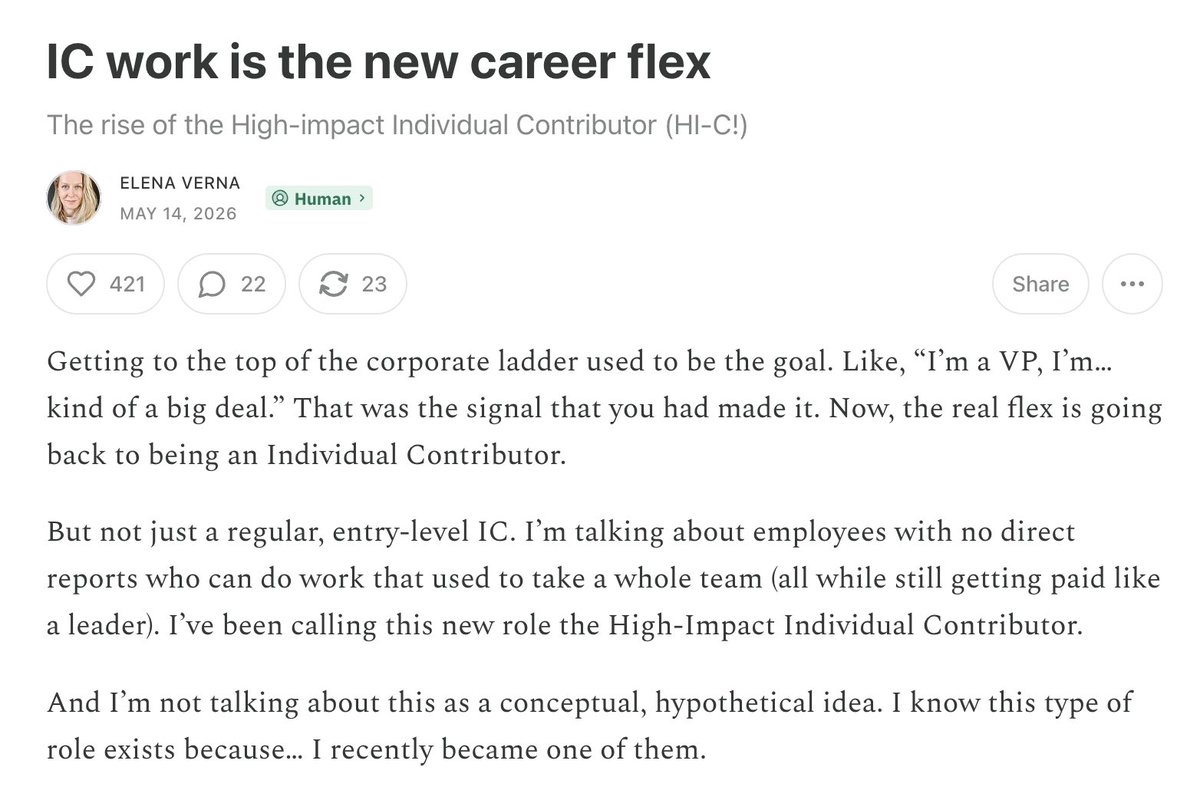
@lennysan @ElenaVerna Did this in late 2024. Never been more satisfied
English

b/acc, context platform engineer retweetledi

Scoop: OpenAI announced another major reorg on Friday, as part of its effort to unify ChatGPT and Codex.
-Greg Brockman is officially taking over OpenAI's products, after previously being tapped as an interim leader
-Head of Codex, Thibault Sottiaux, is now leading core product and platform
-Head of ChatGPT, Nick Turley, is now also going to work on revamping enterprise products

English
@mcuban Deduct cache read costs, and you have a deal
English

We should federally tax Tokens at the Provider level.
Not a lot. Less than 50c per million tokens.
It will accomplish 4 things (at least )
1. It will push the big AI players to optimize tokenization, caching , routing and localization
Which will
2. Reduce energy usage. Saving them in energy costs more than what they paid in tax and reducing strain created by the growth in energy consumption
Which will
3. Generate maybe 10 billion dollars a year to start, but over the next ten years could grow 30x to 100x
Which will
4. Create a source of funding to pay down the federal debt or deploy, in response to the things AI brings that we don’t expect or don’t like
At some point the models will pass it on to customers. Of course. That’s ok. Customers will have the ability to choose between providers. Or to do everything using open source models locally.
Thoughts ?
English
b/acc, context platform engineer retweetledi

"Follow the gigawatt."
Two years ago, Coatue's AI framework was "follow the GPU".
Today the gigawatt is the atomic unit of AI growth, and one of the biggest shortages in the market.
Jaimin Rangwalla, CIO of Public Investments at Coatue, on how the team is mapping the supply chain.
Molly O’Shea@MollySOShea
NEW: Exclusive Interview with Jaimin Rangwalla, Chief Investment Officer of Public Investments at Coatue In @coatuemgmt's Spring 2026 Investor Update, Jaimin walks through the unexpected winners of the AI cycle: memory, optical, CPUs, & the infrastructure layer quietly outperforming the Mag 7. We cover: - Why Coatue is "following the gigawatts" - Private companies breaking into the global top 25 pre-IPO (OpenAI, Anthropic, SpaceX) - Cash flow transferring from hyperscalers to AI infrastructure - The $12T funding engine behind the AI buildout - Sellers of shortage vs. buyers of shortage - The Token Economy - The CPU/GPU flip reshaping compute demand - Coatue's $6T+ AI market estimate - Agents launching agents / "1,000 analysts working 24/7" Read the full deck & watch the update replay below 𝐓𝐈𝐌𝐄𝐒𝐓𝐀𝐌𝐏𝐒 (00:00) Jaimin Rangwalla, CIO of Public Investments at Coatue (00:56) Inside Coatue HQ (02:48) Investor Update Kickoff (04:36) Mapping the AI Stack (06:02) Why Supply Stays Tight (07:03) How Jaimin's Became CIO (10:43) Private Giants vs Mag 7 (12:40) Market Breadth and Reordering (15:24) Where AI Revenue Comes From (17:04) Tokens and Economy (19:43) Agents Change Everything (21:58) OpenClaw Explained (24:49) Memory Demand Explosion (27:12) Architecture Shifts Ahead (27:24) Agents Gain Memory (27:58) CPU Demand Surge (28:38) CPU GPU Ratio Flip (30:21) Key Chip Players (30:45) Intel Comeback Thesis (31:41) Semis Go Mainstream (33:24) Nvidia Mania and GTC (33:59) Tracking Data Center Buildouts (35:21) Jobs Lost and Created (37:30) Sellers Versus Buyers (40:54) Optical Breakouts (41:27) Bottlenecks Everywhere (44:48) Sentiment Versus Fundamentals (47:10) Handling Volatility (49:17) Finding New Leaders (51:18) Trillion Dollar IPOs (52:48) Risks and Disruptions (55:00) Coatue Growth Story (55:58) Staying Curious to Win
English
@deedydas With age comes the wisdom. With wisdom, inner peace.
English

The vibes in SF feel pretty frenetic right now. The divide in outcomes is the worst I've ever seen.
Over the last 5yrs, a group of ~10k people - employees at Anthropic, OpenAI, xAI, Nvidia, Meta TBD, founders - have hit retirement wealth of well above $20M (back of the envelope AI estimation).
Everyone outside that group feels like they can work their well-paying (but <$500k) job for their whole life and never get there.
Worse yet, layoffs are in full swing. Many software engineers feel like their life's skill is no longer useful. The day to day role of most jobs has changed overnight with AI.
As a result,
1. The corporate ladder looks like the wrong building to climb.
Everyone's trying to align with a new set of career "paths": should I be a founder? Is it too late to join Anthropic / OpenAI? should I get into AI? what company stock will 10x next? People are demanding higher salaries and switching jobs more and more.
2. There’s a deep malaise about work (and its future).
Why even work at all for “peanuts”? Will my job even exist in a few years? Many feel helpless. You hear the “permanent underclass” conversation a lot, esp from young people. It's hard to focus on doing good work when you think "man, if I joined Anthropic 2yrs ago, I could retire"
3. The mid to late middle managers feel paralyzed.
Many have families and don't feel like they have the energy or network to just "start a company". They don't particularly have any AI skills. They see the writing on the wall: middle management is being hollowed out in many companies.
4. The rich aren’t particularly happy either.
No one is shedding tears for them (and rightfully so). But those who have "made it" experience a profound lack of purpose too. Some have gone from <$150k to >$50M in a few years with no ramp. It flips your life plans upside down. For some, comparison is the thief of joy. For some, they escape to NYC to "live life". For others still, they start companies "just cuz", often to win status points. They never imagined that by age 30, they'd be set. I once asked a post-economic founder friend why they didn't just sell the co and they said "and do what? right now, everyone wants to talk to me. if i sell, I will only have money."
I understand that many reading this scoff at the champagne problems of the valley. Society is warped in this tech bubble. What is often well-off anywhere else in the world is bang average here.
Unlike many other places, tenure, intelligence and hard work can be loosely correlated with outcomes in the Bay. Living through a societally transformative gold rush in that environment can be paralyzing. "Am I in the right place? Should I move? Is there time still left? Am I gonna make it?" It psychologically torments many who have moved here in search of "success".
Ironically, a frequent side effect of this torment is to spin up the very products making everyone rich in hopes that you too can vibecode your path to economic enlightenment.
English
b/acc, context platform engineer retweetledi

OK I guess Mythos really is meaningfully stronger than 5.5
s1r1us (mohan)@S1r1u5_
seems twitter missed the ExploitBench paper? few observations: we finally got good data on Mythos security capabilities and it's very impressive. Mythos got full exploit chain on 18/41 v8 n-days, while gpt 5.5 only got 1 and open source models are mostly useless.
English
b/acc, context platform engineer retweetledi

Jane Street just showed the inside of their AI training data center in Texas.
4,032 GPUs. 56 racks. 8,000 km of fiber. liquid cooling running through every server because air cooling can't handle the heat anymore.
but the part that got me was the origin story.
Ron Minsky, who co-heads their technology group. said their first compute cluster was literally six Dell boxes stacked on top of each other at the end of a desk row. they called it "the hive."
the trading systems sat out in the room with the traders because they wanted to be able to unplug them if something went wrong.
at one point, someone vacuuming the office unplugged a live trading system in the middle of the day.
from six Dell boxes and a vacuum cleaner incident to a liquid-cooled GPU data center processing trades in under 100 nanoseconds.
that's a 20-year arc.
English
b/acc, context platform engineer retweetledi

Called it, they are gonna use Cursor’s data to leapfrog
Elon Musk@elonmusk
@beffjezos Our recently completed Grok V9 1.5T run is looking great and that is before Cursor data is added in supplemental training
English
b/acc, context platform engineer retweetledi

Critique of the 𝕏 algorithm is welcome.
There will be monthly updates of the latest algorithm to GitHub with release notes.
As reminder, you can always choose no algorithm via the Following tab.
Linus ✦ Ekenstam@LinusEkenstam
This is how the algorithm can completely destroy your reach over night. This is the last: Left: 3 months Right: 2 weeks Super consistent 85-95% drop on all metrics. everything after a viral post going ballistic, I tried everything, cool down, delete low quality posts, block bot accounts. Kept posting after cool down, nothing really breaks through. Short hot takes 🛑 Long form with good signal 🛑 Viral potential post 🛑 Core audience value post 🛑 What bothers me here is that 48h after posting a mega viral post I get suppressed back to the Stone Age. This follow previous situations I’ve had with the grok powered algorithm. Where it feels like tweepCred falls far below a certain level, and you’re locked into a low reach prison with every effort to break out is making it harder and harder to do so. I’m asking for transparency on what we can do as content creators when this happens. I don’t want to spam my way out of this. I’d like to know, if I did something wrong, how I can address it, take the responsibility of algorithmic suppression for what ever the length is. But this limbo is most likely going to make me leave the platform.
English
b/acc, context platform engineer retweetledi

b/acc, context platform engineer retweetledi

We've gone even farther:
Nemotron 3 Super is 120B and pretrained on 25T tokens in NVFP4.
Nemotron 3 Ultra is ~500B and also pretrained in NVFP4.
Accelerated computing means we rethink every aspect of the AI stack looking for new opportunities to improve efficiency.
How To AI@HowToAI_
NVIDIA has done the impossible and nobody's talking about it. They trained a 12 BILLION parameter LLM in 4-bit precision on 10 trillion tokens. For years, the AI industry has been stuck. If you wanted to train a world-class AI, you had to use 16-bit or 8-bit precision. Going lower to 4-bit, was a death sentence for the model. It would become unstable, "hallucinate" its own math, and eventually collapse. But NVIDIA proved that "impossible" was just a math problem. They used a new format called NVFP4. Instead of a standard, rigid structure, NVFP4 uses "micro-scaling." It groups numbers into tiny blocks and applies individual scaling factors to each one. It’s like giving the AI a pair of high-definition glasses for its own data, allowing it to see fine details even with 75% less memory. The result is a total paradigm shift: - 2× to 3× faster arithmetic performance. - 50% reduction in memory usage. - Near-zero loss in intelligence. The researchers compared the 4-bit model against a massive 8-bit baseline. The curves are identical. On MMLU, GSM8K, and coding benchmarks, the "tiny" 4-bit version performed within 0.1% of the more expensive model. This is an economic earthquake. Training a frontier model used to require tens of thousands of GPUs and months of time. NVIDIA just showed we can get the same results with half the hardware and a fraction of the electricity.
English
b/acc, context platform engineer retweetledi
The latest 𝕏 algorithm has been published to GitHub
github.com/xai-org/x-algo…
English
b/acc, context platform engineer retweetledi

Long Context Pre-Training with Lighthouse Attention.
“At 512K context on a single B200 (L=3, p=4, sparsity ~1:64), Lighthouse runs the same forward+backward pass ~17× faster than standard attention”
by @bloc97_ @SubhoGhosh02 @theemozilla
Nous Research@NousResearch
Today we release Lighthouse Attention, a selection-based hierarchical attention for long-context pre-training that delivers a 1.4-1.7× wall-clock speedup at 98K context. It runs the same forward+backward pass ~17× faster than standard attention at 512K context on a single B200, without a custom sparse attention kernel, a straight-through estimator, or an auxiliary loss. During training, queries, keys, and values are pooled symmetrically into a multi-resolution pyramid. We then score every pyramid heads, and a top-k cascade selects a small hierarchical dense sub-sequence, and after a sorting pass that enforces causality, we use standard attention for token mixing. A brief full attention resume at the end converts the checkpoint back into a competent dense-attention model. Validated this using 530M parameter Llama-3 models across 50B tokens, with up to 1M-token benchmarks across 32 B200s under context parallelism. The work on Lighthouse Attention was led by @bloc97_, @SubhoGhosh02, and @theemozilla.
English
@meggmcnulty Jevons paradox playing out between agent harness and model evolution, leads me to believe growing token demand will help extend useful depreciation to 6 years for older gear until the end of the decade.
Very hard to predict beyond that.
English

A frontier-class NVIDIA GPU is estimated to stay at the front of the training pack for two to three years before NVIDIA’s next product cycle displaces it. The SPV debt financing it amortizes over five.
NVIDIA moved to a one-year product cycle in 2025. The chips backing tens of billions of dollars in AI infrastructure debt are about to become previous-generation twice as fast.
CoreWeave depreciates GPUs over six years. Nebius, with the same business model and the same hardware, depreciates the same chips over four. AWS, Microsoft, and Google all moved their server useful-life assumptions from three to four years up to six years in 2023, which reduced reported depreciation expense by roughly $18B annually across $300B of combined capex….
Michael Burry’s claim is that hyperscalers will cumulatively understate depreciation by approximately $176B between 2026 and 2028. The math is independently checkable. If the true useful life of frontier-training GPUs is closer to two to four years and the books say six, the gap between paper value and recovery value is real and enormous.
The recent inference demand surge complicates this. If H100s have genuinely productive life past frontier training, six years may not be wrong. If demand softens again in 2026 or 2027, the writedowns hit at exactly the moment lenders need their collateral to be worth something.
English
b/acc, context platform engineer retweetledi

SemiAnalysis President @fabknowledge on the Cerebras IPO:
"There is a narrow path for them. I think they're going to be able to inference maybe 1 trillion parameters and very small context window sizes. Or smaller models at very fast speeds."
"There's demand. Clearly, we're in a shortage, and ironically in a shortage, it's not the best company who wins — you can look at Nvidia's stock chart and that will tell you."
"It's the second, third, and fourth-best companies where the demand overflows. And we're seeing all that today."
"The reality is the market's big enough for a lot of demand, and Cerebras is in that space."
"They've done a really good job, and it's a cool engineering problem. But we think it's kind of a solution looking for a problem. Because the world of LLMs blew up at a much faster scale than anyone would have ever thought."
$CBRS
English