
R Sreenivas VSM
6.8K posts
R Sreenivas VSM
@AdmSreenivas
Geopolitics, Nat Sec & Self-Reliance ■ Values Bharat's Intrinsic pluralism and Diversity ■ Corporate CEO ■ Views Personal
भारत Katılım Kasım 2022
423 Takip Edilen1.2K Takipçiler

Anyone in Pak army who is not a general. 🤣
Gabbar@Gabbar8244
What can we actually buy ₹10 in 2026?
English

Diplomatically, India has painted itself into a corner. New Delhi’s visible alignment with Washington and Tel Aviv has enraged public opinion from Tehran to Kuala Lumpur. Moreover, the Modi government has taken this position without any serious leverage over US or Israeli decision‑making, nor has it shown the courage to defend Iranian sovereignty. Modi has reduced this grave crisis in West Asia to another episode of telephone calls and photo opportunities.
Read Sushant Singh's (@SushantSin) essay: caravanmagazine.in/politics/us-is…

English
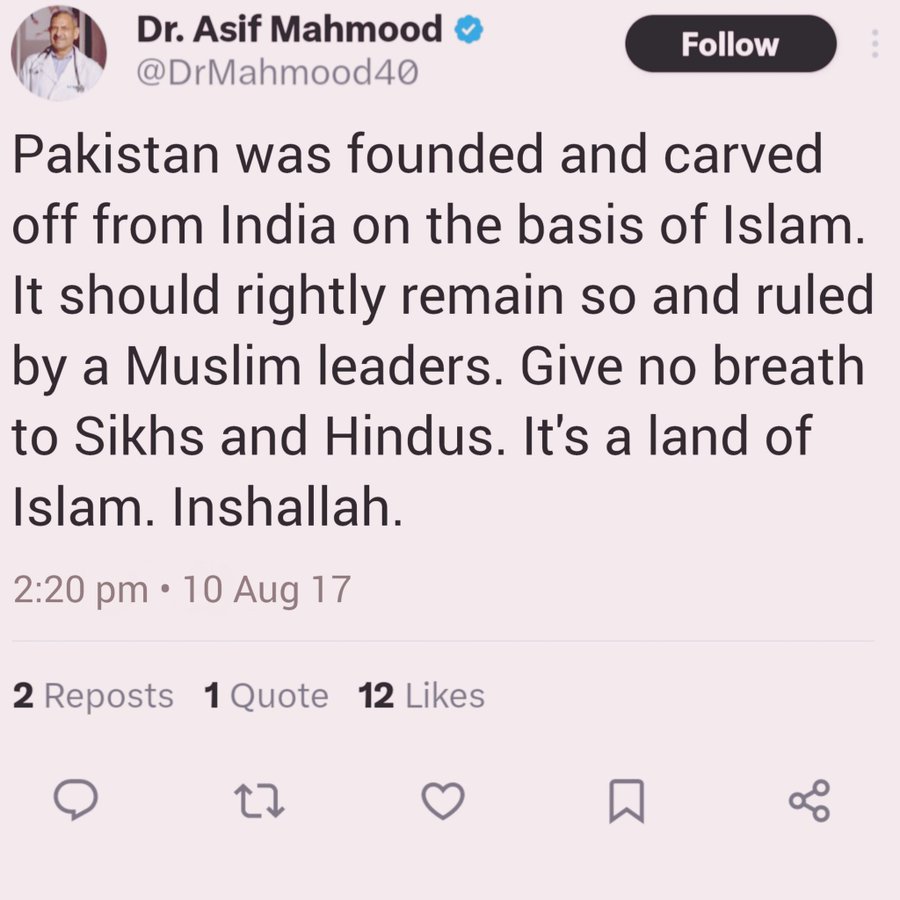
@DrMahmood40 A few hypocrats have a short memory and lumited ability to walk their talk to follow and demonstrate what they write in their profile, yet they want to pass off as intellectuals
English
Church burning, meat ban, forced marriages with young non Hindu girls and in many cases mob lynching is extremely worrisome.
India needs to be designated as CPC by State Department.
USCIRF@USCIRF
Vice Chair @DrMahmood40: “13 Indian states now have anti-conversion laws. ‘Hurting religious sentiment’ charges disproportionately harm minorities, including Christians & Muslims. The USG should designate India as a CPC & should link bilateral trade to improving FoRB conditions.”
English
Two points to burst this hypothesis:-
1. The operational license for Starlink operations in India was accorded way back in June 2025.
2. Elon Musk and Donald Trump don't see eye to eye. Trump would be the last person to lobby for furthering the business interests of Musk
Elon Musk's Starlink's India entry plan: Rs 33,000 per device, Rs 3,000 monthly post-trial - India Today share.google/mH98s38Exb3Uvp…
English

Days after Musk was reportedly on the line during a Modi-Trump call, top Starlink executives visit India, meet Minister, sign MoUs.
Jyotiraditya M. Scindia@JM_Scindia
It was a pleasure to meet Ms. Gwynne Shotwell, President & COO, @SpaceX, Ms. Lauren Dreyer, Vice President, Global Business, @Starlink and the India leadership team today.
English
I thought communal hatred came to the fore again with the partition of India, and communal politics started immediately after the independence.
It went on unabated till 2014 when that one party that sown the seeds of communal and divisive politics was routed out of power.
What someone may say that communal politics has again took the front seat now - is the imminant backlash, in a much milder form, against decades of communalism that was unleashed on this land by divisive forces...
English
Let us rise above communal divisive politics to save the fabric of our great nation!
Today when communal politics has again taken the front seat, we recall -Sarat Chandra Bose ,who stood for a United Bengal literally till his last breath. He had said - '...to accept that concept (i.e. religion as the basis for a State) in the year of grace 1947 and to apply it to India will mean pushing her back into the medieval ages. ..The solution of the communal problem lies ultimately in social justice, and so far as our collective life is concerned, in an emphasis on the political and economic aspects and interests of life and in the divorce of religion from politics and economics.' Today when the ugly head of communalism is again visible, let us all dedicate ourselves to the Bose ideology in which distinctions based on religion, caste, class and gender have no place.
Let us save the nation by uniting all communities as one! Jai Hind!

English

US Govt Report Says Indian Authorities' Takedown Orders to US Social Media Firms 'Politically Motivated'
The takedowns under the IT Rules has been identified by Washington as non-tariff 'trade barriers,' along with frequent internet shutdowns.
thewire.in/trade/us-govt-…
English
Very aptly coined acronyms!
Aravind@aravind
@eshwar_171 GLISCO-DS: Globalists, Islamists, Communists have formed a network that's an unholy alliance scratching each others backs. MAGA-DS: The new all American DS that brought Trump has president againt to fight GLISCO infiltration of US politics and systems.
English

@aravind @NAN_DINI_ Can't agree more with your views.
We've gone through this romanticism with Pakistani back channels and front channels many times and burnt our fingers.
English
There's no "together" with terrorists. There's no common future ahead. India's future is glorious and India's alone.
Doesn't matter women or men, Pakistan wants India's destruction. Why is it so hard for some Indians to get this after so many betrayals trying peace?
Nirupama Menon Rao 🇮🇳@NMenonRao
The women of India and Pakistan need to deploy our ingrained common sense and suggest ways forward in our relationship. We need a women’s caucus. Not to throw accusations against each other but to think calmly and sensibly about the future ahead. For the sake of our children. We need to bring in the counterpoint: without naming it, without sounding defensive, but making it impossible to dismiss. For decades, India–Pakistan engagement has been trapped in a single script: territory, terror, recrimination. We repeat it with ritual precision, but it yields diminishing returns. What if we widened the frame? In West Asia, especially the Gulf, our interests often run in parallel: energy security, diaspora welfare, maritime stability, crisis response. These are not abstractions since they affect millions of lives and the resilience of both economies. Engaging here need not dilute our positions, create false parity, or reopen familiar disputes. It can remain tightly bounded, issue-specific, and without prejudice to core differences. Skeptics will argue that Pakistan cannot compartmentalise, that any engagement risks being instrumentalised, and that peripheral cooperation has never altered core hostility. But the purpose here is not transformation, it is insulation. Not to resolve the conflict by other means, but to prevent it from defining all means. Some may also say Pakistan has found a “role” in the Iran crisis and India should not be seen as seeking one. But this is not about visibility or mediation. Our interests are structural not transitory. If anything, the moment underscores a larger truth: even adversarial states operate beyond their disputes when interests demand it. When the central track is blocked, responsible statecraft does not stand still. It explores parallel ones, carefully, deliberately, and on its own terms. Sometimes, widening the field is not weakness. It is strategy. The women must speak.
English
@RadharamnDas @GangalMukul Such a sick mind is unbelievable for a normal person in a civilised society.
English
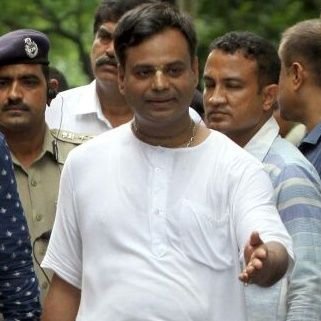
Just see the level of toxicity in this Indian Muslim family where the wife Yasmeen Khan ran a beauty parlour where she invited Hindu girls for free beauty parlor courses. And when these girls came she used to spike their drinks. When they used to became unconscious, she used to call her husband Mohammed Sharif Khan who used to r@pe them. The wife meanwhile used to guard the reception while his husband r@ped the Hindu girls & video recorded his act to blackmail Hindu girls to have s€x with more Muslims.
When police asked the wife why she offered young Hindu girls to her husband for r@ping them, she said that they will get Jannat as she is helping r@ping kafir girls who deserved to be r@ped by Muslims. Hindus needs to be extra beware & should not allow their children's to be in contact with anyone of them. They are crooked evil people
English
@Shree108ansh @anandmahindra @srajagopalan @NandanNilekani @mercatus @YourStoryCo @caleb_friesen @suhasasumukh @enableindia @PMOIndia @myogioffice Wow!
Stay blessed and keep innovating...
English

I built everything from scratch, 100% inhouse in india, it was just me & my obsession of making technology accessible to everyone in need!
It is a brain controlled robotic prosthetic hand!
Learn more at: brhm.in
English

The former Foreign Secretary of India, Nirupama Rao, show on how vulnerable is India’s position in the current Global order. Thanks to Modi Regime’s silence on West Asia.
This is how a Diplomat evaluates the situation, with grace and Class. Not giving in to populism and using sadak chaap language eg. ‘Dalal Nation’.
Nirupama Menon Rao 🇮🇳@NMenonRao
The world is being reordered by those who act and those who define. If India wishes to be counted among the latter, it must ensure that its silence does not speak louder than its convictions. We are living through a moment when the rules of the international system are being rewritten in real time. Assassinations of leaders, the killing of civilians, open assertions of force—these are no longer aberrations but instruments. In such a world, silence is not neutrality. It is read, interpreted, and often misread as consent. India has long claimed a distinctive space in global affairs—not as an appendage to power, but as a voice shaped by its own civilisational experience and its history of speaking for sovereignty, restraint, and balance. That voice mattered because it was consistent, even when inconvenient. Strategic autonomy cannot mean adjusting our language to the hierarchy of power. Restraint has its place. Calibration is necessary. But when fundamental questions arise—about sovereignty, about the limits of force, about the protection of civilians—India cannot afford to be silent. A moral compass is not an ornament of foreign policy. It is its direction. Without it, realism drifts into accommodation, and autonomy into ambiguity. This war has damaged India’s interests in almost every practical sense. It has raised costs, narrowed diplomatic room, stressed shipping, complicated Chabahar, and injected fresh instability into a region vital to India’s economy and external strategy. Even if New Delhi can cushion the blow, it cannot plausibly claim that the blow itself serves India. The deeper question is whether India is willing to say so with sufficient clarity.
English
A physically mature adult from India can write such articles under any one or a combination of the following conditions:
(1) When he's gripped by the combined effect of pathological narcissism, serious imbalance in psyche, and permanent and structural & functional impairment of the brain
(2) When a Brownsepoy suffering from Darbari syndrome is injected with a heavy dose of LeftIntOcon (Leftist Intellectual Overconfidence that any fancy sounding nonsense written by them sells like hotcakes)
English

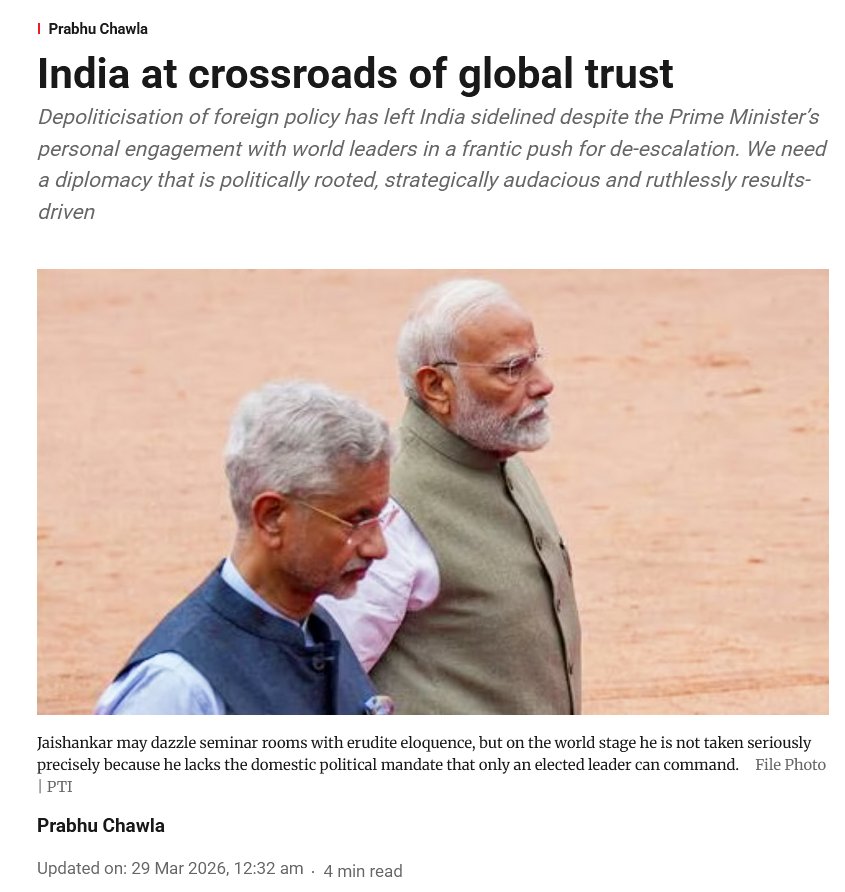
I usually don't read op-eds, but this one came on my feed multiple times hence made the mistake of reading it.
If you want an example of a hitjob designed to attack the foreign minister and attempt to hyphenate India and Pakistan, then this is it. +
English
@scribe9104 @GurorangriPadme What do you expect if they have someone like Dharmendra Pradhan in HRD?
English
Modi govt is great on defence, economy and even foreign affairs but it lacks intellectual depth required to address history, culture and education
I say this every second day
Nikhilam@MopkarNikhil
@scribe9104 Modi government is a complete failure in aspect of education and cultural reforms. Too bothered about external image, constantly seeking validation of the West.
English

@GurorangriPadme The pat on their backs, few more dollars/euros/dinars as incentives (bakshish or bheekh) can motivate these brown sepoys to sell anything they want, in which the first transaction happened by giving away the shame and conscience.
English
This is how brown sepoys, on orders from their white masters, write hit pieces on every initiative India takes for its own good.
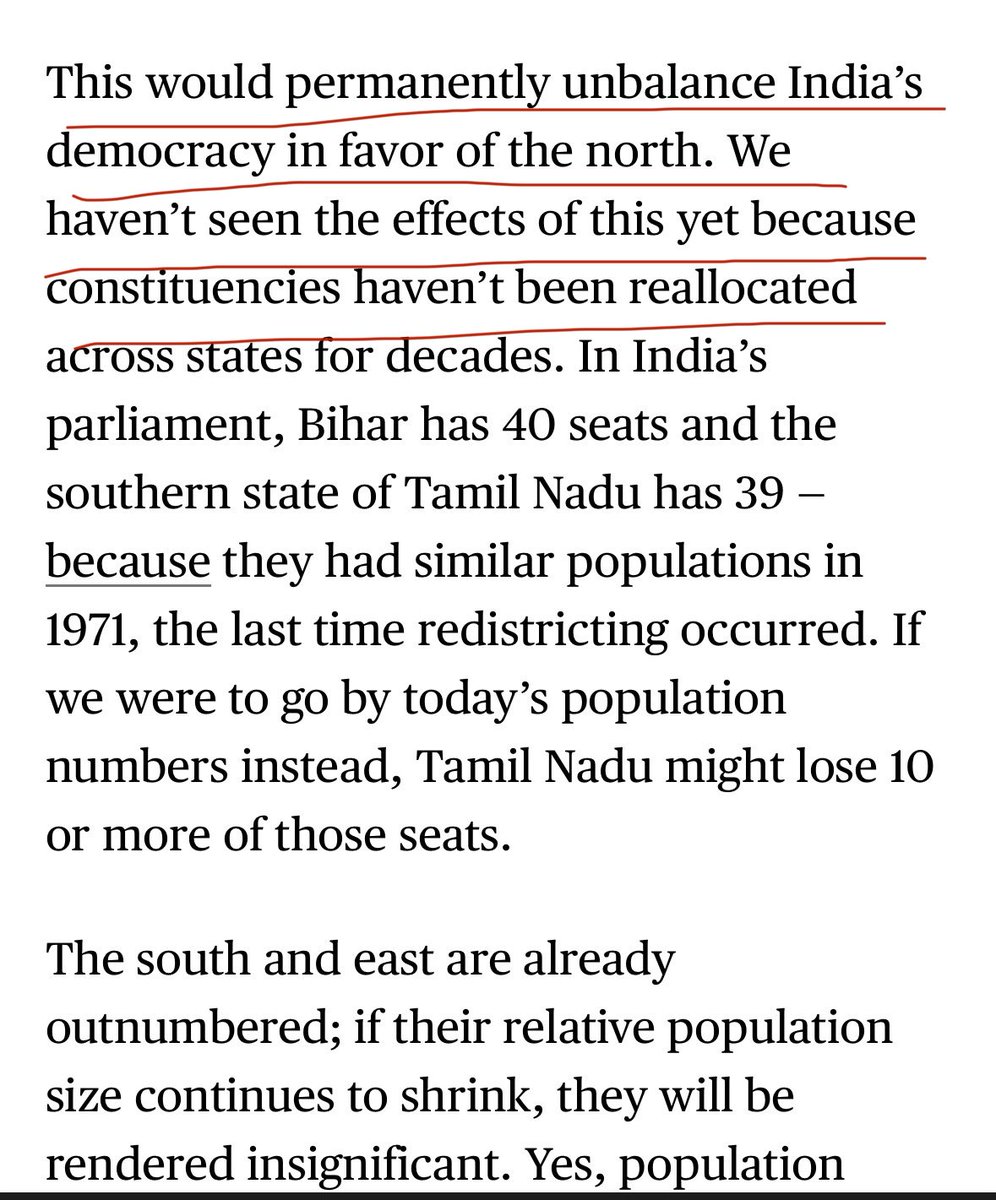
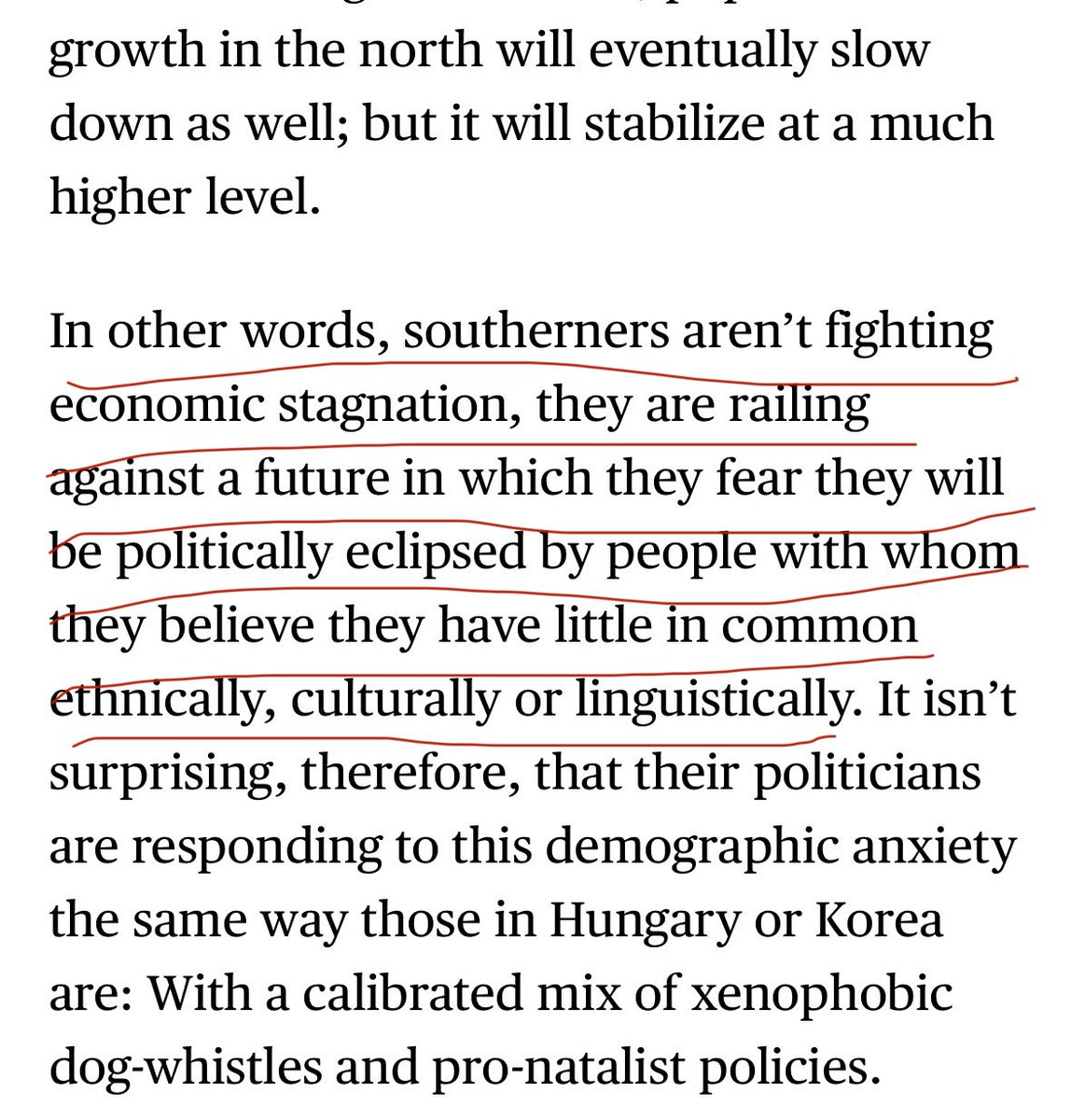
Mihir Sharma claims southern states want to boost population out of fear of North Indians overtaking them, as if they are some invaders.
This is exactly what the opposition amplifies to divide India along regional lines.
When it comes to dividing Indians based on region, demography and numbers matter. But the same becomes racism and majoritarianism when it comes to religion.
The brown sepoy mindset sees a fragmented India, not a civilisational one.
Hypocrisy at its peaks.
Bloomberg@business
Southern Indians are worried they will be eclipsed by the soaring population in the north, writes @mihirssharma. Getting women to have more babies is not the solution (via @opinion) bloomberg.com/opinion/articl…
English
A physically mature adult from India can write such articles under any one or a combination of the following conditions:
(1) When he's gripped by the combined effect of pathological narcissism, serious imbalance in psyche, and permanent and structural & functional impairment of the brain
(2) When a Brownsepoy suffering from Darbari syndrome is injected with a heavy dose of LeftIntOcon (Leftist Intellectual Overconfidence that any fancy sounding nonsense written by them sells like hotcakes)
English
English

Can an FIR be filed?
@Uppolice @DelhiPolice
Radharamn Das राधारमण दास@RadharamnDas
Muslims are having an open online meeting where they are discussing how to divide Hindus, specifically targeting Brahmins & separating them from other Hindu castes, & creating hatred against them so that other Hindus attack them. Why is the government sleeping? When will these thugs be arrested @PMOIndia @HMOIndia?
English
- We don't know exactly if they are Indian muslims. Going by names, locations etc is useless.
- Pak seeds such issues into India publicly for a reason. They run sophisticated fake account ops.
- Their modus-operandi is simple. Seed issues in India, use local divides, incite both sides, destabilize.
- Issues will take an organic form with incited real Indians on all sides amplifying what they seeded.
- They do this using caste, religion, region, and political divides in India to seed issues and incite.
- They do this in foreign countries too, for ex: incite Americans against Indians, Nepalis against Indians etc.
- It is a simple but effective pysops operation to incite, divide, and destabilize a country.
- Once people are incited, they start their own hate pointing at the other, and won't believe the whole hate was seeded from outside.
- This is why a social media monitoring and quick action cell is important to be run by India. If they are Indians, easy to take action. If not, shut them down.
- Simple solution that can prevent a lot of issues from India being seeded or used by adversaries to divide and destabilize India.
Tathvam-asi@tathvamasi6
Indian Muslims publicly discussing how to divide, attack and finish off Hindus. “Brahmins should be attacked first” 🤯😳
English

We had a small get-together since everyone was in the same city for a family function. My 12 cousins, along with their spouses and kids. We were all sitting on the terrace, lights off, just vibing in that proper gaon-style night with lamps around.
In the middle of it, my nephew asked Chachi (about something he saw on reels) that Dhurandhar 2 had removed a scene with the “Musharraf ki dastarkhan pe sar” dialogue. That’s when Didi got emotional and ended up narrating the entire Ashok Listening Post ambush and Bhausaheb’s story.
And guess what… by the end of it, you had around 30 new Pakistan haters in the 12–17 age group. Didi goes on saying Shatrubodh zaroori hai..
Its been 30 minutes and everyone quite.. Intense for kids. (even adults)
English
This is how the socalled 'secularists' redefined 'secularism', possibly in a bid to separate India from its culture and heritage.
A few opined that a talk on Bhagavad-Gita by a serving officer is not in consonance with secular ethos. Another went on to condiscend it, saying that even iranian officers didn't 'invoke' religion during the ongoing conflict, equating a discourse on Bhagavad-Gita to invoking religion.
As a high-school student, I never understood the necessity of the 42nd amendment when the original constitution of India envisioned a pluralistic nation. Looks like it is by design, a design that the architects of the original constitution haven't designed.
x.com/i/status/20373…
English

When Rafale jets were getting inducted in Hellenic Air Force Prayers were performed by Priests and their Fighter Pilots and Air Force Chief in Entire Flying overalls and G-Suite attended prayers.
As far as keeping Chanakya’s Portrait in the Background is Concerned Every Country Practices and flaunts their Civilisational and Cultural Heritage related to Martial History, Diplomacy and Statecraft, but only people here in India have problem and dared to Castigate the COAS for no reason. When people like him who are Veterans have Audacity to openly Tarnish COAS’s Reputation for literally no valid reason then all the Civilians like Bureaucrats in MoD and Opposition Party Leaders who called COAS with names like “Sadak kaa Gunda” will take the Army Chief and his Reputation for granted.

Kaypius@realkaypius
Goes in uniform to swamijis who want PoK as “dakshina”. Replaces legendary 1971 victory pic in his office with a pedestrian caricature of medieval folklore. When trolled for repeated indiscretions, visits temple in civvies & drags in an entire secular force. How low is too low?
English