
Adrian CvS, PhD
349 posts
Adrian CvS, PhD
@Adrianccs
✌️☯️🥊 Polymath Polyglot: Oracle Technologist & Businessman Appl.STEM & Business then Politics & Policies Decarbonization producing Energy & Bioenergy+Health
Katılım Kasım 2009
170 Takip Edilen25 Takipçiler

HELIOS directed energy weapon has been deployed against drones in Iran.
English
@OilBarren very interesting work!
Could you please explain the logic behind licensing for free? People only appreciate & respect things they pay for buying.
Wouldn't ramping up production/ scale-up increase your world impact?
When a new technology arises people tend to seek the "what if it is wrong instead of what if it is (even partially) correct" Kudos for pushing forwards
English
@ChaseLochmiller @CrusoeAI @MubadalaCapital Hi Chase where would it be best to reach you for an offer of a cleaner (primarily CO2-wise) workaround to the highend hydrocarbon turbine backlog?
English

I’m excited to announce that @CrusoeAI has closed our Series E round of financing valuing the company at $10.4B to help us build the infrastructure of intelligence. This round was led by our incredible partners at Valor Equity Partners and @MubadalaCapital. Solving the scaling needs of AI is one of the greatest challenges of our generation. If you’re inspired by working on big and difficult problems, come and join us!
We had an amazing group of investors in the round including @137ventures, @1789Capital, Activate Capital, @AltimeterCap, @Atreidesmgmt, BAM Elevate, DPR Construction, @OraGlobal, @Fidelity, @foundersfund, @FTI_US, @GalvanizeLLC, @LongJourneyVC, @lowercarbon, M37, MCJ, @nvidia, @RadicalVentures, @RibbitCapital, @SalesforceVC, @saquon, @sparkcapital, @stepstonegroup, @Supermicro, @TRowePrice, Tiger Global, @upper__90, @winklevosscap, @ziggcap
crusoe.ai/resources/news…
English
@Electron_Cowboy @CrusoeAI Hi Cully where would it be best to reach you for a cleaner (primarily CO2-wise) workaround to the highend hydrocarbon turbine backlog?
English

These early experiences building Bitcoin mining data centers and self-generating power in harsh environments prepared @CrusoeAI for the much larger AI data centers and power plants we build and operate today. If you can build in winter in North Dakota you can build anywhere IMO.
English
In 2021 @CrusoeAI deployed a turbine fueled by raw natural gas flowing from underground (otherwise being flared/wasted) to power modular data centers at a remote site in North Dakota. VCs invested $350m shortly after we demonstrated this scaling power generation capability.
English
@elonmusk @aakashgupta If 10k flights per year what is it one headed to mars?
English

@aakashgupta Starship V4 Tanker version will deliver >200 tons of propellant per flight, so more like 5 or 6 tanker flights to refill the lunar transit Starship in orbit.
Shouldn’t be too much of a problem if we’re doing >10k flights/year.
English

A city on the Moon will cost somewhere between $100B and $500B, require thousands of Starship flights, and demand a decade of nonstop construction in a place where the temperature swings 400°C between day and night, the dust cuts through metal seals like sandpaper, and a single cracked habitat window means everyone inside is dead in about 90 seconds.
Musk just announced SpaceX is doing it anyway. Here’s the actual engineering path.
You build at the south pole. Specifically the rims and floors of craters like Shackleton and Cabeus, where temperatures in permanent shadow drop below -230°C. NASA estimates 600 million metric tons of water ice are buried in these craters under about 40 cm of dry regolith. That water becomes your oxygen supply, your drinking water, your radiation shielding, and 78% of your rocket propellant by mass. The crater rims get near-continuous sunlight for solar power. You build where the resources are.
Getting there is where it gets wild. Every Starship lunar mission requires 10-15 tanker flights to fill 1,200 tons of propellant in Earth orbit before the ship can even leave. One cargo delivery to the lunar surface burns through roughly 12 Starship launches. Starship V3 lands 100 metric tons per trip. The Moon is 2 days away with launch windows every 10 days. Mars gets one window every 26 months with a 6-month flight. That 13x iteration advantage is why Musk pivoted.
The first 20-30 landings are all cargo. No humans. You’re sending solar arrays for the crater rims targeting 100+ kW continuous, nuclear fission reactors for the 14-day lunar night, ISRU rigs that mine ice from regolith and electrolyze it into hydrogen and oxygen, pressurized hab modules, and autonomous rovers that 3D-print structures from lunar soil using concentrated solar heat. Each landed Starship also stays as a permanent building. 50 meters tall, 9 meters wide, 1,100 cubic meters of pressurized volume. The ISS has 916 cubic meters and took 13 years to assemble. Three Starships on the surface already exceed that.
The economics flip the moment you start producing oxygen on the Moon. You stop shipping 78% of your propellant from Earth. Tanker flights per mission drop from 15 to about 4. Every ton produced locally frees up mass budget on the next inbound Starship for more construction equipment, food systems, and mining hardware. The base starts building the base. That’s what “self-growing” means. Compound logistics where each delivery makes the next delivery cheaper.
2027: first uncrewed Starship lunar landing. SpaceX told investors March 2027. 2028-2030: cargo buildup, 30-50 deliveries, all robotic, ISRU prototypes go operational. 2030-2032: first crews arrive, probably 6-12 people, 6-month rotations, running equipment maintenance and scaling propellant production. 2033-2035: permanent population hits 50-100, propellant depot goes up in low lunar orbit so arriving ships refuel before descent. 2035 onward: population grows past 100, agricultural modules come online, the base becomes partially self-sustaining.
The unsolved problems are real. Lunar dust is electrostatically charged and sharp as broken glass. It shreds seals, clogs machinery, and embeds in lung tissue. Nobody has a long-duration fix. Radiation on the surface runs 200x Earth’s dose. Regolith shelters and water shielding help but add enormous construction overhead. The 14-day night drops temperatures to -173°C and kills all solar power, and the only flight-ready nuclear reactors produce 1-10 kW, far below what a growing base demands. What years of 1/6 gravity do to human bone density and cardiovascular systems is completely unknown.
SpaceX is valued at a trillion dollars and just told investors the Moon comes first. They’re betting that proving lunar logistics at commercial cadence builds the playbook for Mars. The Moon is a 2-day test lab with a 12-day resupply cycle. Mars is a 6-month voyage with a 2.5-year wait if anything breaks. It makes sense.
Elon Musk@elonmusk
For those unaware, SpaceX has already shifted focus to building a self-growing city on the Moon, as we can potentially achieve that in less than 10 years, whereas Mars would take 20+ years. The mission of SpaceX remains the same: extend consciousness and life as we know it to the stars. It is only possible to travel to Mars when the planets align every 26 months (six month trip time), whereas we can launch to the Moon every 10 days (2 day trip time). This means we can iterate much faster to complete a Moon city than a Mars city. That said, SpaceX will also strive to build a Mars city and begin doing so in about 5 to 7 years, but the overriding priority is securing the future of civilization and the Moon is faster.
English
@elonmusk An exploratory Mars landing would give good tabgible data on the contrast of both colonization spots...
English
For those unaware, SpaceX has already shifted focus to building a self-growing city on the Moon, as we can potentially achieve that in less than 10 years, whereas Mars would take 20+ years.
The mission of SpaceX remains the same: extend consciousness and life as we know it to the stars.
It is only possible to travel to Mars when the planets align every 26 months (six month trip time), whereas we can launch to the Moon every 10 days (2 day trip time). This means we can iterate much faster to complete a Moon city than a Mars city.
That said, SpaceX will also strive to build a Mars city and begin doing so in about 5 to 7 years, but the overriding priority is securing the future of civilization and the Moon is faster.
English
How does a directed energy weapon work?
Department of War CTO@DoWCTO
DIRECTED ENERGY DOMINANCE 🇺🇸
English
@xai If xAI datacenters are in space, and the internet is beamed directly from space as well, under which country's jurisdiction would it fall? ...X-topia, UN, open (space) seas?
English

If he just knew how bad the @UN's offices/departments actually are to answer people (that actually want to enhance their outreach and impact), to list a telephone # to call to or simply scheduling an appointment... He would probably consider opting out of the UN as well.
Just imagine the response timeline for people in tight situations!
English

.@POTUS: "The UN just hasn't been very helpful. I'm a big fan of the UN's potential, but it has never lived up to its potential. The UN should have settled every one of the wars that I settled."
English
@nitrokey please expand on how there is a difference in the availability or manufacturability for a processor whether it is for one version or another of the Nitropad, see the following for reference (if need be more context on the thread can be made available through this channel):
"
Hello Adrian,
Thank you for your message.
Unfortunately, the NitroPad V54 with an Core Ultra 7 will not be available again until the beginning of March.
You can either switch to our product with an Core Ultra 5 or to the NitroPad V56 with an Core Ultra 7.
We manufacture the PRODUCT in Germany, which means we refine it here. The original hardware comes from China, and we are required by law to disclose this information....
"
@QubesOS
English

Experts are experts in what WAS, not what will be. If you want to do something new, look outside the field!
English

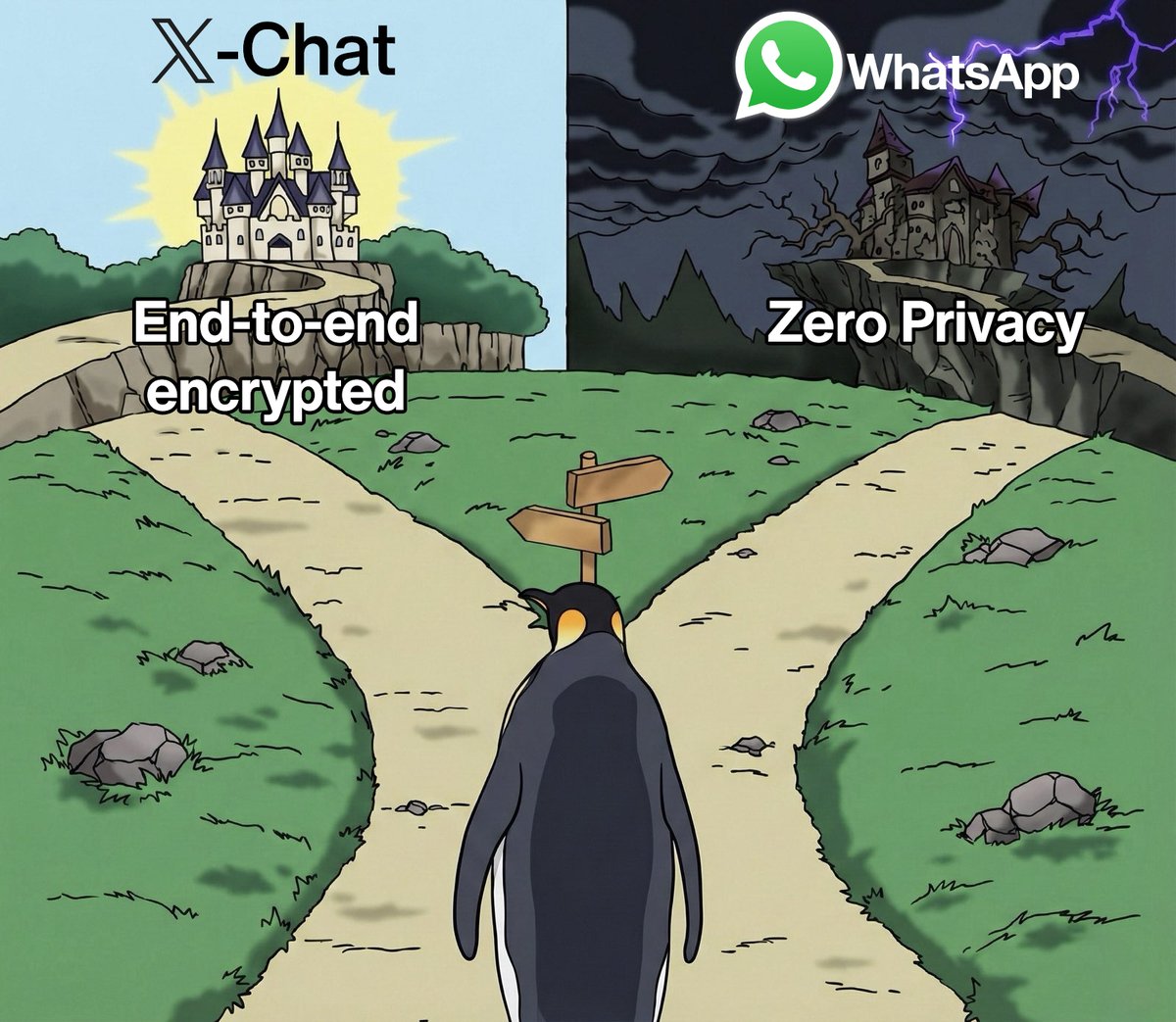
Switch to 𝕏 Chat
- Fully encrypted for maximum privacy
- No third-party dependencies
- No advertising hooks or hidden trackers
- Supports texts, file transfers, audio/video calls
- 𝕏 never reads or sells your chats to advertiser
- You can make calls without sharing your number
English
What are @UN offices doing (or "efforts"/policies) towards pre-emptively rather than reactivly protecting civilians against DEW enhanced (neuro-)cognitive warfare & torture?
@UN_Disarmament @DrAliceJEdwards @UNIDIR @UNHumanRights
Formal emails sent as well, still pending reply :)
English
What is @NATO doing towards protecting civilians, and decision makers against DEW enhanced (neuro-)cognitive warfare?
@NATOpress @NATO_STO
English
@ChiefFusioneer @Andercot @AvalancheFusion BTW which pressures do you guys require inside of the chamber (asking for a friend)
English
@ChiefFusioneer @Andercot @AvalancheFusion Hey Rob
Your team probably already solved this: JiC, PhD experiments for UHV (ultrahighvacuum) experiments, we'd bake-in of the chamber for water & O2 (fancy for heat it up e.g. 350˚C with heating strips for a couple of hours) then flushing with preheated Ar+few %H2. Great work!
English

Did a really cool podcast with the awesome @Andercot on what’s new in fusion and @AvalancheFusion 👇👇👇
Andrew Côté@Andercot
Hyperstition Broadcast - Electrostatic Inertial Confinement x.com/i/broadcasts/1…
English
@joeroganhq How about a fusion energy ceo (e.g. helion, general fusion, ...) and a serious (net+positive energy) cold fusion ceo/scientist? Would be nice to show cold fusion myths/(de-)debunking and actual challenges for scale-up. Probably @lexfridman could help or host them himself.
English

Name someone who you think should get a chance to come on the Joe Rogan podcast?
English
@aakashgupta Hence Elon Musk is suggesting orbital data centers, now rocketing over regulatory compliance...
On the other hand someone should remember they already own Tesla Energy...
English
Everyone’s missing the real story here.
xAI didn’t beat competitors by moving faster. They beat them by ignoring the rules competitors follow.
The 122-day Colossus buildout? Powered by 35 unpermitted gas turbines that the EPA just ruled yesterday were operating illegally. The company exploited a local loophole classifying trailer-mounted generators as “nonroad engines” exempt from Clean Air Act permits. They ran those turbines for over a year in South Memphis, a majority Black neighborhood where cancer risk is already four times the national average.
The “city-level power” comparison in the tweet is accurate. xAI essentially built a 422 MW power plant in a residential area without any environmental review, public notice, or pollution controls. The Shelby County Health Department only permitted 15 turbines. xAI operated 35.
While OpenAI and Anthropic are waiting 12-24 months for grid connections and permits at their Stargate and Rainier facilities, xAI discovered you can move faster if you simply don’t ask permission. Oracle’s OpenAI data centers just got delayed from 2027 to 2028 due to labor and material shortages. xAI’s secret? Skip the permitting process entirely, deal with the lawsuits later.
The expansion to Colossus 2 across the Mississippi border wasn’t “genius” site selection. It was jurisdiction shopping after Tennessee regulators started getting heat from NAACP lawsuits and EPA scrutiny.
This tells you everything about how Musk views regulatory compliance as a competitive moat to be tunneled under. SpaceX and Tesla have the same pattern. Move fast, break environmental rules, pay fines later.
The EPA ruling yesterday closes the loophole. Future xAI expansions will face the same permitting timelines everyone else deals with. The “speed advantage” was a one-time regulatory arbitrage play, and it came at the expense of Memphis residents breathing 2,000+ tons of NOx emissions per year.
X Freeze@XFreeze
xAI has officially become the first to bring a gigawatt-scale coherent AI training cluster online That’s more electricity than the peak demand of San Francisco While competitors are still drafting roadmaps for 2027, xAI is already operating at major city–level power today The execution speed is unreal: Colossus 1 → from dirt to fully operational in 122 days Colossus 2 → just crossed the 1 GW barrier, targeting 2 GW total Elon’s playbook hasn’t changed: move faster than everyone, scale before they finish meetings The strategy is clear: speed and execution at scale
English