
Sabitlenmiş Tweet
Alec Stapp
34.2K posts


Alec Stapp
@AlecStapp
Co-founder @IFP, an innovation policy think tank
Washington, DC 🇺🇸 Katılım Haziran 2009
1.5K Takip Edilen110.8K Takipçiler
The gambling industry is out of control

McKay Coppins@mckaycoppins
Last year, The Atlantic gave me $10K to gamble with. What started as a journalistic gimmick turned into something more... unnerving. My cover story on the online betting boom warping sports, culture, politics, and the psyches of millions of young men: theatlantic.com/magazine/2026/…
English

Everyone is covering Terafab as a chip factory.
It is not a chip factory.
Last night in Austin, Elon unveiled a facility that makes masks, fabricates chips, and tests them inside a single building with a nine-month recursive improvement cadence. No such loop exists anywhere else on Earth. Then he told you 80% of the output goes to space. Then he showed you a 100-kilowatt AI satellite with solar panels and radiators, scaling to megawatt range. Then he said Optimus plus photovoltaics will be the first von Neumann probe, a machine capable of replicating itself from raw materials found in space.
Nobody connected the sequence.
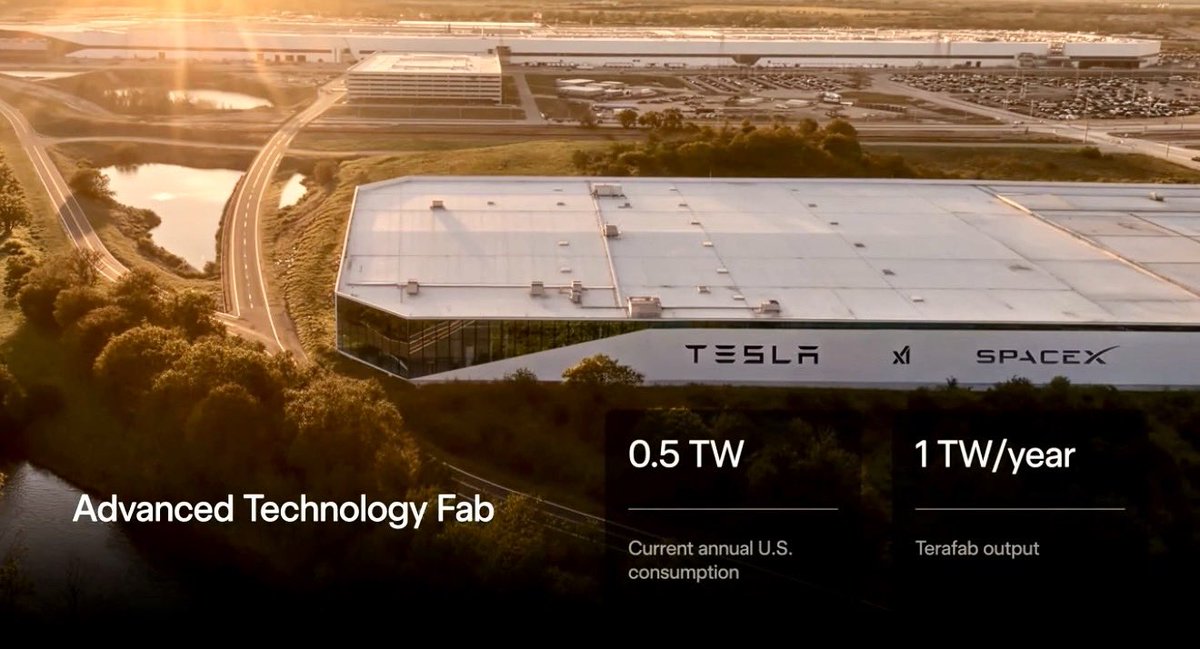
Terafab produces 1 terawatt per year of compute. The entire United States consumes 0.5 terawatts of electricity. Musk is building a single factory whose output in AI silicon exceeds twice the power consumption of the country it sits in. And he is sending 80% of it off-planet because Earth literally cannot power what he is building.
Follow the mechanism. Terafab seeds the chips. Starship launches Optimus robots and solar arrays at 100 million tons per year. The robots mine lunar and asteroid regolith for silicon, iron, and nickel. They 3D-print more robots. They fabricate more solar panels. They assemble more AI satellites. Each satellite runs hotter-burning D3 chips designed specifically for vacuum, where free radiative cooling eliminates the thermal constraints that strangle every terrestrial data center on the planet. The nodes replicate. The replication is exponential.
This is a Dyson Swarm bootstrap hidden inside a semiconductor announcement.
The math is public. The Sun outputs 3.828 times 10 to the 26th watts. A 2022 paper in Physica Scripta calculated that 5.5 billion satellites at 290 kilograms each, robotically manufactured from Mars resources, capture enough solar energy to meet all of Earth’s power needs within 50 years. A 2025 paper in Solar Energy Materials calculated a partial swarm capturing 4% of solar output yields 15.6 yottawatts, roughly a billion times current human civilization’s total energy budget. Musk just announced the factory that builds the chips that go inside the satellites that replicate themselves forever.
92% of advanced logic chips are fabricated in Taiwan. One factory in Austin does not fix that. But one self-replicating system seeded by that factory, launched by the only company with reusable heavy-lift rockets, assembled by the only humanoid robot in mass production, and powered by the only star within reach, does not fix a supply chain. It obsoletes the concept of supply chains entirely.
The market priced this as a $20 billion capex story about semiconductor independence.
The actual announcement was the engineering blueprint for Kardashev Type II.
Humanity sits at 0.73 on the Kardashev scale. 18 terawatts. The distance between here and harnessing a star is not a technology gap. It is a recursion gap. And recursion is exactly what a single building in Austin that makes its own masks, builds its own chips, tests its own chips, and launches the output into orbit on its own rockets was designed to close.
Every civilization that makes it past this point never looks back.
SpaceX@SpaceX
TERAFAB: the next step to becoming a galactic civilization Together with @Tesla & @xAI, we're building the largest chip manufacturing facility ever (1TW/year) – combining logic, memory & advanced packaging under one roof
English
Alec Stapp retweetledi

Hayek's fundamental argument about information economics implies that central planning is impossible because the information required for economic activity is only manifested in the practice of economic activity by the agents.
Blocking private enterprise means blocking the process by which this information is manifested.
It's not a problem of the central planner lacking computational power, or even a problem of providing incentives in order to extract the information (i.e., it's not a problem of mechanism design).
His argument is that this information fundamentally does not exist in a form that can be articulated and communicated through, lets say, writing.
Lets consider an example: can the average person write down their utility function in a piece of paper and give the paper to the government in such a way that the central planning computer can replicate that person's consumption patterns over a period of lets say, a year?
Daron Acemoglu@DAcemogluMIT
Coming back to Hayek’s argument, there was another aspect of it that has always bothered me. What if computational power of central planners improved tremendously? Would Hayek then be happy with central planning?
English

Terence Tao has won every award mathematics can give a human being.
Fields Medal. Breakthrough Prize. MacArthur Genius Grant.
He is widely regarded as the greatest living mathematician. Not one of. The greatest.
He just said something that should terrify every university on Earth.
Tao: “We live in a particularly unpredictable era. I think things that we’ve taken for granted for centuries may not hold anymore.”
Not years. Not decades. Centuries.
The assumptions governing who gets to contribute to knowledge have been in place longer than most nations have existed.
Tao just told you those assumptions are dissolving.
Tao: “The way we do everything, not just mathematics, will change.”
This is not a man who deals in hyperbole. He builds arguments the way he builds proofs. Piece by piece. Nothing unverified.
When he says everything, he means everything.
Tao: “In math, you previously had to basically go through years and years of education, be a math PhD before you could contribute to the frontier of math research.”
That was the contract. You give a decade of your life to an institution. You grind through coursework, committees, dissertation reviews, postdoc rotations.
Then maybe you get to touch the boundary of what’s known.
The entire system was built on that bottleneck. Time was the gate. Credentials were the key.
Tao: “Now it’s quite possible at the high school level that you could get involved in a math project and actually make a real contribution because of all these AI tools.”
A high schooler. Contributing to frontier mathematics. The same frontier that used to require a decade of institutional obedience to even approach.
He said this about math. He already told you this applies to everything.
AI didn’t just speed up the path. It removed the path entirely.
The university sold you a ten-year toll road. AI just paved around it overnight.
The toll booth operators haven’t realized yet that no one’s coming.
Tao: “In many ways, I would prefer the much more boring, quiet era where things are much the same as they were ten years ago, 20 years ago.”
This is the line that should haunt you.
The smartest mathematician on the planet would rather this wasn’t happening.
He is not selling this. He is not positioning himself for a funding round.
The acceleration is so violent that even the mind best equipped to process it would prefer it stopped.
If Tao is uncomfortable, you should be paying very close attention to your own assumptions about what’s coming.
Tao: “The things that you study, some of them may become obsolete or revolutionized, but some things will be retained.”
That word “some” is doing enormous work in that sentence.
It means the rest won’t be.
Entire fields that people spent their careers building will collapse. Not slowly. Not politely. And Tao is telling you he can’t predict which ones survive.
Tao: “You should be open to very, very different ways of doing science, some of which don’t exist yet.”
Most people will scroll past this. It’s the most important line in the entire clip.
He’s not saying learn new tools. He’s not saying adapt your workflow.
He’s saying the methods themselves haven’t been invented yet.
The frameworks don’t exist.
You cannot prepare for what hasn’t been created. You can only build the kind of mind that doesn’t break when the ground shifts beneath it.
Tao: “It’s a scary time, but also very exciting.”
He said scary first.
Every tech founder says exciting first and mentions risk as a footnote.
Tao reversed it.
When the most brilliant mind of a generation leads with fear and follows with possibility, that is not optimism.
That is a man telling you the truth about what’s coming while still choosing to walk toward it.
The people who survive the next decade won’t be the ones with the best credentials.
They’ll be the ones who stopped mourning the world that was and started building for the one that doesn’t exist yet.
English
This is a mind-blowing statement to see from a democratic socialist...
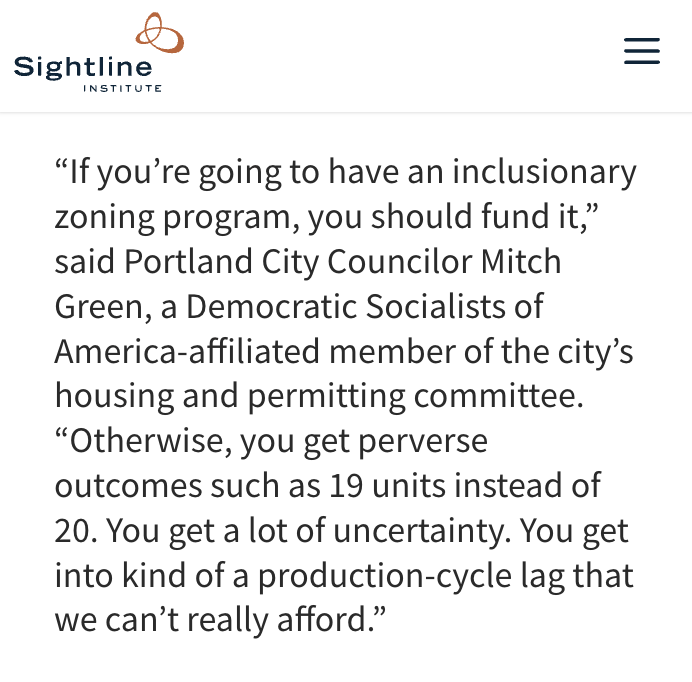
Everyone is starting to see how counterproductive unfunded inclusionary zoning mandates are.
Chris Elmendorf@CSElmendorf
Progressives in the Pacific Northwest are lapping their CA sibs in the race for good housing policy. The latest: An Oregon ban on unfunded inclusionary zoning, with Democratic Socialists leading the charge! 1/3
English
Alec Stapp retweetledi

The question isn't whether Americans prefer space or density. We live in a market economy and people can choose among different alternatives, according to price.
The question is whether one side of a nearly 50/50 split should be able to ban the other side's preferences entirely
True Discipline@TruueDiscipline
Americans still prefer space over density:
English
Alec Stapp retweetledi

Feel free to bury your head in the sand about the real problems with the H1B.
But don’t lie about those of us who are trying to improve it. All of us pointed out how some selection mechanisms are open to employer manipulation.
Here’s me in January last year:

Stan Veuger@stanveuger
I don’t think any of the folks who promoted a bigger role for salaries in how H-1Bs are assigned pushed for this system, but I also don’t think any of them warned this is what such a system might look like and what the unintended consequences would be. Despite that their advocacy for a more active federal role in selecting immigrants appears to continue unabated.
English


@AlecStapp IZ is just bad. Rent control is bad.
I'll take baby steps, but it's all just a tax on new units.
English

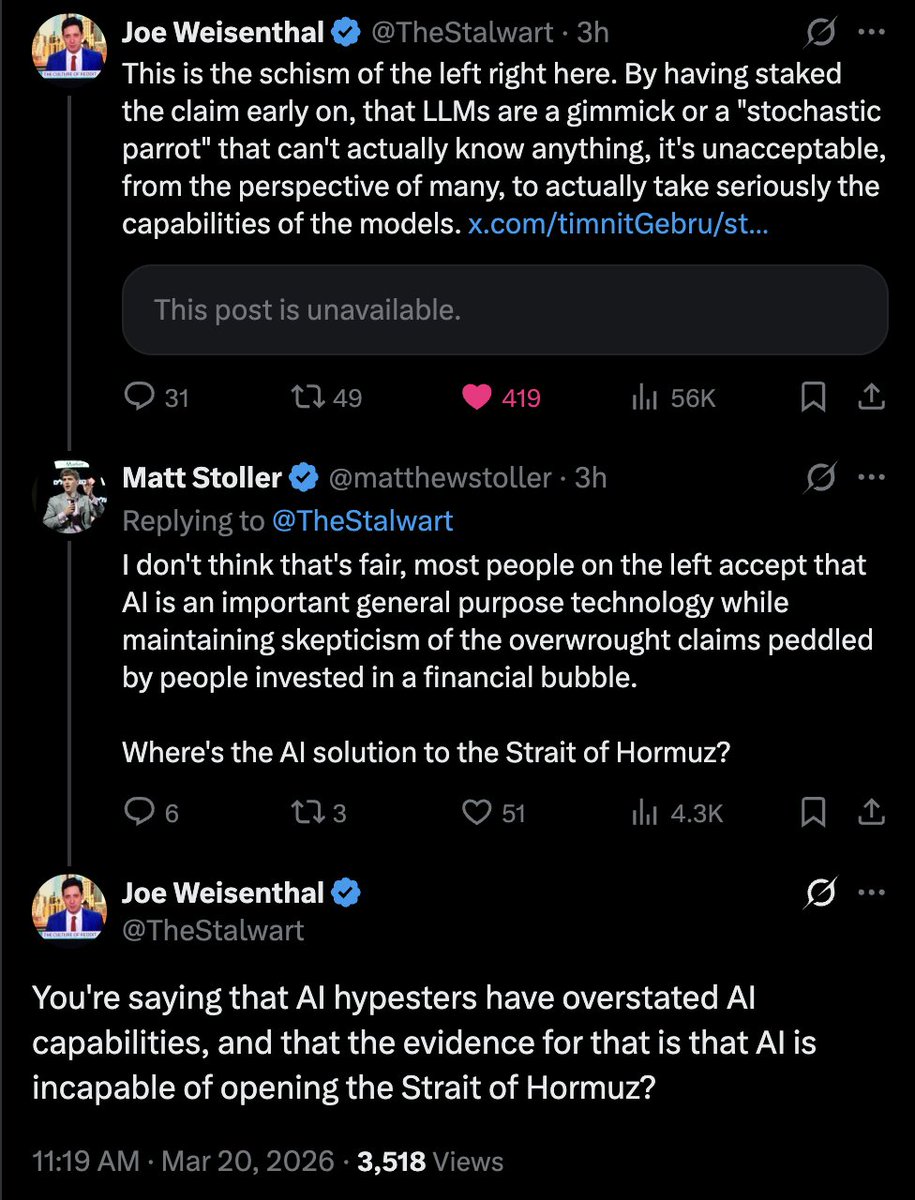
@AlecStapp Doesn’t Stoller call AI an overhyped Clippy on a weekly basis. Seems Weisenthal is on point here
English

@AlecStapp @IFP soon they will morph into sensible nordic style social democrats
English
Alec Stapp retweetledi

for everyone who isn't going to read the full tweet, yes, statecraft will be continuing
Santi Ruiz@rSanti97
Some professional news: I'm joining Anthropic's editorial team! I'll be leading the team's work on economics and policy, and working closely with the Anthropic Institute (about which more here: x.com/AnthropicAI/st…). Dramatic AI progress is coming in the next two years, and researchers+policymakers+the public alike will need the best information available about that shift. It's a big new challenge, and I can’t wait to get started. [Some important housekeeping: I’ll keep running Statecraft at @IFP as a Nonresident Senior Fellow! And will remain on the board at Recoding America/ as a journalist-in-residence at @johnshopkins School of Government and Policy. I start at Anthropic in a few weeks.] The move from frontier think tank to frontier lab is bittersweet. I’ve been at IFP for three years, and it’s been the most formative professional experience of my life. In a short period of time, IFP has become one of the most effective institutions in DC, generating a truly shocking amount of counterfactual policy impact (not all of it public). Being on this team has permanently raised my ambitions. I'm very grateful.
English

@rSanti97 May your impacts effect the landscape at Antrhopic to the extent they have done so, which is to a great extent, at the IFP.
English

Some professional news: I'm joining Anthropic's editorial team!
I'll be leading the team's work on economics and policy, and working closely with the Anthropic Institute (about which more here: x.com/AnthropicAI/st…).
Dramatic AI progress is coming in the next two years, and researchers+policymakers+the public alike will need the best information available about that shift. It's a big new challenge, and I can’t wait to get started.
[Some important housekeeping: I’ll keep running Statecraft at @IFP as a Nonresident Senior Fellow! And will remain on the board at Recoding America/ as a journalist-in-residence at @johnshopkins School of Government and Policy. I start at Anthropic in a few weeks.]
The move from frontier think tank to frontier lab is bittersweet. I’ve been at IFP for three years, and it’s been the most formative professional experience of my life. In a short period of time, IFP has become one of the most effective institutions in DC, generating a truly shocking amount of counterfactual policy impact (not all of it public).
Being on this team has permanently raised my ambitions. I'm very grateful.
Anthropic@AnthropicAI
Introducing The Anthropic Institute, a new effort to advance the public conversation about powerful AI. anthropic.com/news/the-anthr…
English
Alec Stapp retweetledi
Reasonable people can disagree about the value of a podcast about historic preservation.
But hard to see any argument for podcasts being required by the text of the NHPA, which says only that the government shall "take into account" its effects "on any historic property."
This is the kind of creeping "everything bagel" expansion of legal requirements that make it so expensive to build in America.
Thomas Hochman@ThomasHochman
As currently implemented, the National Historic Preservation Act allows for a sort of quasi-extortion, whereby developers end up having to fund projects that have nothing to do with actual mitigation. A few examples: SpaceX: To obtain a launch license from the FAA, SpaceX was required to fund: - A comprehensive Historical Context Report on the Mexican War and Civil War activities in the geographic area; - The design, production, and installation of five multilingual interpretive signs describing the history and significance of historic properties in the area; and - Educational outreach to the public about the region's cultural heritage Susquehanna-Roseland Transmission Line: The developer was required to pay for the completion of four "interpretive products", including: - Podcasts; - Popular publications; and - Scenic byway signs Donlin Gold: The Donlin Gold mining project was required to participate in "creative mitigation" that included: - Sponsoring a rural community teacher to attend the year-long Iditarod Trail in Every Classroom (iTREC) training program; - Funding an "interpretive kiosk" explaining the connection between the local community and the Iditarod trail; and - Cabin maintenance Kings Mountain Lithium: Albemarle was required to carry out “Community Outreach and Public Interpretation,” including: - Digitizing historic documents; and - Creating an ArcGIS Story Map about the affected historic properties All of this, despite the fact that the NHPA contains no authority for agencies to impose these costs on a private party as a condition of a federal license. NHPA Section 106, like NEPA, is purely procedural. The agency must "take into account" effects on historic properties, but it does not authorize the sorts of preservation agreements that have become commonplace. It's time for reform.
English