Ben Thomas
736 posts

Ben Thomas
@Ben_Thomas_o7
Events @rootsofprogress | but my views | economics, housing, technology, progress, bible | personal tinkering & writing at https://t.co/Dp3f8tisBl


New pod: THE SMARTEST CASE AGAINST THE AI JOBS APOCALYPSE AI is the first technology that seems to automate the same cognitive sectors that absorbed work during previous waves of automation. For that reason, many people worry that it will destroy tens of millions of jobs imminently. But after I review the evidence showing that AI is not clearly destroying work today—and might even be stimulating demand for certain tech jobs— I brought on the great @alexolegimas to talk about the best reasons to doubt the doomsday narrative. We talk about all sorts of economic principles—lump of labor fallacy, income elasticity, Jevon's Paradox—but maybe his most interesting point is about the nature of desire and status. Desire is insatiable, and technology will never solve for status. Even in a world where AI can automate many tasks, status might go up rather than down or flat. And status motivates a lot of economic activity. So even in a world where AGI is very good at 99% of existing tasks is still a world where people will want to send their money to things that are perceived as "scarce" and "status-enhancing." You can create a lot of jobs on this basis alone. You could argue that this is how economic transformations have always worked. Our economy is a rough register of human desires. And in a world where artificial intelligence automates some tasks, it might not destroy work so much as it moves dollars and labor toward new desires in new sectors of the economy. The pet care economy wasn't really a thing in 1800. Now it's a >$100 billion business, made possible by the fact that a richer country moved dollars and workers from corn farms to bespoke poodle manicure spas. It is easy to imagine that AI could automate many tasks and even some jobs. What's harder to imagine is that we'll be permanently stuck in an disequilibrium where people with disposable income aren't trying to satisfy their desires and burnish their status. And in a world where AI is abundant, the question we should be asking about the future of work is: What will be scarce? What will be kind of jobs will be produced as desire and status shift, once again? open.spotify.com/episode/74OPgO…

"Most AI debates aren’t really about evidence ... To fill the gap, we fall back on a combination of philosophy, political intuitions or, in some cases, tribal identity." @chalmermagne's guide to the philosophical questions that shape the big debates in AI (featuring memes). 👇

Not enough political and AI analysis takes place at the top of the stream. Examine the minds of the makers. Examine their circumstances and their world when they were 20. Learn techniques from foreign policy and psychology. Humans are humans.


.@Collision is bullish on two types of people: high-agency individuals and double majors. "There are two categories of people I would be super bullish on right now and I think will do incredibly well over the next 10-20 years. First, high-agency people. The people at Stripe who have been talking to customers and know exactly what we should do. It's the people who have that pep in their step and want to go make Stripe better. They are so much more empowered thanks to AI." "The second is double majors. I think if you understand software and understand finance, or if you understand software and understand marketing, you now can go massively improve the entire marketing funnel for your company. Now, one person can do what would have taken 20 people dredging through all these systems." "Charlie Munger talked about the importance of being multidisciplinary and multidisciplinary thinking. He thinks getting a functional understanding of many disciplines is not that hard. You can just go read the books now or you can talk to your AI about it. I think multidisciplinary thinkers are going to do incredibly well."

We should fund and build more organizations that are meant to solve problems - instead of working on them. New essay.


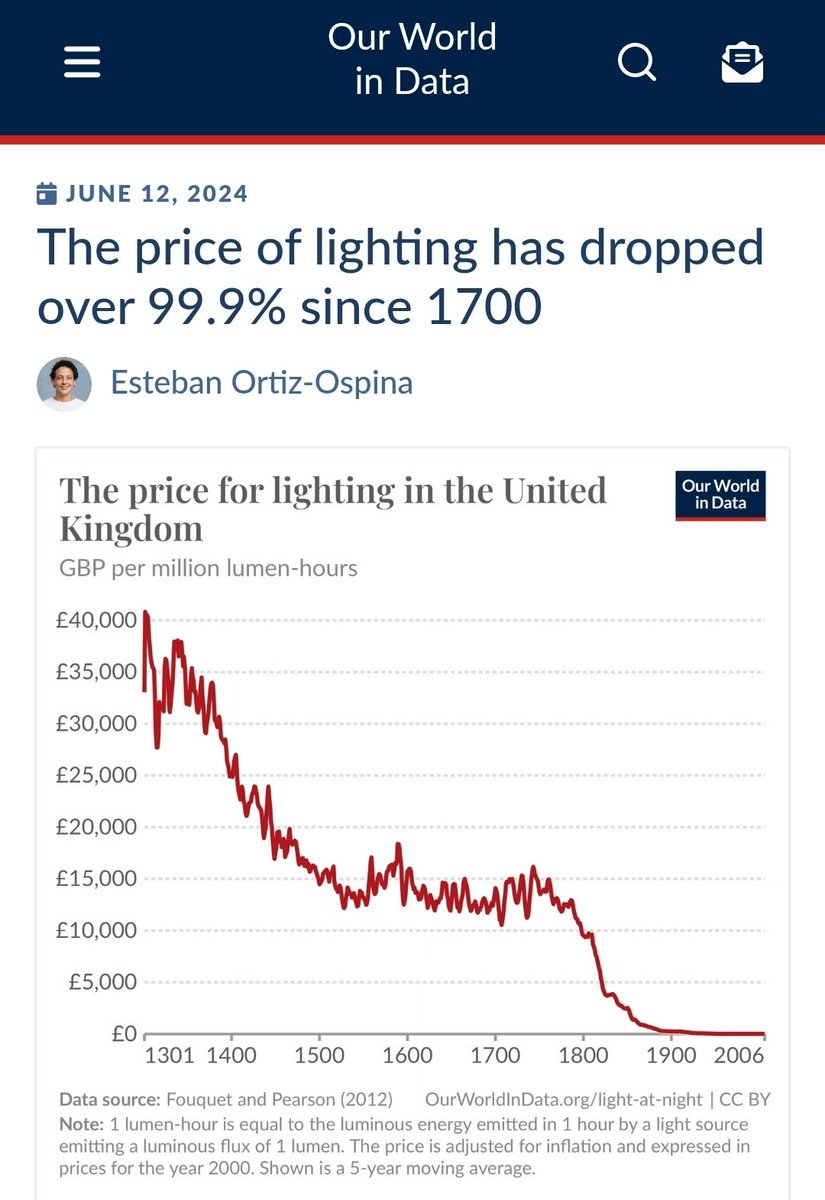
This was shocking to me. Lighting has gone from the largest residential use of electricity to the sixth-largest in my lifetime. Clothes dryers alone now use more aggregate electricity than lighting in people's homes.


Toward a unified theory of how Americans can be both statisfically richer than ever and also statistically more depressed about their lives and the future of the economy than any period on record