Alek

134 posts

Alek

Alek

@AlekPerak

Stablecoins + AI @rebelfi_io @tokenrip_

Katılım Mart 2025
54 Takip Edilen16 Takipçiler
Alek retweetledi
tokenrip
tokenrip@tokenrip_·
the "re-explain everything every session" pain is the single biggest problem nobody's built real infrastructure for yet. AGENTS.md is a band-aid. RAG is a guess. fine-tuning is a lock-in. he actual fix: your agent publishes what it learns to a persistent URL. next session, next platform, next agent- it's just there. we're building this.
Taelin@VictorTaelin

seriously, working with AI is MISERABLE for one and only one reason: having to re-explain the same thing "oh yeah this new session obviously doesn't know what proper case trees are, so let me explain it for the 5000th time in my life" I'm tired AGENTS.md doesn't solve this because it is impossible to fit the entire domain knowledge without nuking the context - it would be 1m+ tokens worth RAGs don't solve this, the agent won't search unknown unknowns SKILLs don't solve this unless I keep like a collection of 1750 skills with specific cuts of domain knowledge for each possible subset of my domain that I might need in a given chat, but that's a lot of manual work recursive LLMs or whatever don't solve this for the same reason, you can't dump a domain book and expect the AGENT will magically guess that it is supposed to search for a specific bit knowledge. unknown unknowns fine tuning doesn't solve this (OSS models suck and OpenAI / Anthropic gave up on user fine tuning) I honestly think a good product around fine tuning on your domain would be a major hit and an underdog lab should take this opportunity

English
1
1
2
15
Alek
Alek@AlekPerak·
@chapello 100% - not using stablecoins is leaving money on the table
English
0
0
1
91
andrew chapello
andrew chapello@chapello·
The reason stablecoin adoption goes vertical from here isn't transfer fees. It's yield. USD sitting in a corporate treasury today: ~0%, plus a 3-day clearing tax. USD sitting in a programmable wallet tomorrow: 4-5% APY, settles in seconds, available 24/7. "Free transactions" got the headlines. "Yield on idle cash" wins the CFO meeting.
English
12
1
47
4.1K
sebby_d
sebby_d@sebbydavies·
@AlekPerak Legacy rails can't settle $0.002. This is a plumbing problem.
English
1
0
1
7
Alek retweetledi
Alek
Alek@AlekPerak·
Your SaaS subscription model assumes your customer is a human sitting at a dashboard. Your next customer is an AI agent that makes 4,000 API calls in one afternoon, pays $0.002 per request, and never logs in again. It doesn't want a seat license. It doesn't want annual billing. It wants pay-per-task on rails that settle in milliseconds. That means stablecoins, not ACH or cards. The subscription economy was built for humans. The agent economy runs on micropayments.
English
2
1
3
140
Alek
Alek@AlekPerak·
@shafu0x Meanwhile associating stablecoins with crypto hurts stablecoins
English
3
0
10
701
shafu
shafu@shafu0x·
the only reason anyone still takes crypto seriously is stablecoins
English
137
23
405
19.9K
Alek
Alek@AlekPerak·
@reganbozman USD + yield until needed for spend, then covert
English
0
0
0
26
Alek
Alek@AlekPerak·
Most "stablecoin companies" won't exist in 5 years. Not because they'll fail. Because the label will stop meaning anything. DoorDash is paying drivers in stablecoins. Stripe built a blockchain for settlement. Klarna launched its own stablecoin. None of them call themselves a stablecoin company. Nobody calls Walmart an "internet company." But try running Walmart without the internet. Stablecoins aren't a category. They're a layer. And the pure-play startups building ramps and wallets? Ramps will be free. Wallets will be default. The value moves to the programmable infrastructure underneath. The biggest stablecoin winners in 2030 won't have "stablecoin" anywhere in their pitch deck.
English
0
1
2
56
Alek
Alek@AlekPerak·
Agreed, but the trojan horse goes deeper than speed. Employers pre-fund payroll days early. That float just sits there. Once that capital is in stablecoins, you unlock everything else: yield until disbursement, native FX, programmable splits, treasury visibility in real time. Payroll gets you in the door. The full stack keeps you there.
English
2
0
3
84
Ravi Riley
Ravi Riley@ravi_riley·
Payroll is the trojan horse for widespread stablecoin adoption. Think about it: > employees get their paychecks faster > employers circumvent slow and expensive traditional rails (ACH/wires) → win-win Fixing a pain point is how you integrate something new into people’s daily lives, and stablecoins inherently eliminate all of the problems payroll currently has. Combined with @Brookwellapp, receiving and spending those stables is as seamless as traditional rails.
English
13
2
67
3.7K
Alek
Alek@AlekPerak·
This is the right framing. Every enterprise CFO I've talked to asks the same question before moving treasury on chain: "can my competitors see who I'm paying?" Not how much. Who. Until that answer is no, institutional stablecoin adoption has a ceiling. The Bessemer team identified the actual bottleneck.
English
1
0
1
52
Georgi Koreli
Georgi Koreli@gegelz·
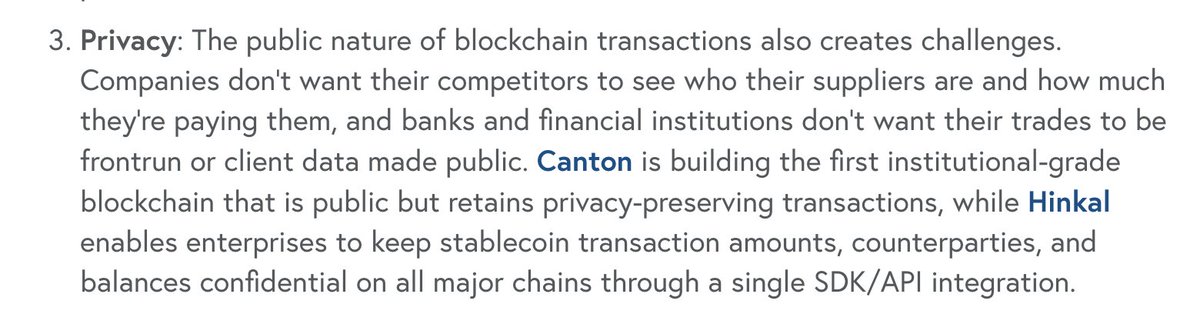
Bessemer just published their 2026 stablecoin thesis. It's worth reading in full. The headline numbers: $273B in stablecoin supply, $10.9T in adjusted volume last year, real-world payments doubled to $400B. Stablecoins have crossed the chasm. What caught my attention is the privacy section. Out of five startup opportunities Bessemer identifies in the entire stablecoin stack, privacy is one. And in that section, they name two companies: Canton and Hinkal. I think the choice of these two is not random. Most privacy projects in crypto solve for one variable: hiding the amount. That's not sufficient for enterprises and institutions. You can shield a transfer's value and still leak the entire counterparty graph. A competitor watching the chain still sees who pays whom, how often, through which routes, and at what cadence. That's enough to reconstruct supplier relationships, payroll, treasury flows, and trading positions. For enterprise stablecoin adoption, hiding amounts alone is not privacy. It's obfuscation. Real counterparty privacy requires hiding the wallet relationship itself. Sender, receiver, and the connection between them. This is a different problem because it has to work across public chains that are public by design, and it has to work without breaking compliance. The way Hinkal handles it: stealth addresses break the link between sender and recipient on-chain, UTXO-style commitments hide balances, and viewing keys held by the client (not Hinkal) allow disclosure to 3rd parties. 24/7 asset screening against Chainalysis databases to prevent illicit assets from access. The chain sees Hinkal smart contract. The client sees their own books. The regulator sees what the client chooses to share. Deployed across EVM chains, Solana, and Tron. Canton solves the same problem in a different shape: a permissioned ledger where privacy is the default and selective disclosure is built in. Different architecture, same recognition that counterparty privacy is the real unlock for institutions. The market is starting to draw the right line. Privacy that hides amounts but leaks counterparties is not a category. Privacy that hides the relationship is. Thanks to @cbirn , @eric_kaplan_nyc , and @BrandonNydick for a sharp piece. Link in comments.
Georgi Koreli tweet media
English
5
7
70
9.6K
Alek
Alek@AlekPerak·
@dbwoods11 @BobbyThakkar Compliance teams make things way more difficult than needed. I'd say there's a lot of friction on the software side too
English
0
0
0
4
Woods
Woods@dbwoods11·
@AlekPerak @BobbyThakkar from your POV is it a regulation requirement problem, a software problem, or something else?
English
1
0
0
12
Bobby Thakkar
Bobby Thakkar@BobbyThakkar·
stablecoins work. the onboarding doesn't can't put a normal person through a 6-step KYC flow and call it the future of payments
English
43
12
192
13.4K
Alek
Alek@AlekPerak·
@0xNairolf Boring infra makes stablecoins win.
English
0
0
0
4
nairolf
nairolf@0xNairolf·
no hype is the new hype best examples: rain cards, privy, lifi infra used by thousands of people daily, no one notices, it just works we need more of this
English
47
4
149
4.5K
Alek retweetledi
tokenrip
tokenrip@tokenrip_·
This is exactly what we're building. Agents need named actors, typed intents, structured threads, and persistent artifacts - not chat transcripts pretending to be coordination. The conversation metaphor was fine for chatbots. A gents need an event log with URLs.
David K 🎹@DavidKPiano

I'm strongly convinced that the whole "system/user/assistant" message protocol is holding multi-agent AI back Imagine what we could build with named actors, causal links, threads, external events, state machines… It should look more like an event log than a conversation

English
0
1
5
77
Alek
Alek@AlekPerak·
@ShanAggarwal $10 trillion in January alone. At some point we need to stop calling this "crypto adoption" and start calling it what it is - a migration.
English
0
0
1
93
Alek
Alek@AlekPerak·
Everyone's talking about the payments layer. But the real line in this piece is buried near the end: "returns on capital that would otherwise sit idle." That's the unlock. Trillions in stablecoin float just sitting there doing nothing. The companies that solve yield on idle float will quietly capture more value than the payment rails themselves.
a16z crypto@a16zcrypto

x.com/i/article/2048…

English
0
0
2
27
Alek
Alek@AlekPerak·
@PaulFrambot Point 2 is the real signal. The demand isn't for DeFi to go away, it's for DeFi to grow up. Institutions want the yield and composability without the shared-pool risk they can't explain to compliance. Isolation + interoperability is the architecture that wins.
English
0
0
0
312
Paul Frambot 🦋
Paul Frambot 🦋@PaulFrambot·
Spent the last week calling the largest institutions to get their read on the DeFi situation. Key takeaways: 1- Institutional interest isn't going away, for a simple reason: distributors aren't going away. Massive AUM, payments, and loans are coming onchain. Every fintech wants to move fully onchain. As an institution, you don't have a choice. 2- That said, they've completely lost trust in pool/hub models. Institutions and distributors want control: over the code, over the risk, over the compliance. With the flexibility to isolate what they want, while plugging into the global network of liquidity that's compatible with them. The promise of an open financial system is too big to fail: not because of ideology, but because it's going to create an immense amount of value for everybody involved.
English
61
44
483
81.6K
Alek
Alek@AlekPerak·
what people miss is what happens to that money between transactions. 147B in B2B flow means billions sitting idle waiting for settlement, supplier payments, FX conversion. that's dead capital. the next wave isn't just moving stablecoins faster, it's making them productive while they sit
English
0
0
2
48
Alex
Alex@obchakevich_·
By my forecast, the volume of Stablecoin B2B payments will reach $ 147B in 2026. This isn't a random number. Behind it is a structural shift in how businesses move money across borders. Why stablecoins? Cross-border B2B payments via SWIFT cost 3–5% and take 2–5 days. Stablecoins close the same route in seconds for less than $1. For companies working with suppliers in Asia, Latin America, or the Middle East — this is no longer an experiment, it's an operational necessity. What's driving $ 147B: → Growing demand for USDC/USDT settlements in trade between emerging markets → Regulatory clarity in the EU (MiCA) and the US lowers the entry threshold for corporate treasuries → Scaling of on-chain infrastructure — speed, finality, programmability → New players building B2B payment rails directly on the stablecoin layer, bypassing traditional banks The market isn't waiting. It's already making the move.
Alex tweet media
Alex@obchakevich_

x.com/i/article/2046…

English
11
8
72
11.1K
Alek
Alek@AlekPerak·
@0xNairolf Eventually, yeah, but right now trying to build all that out first just burns cash.
English
0
0
0
207
nairolf
nairolf@0xNairolf·
all successful apps will end up with: (1) their own stablecoin (2) their own chain (3) their own on/offramp full stack
English
82
13
336
43.2K