Aleksander Smywiński-Pohl 🇵🇱 🇺🇦

600 posts

Aleksander Smywiński-Pohl 🇵🇱 🇺🇦

Aleksander Smywiński-Pohl 🇵🇱 🇺🇦

@AleksanderPohl

Uczę programowania obiektowego i przetwarzania języka naturalnego na AGH. Pracuję nad systemem informacji prawnej nowej generacji.
Katılım Haziran 2012
364 Takip Edilen159 Takipçiler
Aleksander Smywiński-Pohl 🇵🇱 🇺🇦
@josevalim I have a separate account for Claude (I don't use Desktop though). I blocked my home dir for it. Also I gave it rootless docker. Projects shared by mount --bind. I think that's the only way to keep things safe.
English
2
0
5
772
José Valim
José Valim@josevalim·
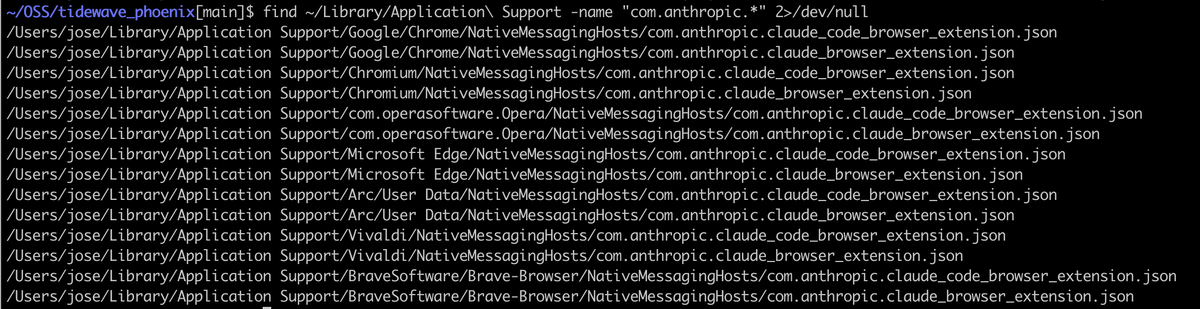
So apparently when you install Claude Desktop app, they write a manifest file to several browser directories, even if you have never installed any of those browsers or never opted into using Anthropic's browser extension?
José Valim tweet media
English
8
11
93
12.3K
Elixir by Software Mansion
Elixir by Software Mansion@swmansionElixir·
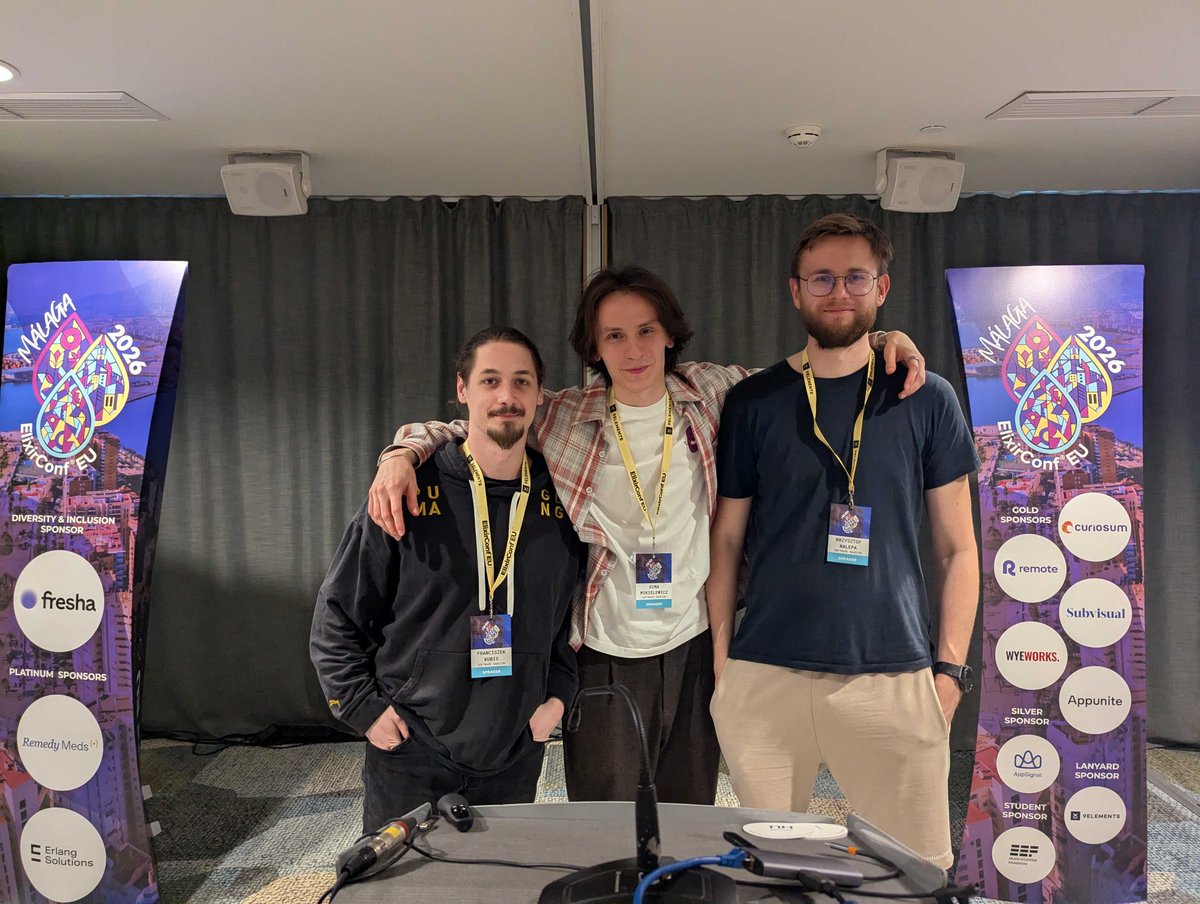
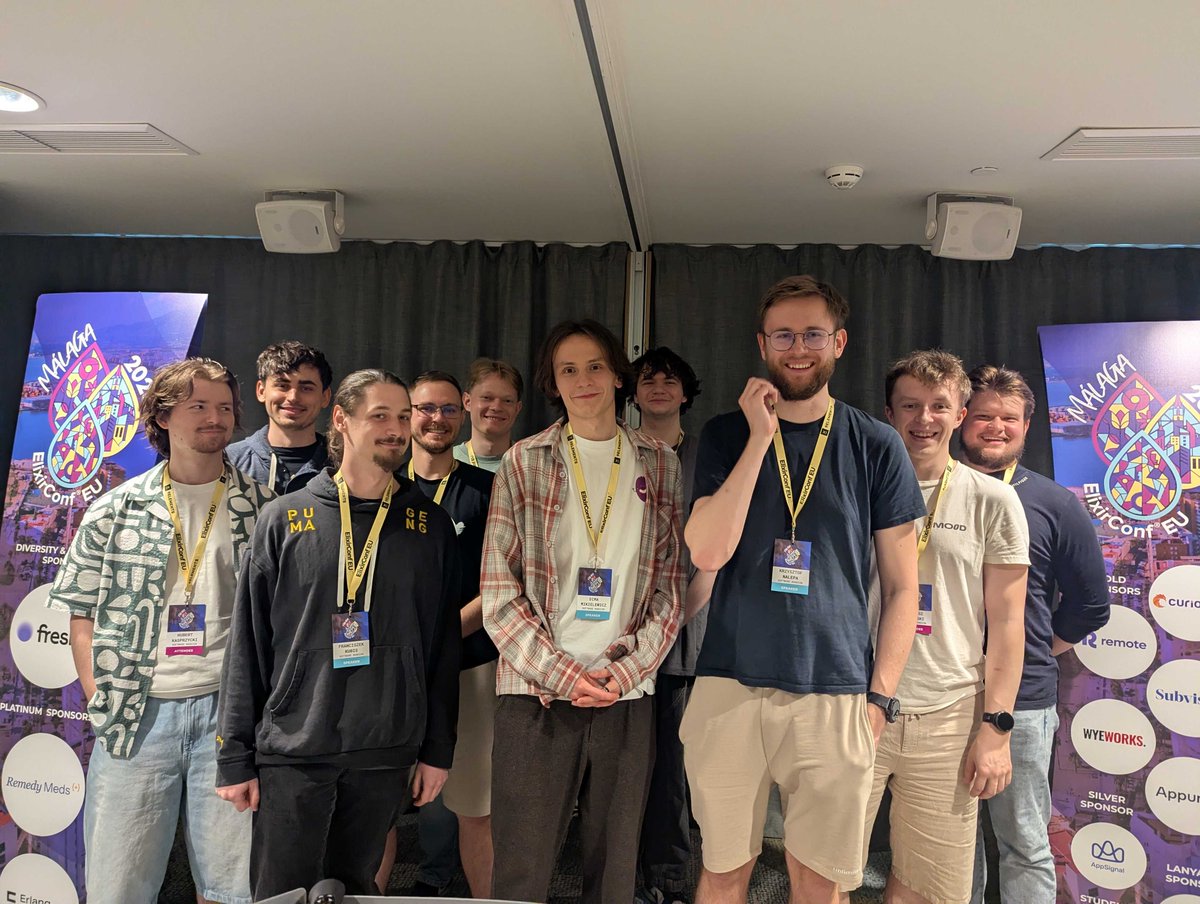
We brought 3 speakers to @ElixirConfEU – which kicked off yesterday in Málaga! 🧪 That makes Software Mansion one of the most represented companies on stage, and we couldn't be more proud of the team. Here's what we're talking about 🧵👇
Elixir by Software Mansion tweet mediaElixir by Software Mansion tweet media
English
2
5
46
1.3K
Jarosław Wolski
Jarosław Wolski@wolski_jaros·
Potwierdzona strata E-3G “Sentry” czyli AWACSa Airborne Early Warning and Control (AEW&C) Tutaj nie ma żadnych wątpliwości - Amerykanie w irańskim ataku rakietami balistycznymi stracili bardzo cenny samolot który nie tylko był latającym radarem ale też stanowiskiem kontroli i dowodzenia. Co więcej - owe zdjęcia pokazują że wcześniej upublicznione przez Irańczyków zdjęcia satelitarne z ataku na bazę Prince Sułtan w Arabii Saudyjskie są prawdziwe zatem Amerykanie nie tylko stracili E-3G Sentry ale też 2 lub 3 tankowce KC-135 oraz być może uszkodzone drugie tyle samo maszyn. Mamy zatem do czynienia z jednym z najskuteczniejszych ataków rakietami balistycznymi przez Iran w tej wojnie. Z czego wynikają sukcesy Iranu? Zapewne z braku odpowiedniej koncentracji sił przez USA w basenie Zatoki Perskiej co prawdopodobnie wynikało z lekceważenia przeciwnika przez czynniki polityczne w USA. Komuś się Teheran z Caracas pomylił a płacą za to żołnierze. Iran bez wątpienia jest najlepiej dowodzonymi i zorganizowanym przeciwnikiem USA od czasów Serbii w 1999. Tyle że wtedy koalicja mogła bezkarnie obracać Serbię w ruinę niszcząc infrastrukturę cywilną a teraz Iran ma bardzo wymierne atuty w postaci selektywnej blokady cieśniny Ormuz, Houti w Jemenie oraz faktu że USA dołączyło do uderzenia Izraela a szerokiej koalicji takiej jak w 1999 de facto nie ma. Moje odczucia są takie że jest to najgorzej przygotowana amerykańska interwencja od czasów mroków zimnej wojny na dodatek fatalnie rozgrywana politycznie.
Jarosław Wolski tweet mediaJarosław Wolski tweet mediaJarosław Wolski tweet mediaJarosław Wolski tweet media
Polski
140
185
2K
149.1K
Aleksander Smywiński-Pohl 🇵🇱 🇺🇦
@JustDeezGuy @josevalim Talk to anyone writing a concurrent code in any language and what's the first question that pops up immediately - is the code of X thread safe? The fact that you can write thread safe code in any language does not mean that it's easy. But in Erlang/Elixir it's dead simple.
English
0
0
0
25
Paul Snively
Paul Snively@JustDeezGuy·
@josevalim You lose instantly at “global mutable state.” Again: this is not hypothetical. I’ve been building the equivalent of Erlang/Elixir systems with mainstream technology for ~15 years, and when the subject comes up, Erlang/Elixir fans talk like the alternative is Java circa 2000.
English
8
1
12
1.6K
José Valim
José Valim@josevalim·
Saying "isolated processes for fault tolerance are not relevant because they were pushed to orchestration layer" is like saying "we don't need threads, because we will just run one pod per core anyway". The difference in reacting and responding to "my connection pool crashed" by restarting the pool locally vs restarting the whole pod is going to be massive, similar to the differences in latency when coordinating across threads vs across pods. Yes, other programming languages have threads, and they raise a signal when they fail, but that's missing the point. What matters it not the signal but the guarantees. If you have global mutable state and a thread crashes, can you guarantee it did not corrupt the global state? If you can't, the safest option is to restart the whole node anyway, because it is best to have a dead node than running a corrupted one. PS: somewhat related 6-years-old post: dashbit.co/blog/kubernete…
Paul Snively@JustDeezGuy

This is why I’m unimpressed by Erlang/Elixir: every major language runtime has VERY high-quality M:N work-stealing “thread” schedulers with good APIs (structured concurrency), and the “isolated processes” and “RPC” got pushed up to an orchestration layer (DC/OS, Nomad, k8s…)

English
9
48
349
30.2K
Grady Booch
Grady Booch@Grady_Booch·
A gentle reminder that contemporary neural networks are only an abstraction built upon Boolean logic And that said neural networks are only an echo of a whisper of what organic neurons are.
English
39
77
631
40.1K
José Valim
José Valim@josevalim·
We have converted our Livebook Desktop app to Tauri. If you're using Livebook, please give it a try by downloading the nightly builds: #desktop-app" target="_blank" rel="nofollow noopener">github.com/livebook-dev/l… Our goal is to extract the Tauri integration as a separate package to make it easier for people to ship Tauri+Elixir.
English
8
31
228
9.7K
Aleksander Smywiński-Pohl 🇵🇱 🇺🇦
@josevalim Hmm while all these are valid points I think the very important feature is concurrency in the context of LLMs. Here everything take substantial amount of time - being able to write concurrent code with ease is a major win for Elixir. That's critically important for the UI loop.
English
0
0
0
160
José Valim
José Valim@josevalim·
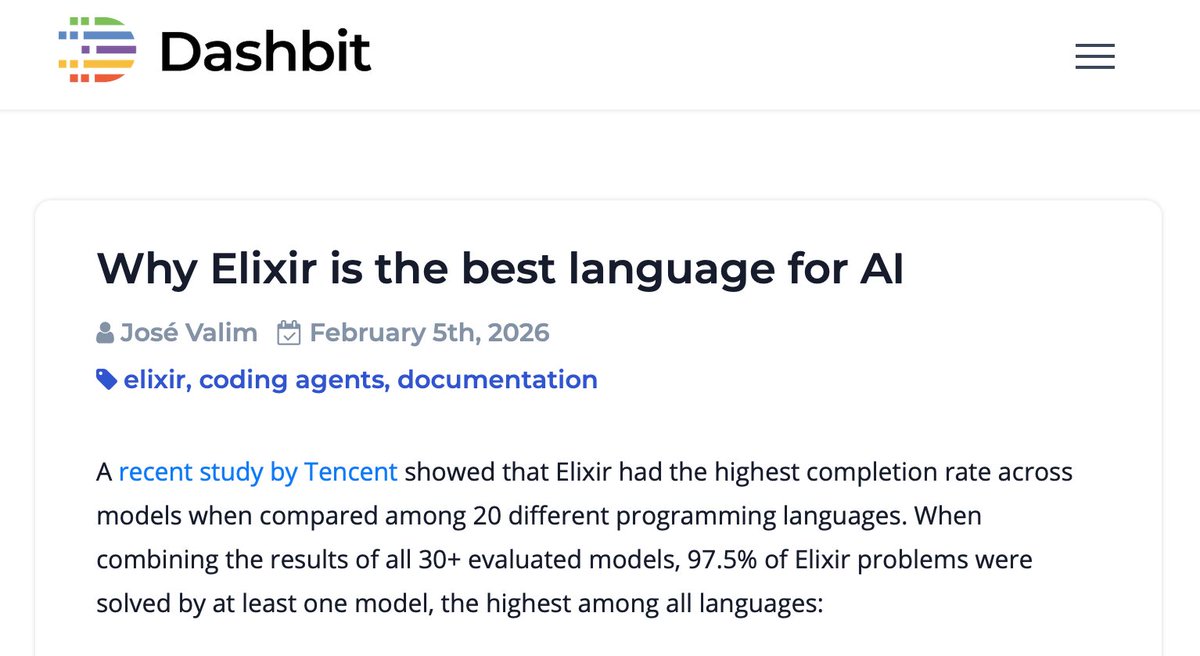
Here is my take on why Elixir is the best language for AI: immutability, documentation, stability, and tooling for coding agents. It builds on the recent study in which Elixir had the highest completion rate across models among 20 different languages. Link in the thread below.
José Valim tweet media
English
17
98
398
33.8K
Aleksander Smywiński-Pohl 🇵🇱 🇺🇦
@josevalim Moreover I think the reason ppl have some magic moments is for tasks when the codebase used for training already included a very similar project. Due to the size of the model it's possible to memorize a lot. What I hate the most is the amount of duplication the models do.
English
0
0
0
13
Aleksander Smywiński-Pohl 🇵🇱 🇺🇦
@josevalim Yes that's exactly my observation. I'm mostly using cursor with auto mode. Whenever there's sth more tailored to my needs the model goes off the rails when the task is not broken into step by step implementation, when I check small additions to the code.
English
1
0
1
132
José Valim
José Valim@josevalim·
IMO, unsupervised coding agents are still in the "uncanny valley" of software development. Given the recent hype of AI writing "a browser with 1 million lines of code from scratch", I have been trying to give it more open-ended tasks, and every time it delivered seemingly working software but with large flaws in the implementation. Last week it was a "download manager in Rust" that completely failed at concurrent downloads. This week was a port of the Ryu algorithm for pretty-printing floating points with different precisions (f32/f16/bf16/f8). Both times the software seemed to work but had deal breaker bugs lurking. Fixing those required me to become part of the loop and supervise the agent. Here is a breakdown of the latest experiment, for those who may be interested. TL;DR: github.com/elixir-nx/nx/p… (it says 66k lines added, but 65.5k is a generated fixture file, so the diff is more like +800/-300). --- The goal was to implement pretty-printing of floating points (f32/f16/bf16/f8) in Numerical Elixir. I created a blank repository, wrote the problem statement, and mentioned I specifically wanted the Ryu algorithm, linking to a reference implementation in Erlang (github.com/erlang/otp/pul…) and to the paper (dl.acm.org/doi/10.1145/31…). I did one attempt with Sonnet, another with Opus, and while they both delivered a project with a passing test suite, both implementations were wrong and incomplete. In the first attempt, many of the tests were fabricated, to match the faulty implementation. With wrong code and wrong tests, there was not much to salvage. Time to start over. In the second attempt, now with Opus, I suggested it could generate all possible printable values for f16 from the canonical Ryu implementation in C (since there are only 65k of them), and use that to validate the algorithm. Once again, it delivered a passing suite, but it made one crucial mistake early on: when generating the reference table, they cast f16 to f32 before printing (a subtle mistake many would make), which led to wrong reference values. And because the reference table was wrong, it lead to all sorts of wrong decisions downstream, such as adding casting and deltas. That's when I decided to be in-the-loop and break the problem into smaller ones: 1. I asked Claude to create a f16 reference table and made it clear in the prompt that any sort of casting would lead to the wrong solution. That's the reference table you can find in the PR 2. Then I asked it to explicitly port the Erlang algorithm, as is, and then parameterize the constants in the algorithm to make it generic (so it works for f16/f32/etc). Then write a test comparing all reference f16 values 3. Then I moved the algorithm to Nx. Since pretty printing is now precise, it broke 150 tests, which I used Claude to fix (with specific instructions to change only the precision in numbers and not touch anything else) Claude still made mistakes but because I broke the problem into small steps, and verified their correctness each step along the way, I avoided bad decisions cascading through the whole implementation. And yes, using Claude was still extremely helpful (honestly, if I used Claude only on step 3, it would have already been worth the price tag). Those two experiments have been orders of magnitude smaller than the browser one, both they seemed to work, but were flawed upon deeper inspection. For now, I'd still advise staying in the loop and avoiding falling into this trap.
English
14
21
135
9.8K
Aleksander Smywiński-Pohl 🇵🇱 🇺🇦
@hubertlepicki I don't believe in the US military supremacy against Russia and China. It is interesting what has happened but probably more like personnel didn't want to fight. But the hard question is about the aftermath. Will this bring peace to Venezuela? I'm afraid the exact opposite.
English
0
0
0
48
Hubert Łępicki
Hubert Łępicki@hubertlepicki·
To sum up Venezuela situation: - The USA captured Maduro and his wife without a single loss of soldier, in a 2 hours long operation - Russian and Chinese weapons and military rendered useless - Venezuelan regime hopeless, forced to negotiate transition of power under threat of further attacks they can't do anything about - every single dictator wannabe scared shirtless USA could do that to him any moment (Lukashenko 🤡) - China without independent access to oil - Iran next (maybe today 😅) I said a lot of bad shit about Trump but he's making it up big time.
English
7
2
22
4.2K
Tomasz Zalewski
Tomasz Zalewski@tomasz_zalewski·
AI will kill all the lawyers
Tomasz Zalewski tweet media
English
2
0
6
891
Aleksander Smywiński-Pohl 🇵🇱 🇺🇦 retweetledi
José Valim
José Valim@josevalim·
Elixir v1.19.0-rc.2 is out! It is our last stop before v1.19, so please give it a try: elixirforum.com/t/elixir-v1-19… The results are great: the @remote folks confirmed their codebase compiles 55% on v1.19 and type checking is still ~1ms/module on average, even with all new features! We worked really hard on this one! @duboc_guillaume and I had to go beyond the current state of the art to optimize some key operations used during set-theoretic typing checking! We will publish some articles on this later on. Enjoy!
English
9
39
281
22.1K
Aleksander Smywiński-Pohl 🇵🇱 🇺🇦
@nkxxll @ThePrimeagen For sure. I have known Basic Pascal C++ Java Perl Lisp and Ruby. And then I learned elixir. Most similar to lisp but with real syntax haha. I really enjoy it, although you have to change some habits from more popular languages.
English
0
0
0
41
nkxxll
nkxxll@nkxxll·
@ThePrimeagen Worth learning when you already know many languages?
English
1
0
0
88
ThePrimeagen
ThePrimeagen@ThePrimeagen·
after one month of using elixir i can confidently say that i really like the language
English
51
40
1K
84.1K
José Valim
José Valim@josevalim·
We asked Tidewave to improve its own homepage with autoplay of videos as we scroll through our features list. It implemented the feature and used contextual browser testing to scroll through the page, check the DOM, and verify it works! 🎯 Coming for Rails and Phoenix... today!
English
5
30
265
20.2K
Aleksander Smywiński-Pohl 🇵🇱 🇺🇦
@josevalim Moreover - not that important in codebases - but for non-English texts you would have to properly configure the index to support e.g. inflection. While embeddings automatically resolve this problem.
English
0
0
1
19
Aleksander Smywiński-Pohl 🇵🇱 🇺🇦
@josevalim Well it depends. As in your example you have just one word which is expanded to multiple terms. But if you have many words such expansion brings noise and you lose the order. There are IR models like Colbert and sparse embeddings which work better. Yet they are rarely supported
English
2
0
1
84
José Valim
José Valim@josevalim·
Anyone exploring query expansion for RAG in codebases? For example, instead of doing a vector search, you could instruct the LLM to expand the query whenever searching. E.g. to find the authentication code, it could query for "authentication|auth|login|signin|credentials".
English
12
2
66
9.1K