
Sabitlenmiş Tweet
Alexander
73 posts


Alexander
@AlexBPAS
Southern Baptist, of the Calvinist sort. PNW Yankee. Army Veteran. Seminarian @SBTS. BS History @LibertyU. Esse quam videri
Tacoma, WA ➡️ Louisville, KY Katılım Eylül 2023
260 Takip Edilen126 Takipçiler

Alexander retweetledi

You can’t just make me choose between the only three politic issues I care about.
Sean Cooksey@SeanJCooksey
When you register as a Republican in Virginia, they make you pick which part of the GOP's three-legged stool you want to identify with.
English
La France, si les huguenots ont gagné
Alessandro ⚜️@AlexMasnada02
Althist map I found on Reddit for my French oomfs
Français
Alexander retweetledi



It is to our shame that Rev. Ian Paisley is principally remembered for his politics.
youtube.com/watch?v=Cwh1No…

YouTube
English
Alexander retweetledi

"The election of Romans 9:11; 11:5 is a choosing in Christ before the foundation of the world (Eph. 1:4). The elect are the personal objects of election, those who by faith have renounced all merit, and in whom God’s saving purpose of free grace in Christ has been realized."

English

Has anyone ever wondered who was giving Republicans the 40 some off percent of the vote they got in places like NC between 1880 and 1960…
English
Alexander retweetledi

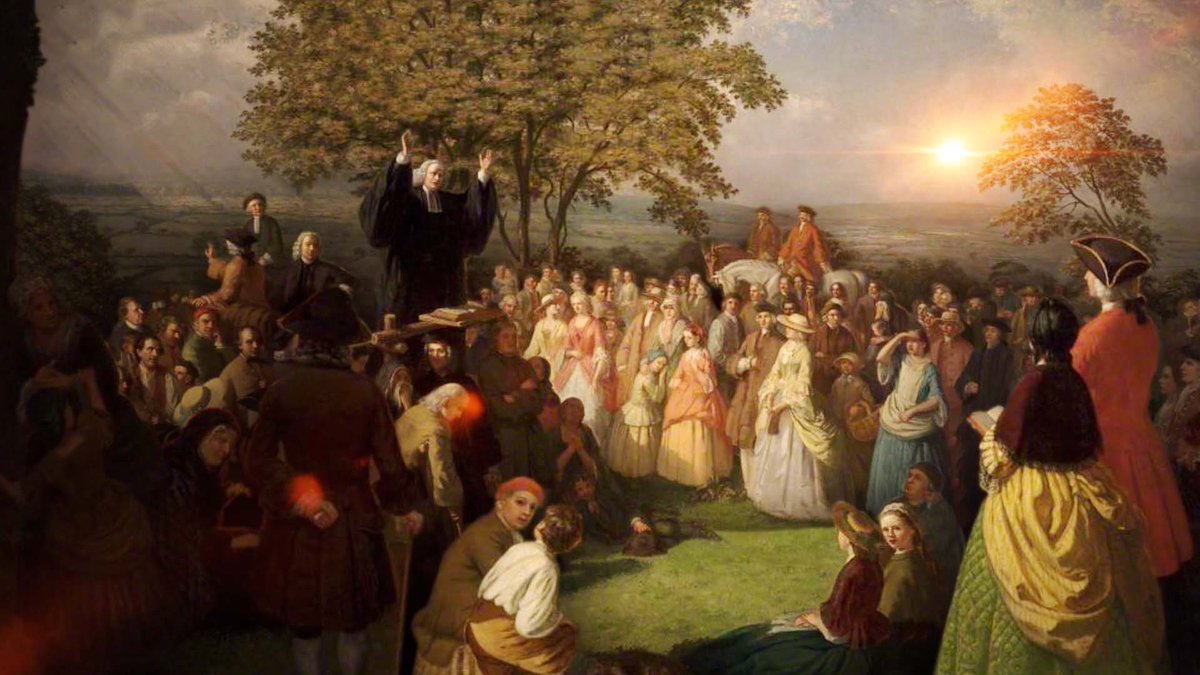
We live in the land of Jonathan Edwards, of Reverend Gano baptizing Washington at Valley Forge, we live in the land of Roger Williams and the Mather family.
We do not live in the land of wholesome inoffensive theology, megachurches, and placeless modern newbuilds
English
@brandan_buck @IVMiles This looks like an interesting read, especially as someone born in NC because of the military.
English
@IVMiles As far as the early 20th century, it's a motley crew of native Southerners who couldn't abide the New Deal/entry into WWII and Northern transplants who came South for the defense industry. Kari Frederickson's Cold War Dixie is pretty good on the latter.

English
Alexander retweetledi

Good reflections from Pascal Denault on how historic Baptist covenant theology solves the errors present in both Westminster covenantalism and dispensationalism:
“The church has existed since the beginning of the covenant of grace; the difference between the Old Testament and New Testament churches consisted in the extent of the nations to which the covenant of grace was announced and not in the identity of the church being different from one testament to another.
It would be impossible to exaggerate the importance of this point in order to avoid the failure to which the dialogue between Reformed and dispensationalist theology has so often led.
The dispensationalists accused the Reformed of creating a theology of replacement by giving tha church Israel's place, while Israel's place had to be permanent. Actually, historically, the Reformed did not teach that the church replaced Israel, but that the Gentiles joined believing Israel in the covenant of grace at the moment when the new covenant replaced the old covenant.
It is, therefore, not the case of one people replacing another people, but the case of one covenant replacing another covenant when the promises revealed by the covenant of grace from Genesis 3:15 on were accomplished, when the old covenant ended, and when a large group made up of Jews and non-Jews entered into the new covenant.
One must refuse the opposition between Israel and the church and rather emphasize the scope of the covenant of grace in the Old Testament (primarily within Israel) and the scope of the covenant of grace in the New Testament (openly extended to inhabitants of every nation). The opposition that is found in the New Testament is between the old and new covenants and not between Israel and the church, which is rather an artificial opposition coming from dispensationalism.
We think the Presbyterians have a harder time trying to demonstrate that dispensationalism erroneously uses the discontinuity or opposition between the testaments since their own theology simply blurs this opposition, thereby denying, at least in the dispensationalist view, the biblical affirmations of this discontinuity (Rom. 6:14; 2 Cor. 3; John 1:17; Heb. 10:9).
As for the Baptist approach, it allows for the vigorous assertion of the continuity of the covenant of grace and, consequently, the continuity of only one church in both testaments, while simultaneously affirming, in concert with the Bible and the dispensationalists, a discontinuity between the old and the new covenants.
The dispensationalists, for their part, accentuated the discontinuity between the testaments to the point of separating Israel and the church while giving a status as people of God to Israel while abolishing the old covenant (Israel's covenant). They then find themselves in a theological impasse: on one hand, they affirm the cessation of the Old Testament system during the era of the church; on the other, they must maintain the permanent validity of this system in order to justify the continuity of the existence of Israel as God's people.
This contradiction is the main ambiguity of dispensationalism: the end of the Old Testament at the same time as the maintaining of it. Their solution consists in separating Israel from the church and temporarily putting the former aside during the time of the church while preserving its initial status. This seems to us to be an artificial construction that does not take into account the definitive abolition of the old covenant without the abolition of its promises. These promises were accomplished, unbeknownst to the majority of the Jewish people, in Jesus Christ in the new covenant and, while they first referred to Israel, they do not exclusively concern it, but extend themselves to all nations. Only the Baptist understanding seems to bring a solution that takes into account the biblical continuity and discontinuity.”


English
Childhood: PCA/Northern Baptist/Mega church
2015: New Age
2016: New Age->Presbyterian
2017: Presbyter
2018: PCA
2019: PCA->SBC
2020: SBC
2021: SBC
2022: SBC
2023: SBC
2024: SBC
2025: SBC
2026: SBC
Gizmo@gizmorazaar
2015: Atheist 2016: Atheist 2017: Atheist 2018: Atheist -> Episcopalian 2019: Episcopalian 2020: TEC -> Orthodox catechumen 2021: Orthodox 2022: Orthodox 2023: Orthodox 2024: Orthodox 2025: Anglican 2026: Presbyterian (PCA), but also still Anglican
English
Alexander retweetledi

Has anyone done any serious research on how all the secular lib parents are naming their kids Gideon and Celeste and all the God-fearing red-blooded Americans are giving their kids avant-garde dog names
Viper 🇻🇦@papistlurker
My wife is flabbergasted by these kid names at this 1st grade recital she's accompanying. Winter, Envy, Solo Do parents forget their kids will be adults someday?!
English