Alex Abrudan

17 posts

Alex Abrudan

Alex Abrudan

@Alex__Abrudan

PhD student interested in AI in Protein Design. My research is focused on multi-state proteins and intrinsically disordered protein systems.

University of Cambridge Katılım Aralık 2024
134 Takip Edilen92 Takipçiler
Alex Abrudan retweetledi
Chaitanya K. Joshi
Chaitanya K. Joshi@chaitjo·
Introducing gRNAde: our own little "AlphaGo Moment" for RNA design! 🧬🚀 📝: tinyurl.com/gRNAde-paper Unlike proteins, RNA design has long relied on "wisdom of the crowd" (human experts) or the slow crawl of directed evolution — gRNAde changes that! 🧵👇
Chaitanya K. Joshi tweet media
English
10
46
218
32.4K
Alex Abrudan
Alex Abrudan@Alex__Abrudan·
@benjfdup Congrats @benjfdup on an outstanding MPhil project! 🎉 It's been a pleasure working with you and I'm excited to take our ideas on CycLOPS forward!
English
1
0
0
71
Alex Abrudan retweetledi
Ben du Pont
Ben du Pont@benjfdup·
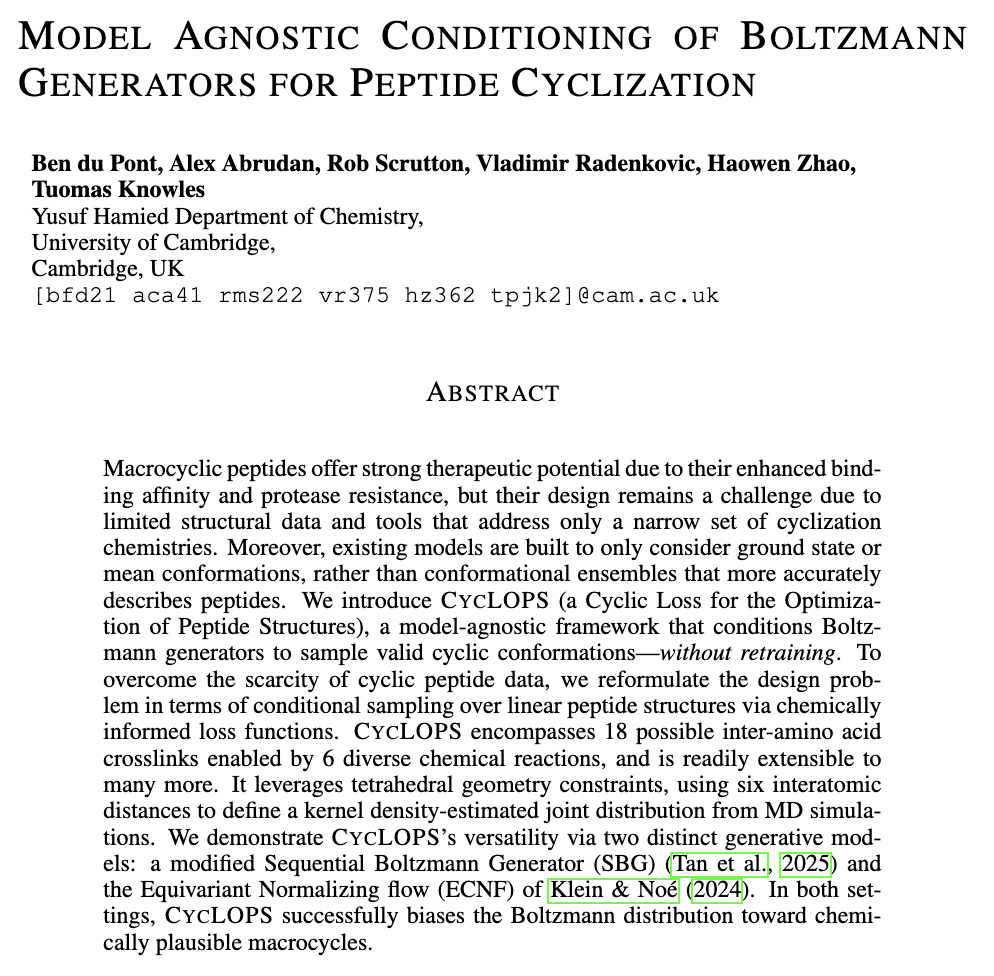
🧬Check out our new preprint “Model Agnostic Conditioning of Boltzmann Generators for Peptide Cyclization,” introducing CycLOPS (a Cyclic Loss for the Optimization of Peptide Structures) 📝Preprint: biorxiv.org/content/10.110… Code (coming soon): github.com/benjfdup/cyclo… (🧵 1/7)
Ben du Pont tweet mediaBen du Pont tweet media
English
3
5
24
2K
Alex Abrudan
Alex Abrudan@Alex__Abrudan·
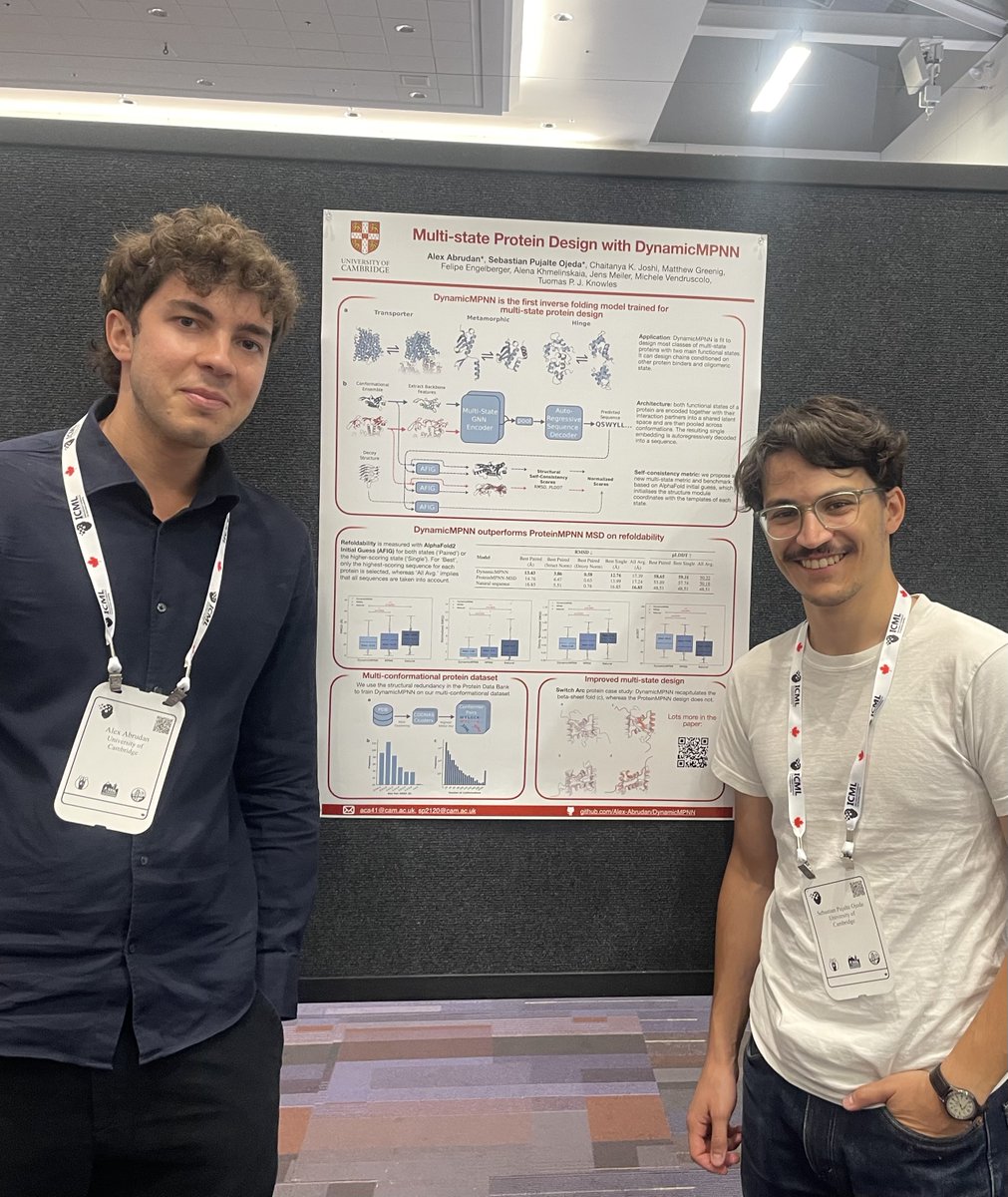
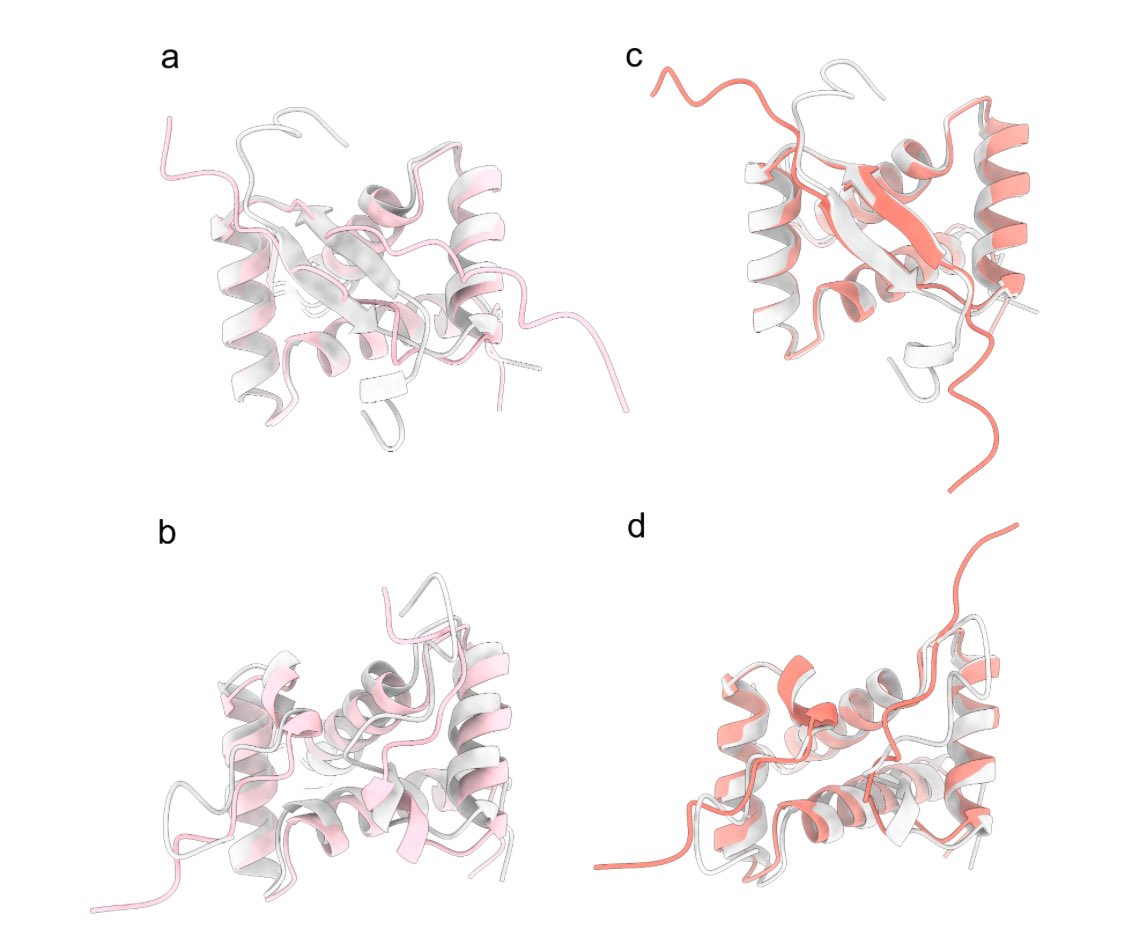
📢 I ’m thrilled to share the first pre-print of my PhD, co-authored with @rumbacarumba! Our work presents the preliminary results on "Multi-state Protein Design with DynamicMPNN". 📄 Paper: lnkd.in/dfs4v3Qt 💻 Github: lnkd.in/dgntqbKR This  project has been quite a journey - we reformulated our approach to multi-state protein design multiple times as we delved deeper into understanding protein dynamics and tackled the challenge of scarce multi-conformational data. We’re also excited that this work was accepted for the 🇨🇦 ICML 2025 GenBio Workshop, where we had a blast 🎉 🔴 Existing multi-state design approaches rely on post-hoc aggregation of single-state predictions, achieving poor experimental success rates compared to single-state design. 🟢 DynamicMPNN is a GNN-based inverse folding model designed to handle most classes of multi-state proteins with two main functional states. It can design chains conditioned on other protein binders and oligomeric states. Key contributions: • Created a new ML-ready dataset of proteins with multiple conformations using sequence redundancy in the PDB. • Evaluated our method on a challenging test set containing 94 biologically relevant metamorphic, hinge, and transporter proteins. • Proposed a multi-state self-consistency refoldability metric and benchmark, which we argue is superior to sequence recovery. • 𝐃𝐲𝐧𝐚𝐦𝐢𝐜𝐌𝐏𝐍𝐍 𝐢𝐦𝐩𝐫𝐨𝐯𝐞𝐬 𝐩𝐞𝐫𝐟𝐨𝐫𝐦𝐚𝐧𝐜𝐞 𝐨𝐯𝐞𝐫 𝐏𝐫𝐨𝐭𝐞𝐢𝐧𝐌𝐏𝐍𝐍 𝐨𝐧 𝐨𝐮𝐫 𝐛𝐞𝐧𝐜𝐡𝐦𝐚𝐫𝐤 𝐛𝐲 𝐮𝐩 𝐭𝐨 𝟏𝟑% 𝐨𝐧 𝐑𝐌𝐒𝐃. Some key lessons we’ve learned: • For better multi-state design, the BioML community needs to develop targeted approaches for specific types of protein dynamics. • DynamicMPNN targets proteins with clear nodes in their energy landscape, i.e. where ‘states’ can be easily discretized and their function still heavily relies on structure and their shape-complementarity with binders, just like for single-state proteins. 𝐒𝐭𝐮𝐝𝐲𝐢𝐧𝐠 𝐨𝐭𝐡𝐞𝐫 𝐤𝐢𝐧𝐝𝐬 𝐨𝐟 𝐝𝐲𝐧𝐚𝐦𝐢𝐜𝐚𝐥 𝐩𝐫𝐨𝐭𝐞𝐢𝐧𝐬 𝐥𝐢𝐤𝐞 𝐢𝐧𝐭𝐫𝐢𝐧𝐬𝐢𝐜𝐚𝐥𝐥𝐲 𝐝𝐢𝐬𝐨𝐫𝐝𝐞𝐫𝐞𝐝 𝐩𝐫𝐨𝐭𝐞𝐢𝐧𝐬 𝐫𝐞𝐪𝐮𝐢𝐫𝐞𝐬 𝐚 𝐝𝐢𝐟𝐟𝐞𝐫𝐞𝐧𝐭 𝐚𝐩𝐩𝐫𝐨𝐚𝐜𝐡. • Care should also be taken when picking the right design targets due to the limited understanding of conformational switch mechanisms. Huge thanks to @chaitjo for all the mentourship and insights we gained from his RNA design project gRNAde, and to all our co-authors Matt Greenig, @Felipe @fengel97, @akhmelinlab , @MeilerLab, Michele Vendruscolo, and my PhD supervisor Tuomas Knowles at @KnowlesLabCamb. Much more to come on this exciting research direction!
Alex Abrudan tweet mediaAlex Abrudan tweet media
English
4
26
119
9.4K
Alex Abrudan retweetledi
くろたんくLab
くろたんくLab@blacktanktoplab·
DynamicMPNN SE(3)等変性を保持したGeometric Vector Perceptionを採用した、タンパク質のmulti-stateを同時に満たす配列設計手法の提案 Multi-state Protein Design with DynamicMPNN arxiv.org/abs/2507.21938 実装 github.com/Alex-Abrudan/D…
くろたんくLab tweet mediaくろたんくLab tweet media
日本語
0
6
23
1.4K
Alex Abrudan retweetledi
Chaitanya K. Joshi
Chaitanya K. Joshi@chaitjo·
🚨 Protein designers: we keep saying we're getting really good at making static, rock-like proteins... Introducing Dynamic MPNN - our first step towards truly multi-state and 'programmable' protein design! Great collab with @KnowlesLabCamb, led my Alex Abrudan and @rumbacarumba
Kyle Tretina, Ph.D.@AllThingsApx

Proteins aren't static; why should our designs be? 🔄 🧬 DynamicMPNN trained on pairs of structures, crafting sequences that snap between states (+13% RMSD >ProteinMPNN on 94‑proteins) What's the most exciting application? metamorphic enzymes, transporters, or hinges?? #AI4Bio #ProteinDesign

English
4
6
40
3.4K
Alex Abrudan retweetledi
Biology+AI Daily
Biology+AI Daily@BiologyAIDaily·
Multi-state Protein Design with DynamicMPNN 1. DynamicMPNN is a groundbreaking inverse folding model that generates protein sequences compatible with multiple conformations. It outperforms ProteinMPNN by up to 13% on structure-normalized RMSD, demonstrating significant improvements in multi-state protein design. 2. The model is trained on 46,033 conformational pairs covering 75% of CATH superfamilies. It uses a novel multi-state self-consistency metric based on AlphaFold initial guess (AFIG) to evaluate the refoldability of generated sequences across multiple conformations. 3. DynamicMPNN captures sequence constraints required for multiple functional conformations by jointly learning across conformational ensembles, rather than aggregating single-state predictions. This approach is crucial for designing synthetic bioswitches and molecular machines. 4. The study provides a new benchmark for multi-state protein design, using challenging metamorphic, hinge, and transporter proteins. DynamicMPNN’s performance on this benchmark highlights its potential for engineering proteins with complex conformational changes. 5. The authors argue that refoldability, rather than sequence recovery, is a more direct and structure-grounded metric for evaluating inverse folding models. DynamicMPNN’s superior performance on this metric suggests it can generate sequences that are more likely to fold into the desired structures. 6. The model incorporates SE(3)-equivariant Geometric Vector Perception layers and conformation order-invariant pooling, ensuring computational efficiency and robustness. These features enable DynamicMPNN to handle the complexity of multi-state protein design effectively. 7. The study concludes that DynamicMPNN opens new possibilities for engineering synthetic bioswitches, allosteric regulators, and molecular machines, advancing the field of protein design and synthetic biology. 💻Code: github.com/Alex-Abrudan/D… 📜Paper: arxiv.org/abs/2507.21938 #DynamicMPNN #ProteinDesign #MultiStateProteins #MachineLearning #StructuralBiology #SyntheticBiology
Biology+AI Daily tweet media
English
2
19
108
6.2K
Alex Abrudan
Alex Abrudan@Alex__Abrudan·
@AllThingsApx We have found this interesting too - please read our Discussion section where we wonder if the best designed sequences are indeed better than the natural ones at folding into those states or if it is a metric artifact.
English
0
0
2
34
Kyle Tretina, Ph.D.
Kyle Tretina, Ph.D.@AllThingsApx·
This looks like a hard problem: While DynamicMPNN wins on “best” sequences, the average designed sequences aren’t yet much better than nature’s own
Kyle Tretina, Ph.D. tweet media
English
1
0
5
532
Alex Abrudan retweetledi
Kyle Tretina, Ph.D.
Kyle Tretina, Ph.D.@AllThingsApx·
Proteins aren't static; why should our designs be? 🔄 🧬 DynamicMPNN trained on pairs of structures, crafting sequences that snap between states (+13% RMSD >ProteinMPNN on 94‑proteins) What's the most exciting application? metamorphic enzymes, transporters, or hinges?? #AI4Bio #ProteinDesign
Kyle Tretina, Ph.D. tweet media
English
3
25
164
10.9K
Alex Abrudan
Alex Abrudan@Alex__Abrudan·
@AllThingsApx Thanks for sharing @AllThingsApx - I hope you find the preliminary results promising. More work following soon on this tricky area of protein design!
English
1
0
3
233