Alexandre Boyer

223 posts

Alexandre Boyer banner
Alexandre Boyer

Alexandre Boyer

@AlexandreBoyerX

Quand je code je m'effraie, quand je vibe code je me rassure.

France Katılım Kasım 2019
36 Takip Edilen14 Takipçiler
Alexandre Boyer
Alexandre Boyer@AlexandreBoyerX·
@unclebobmartin Do you think AI systems can understand and plan without reading the code, and escape code gravity?
English
0
0
0
235
Uncle Bob Martin
Uncle Bob Martin@unclebobmartin·
Clean Code was never about syntax. It was always about structure. The second edition makes that even clearer by using the same principles in multiple languages. If we, who pilot agents, disengage from syntax, we are not disengaging from structure. The Clean Code principles still apply.
English
40
50
724
33.6K
Alexandre Boyer
Alexandre Boyer@AlexandreBoyerX·
Don't tell so much architecture patterns in your CLAUDE.md or AGENTS.md. Just configure code-moniker to harness code hygiene and structural dependencies / frontiers on write hooks. Millisecond grade harness for your entire repo github.com/ng-galien/code…
English
0
0
0
13
Alexandre Boyer
Alexandre Boyer@AlexandreBoyerX·
Claude is for vibe coding, codex is for coding with agents. Claude is good when you don't know how to write code, but it's a nightmare when you wan't to drive your code with an agent. Codex just understand and follow your instructions
English
0
0
0
30
Kaito
Kaito@KaiXCreator·
Anyone here cancelled their Claude Code subscription and moved to Codex?
English
324
4
465
75.1K
Alexandre Boyer
Alexandre Boyer@AlexandreBoyerX·
@Boris_Gauty Aux US la mode est terminée, mais chez nous... Les ms peuvent ruiner un projet voir plus. Surtout quand le projet démarre en ms.
Français
1
0
0
118
𝑮𝒂𝒖𝒕𝒊𝒆𝒓🦁💙
À moins que votre produit ne soit du calibre de Google, Netflix, Twitter, WhatsApp, Instagram, GitHub ou YouTube, vous n'avez probablement rien à faire avec les microservices. La plupart des produits ajoutent une complexité distribuée à des problèmes qui n'existent pas encore.
Français
4
3
12
1.2K
Alexandre Boyer
Alexandre Boyer@AlexandreBoyerX·
Just switch from claude to codex. Claude was messy, verbose, and not straight regarding instructions. So I've developed a live harness system for - verbose comments - architecture violation - etc github.com/ng-galien/code…
English
0
0
0
19
Matt Pocock
Matt Pocock@mattpocockuk·
/improve-codebase-architecture will soon output HTML This rocks, thanks @trq212
Matt Pocock tweet mediaMatt Pocock tweet media
English
68
72
2.2K
117.9K
Andrej Karpathy
Andrej Karpathy@karpathy·
This works really well btw, at the end of your query ask your LLM to "structure your response as HTML", then view the generated file in your browser. I've also had some success asking the LLM to present its output as slideshows, etc. More generally, imo audio is the human-preferred input to AIs but vision (images/animations/video) is the preferred output from them. Around a ~third of our brains are a massively parallel processor dedicated to vision, it is the 10-lane superhighway of information into brain. As AI improves, I think we'll see a progression that takes advantage: 1) raw text (hard/effortful to read) 2) markdown (bold, italic, headings, tables, a bit easier on the eyes) <-- current default 3) HTML (still procedural with underlying code, but a lot more flexibility on the graphics, layout, even interactivity) <-- early but forming new good default ...4,5,6,... n) interactive neural videos/simulations Imo the extrapolation (though the technology doesn't exist just yet) ends in some kind of interactive videos generated directly by a diffusion neural net. Many open questions as to how exact/procedural "Software 1.0" artifacts (e.g. interactive simulations) may be woven together with neural artifacts (diffusion grids), but generally something in the direction of the recently viral x.com/zan2434/status… There are also improvements necessary and pending at the input. Audio nor text nor video alone are not enough, e.g. I feel a need to point/gesture to things on the screen, similar to all the things you would do with a person physically next to you and your computer screen. TLDR The input/output mind meld between humans and AIs is ongoing and there is a lot of work to do and significant progress to be made, way before jumping all the way into neuralink-esque BCIs and all that. For what's worth exploring at the current stage, hot tip try ask for HTML.
Thariq@trq212

x.com/i/article/2052…

English
933
1.8K
17.5K
2.8M
Uncle Bob Martin
Uncle Bob Martin@unclebobmartin·
Authoring code by hand HAS GONE AWAY. Engineering module structure and architecture has not.
English
133
135
1.4K
87.2K
Alexandre Boyer
Alexandre Boyer@AlexandreBoyerX·
@martinfowler This strongly resonates with what I’m exploring with code-moniker and ESAC. If code is also a conceptual model, then agents should not only read source text. They need symbolic, queryable views of that model github.com/ng-galien/code…
English
0
0
0
267
Martin Fowler
Martin Fowler@martinfowler·
NEW POST Will there be source code in the future? To wrestle with this, we have to understand what code is. Unmesh Joshi sees code as having two distinct but intertwined purposes: instructions to a machine and a conceptual model of the problem domain. martinfowler.com/articles/what-…

English
9
46
269
27.2K
Zara Zhang
Zara Zhang@zarazhangrui·
Yes HTML is eating everything A great way to get started with AI coding: try replacing all word, excel, ppt, pdf, dashboards, prototypes with HTML
Thariq@trq212

x.com/i/article/2052…

English
45
33
468
68.4K
Nicolas Bustamante
Nicolas Bustamante@nicbstme·
I turned @trq212's article into an interactive HTML! I was a markdown boy but since I started working at Microsoft I'm using HTML more and more. Our engineers love to send AI-generated HTML to coordinate between SWE/PM on projects since it's easier to read than markdown.
Thariq@trq212

x.com/i/article/2052…

English
59
38
958
147.9K
ᴅᴀɴɪᴇʟ ᴍɪᴇssʟᴇʀ 🛡️
This is really cool thinking from @trq212 here, but I think I disagree with the solution. He makes a great point about Markdown being more difficult to share and communicate ideas with, because formatting and visuals can make things super easy to understand. My problem with the approach is that, by trading editabilty for readability, we’re separating we humans even further from the creation process. I value Markdown because I value text. And I value text because I see it as one step away from thought. I believe thinking is the one thing we should be careful not to outsource, and I worry what this idea smuggles in is a major step toward making our creations opaque to humans. Not just AI's creations, but ours as well. The reason I value Paul Graham so much is because of the idea compression work that goes into writing super clean prose. It's difficult to write clearly because it requires thinking clearly. Text makes your ideas naked, and I like that. - What is the problem, exactly? - What should we do to solve it? - Why is our solution better than alternatives? I love the challenge of crystalizing this kind of critical stuff in pure text before any technology is involved. If we're not writing that text ourselves, and then editing it, it starts to feel a lot like bringing a strong robot to the gym. I worry that if we vibe-think to AI and have it spit out amazing HTML, we're instantly disconnected from the idea. Like where did the idea go? It started as vibes and got put through a woodchipper and turned into someone else's HTML. Can I see it in 4 simple bullets? Can I stare at it? Can I grapple with it. Can I tweak it? It's an idea. I need to be able to wrestle with it. Of course we can ask the AI to summarize its brilliant HTML document into four bullets, but we'll have lost through compression and expansion some percentage of the original. Maybe I'm being overly emotional here. I just feel like if you didn't put the hard thinking and writing work into the original idea, and then maintain it in a format that's easy for humans to read and edit, then you have somehow surrendered something Holy to the machines. I say this as a total AI maximalist. But I get the point he's making, and I think it's super valid. It's hard to explain or convince people of things with a giant text file. Formatting massively helps. Images massively help. Even an interface or a video or something. So we're synched on that. I just think it might be better to come at the output we both want in a different way. - MARKDOWN: Easy for humans to write, hard for humans to read. - HTML: Hard for humans to write, easy for humans to read. Maybe the solution isn't moving the first step to HTML where it becomes more opaque to both agents and humans (plus the versioning issues Thariq talked about). Maybe the solution is something crazy like document pairing: like you have the thought file and you have the presentation file(s). The proposal is to ask AI to just write HTML, right? Well why not just have a separate but linked file for that? One is for crystal-clear human creation and sync between human and AI. Simplicity, clarity, precision, and human editability. And then AI can produce whatever from that. Images, diagrams, videos, or whatever. And if you want, yes, a full HTML file that contains all of them. And that can be what you use to present or share the idea with audiences. (Plus there's the fact that some file formats are literally directories, which could be shared with lots of related content, and then there's also things like .mdx that allow for richer content in Markdown, etc.) I hate the idea of multiple files, but I think it's far preferable to losing the transparent, editable connection to the idea that you get with text. Plus, the better and cheaper AI gets, the more trivial it will be to have the core thought file plus n-number of associated versions or formats that are useful for different audiences. Basically I think it's much easier for AI to make a rich and shareable version of clean, editable thought, in the form of text, than it is for humans to stay connected with ideas as opaque HTML. And I think the human thought-to-text connection is the most important thing to preserve. Still thinking it through, however, and massive thanks to @trq212 for the push for all of us to evolve on this.
Thariq@trq212

x.com/i/article/2052…

English
73
22
298
46.3K
Alexandre Boyer
Alexandre Boyer@AlexandreBoyerX·
@MikeCodeur Je serai curieux de savoir comment tu fais pour communiquer avec Claude code sans passer par le tmux
Français
0
0
0
64
Mike Codeur
Mike Codeur@MikeCodeur·
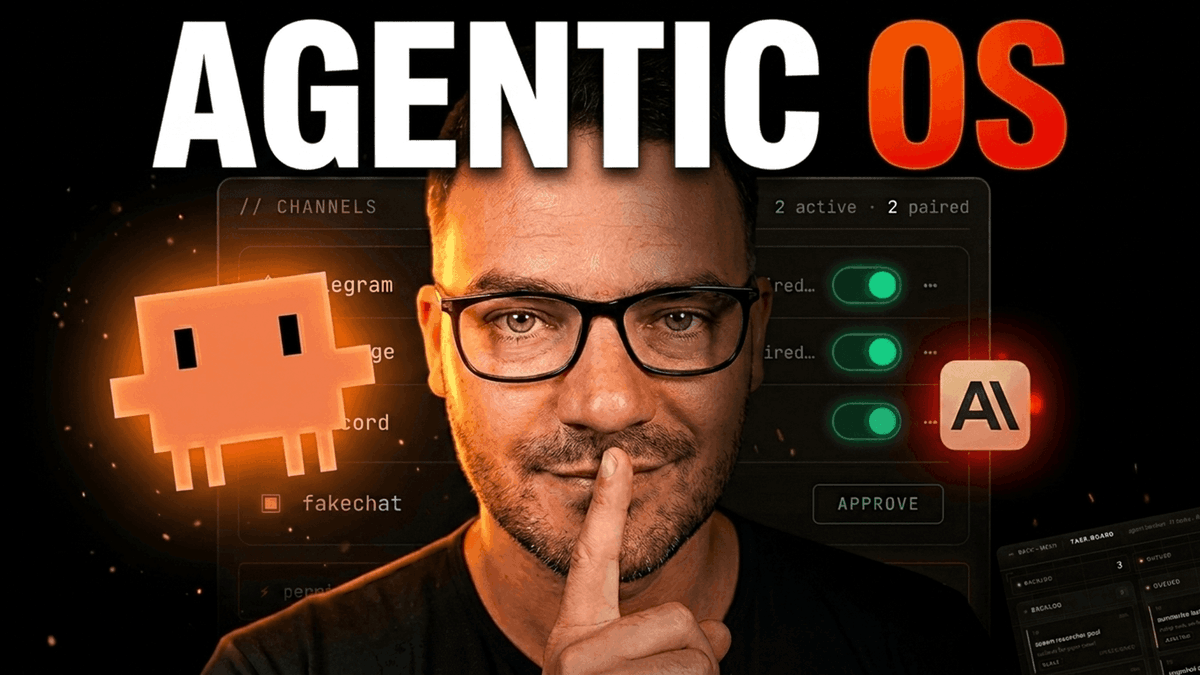
J'ai craqué. Mises à jour OpenClaw qui cassent mon stack à chaque fois. Conventions Hermes qui imposent leur philosophie. Trop. J'ai construit mon Agentic OS perso, basé sur Claude Code. 📺 mkc.sh/agentic-os?utm… 22 min de démo. 9 features : → Visualizer : mesh des agents en parallèle → Edit config : modèle, permissions, channels Telegram/Discord, pilotage à distance → Chat agent : converser avec un sous-agent depuis l'UI → Memory editor : decisions.md, patterns.md, log.jsonl éditables à la main → Missions tracking : coût USD, tokens, events détaillés → Kanban : vue globale, glisser-déposer entre colonnes → Routine cron : standup matinal, recap newsletter, audits nocturnes → Skills management : catalogue activable par agent → Dashboard radar : coûts par domaine, tokens cumulés Tout local. Plan Max exploité à fond. Zéro API key parallèle. Et le risque ban Anthropic (déjà arrivé à OpenClaw) ? Zéro. Mon OS s'appuie sur Claude Code natif. C'est pas anti-OpenClaw ou anti-Hermes. C'est pour le 20% de devs qui veulent un truc plié à LEUR workflow, pas l'inverse. 🎁 Le pack pour faire le tien : mkc.sh/the-agentic-de… 📩 Newsletter : mkc.sh/the-agentic-dev
Mike Codeur tweet media
Français
2
0
6
845