Sabitlenmiş Tweet

Most "AI memory" today is backwards.
ChatGPT remembers a few user preferences.
Codex remembers a repo if you keep feeding it context.
Claude/Cursor have their own little islands.
But real businesses don't run in one tool.
Their operations live across texts, calls, CRMs, spreadsheets, invoices, Slack, email, Notion, random PDFs, and tabs.
Agents are the same way now:
GPT here.
Codex there.
Claude somewhere else.
Custom MCPs duct-taped into client workflows.
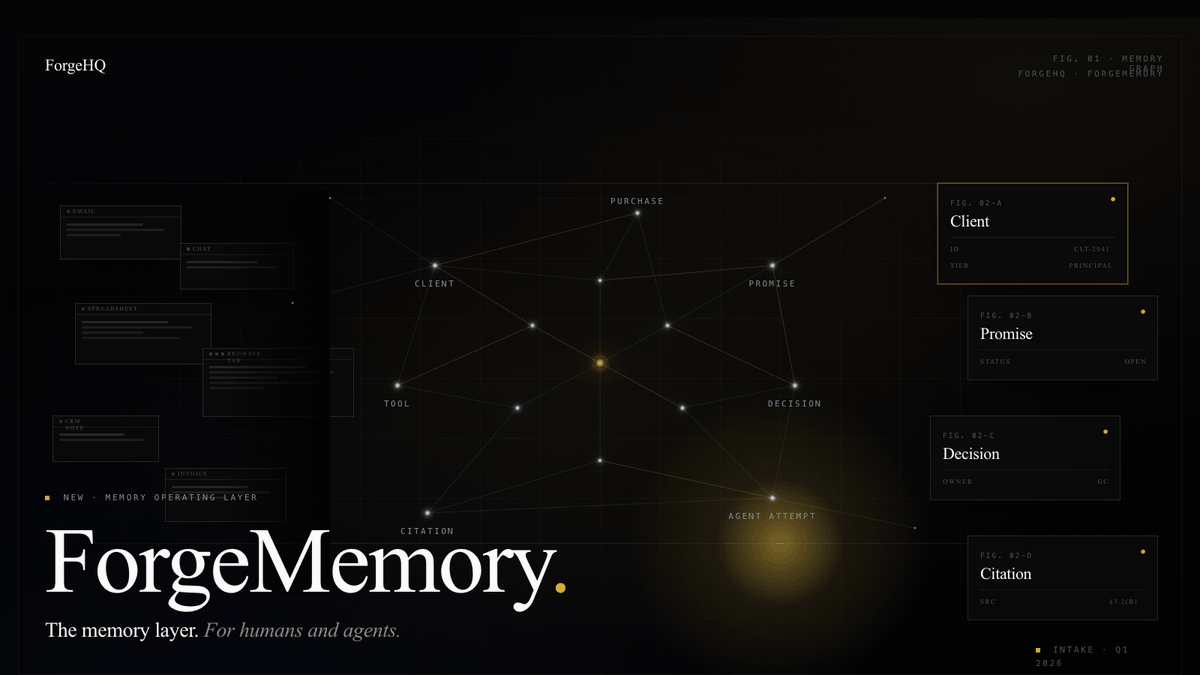
So we started building ForgeMemory — a shared memory layer for humans and agents alike.
The idea is simple:
Human memory and agent memory should be the same layer.
Not "dump every chat into a database."
A real memory system should know:
- who the client is
- what they bought
- what they care about
- what was promised
- what systems exist
- what changed
- what the agent already tried
- what decisions were made
- what's stale, uncertain, or superseded
And it should expose that back to every agent through MCP/API, with citations.
For one client, we already built a custom MCP so their agents could remember the business instead of constantly starting from zero.
Now we're turning that pattern into a public open-source tool.
Inspired by the way @karpathy talks about context engineering: agents don't just need bigger context windows.
They need structured context.
Durable memory.
Retrieval that knows what matters.
A small graph of the business they're operating inside.
Over the next few weeks I'm going to build ForgeMemory in public:
1. local event log
2. importers from GPT / Claude / Codex / Hermes sessions
3. SQLite search
4. MCP server
5. memory distillation
6. client/project graph
7. open-source release
The future agent stack won't be "one chatbot with memory."
It'll be a memory layer that every human and every agent can share.
That's what we're building. Follow along.
English