Almost Sure

9.1K posts

Almost Sure banner
Almost Sure

Almost Sure

@Almost_Sure

George Lowther, Author of Almost Sure blog, on maths, probability and stochastic calculus. Also on YouTube https://t.co/VyOijwbe9l

London, UK Katılım Eylül 2020
251 Takip Edilen8.8K Takipçiler
Sabitlenmiş Tweet
Almost Sure
Almost Sure@Almost_Sure·
New YouTube video “The Joy of Coupling” Happy Valentine’s Day! (link below)
Almost Sure tweet media
English
1
4
30
3.5K
Almost Sure
Almost Sure@Almost_Sure·
the genus is (n-1)(n-2)/2 so has genus > 1 only for n ≥ 4. The case n=3 is different. FLT still applies but, algebraically, it’s a different kettle of fish. An elliptic curve, which could potentially have infinitely many solutions, but here the rank is 0, so only finitely many.
English
0
0
5
294
Almost Sure
Almost Sure@Almost_Sure·
An example application of Faltings’ theorem is that for each integer n ≥ 4 xⁿ + yⁿ = 1 has only finitely many rational solutions. That’s because it’s a curve of genus > 1. ofc, Fermat’s Last Theorem says only solutions are x=0 or y=0, but Wiles’ proof is relatively recent
Almost Sure@Almost_Sure

Congrats to Gerd Faltings! And if you want to know how to prove Faltings’ theorem (formerly Mordell conjecture), check out this …ahem… “introduction” to the theory!

English
1
3
47
3.2K
Almost Sure
Almost Sure@Almost_Sure·
@jamestanton Reducing to lowest terms, a² and b² must be in {1,4,7} modulo 9. No pair of these sum to 0 mod 9. So, no
English
0
0
0
135
James Tanton
James Tanton@jamestanton·
A power of three can be the side-length of an integer right triangle. (Why?) Can it be the hypotenuse of one?
James Tanton tweet media
English
2
2
7
721
DrSponz
DrSponz@SponzDr·
@Almost_Sure Hindry and Silverman however give a different proof (Bombieri's version of Vojta's, using Diophantine approximation), not the original one by Faltings. For the latter, see the 1986 volume edited by Cornell and Silverman that includes an English translation of Falting's original.
DrSponz tweet media
English
1
0
3
119
Bryan Cheong
Bryan Cheong@bryancsk·
Apparently the British make charcuterie boards but with leftovers and call them "picky bits" it's very endearing.
English
7
0
65
3.9K
Henry Shevlin
Henry Shevlin@dioscuri·
There is no fucking way you’d ever guess whose Wikipedia page this is from.
Henry Shevlin tweet media
English
21
9
235
52.7K
Almost Sure
Almost Sure@Almost_Sure·
Fixing aliasing issue and increasing resolution. Except for some text overlapping, it looks good!
English
0
0
2
161
Almost Sure
Almost Sure@Almost_Sure·
Asking it to use exact formulas instead of FFT. A little better but still doesn’t look quite right, will need manually checking
English
1
0
2
240
Almost Sure
Almost Sure@Almost_Sure·
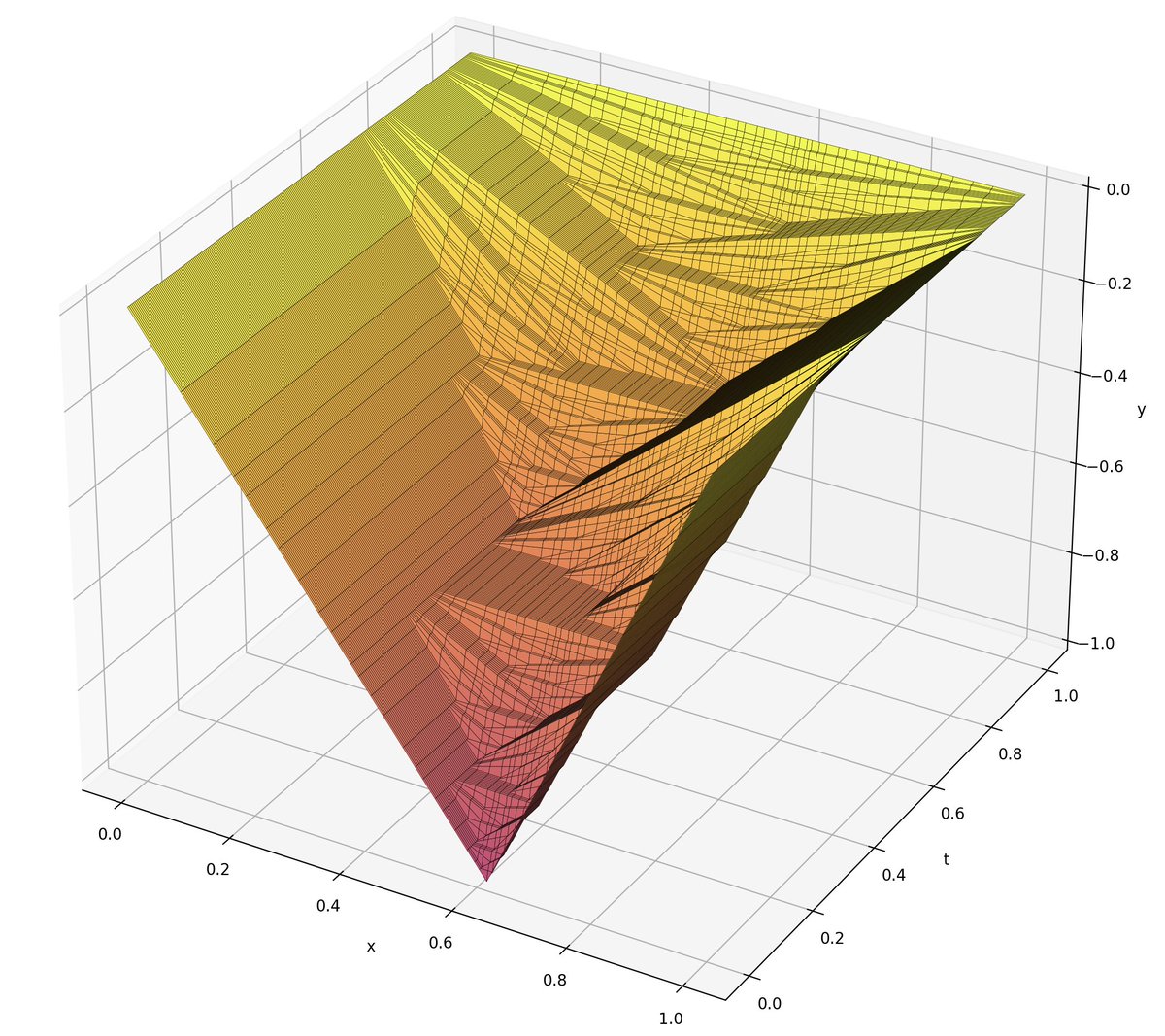
Using Claude to generate some animations… looking pretty good. Not perfect, there seems to be some artefacts which may be down to FFT use.
Almost Sure tweet mediaAlmost Sure tweet media
English
1
0
12
1.7K
Almost Sure
Almost Sure@Almost_Sure·
@jamestanton only possibilities are multiples of (2ⁿ⁺¹)² + (4ⁿ-1)² =(4ⁿ+1)² for n=1,…99. So answer is 99
English
0
0
1
153
James Tanton
James Tanton@jamestanton·
How many integer right triangles have a side of length 2^100?
James Tanton tweet media
English
4
3
9
1.8K
Julia Gomez
Julia Gomez@microfusio91945·
Prove it
Julia Gomez tweet media
Republic of Korea 🇰🇷 English
7
5
131
42.9K
Almost Sure
Almost Sure@Almost_Sure·
translated and typeset, of course...
English
1
0
2
406
Almost Sure
Almost Sure@Almost_Sure·
@BrunsJulian1541 ok, but it remains, that if they can’t solve it properly for whatever reason, they might just make up a wrong answer and then claim a proof of the wrong answer
English
0
0
0
12
Julian Bruns
Julian Bruns@BrunsJulian1541·
@Almost_Sure all of that is contained in their training data, no online search required.
English
1
0
0
28
Almost Sure
Almost Sure@Almost_Sure·
From the responses it seems that the higher tiers of chatbots correctly solve this. However, I’m suspicious that if they couldn’t find sufficient info online, they might still just guess an answer and claim it’s correct
Almost Sure@Almost_Sure

So ChatGPT gets the wrong answer, then *proves* the wrong answer. Then when a counterexample is pointed out, calls it *my* assumption that was wrong 🤷 do the more advanced versions that you subscribe to handle this better?

English
1
0
5
1.3K