Tom Tillerman@ThomasTillerman
Sure @Almostmiddleag1. Let's break this down.
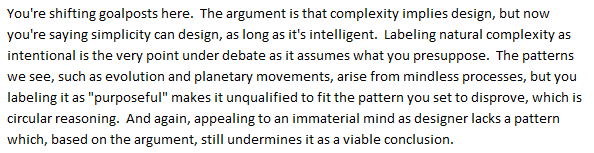
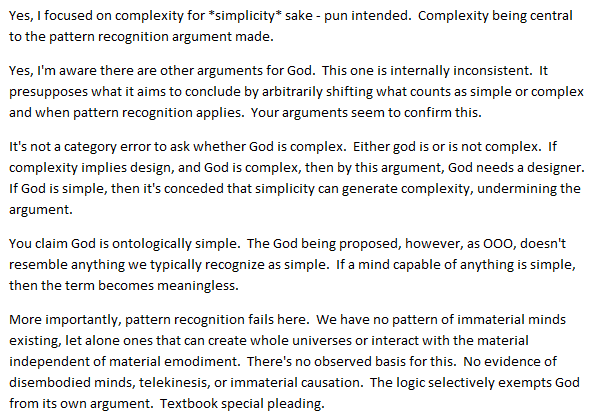
1) “You’re shifting goalposts… complexity implies design, now you say simplicity can design if intelligent.” This is a misunderstanding. I never claimed that simplicity implies design. I claimed that an intelligent cause doesn’t have to be structurally complex (as Swinburne argues), which is entirely consistent with classical theism where God is ontologically simple but still fully intelligent. That’s not shifting the goalposts; it’s clarifying what “design” requires: intention, not structural complexity.
2) “Labeling natural complexity as intentional is the very point under debate… assumes what you presuppose.” That’s a fair concern and worth clarifying. The argument doesn’t label all complexity as intentional. It contends that certain specific features, like fine-tuning or the information content in DNA, are best explained by intelligence. That’s an inference to the best explanation, not circular reasoning or question-begging.
3) “The patterns we see arise from mindless processes… you labeling them as purposeful is circular.” This overstates the issue. The real question is: Do the features of the universe resemble things that, in our uniform experience, result from minds? Things like symbolic language, goal-directed systems, and functional integration typically indicate intentionality. I’m not assuming purpose, I’m inferring it based on characteristics that, in every other context, are associated with purposeful design.
4) “Appealing to an immaterial mind lacks a pattern, which… undermines it as a viable conclusion.” This goes back to the category error I mentioned earlier. I don’t need a pattern of immaterial designers to justify the inference. We don’t have multiple universes to compare, yet we still infer things like a beginning (from cosmology) or fine-tuning. Similarly, we can rationally infer a non-physical cause if that’s what best explains the data. The absence of “repeated patterns” of immaterial minds doesn’t disqualify the conclusion, any more than the uniqueness of the Big Bang disqualifies cosmological arguments.