Amach Health
1.1K posts

Amach Health
@AmachHealth
Building Amach Health | Your Health Data. In Your control. Your Personalized Insights. | Encrypted · Decentralized · Anonymous | Documenting the journey 🧬


Venice just shipped end-to-end encrypted AI inference. Every major AI platform today runs on the same basic trust assumption. You have to trust the provider to handle your data responsibly. @AskVenice has operated with a slightly different architecture. Conversations are stored locally on your device and prompts are not persisted server-side. When you use frontier models, Venice proxies the request so the provider never receives your identity data. However, the same trust assumptions still apply here. If Venice or a partner wanted to intercept data, nothing in the architecture would prevent it. The new launch introduces two hardware-enforced privacy modes. TEE runs inference inside secure hardware enclaves operated by NEAR AI Cloud and Phala Network, isolating computation from the host OS and infrastructure operator. Remote attestation ties a cryptographic certificate to the physical hardware so anyone can independently verify the model is running inside a genuine enclave. You no longer need to trust the GPU operator but you are still trusting Venice's transit layer. E2EE removes that remaining trust assumption. Prompts are encrypted on device before transmission, stay encrypted through Venice's infrastructure, and only decrypt inside the verified enclave. Venice cannot see your data at any point during normal operation. The tradeoff is that responses may be slower, web search and memory are disabled since they would require decryption outside the enclave. Both modes currently run on a handful of open source models through NEAR AI Cloud and Phala Network and are exclusive to Pro subscribers. How robust these guarantees are in practice depends on the attestation implementation and whether independent audits confirm the claims.

This is huge!! Venice just proved their privacy commitments on-chain. For Amach, this is a validation of a decision we made on day one. When we chose Venice as Amach's inference backbone, it was rooted in a commitment to user privacy. A platform built around health data sovereignty needs an AI layer that treats privacy as infrastructure, not policy. Venice's commitment was clear from the beginning and today that commitment is cryptographically verifiable, that changes everything. This matters more in health than anywhere else. Your HRV trends, your sleep patterns, your bloodwork, your medication history, this isn't browsing data. It's the most intimate longitudinal record a person can generate. Routing AI queries on that data through every other AI involves data retention. Venice claimed they don't retain data, but couldn't prove it. Now they can. On-chain. Verifiable by anyone. That's the layer our AI runs on. On the storage side, Amach uses Storj, a decentralized, cryptographically secured platform with each user's health data isolated in individual encrypted buckets with no shared access. Your records don't sit in a shared pool. The encryption is yours. No one reaches it without your explicit grant. And the verification layer closes the loop entirely. Amach's zero-knowledge proof system means a user can prove specific things about their health data to third parties a without the underlying records ever leaving their vault. The proof travels. The data doesn't. Three layers. One direction. Venice for inference that's now provably private on-chain. Storj for storage that's cryptographically isolated by design. Zero-knowledge proofs for verification that requires no surrender of the underlying data. This is what health data infrastructure looks like when it's built around the person generating it, not the platforms that have historically profited from holding it. The stack holds. The commitment is on-chain. @AmachHealth — Own your data. Keep the value. Read the signals. x.com/AskVenice/stat…


Venice AI just released End-to-End Encryption Verifiable by any external party Vires in numeris Here's how it works 🧵

49% of U.S. residents struggle to pay rent or mortgages, per Redfin.


Venice AI just released End-to-End Encryption Verifiable by any external party Vires in numeris Here's how it works 🧵


Introducing our four Privacy Modes on Venice. Every AI model now falls into one of four categories, each with different protections and trade-offs. You choose based on what matters most for each conversation.


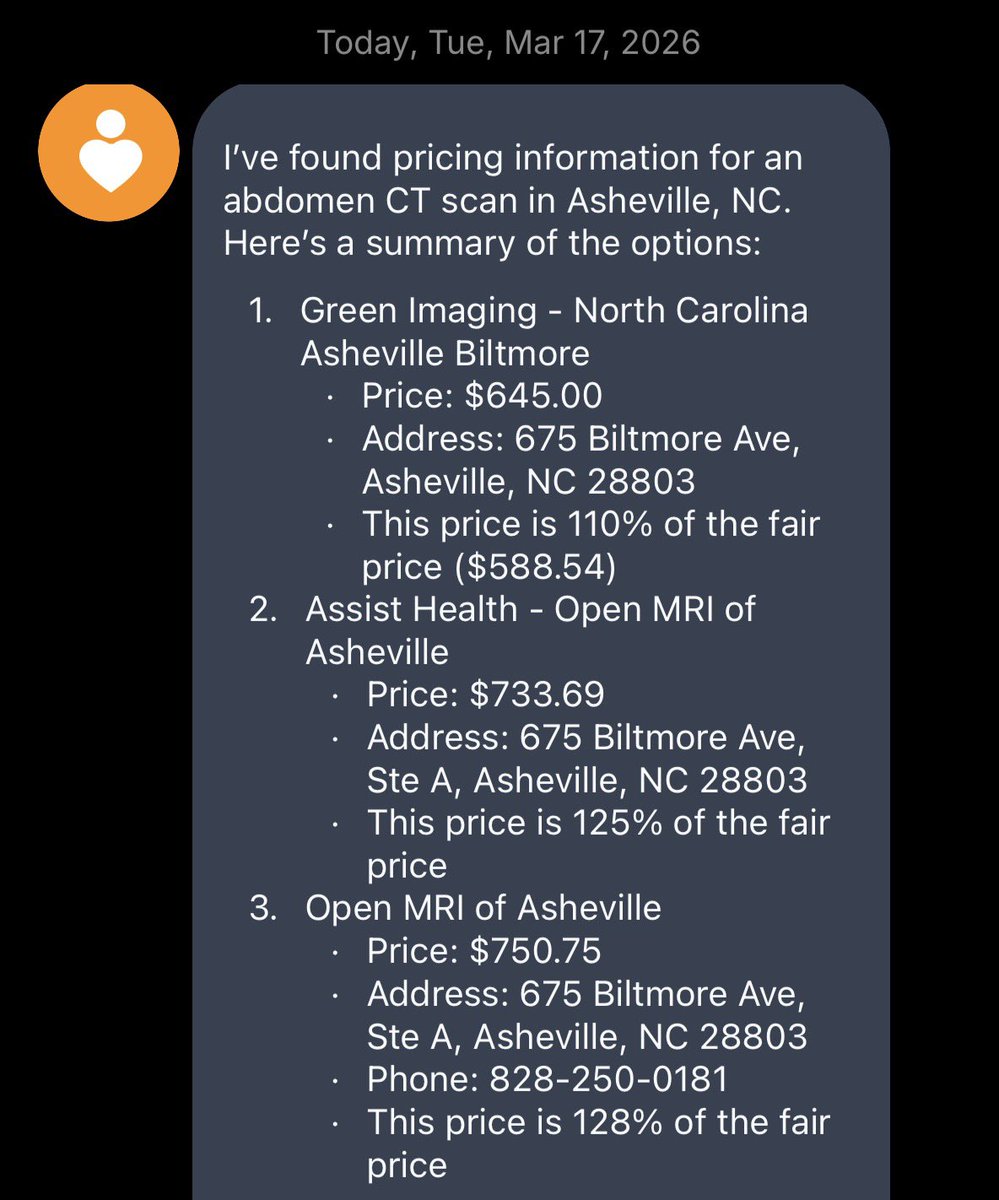
RFK Jr. moves to require hospitals and insurers to publicly post their prices. The fact that it took a government mandate to force hospitals and insurers to show you what things cost tells you everything about how broken the system is.