
Ambrogio Cesa-Bianchi

1.7K posts

Ambrogio Cesa-Bianchi banner
Ambrogio Cesa-Bianchi

Ambrogio Cesa-Bianchi

@AmbrogioCB

Economist at Bank of England. CEPR fellow. Guest lecturer at LSE. Associate editor at EER. Views are my own. When not here, I'm often here https://t.co/MhEmbvOkhz

N16 Katılım Ekim 2011
917 Takip Edilen3.6K Takipçiler
Sabitlenmiş Tweet
Ambrogio Cesa-Bianchi
Ambrogio Cesa-Bianchi@AmbrogioCB·
📢 The VAR TOOLBOX 3.0 is now available 📢 sites.google.com/site/ambropo/M… The VAR Toolbox is a collection of Matlab codes to perform Vector Autoregression analysis. It comes with a "Primer on VARs" (code + slides) with examples and replications of well-known papers [Short thread] 👇🏼
English
15
133
569
0
Ambrogio Cesa-Bianchi retweetledi
Marco Del Negro (he, him)
Marco Del Negro (he, him)@marcodelnegro·
Growth in 2026 is expected to be more robust, and inflation more persistent, than predicted in December. Stronger investment is the main driver for higher growth, while cost-push shocks, possibly capturing the effects of tariffs, are the key factors behind higher inflation.
New York Fed Research@NYFedResearch

DSGE Model Forecast: March 2026 Compared to the December 2025 forecast, growth in 2026 is expected to be more robust and inflation more persistent. nyfed.org/4bKgIxs #AMEC

English
0
10
36
9.5K
Ambrogio Cesa-Bianchi retweetledi
Isabel Schnabel 🇪🇺🇺🇦
Warm congratulations to the great @HyunSongShin who had such an enormous impact on my thinking and research. I am sure the lessons from the famous #BankOfAmsterdam will be useful also for the Bank of Korea. 😉Fantastic choice!
Bloomberg@business

South Korea’s President Lee Jae Myung has nominated Shin Hyun Song, head of the monetary and economic department at the Bank for International Settlements, as the new Bank of Korea governor, the Presidential Office said Sunday bloomberg.com/news/articles/…

English
0
5
57
4.5K
Ambrogio Cesa-Bianchi retweetledi
Bank for International Settlements
Hélène Rey, Professor of Economics at @LBS, is appointed as Economic Adviser and Head of the Monetary and Economic Department, replacing Hyun Song Shin, from 1 September 2026 bit.ly/4skt7zc
Bank for International Settlements tweet media
English
18
113
542
222.8K
Ambrogio Cesa-Bianchi retweetledi
Ivan Werning
Ivan Werning@IvanWerning·
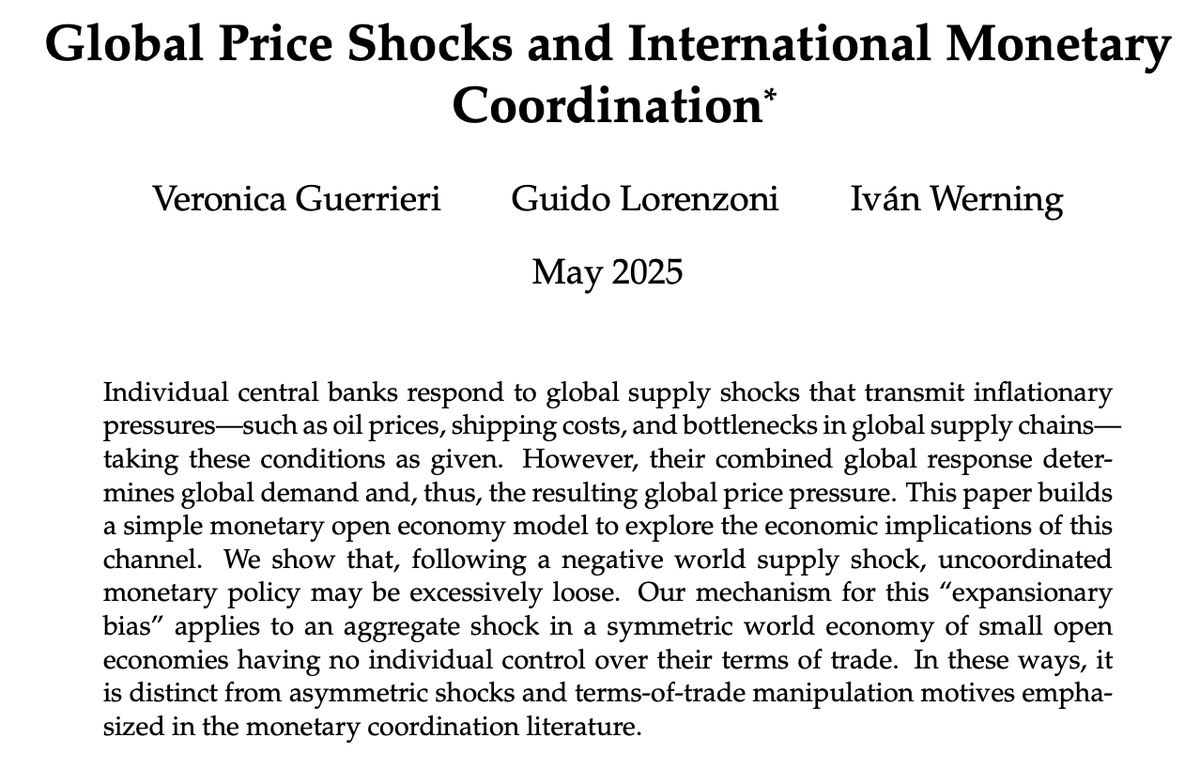
Iran War --> Oil shock 📈 How should central banks respond? Why is coordination needed? When inflation comes from global price shocks, each central bank takes the shock as given—but their policies jointly determine global demand. That’s the mechanism in our paper.
Ivan Werning tweet media
English
7
83
355
48.9K
Ambrogio Cesa-Bianchi retweetledi
Markus K. Brunnermeier
Markus K. Brunnermeier@MarkusEconomist·
R.I.P. Christopher Sims (21 Oct. 1942 - 14 March 2026) - a giant in macroeconomics and one of the finest human beings I have ever met -
Markus K. Brunnermeier tweet media
English
33
451
1.8K
497.3K
Ambrogio Cesa-Bianchi retweetledi
Ben Moll
Ben Moll@ben_moll·
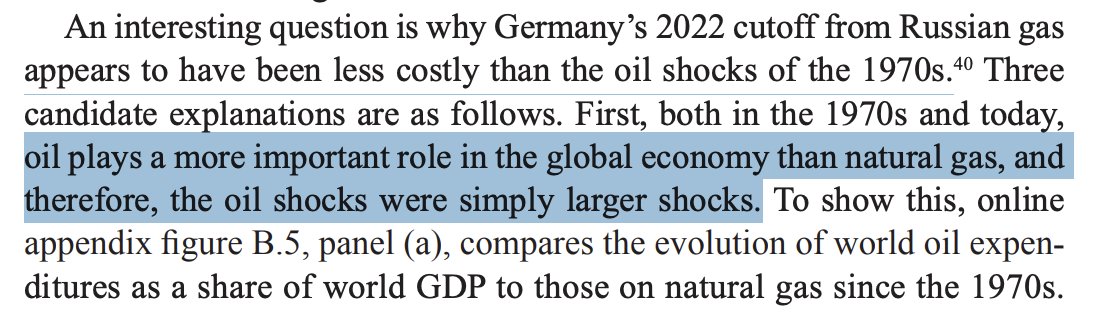
Very much agreed! However, I do think that an oil shock might have larger macroeconomic effects than the gas shock for a number of reasons we discuss in our paper with @MSchularick and @GeorgZachmann benjaminmoll.com/GGGD/
Ben Moll tweet mediaBen Moll tweet mediaBen Moll tweet media
Josh Bailey@joshuabailey_

When thinking about the effect of the energy shock, worth recalling @ben_moll and co's great paper on the 2022 shock. Predictions then were of a much more severe German recession. It never came to pass because production isn't as rigid as simple models assume. Even tiny substitution elasticities dramatically reduce output losses.

English
4
38
143
23.4K
Ambrogio Cesa-Bianchi retweetledi
Tommaso Monacelli
Tommaso Monacelli@monacelt·
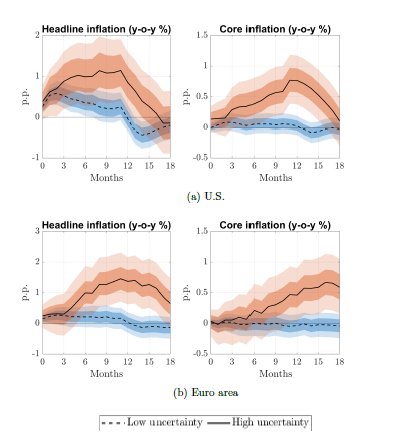
Spike in oil price all over the news, plus concern for supply chain disruption. In recent work we show that it is not the spike in oil price per se that matter (for inflation). It is when oil shocks interact with states of *high supply chain uncertainty.* ➡️Exactly as now👇
Tommaso Monacelli tweet media
English
3
31
134
16.5K
Ambrogio Cesa-Bianchi retweetledi
Michael Pettis
Michael Pettis@michaelxpettis·
1/3 Caixin: "China’s central bank will seek to prevent global shocks from spilling into its financial system, Governor Pan Gongsheng said Friday, citing rising geopolitical tensions and uncertainty over monetary policy in major advanced economies." caixinglobal.com/2026-03-06/chi…
English
3
6
57
13.8K
Ambrogio Cesa-Bianchi retweetledi
Luca Fornaro
Luca Fornaro@LucaFornaro3·
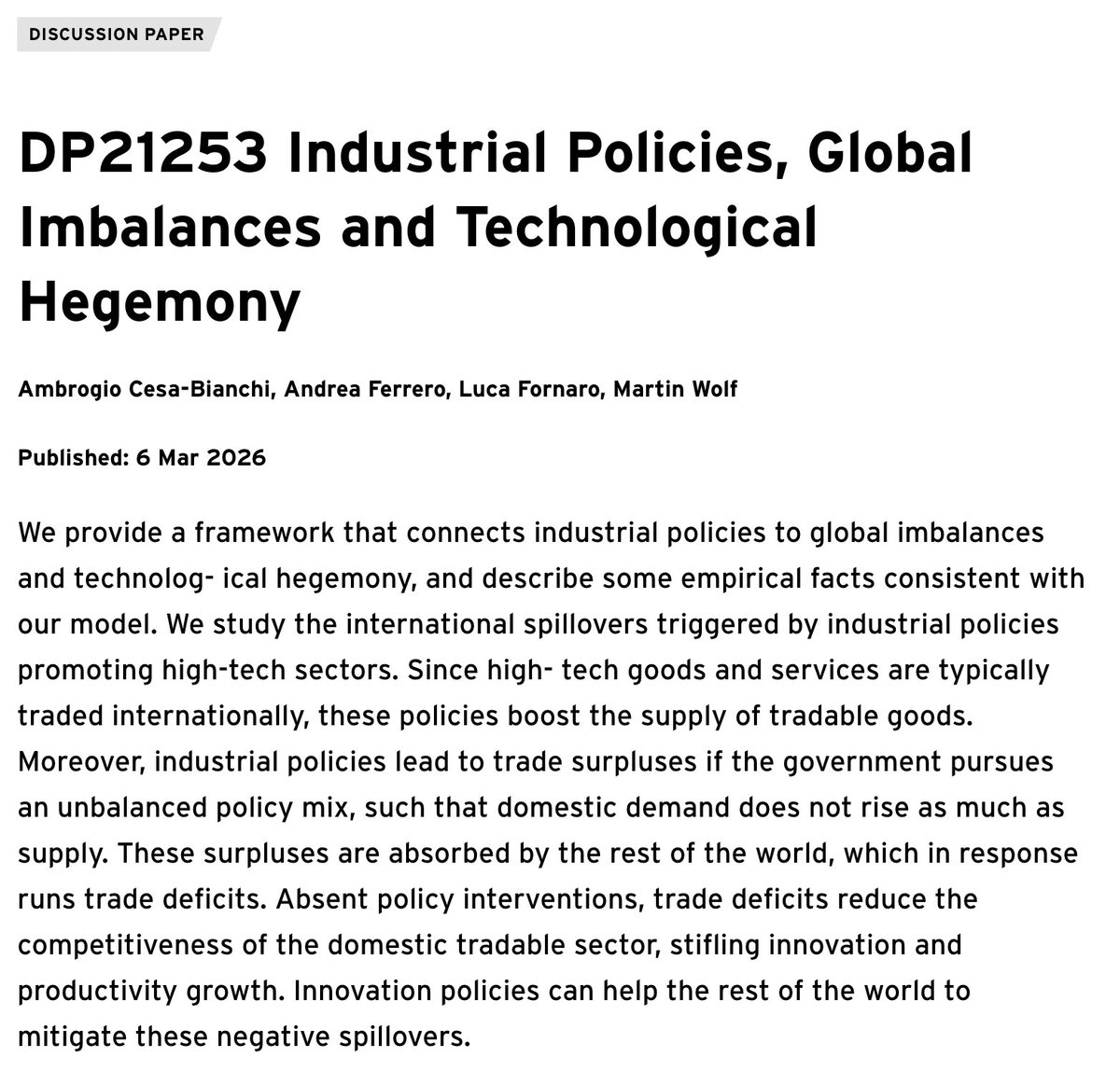
Europe is heavily exposed to the Second China Shock. Big risk that EU will experience a financial resource curse: trade deficits -> contraction in high-tech tradable sectors -> lower innovation -> lower productivity growth in the medium run. x.com/LucaFornaro3/s…
Daniel Kral@DanielKral1

The 🇪🇺 is the only region whose share in 🇨🇳 exports has risen at the same time as its share in 🇨🇳 imports has dropped. Others export inputs, commodities or critical minerals that 🇨🇳 has been hungry for. The 🇪🇺 is at the epicentre of the 🇨🇳 shock and no one is coming to help.

English
3
15
56
11.1K
Ambrogio Cesa-Bianchi retweetledi
Thomas Drechsel
Thomas Drechsel@td_econ·
Thank you Francesco! I am excited to start a new chapter in my career and to contribute to the amazing trajectory of JHU Econ! 🚀 I am also sad to leave a wonderful department at U of Maryland. I loved every day there and I am grateful to many superb colleagues & students ❤️🙏
Francesco Bianchi@Francesco_Bia

I am very happy to announce that Thomas Drechsel @td_econ will be joining @JohnsHopkins econ! A fantastic hire that further strengthens our department. Thomas has a very broad research agenda, spanning Monetary Economics, International Macro, HANK,... Welcome to JHU Thomas!

English
24
5
254
13.1K
Ambrogio Cesa-Bianchi retweetledi
Atif Mian
Atif Mian@AtifRMian·
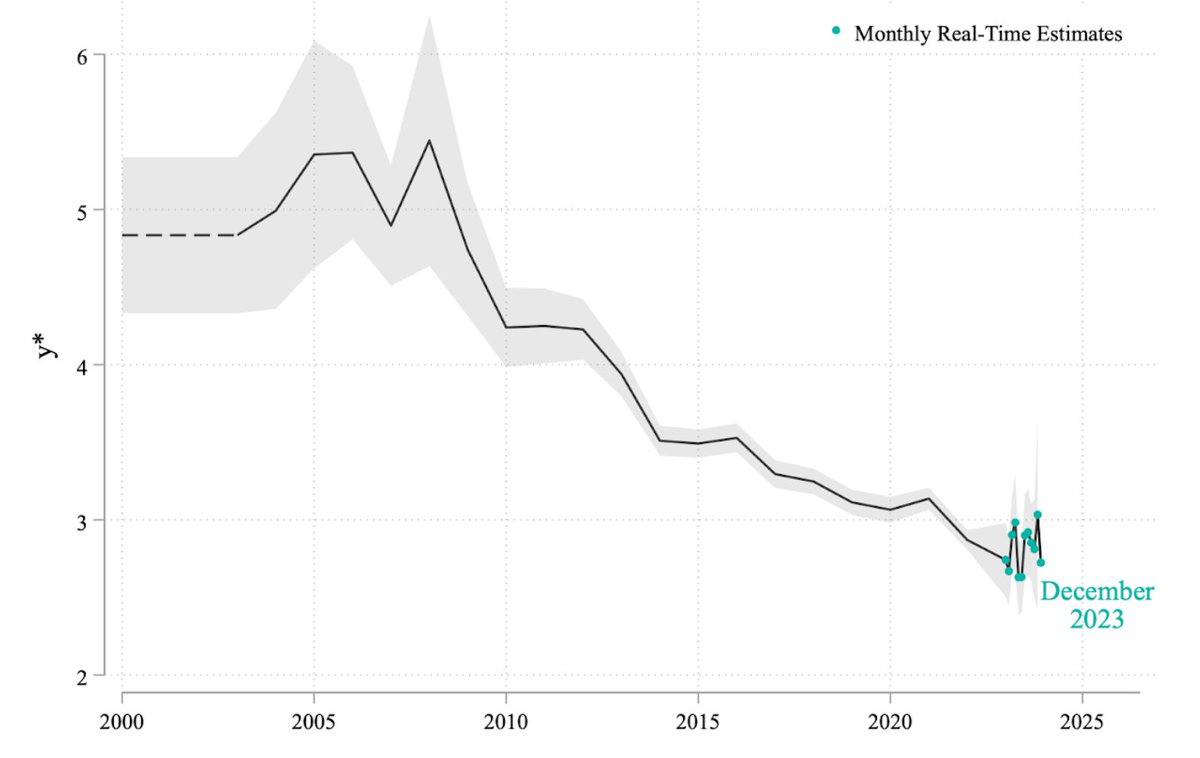
Happy to share new administrative data and code with the public (joint work with @VBPeral and @JADHazell ) It allows people to estimate y*: the expected long-term housing yield in real-time going forward y* equals r*, expected long-term yield on safe assets, plus long-run housing risk premium minus capital gains It is thus a natural object of interest for policy makers such as central banks, and nerdy academics like us Long-run objects like y* are notoriously difficult to measure, but we take advantage of a quirky feature of UK housing market: Every month, over a thousand apartments get the duration of their lease extended from 70 years to about 160 on average We build (and make public) an administrative data set that records market values of such apartment leases before and after extension from the year 2000 till today - and continue to update incoming data on our website We develop a methodology that uses thousands of these "natural experiments" in real-time to estimate y* from the gain in market-value due to lease maturity extension Intuitively, the larger the market gain from extension, the lower is the implied y* - see our paper for details The figure below shows the main result: y* was stable between 2000-2007, but started falling at the onset of the 2008 Great Recession The fall is remarkable in magnitude. About 2 percentage points from 2008 to end of 2023 This implies close to doubling of asset valuations! We believe the 2pp decline largely reflects the decline in long-term expected r* Interestingly, the recent rise in interest rates has not moved y* up yet - we'll see if rates come down, or y* moves up - This is the significant "duration risk" that global economy faces today A useful feature of the data we are making public is that it is updated every month in real-time, from new lease extensions and their market transactions Thus anyone can update our y* estimates in real-time - the full code is online as well Please read the working paper behind this effort, and we hope people find the data useful! sites.google.com/view/ystar-dyn…
Atif Mian tweet media
English
1
40
173
43K
Ambrogio Cesa-Bianchi retweetledi
Joe Hazell
Joe Hazell@JADHazell·
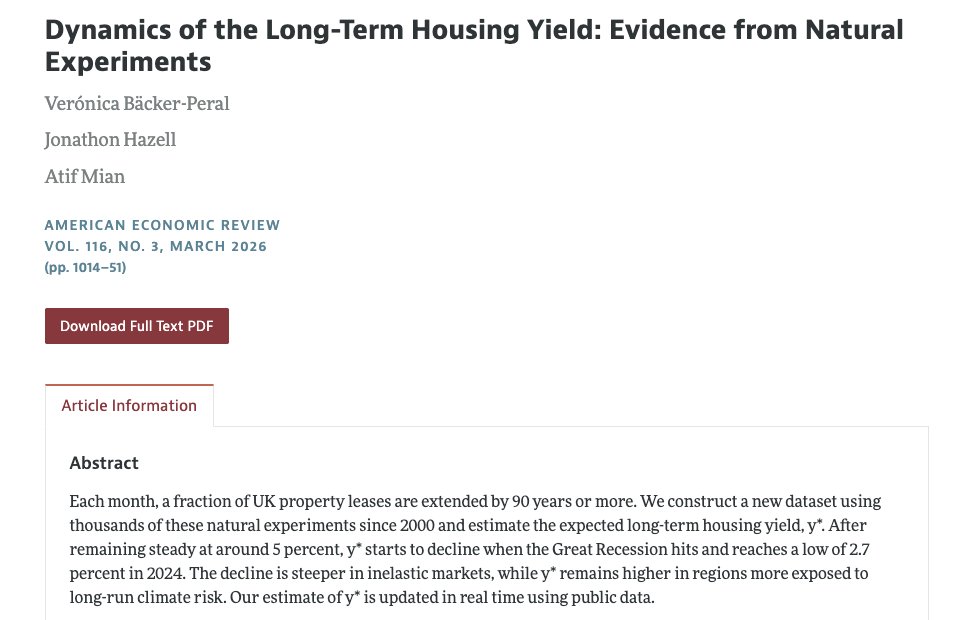
Awesome to see our paper with @AtifRMian and @VBPeral out in this month's edition of @AEAjournals the American Economic Review! Attached is a thread by Atif about the paper.
Joe Hazell tweet media
Atif Mian@AtifRMian

Happy to share new administrative data and code with the public (joint work with @VBPeral and @JADHazell ) It allows people to estimate y*: the expected long-term housing yield in real-time going forward y* equals r*, expected long-term yield on safe assets, plus long-run housing risk premium minus capital gains It is thus a natural object of interest for policy makers such as central banks, and nerdy academics like us Long-run objects like y* are notoriously difficult to measure, but we take advantage of a quirky feature of UK housing market: Every month, over a thousand apartments get the duration of their lease extended from 70 years to about 160 on average We build (and make public) an administrative data set that records market values of such apartment leases before and after extension from the year 2000 till today - and continue to update incoming data on our website We develop a methodology that uses thousands of these "natural experiments" in real-time to estimate y* from the gain in market-value due to lease maturity extension Intuitively, the larger the market gain from extension, the lower is the implied y* - see our paper for details The figure below shows the main result: y* was stable between 2000-2007, but started falling at the onset of the 2008 Great Recession The fall is remarkable in magnitude. About 2 percentage points from 2008 to end of 2023 This implies close to doubling of asset valuations! We believe the 2pp decline largely reflects the decline in long-term expected r* Interestingly, the recent rise in interest rates has not moved y* up yet - we'll see if rates come down, or y* moves up - This is the significant "duration risk" that global economy faces today A useful feature of the data we are making public is that it is updated every month in real-time, from new lease extensions and their market transactions Thus anyone can update our y* estimates in real-time - the full code is online as well Please read the working paper behind this effort, and we hope people find the data useful! sites.google.com/view/ystar-dyn…

English
2
16
113
36.5K
Ambrogio Cesa-Bianchi retweetledi
Markus K. Brunnermeier
Markus K. Brunnermeier@MarkusEconomist·
Nick Bloom on "Does AI boost US Productivity?". He provides survey evidence which changed his mind. Here a teaser. Youtube link for full video: youtube.com/watch?v=FYUBRv…
YouTube video
YouTube
English
0
49
192
26.6K