
Andrew Johnston

4.5K posts

Andrew Johnston banner
Andrew Johnston

Andrew Johnston

@AndrewJ79

Professor of Innovation and Entrepreneurship at @UoHBusinessSch and wannabe music biographer. All views are mine

Sheffield, UK Katılım Mart 2009
1.3K Takip Edilen634 Takipçiler
Andrew Johnston retweetledi
Michael Thrower Chowdhury
Michael Thrower Chowdhury@BevansAdvocate·
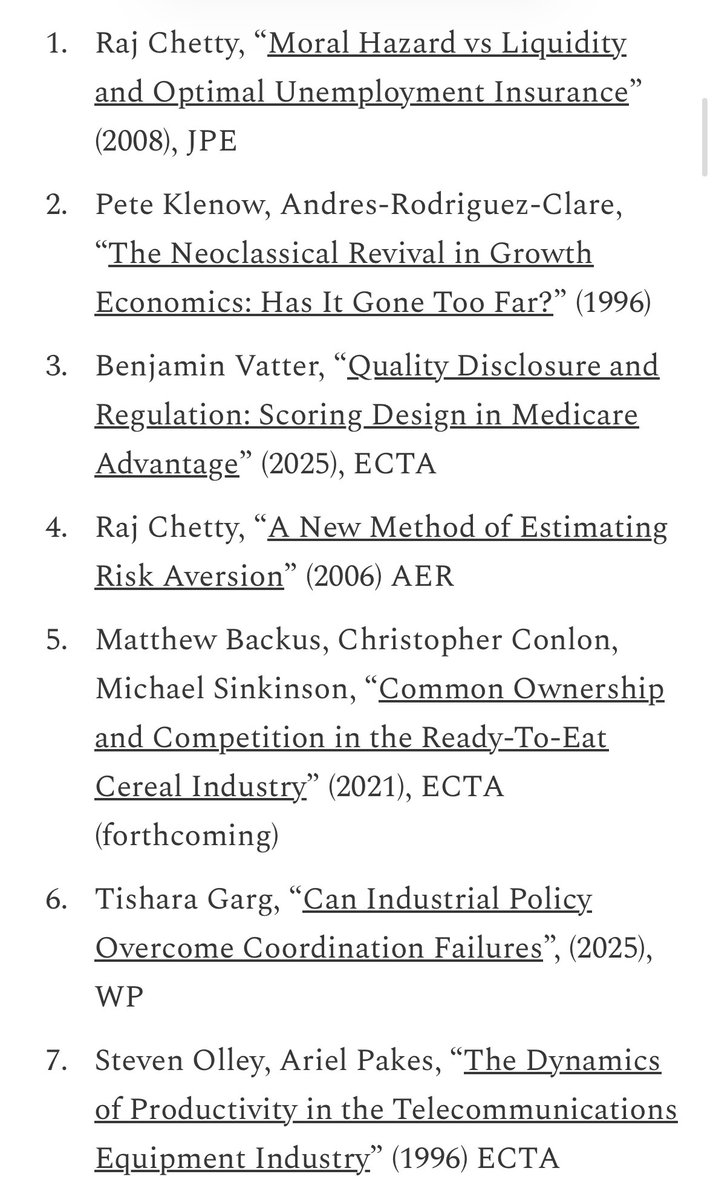
Some of my favourite economic papers that changed the way I think
Michael Thrower Chowdhury tweet media
English

6
201
1.1K
45.6K
Andrew Johnston retweetledi
joaquin
joaquin@wakincognitwo·
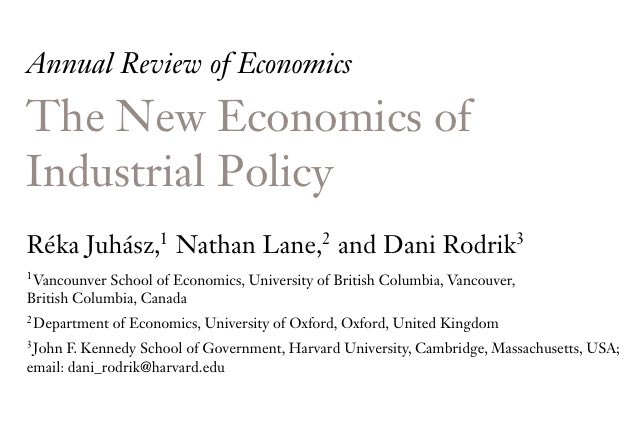
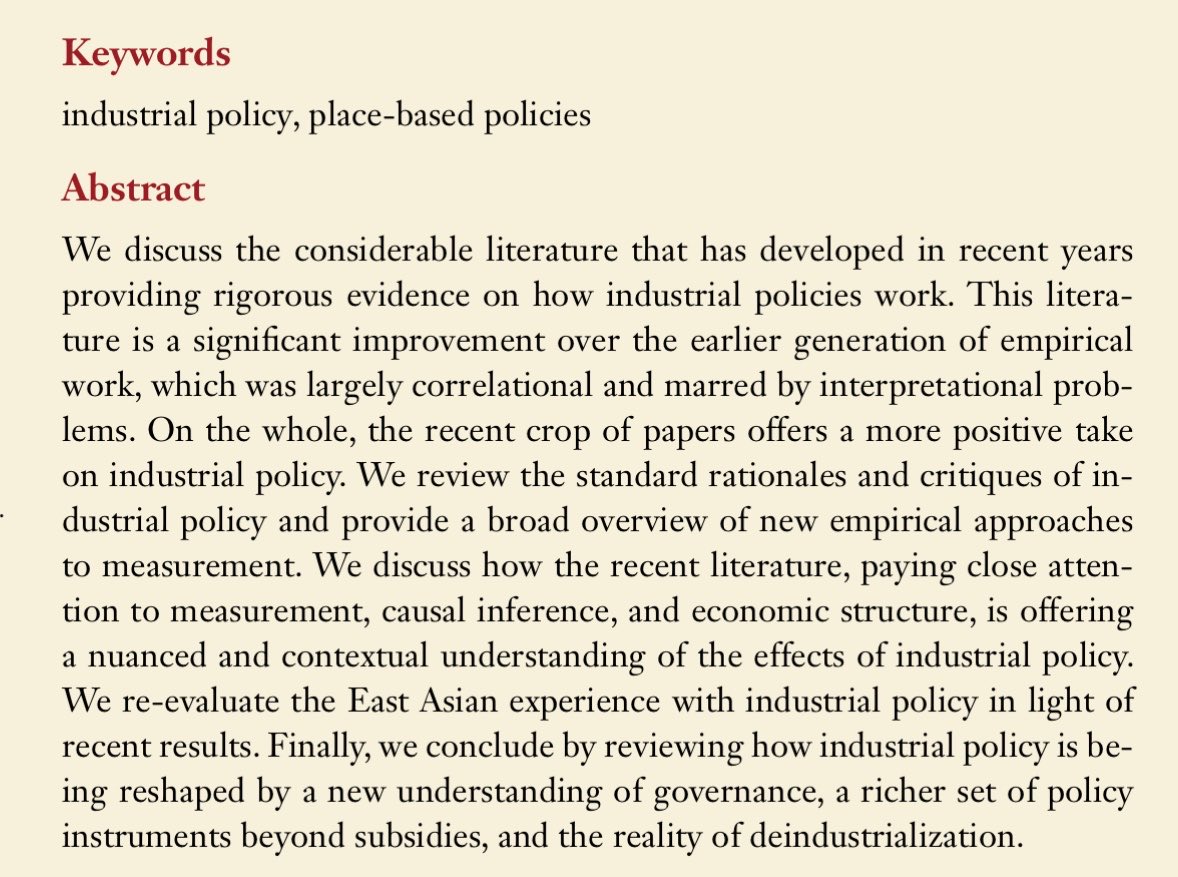
Some thoughts re: the profession’s so-called focus on RCTs and poverty versus industrial policy and growth, from someone who has hyper-fixated on this fact for some time. First it would help to read this review by Juhasz, Rodrik, & Lane, published in the Annual Review (1/n)
joaquin tweet mediajoaquin tweet media
English
6
68
341
45.8K
Andrew Johnston retweetledi
James
James@jamescoder12·
🚨 BREAKING: Research just got 10x faster. Claude can now break down dozens of academic papers into structured insights like a Stanford-level researcher. Use these 9 prompts to skip the overwhelm and get straight to clarity 👇 (Bookmark this)
James tweet media
English
64
235
1.1K
165.5K
Andrew Johnston retweetledi
James
James@jamescoder12·
BREAKING: GOODBYE POWERPOINT. 🚨 Claude can now create a full presentation in just 120 seconds. No slides. No stress. Use these prompts and watch the magic happen. ❤️‍🔥
James tweet media
English
51
129
583
72.1K
Andrew Johnston retweetledi
Vincent Geloso
Vincent Geloso@VincentGeloso·
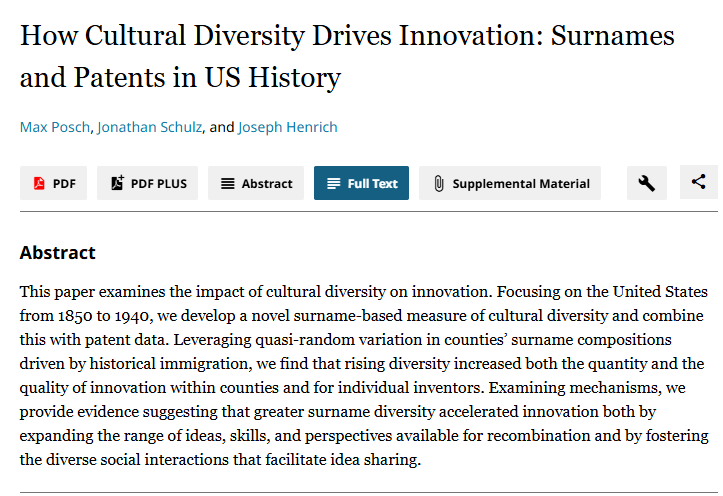
My colleague Jonathan Schulz has a piece just out at Journal of Political Economy showing that cultural diversity boosts innovation. Using surnames and their composition (by linguistic distance), they find that rising diversity explains America's big innovation boost. Years ago, Leonard Dudley (my first EH prof at UdeM) compared ideas to states of matter. Solids don’t mix--orthodoxies just sit there. Gases mix effortlessly, but nothing sticks--lots of talk, little structure. Liquids sit in between: fluid enough to recombine, structured enough to crystallize into something usable. That middle state is where progress actually happens. And progress happens if more liquids are mixed. In his case, he was talking about the importance of language (something that is rarely discussed in economics -- but totally on point for someone who grew up or evolved in Quebec), but it applies to what Jonathan did. Also, on a related note, this is proof that GMU is the better place to be to do economics
Vincent Geloso tweet media
Niclas Berggren@Nonicoc

How Cultural Diversity Drives Innovation: Surnames and Patents in US History journals.uchicago.edu/doi/abs/10.108…

English
50
47
215
78.8K
Andrew Johnston retweetledi
Philipp Heimberger
Philipp Heimberger@heimbergecon·
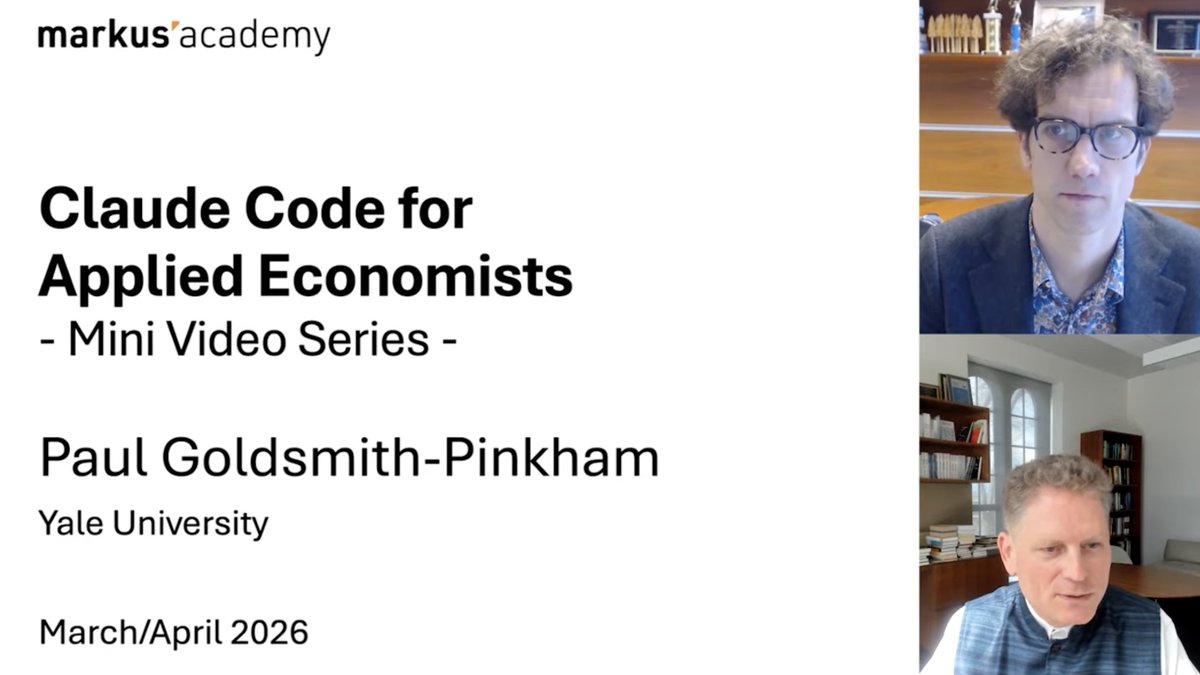
This is a useful introduction to using Claude code for applied economists, including content on data analysis, web scraping and large datasets.
Philipp Heimberger tweet media
English
2
119
944
51K
Andrew Johnston retweetledi
Faheem Ullah
Faheem Ullah@Faheem_uh·
PhD Students - How much of your manuscript is AI-written? Find out in 10 seconds. 1. Go to answerthis.io/home-2?fpr=fah… 2. Click on 𝐴𝐼 𝑤𝑟𝑖𝑡𝑒𝑟 3. Copy and paste specific text or upload manuscript 4. Click on 𝐴𝑛𝑎𝑙𝑦𝑠𝑖𝑠 and then on 𝑃𝑙𝑎𝑔𝑖𝑎𝑟𝑖𝑠𝑚 5. You will get a complete plagiarism report. 6. Now click on 𝐴𝐼 𝐷𝑒𝑡𝑒𝑐𝑡𝑖𝑜𝑛 7. You will get an AI plagiarism report Here you will see how much % of your text is AI-written You will also see the exact sentences A manuscript with plagiarized content is not acceptable What to do next? - Remove plagiarized content from your manuscript - Also, remove AI patterns in your writing - Once done, go ahead and submit.
English
8
73
398
184.1K
Andrew Johnston retweetledi
andrew engler
andrew engler@aerockrose·
In 2013, Harvard professor Clayton Christensen gave a 59-minute masterclass at Oxford on why smart companies destroy themselves. His frameworks: - The seminary of new finance - The steel mill death spiral - The $35 plastic box that changed India 12 lessons on disruption:
English
7
128
534
41.1K
Andrew Johnston retweetledi
Muhammad Ayan
Muhammad Ayan@socialwithaayan·
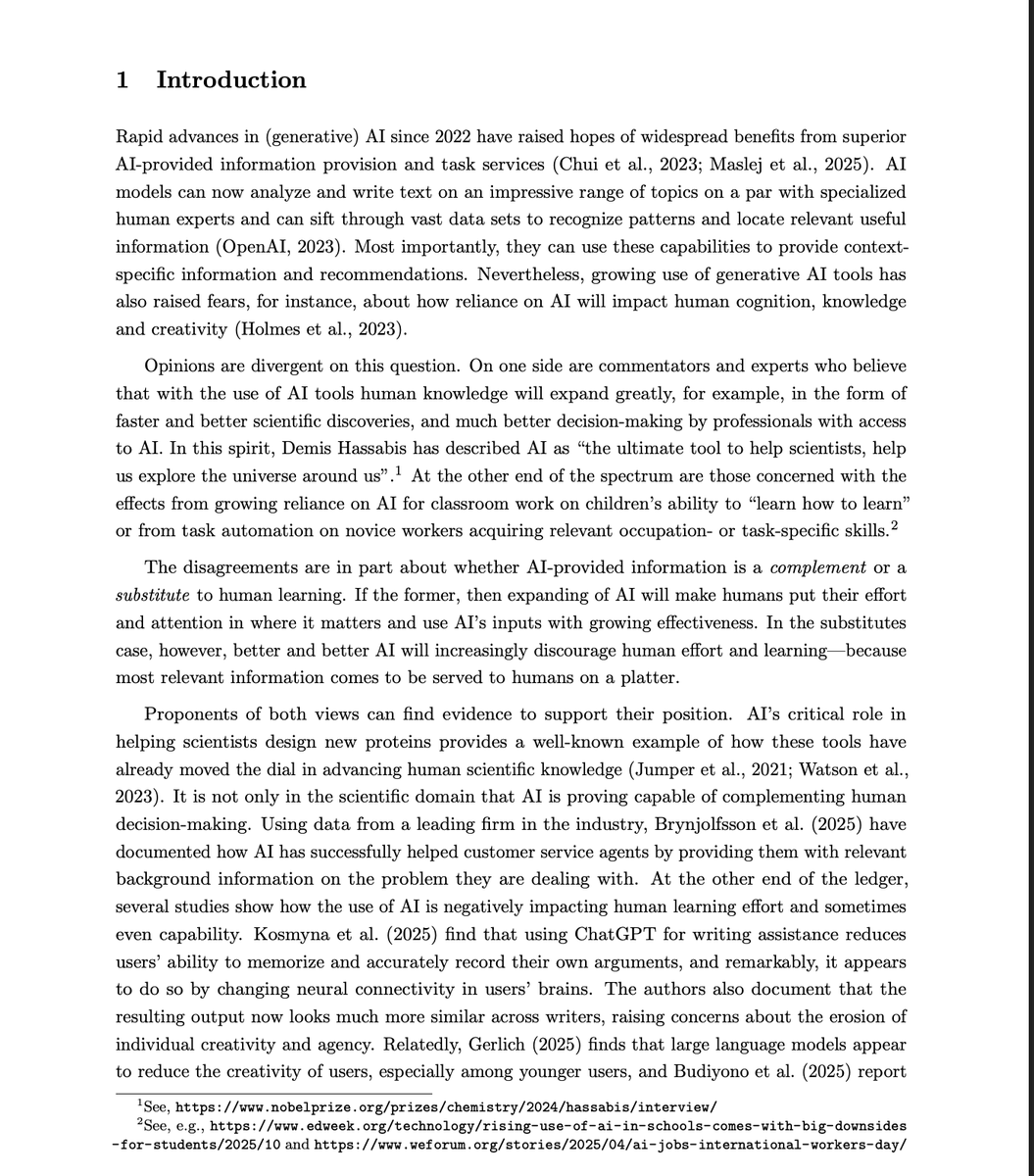
MIT's Nobel Prize-winning economist just published a model with one of the most alarming conclusions in the AI literature so far. If AI becomes accurate enough, it can destroy human civilization's ability to generate new knowledge entirely. Not gradually degrade it. Collapse it. The paper is called AI, Human Cognition and Knowledge Collapse. Authors: Daron Acemoglu, Dingwen Kong, and Asuman Ozdaglar. MIT. Published February 20, 2026. Acemoglu won the Nobel Prize in Economics in 2024. He is not a doomer blogger. He is the most cited economist of his generation, and his models tend to be taken seriously by the people who set policy. Here is the argument in plain terms. Human knowledge is not just a collection of facts stored in individuals. It is a living system that requires continuous reproduction. People learn things. They apply them. They teach others. They build on prior work to generate new work. The entire engine of science, medicine, technology, and innovation runs on this cycle of active human cognition. What happens when AI provides personalized, accurate answers to every question people would otherwise have to learn themselves? Individually, each person is better off. They get correct answers faster. They make fewer errors. Their immediate outcomes improve. But they stop doing the cognitive work that sustains the collective knowledge base. Acemoglu's model shows this produces a non-monotone welfare curve. Modest AI accuracy: net positive. AI helps at the margin, humans still do enough learning to sustain collective knowledge, everyone gains. High AI accuracy: net catastrophic. AI is accurate enough that learning yourself feels unnecessary. Human learning effort collapses. The knowledge base that AI was trained on is no longer being refreshed or extended. Innovation stalls. Then stops. The model proves the existence of two stable steady states. A high-knowledge steady state where human learning and AI assistance coexist productively. A knowledge-collapse steady state where collective human knowledge has effectively vanished, individuals still receive good personalized AI recommendations, but the shared intellectual infrastructure that enables new discoveries is gone. And the transition between them is not gradual. It is a threshold effect. Below a certain level of AI accuracy, society stays in the high-knowledge equilibrium. Above that threshold, the system tips. And once it tips, the collapse is self-reinforcing. Because the people who would have learned the things that would have pushed the frontier forward never learned them. And the AI cannot push the frontier on its own. It can only recombine what humans already knew when it was trained. The dark irony at the center of the model: The AI does not fail. It keeps giving accurate, personalized, useful answers right through the collapse. From the individual's perspective, nothing looks wrong. You ask a question, you get a correct answer. But the collective capacity to ask questions nobody has asked before, to build the frameworks that generate new knowledge rather than retrieve existing knowledge, that capacity is quietly disappearing. Acemoglu has been the most prominent mainstream economist skeptical of transformative AI productivity claims. His prior work found that AI's actual measured productivity gains were much smaller than the technology industry projected. This paper is a different kind of warning. Not that AI will fail to deliver promised gains. But that if it succeeds too completely, it will undermine the human cognitive infrastructure that makes long-run progress possible at all. The welfare effect is non-monotone. That is the sentence worth sitting with. Helpful until it is not. Beneficial until it crosses a threshold. And past that threshold, the same accuracy that made it so useful is precisely what makes it devastating. Every student who uses AI instead of working through a problem is a data point. Every researcher who uses AI instead of developing intuition is a data point. Every generation that grows up with accurate AI answers and no incentive to develop deep domain knowledge is a data point. Individually rational. Collectively catastrophic. Acemoglu proved this is not just a cultural concern or a vague anxiety about screen time. It is a mathematically coherent equilibrium that a sufficiently accurate AI system will push society toward. And there is no visible warning sign before the threshold is crossed.
Muhammad Ayan tweet mediaMuhammad Ayan tweet media
English
199
1.1K
2.7K
416.9K
Andrew Johnston retweetledi
Kyle Saunders
Kyle Saunders@profgoose·
More updates to my "Mapping the Structural Divide in Higher Education" project! Thanks for your feedback! Search for your school, explore the project, especially the @anthropic-derived AI exposure measure for your institution, here: kylesaunders.com/university-map/ Please share widely! We need to be having these conversations!
English
2
4
15
2.1K
Andrew Johnston retweetledi
Mariana Mazzucato
Mariana Mazzucato@MazzucatoM·
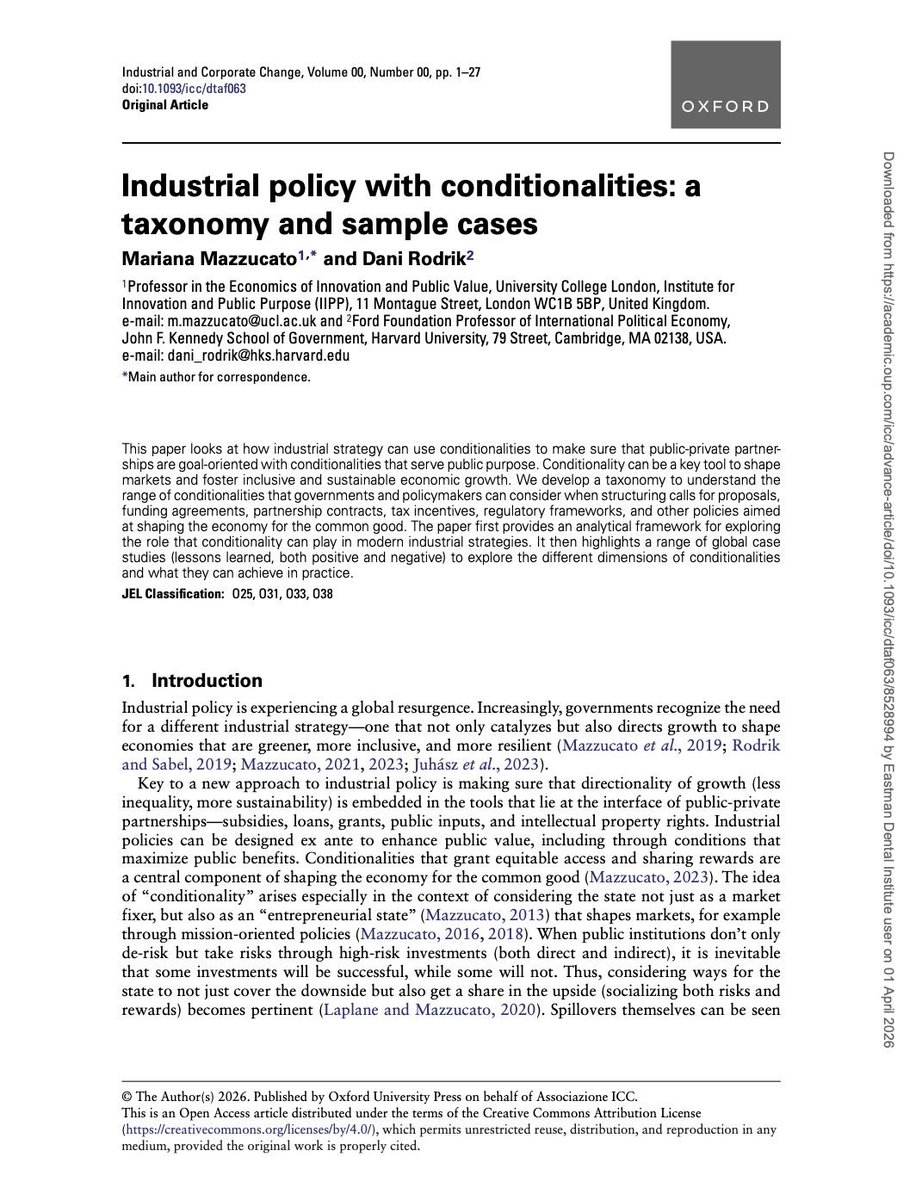
Tesla received billions in government loans, tax credits and subsidies, making Elon Musk the world's richest person. The public? No equity stake, no profit-sharing, no guarantee of affordable access. My working paper with @rodrikdani has now been published in Industrial and Corporate Change. It explores the conditionalities—profit-sharing, reinvestment requirements, knowledge transfer—that can ensure industrial policy delivers public value, not just private wealth. [LINK IN NEXT POST]
Mariana Mazzucato tweet media
English
63
924
2.1K
116.6K
Andrew Johnston retweetledi
nature
nature@Nature·
A massive seven-year project exploring 3,900 social-science papers has ended with a disturbing finding go.nature.com/4bZ9khs
English
47
223
690
173.8K
Andrew Johnston retweetledi
NBER
NBER@nberpubs·
Evidence from 23 European countries finds that weak contract enforcement makes young firms start smaller and remain financially constrained longer, from Gonzalo E. Basante Pereira and Ina Simonovska nber.org/papers/w34985
NBER tweet media
English
0
8
28
5.5K
Andrew Johnston retweetledi
Jaynit
Jaynit@jaynitx·
In 2019, MIT professor Patrick Winston gave a legendary 1-hour lecture called “How to Speak.” It has 18M+ views for a reason. His frameworks: • Your ideas are like your children • The 5-minute rule for job talks • Why jokes fail at the start 15 lessons on communication:
English
231
8.6K
40.7K
5.1M
Andrew Johnston retweetledi
Mr Nikola
Mr Nikola@nikola_mr64990·
Harvard University just released free online courses. No payment is required. Here are 12 courses you don't want to miss in 2025:⤵️
Mr Nikola tweet media
English
59
60
335
77.4K
Andrew Johnston retweetledi
Michael Thrower Chowdhury
Michael Thrower Chowdhury@BevansAdvocate·
My recommendations on economic growth and development
Michael Thrower Chowdhury tweet media
English
9
202
1.7K
102.1K
Andrew Johnston retweetledi
Glenn Koepke
Glenn Koepke@LogTech1999·
In the 1960s, MIT Professor Jay Forrester created something that changed the way we think about supply chains—The Beer Game. This game is a simple simulation, but it messed with the minds of thousands. Here's the game:
Glenn Koepke tweet media
English
112
639
4K
1.2M