weather report
495 posts


🇮🇷 These guys are getting a little too comfortable with LEGO animation.
On the anniversary of President Raisi's death, Iran published a LEGO-style animation commemorating his life and "martyrdom."
The meeting where this got approved must have been something.
Source: NAYA
English
@MarioNawfal Why the women in the animation is speaking Turkish?
English

Crown Prince @PahlaviReza slams the Western mainstream media for ignoring the Iranian people’s fight for freedom and the sacrifices made by 40 000+ anti-regime protesters in January.
He thinks it’s clear that Western mainstream media protects the regime
English

For the last 2 days, Iranian state TV and the Foreign Ministry have said no talks are scheduled. Today, President Trump says his team is landing within hours.
This is one of the most misaligned regimes we’ve seen in a long time.
Whether talks happen or not, it shows how weak and divided the regime has become.
Open Source Intel@Osint613
Iranian Foreign Ministry spokesman, Ismail Baghaei: We have no plans for the next round of negotiations
English
@yatirimci Piyasalar hala eski oyun kuralları ile oyuna devam edeceklerini sanıyorlar. Görmedik, duymadık, birşey olmaz havasındalar.
Türkçe
@yatirimci Batı piyasalarının hala üç maymunu oynamasına şaşırıyorum. İran savaşı ile artık verildi, bundan sonra ne okursa olsun, hasar geri gelmeyecek. Damage Done. Sadece hasarın sonuçlarını ve finans & ekonomiye etkilerini zamanla göreceğiz ve bu zaman çok uzak değil.
Türkçe

Küresel ekonominin şalteri sayılan petrodolar sistemi tarihin en büyük sınavını veriyor. 1945'ten beri devam eden Pax Americana dönemi kapanmak üzere. Enerji üzerinden dönen devasa bir satranç oynanıyor. Piyasaların ateşi her geçen gün yükselirken, asıl korkulması gereken göstergeler faiz, istihdam ve yapay zeka üçgeninde alarm veriyor.
Şu an ortada 5 ana aktör var:
• ABD: Küresel hegemonyasını ve petrolün dolarla fiyatlanma zorunluluğunu koruma derdinde.
• Çin: Tek kurşun atmadan doları tahtından edip küresel emtia fiyatlarının belirleyicisi olmak istiyor.
• Rusya: Dolar rezervlerine el konulmasının ardından "dondurulamayacak" bir ödeme sisteminin peşinde.
• İran: Asimetrik bir strateji izliyor. Küresel ekonominin can damarı Hürmüz Boğazı'nda tansiyonu yüksek tutarak dünyaya "Ekonominiz zarar görüyorsa beni rahat bırakın" mesajı veriyor.
• Körfez Ülkeleri: Eski petrodolar sistemi ile kurulmakta olan yeni düzen arasında denge arıyor.
Asıl çarpıcı olan kısım, Çin, Rusya ve İran'ın petrodolara saldırmak yerine sessizce alternatif bir sistem inşa etmesi. Formül son derece basit. Doları sat, altın al. Altını Çin'e verip Yuan al. O Yuan ile petrol al.
Bunun en somut kanıtı, İsviçre üzerinden Suudi Arabistan'a akan rekor miktardaki altın. ABD bile şu an rekor seviyede fiziksel külçe altın ihraç ediyor. Ancak burada devasa bir matematik problemi yatıyor. Küresel petrol pazarı yıllık 4.1 trilyon dolar büyüklüğünde. Altın pazarı ise sadece 485 milyar dolar. Petrol ticaretinin çok ufak bir kısmı bile altında fiyatlanmaya başlarsa, altında eşi benzeri görülmemiş bir talep şoku yaşanır.
Diğer yanda ABD'nin kendi iç dinamikleri alarm veriyor. Hükümetin sadece temel harcamaları ve borç faizleri, topladığı tüm vergi gelirlerini çoktan aştı. Tahvil piyasası baskı altında çünkü yatırımcı, dünyanın bu kadar belirsiz olduğu bir dönemde devlete ucuza borç vermek istemiyor.
Tüm bunlar olurken borsalar tamamen gerçeklikten koptu. ABD'de özel sektörün net iş yaratımı son bir yılda sıfıra indi. Büyük şirketler yapay zekayı bahane ederek on binlerce çalışanı kapı önüne koyuyor. Borsa, yapay zekanın şirketleri daha da zengin edeceğini fiyatlıyor. İşsiz kalan, alım gücü düşen kitleler bu şirketlerin ürünlerini nasıl alacak? Borsalar ile reel ekonomi arasındaki bu devasa uçurum sonsuza kadar açık kalamaz.
Bu düğüm er ya da geç çözülecek. Piyasalar bu kadar gerginken sermayenin hisse senetlerinden çıkıp altın, gümüş ve diğer fiziksel varlıklara kaydığı büyük bir rotasyon döngüsünün içindeyiz. Sistem dipten uca değişiyor. Piyasaların yeni yönünü okuyamayanlar, bu devasa dönüşümün altında ezilecek.
Türkçe
@AhmetBeyefendi Sizin alıntı yaptığınızı görüp takip etmeye başlamıştım ben de, sizinle aynı fikirdeyim Ahmet Bey.
Türkçe

Among those injured in Arad, Israel after the Islamic regime targeted a residential neighborhood:
• A 6 year old boy was seriously hurt after being thrown from a third floor window by the blast
• A woman in early pregnancy is on a ventilator, though her condition is stable and her life is not in danger
Open Source Intel@Osint613
The Israeli Air Force has opened an investigation after a direct missile impact in Arad. Despite interception attempts, the strike hit residential buildings, leaving dozens wounded.
English

@sentdefender They are decoys. Don’t you notice in the videos, nothing happens after hit.
English

According to a release from the Israel Defense Force (IDF), the IDF has targeted 6 Iranian military airports since the start of ongoing joint U.S.-Israeli operations against Iran.
English

The American housing market is BREAKING apart in slow motion.
The data just hit a level we haven't seen since the last financial crisis.
Here's what nobody in power is willing to say out loud
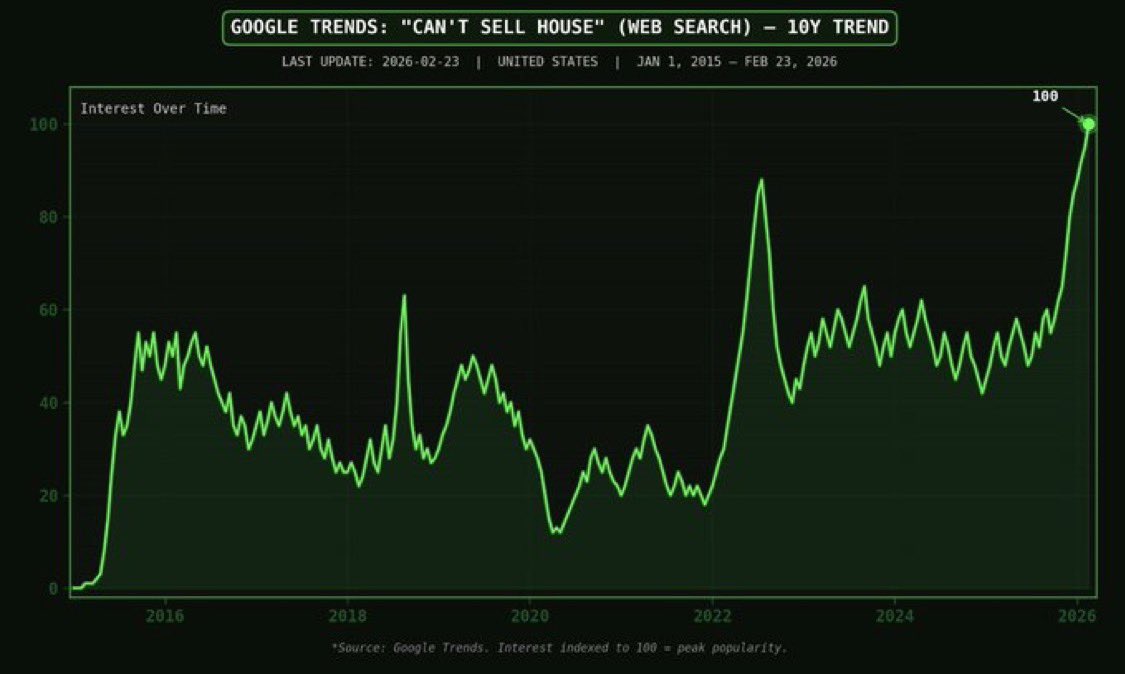
Google searches for "can't sell house" just hit an ALL-TIME HIGH.
Higher than COVID.
Higher than 2008, the year the entire financial system nearly collapsed.
At the same time, searches for "help with mortgage" have exploded to levels unseen in almost two decades.
The last time this happened, 10 million Americans lost their homes.
Redfin confirmed there are now 44% more home sellers than buyers across the country.
600,000 more people trying to get out than trying to get in.
The second largest gap ever recorded.
Over 40,000 home purchases were canceled in December alone.
16.3% of every deal signed that month fell apart.
The highest cancellation rate ever tracked.
Buyers are signing contracts and then running for the exits.
Here's how they're doing it.
Buyers are weaponizing inspection contingencies as a legal escape hatch.
They find a minor crack in the foundation.
They use it to walk away.
The real reason? They can't afford the payments.
Meanwhile, mortgage delinquencies are climbing at the fastest rate in years.
Early stage missed payments surged 30.9% in a single year.
Over 850,000 Americans are now 90 or more days behind on their mortgage.
The highest number since 2022.
Foreclosure filings are up 26% year over year.
Completed foreclosures up 59%.
Eleven straight months of increases.
DR Horton, the biggest homebuilder in America just admitted the quiet part out loud.
They're slashing prices, stacking incentives and buying down mortgage rates for buyers.
Still can't move houses.
When the largest builder in the country is struggling, the rest of the market is 6 to 12 months behind.
Nationally, employers announced 1.2 million job cuts in 2025.
Consumer confidence is near a record low.
Nobody buys a house when they're worried about keeping their job.
Here's the part that should terrify you.
Mortgage rates just dropped below 6% for the first time in three years.
That was supposed to fix everything.
It didn't, sales still collapsed 8.4% in January.
Buyers still aren't showing up.
The cavalry came but it wasn't enough.
So is this 2008 again?
The honest answer: the structure is different.
Most homeowners have equity. Lending standards are tighter.
There's no wave of exploding adjustable rate mortgages.
But that's also the trap.
Owners refuse to drop prices because they have equity.
So nothing sells, liquidity disappears.
And the market freezes solid.
Sellers can't sell. Buyers can't afford.
Builders can't move inventory, workers can't find jobs.
Everyone is stuck and the longer it lasts, the more fragile the whole system becomes.
The last time Google searches looked like this, the housing market lost $6 trillion in value.
Pay attention.
Bookmark and share this.
English
weather report retweetledi
@_The_Prophet__ I subscribed today open.substack.com/pub/sightbring… liked this cast. Thanks!@_The_Prophet__
English
@furkancerkesx @furkanbolukbasi Bu dinsizleri okuyacağına kuran okusaydın hergele…
Türkçe

Cezaevindeyken okuduğum kitaplar:
• Dostoyevski - Kumarbaz
• Tolstoy - Aile Mutluluğu
• Teoman Duralı - Çağdaş İngiliz-Yahudi Küresel Medeniyeti
• Teoman Duralı - Omurgasızlaştırılmış Türklük
• Teoman Duralı - Öyle Geçer ki Zaman
• Feridüddin Attar - Mantiku’t-Tayr
• Gazali - Kalplerin Keşfi
• İhsan Fazlıoğlu - Kendini Aramak
• İhsan Fazlıoğlu - Kendini Bulmak
• İhsan Oktay Anar - Tiamat
• Dua - Evrad-ı Şerife
• Nouman Ali Khan - Dirilt Kalbini
• J. R. R. Tolkien - Yüzüklerin Efendisi
Türkçe
@furkancerkesx @furkanbolukbasi Dinimize uygun değil, laikçi bir film ve kitap. Caiz değildir.
Türkçe
Masumiyet Müzesi’ni seneler önce okudum. Müzesini de birkaç kez gezdim. Herkes Kemal’e yükleniyor, yüklenmekte de haklılar. Genç bir kızı kullandı ve hiç düşünmeden bir kenara attı. Bunun hiçbir şekilde affı yok. Fakat Füsun da mağdur edildikten sonra soğukkanlı bir zalime dönüşüyor. Kendisini aşık zanneden ağır takıntı hastası Kemal’den intikamını çok ağır bir şekilde sindire sindire alıyor. Adeta senelerce psikolojik işkence yapıyor adama. Sonunda da yıllarca zihnini ve psikolojisini harap ettiği Kemal ile sevmediği halde evlenmeyi kabul ediyor. Kemal sevilmediğini fark edemiyor bile takıntısından. Bence Füsun intikamını bir ömür boyu almaya devam edebilmek için evlenmeyi kabul ediyor Kemal’le. Fakat sonra bilinçaltında kendisini öldürürse Kemal’e daha büyük azap çektirebileceğini fark ediyor. Aslında biz romanda masumiyeti değil masumiyetin kirletilmesine karşı alınan ağır bir intikamı okuyoruz. Füsun, öfkesini, nefretini, iğrenmesini, mide bulantısını saklayarak, profesyonel bir şekilde görüyor işini. Çünkü bir kadın eğer dilerse bir erkeğin hayatını cennete de cehenneme de çevirebilir. Buna her iki yönden de şahit oluyoruz romanda.
Türkçe
@FatihErsahin_ Siktir git lan dallama, hep mağdur hep mağdur..
Türkçe

Yıllarca komedi diye, Müslümanların kutsallarına saldırdınız. Senaryosundan, yapımcısına, yönetmeninden, oyuncusuna topunuza Allah hidayet etsin.
Ulan kafir yapmaz sizin şu yaptığınızı.
Türkçe
weather report retweetledi

Hypersonic Missiles: Why One Strike Would Put a US Aircraft Carrier Out of Action
Aircraft carriers are not designed to survive a strike by hypersonic missile entering the ship vertically from above.
The United States Navy has long sold the myth of the invincible aircraft carrier. These floating cities—90,000 tons of steel, bristling with aircraft and sailors—are meant to project power across the globe, symbols of American dominance at sea. Yet the uncomfortable truth is this: a single hypersonic missile, striking vertically through the decks and detonating deep in the hull, would put one of these leviathans out of action straight away.
The Navy’s own history offers a cautionary tale. In 2005, the decommissioned USS America was subjected to weeks of punishment in a classified sinking exercise. Torpedoes, bombs, and explosives battered her, yet she stubbornly refused to go down. Admirals hailed this as proof of carrier resilience. But survivability in a controlled test is not survivability in combat. The America was empty—no fuel, no ordnance, no crew. A hypersonic strike in wartime would be a different beast entirely.
The Vertical Kill Shot
Hypersonic missiles travel at Mach 5 and beyond. Their speed alone makes interception almost impossible. A vertical strike—plunging through the flight deck, smashing through hangars, and exploding at the keel—would bypass the carrier’s layered defences. The result? A gaping hole at the bottom of the ship, flooding compartments from below and crippling propulsion, power, and damage-control systems in one blow.
Carriers rely on compartmentalisation to contain damage. But a vertical penetration connects multiple decks, overwhelming watertight integrity. Flooding spreads upward, fires ignite aviation fuel, and secondary explosions ripple through magazines. Within minutes, the ship is mission-killed. It may not sink immediately, but it cannot launch aircraft, manoeuvre effectively, or sustain operations. For a carrier, that is defeat.
The Myth of Unsinkability
American admirals like to remind us that carriers are hard to sink. True enough—size buys time. But the question is not whether a carrier sinks; it is whether it fights. A carrier that cannot fly jets is a useless hulk, a liability rather than an asset. In the age of hypersonic weapons, survivability must be measured not in hours afloat but in minutes of combat effectiveness.
China understands this perfectly. Its investment in “carrier-killer” missiles—the DF-21D and DF-26—reflects a strategic calculation: neutralise the carrier, and you neutralise American power projection in the Pacific. The Pentagon’s own war games admit as much. Once hypersonics are in play, carriers cannot safely operate within thousands of miles of contested waters.
The Strategic Shock
The implications are stark. For decades, the carrier has been the centrepiece of US naval doctrine. It is the platform around which fleets are built, the symbol of deterrence, the tool of intervention. Yet one hypersonic strike could render it impotent. That is not just a tactical setback—it is a strategic shock.
Britain, too, should take note. Our own carriers, the Queen Elizabeth class, are smaller but no less vulnerable. We have invested billions in platforms that may be obsolete before they reach maturity. Hypersonic weapons are not science fiction; they are already deployed. Russia has tested them, China has fielded them, and the US is scrambling to catch up.
Rethinking Naval Power
The uncomfortable conclusion is that the age of the carrier may be ending. Distributed lethality—smaller ships, unmanned systems, long-range missiles—offers resilience where the carrier offers vulnerability. Power projection must adapt to a world where a single strike can silence a fleet’s flagship.
The US Navy will not admit this easily. Carriers are political as much as military, symbols of national pride and industrial might. But pride does not stop hypersonic missiles. The lesson of the USS America is not that carriers are unsinkable—it is that survivability in peacetime tests means little against weapons designed to exploit their weaknesses.
Final Thought
A vertical hypersonic strike is the nightmare scenario: swift, unstoppable, devastating. It would not just damage a carrier; it would put it out of action straight away. In an era of hypersonic warfare, the carrier is no longer the hunter—it is the hunted. And unless navies adapt, the next great war at sea may be decided in minutes, not months.
19fortyfive.com/2026/01/the-u-…
English
Sayın Paşam, uçak gemileri ve deniz gücünün tekrar düşünülüp tanımlanması gerektiği argümanını siz değerlendirmeniz için paylaşmak istedim. Saygılar, @cemgurdeniznet
Ignis Rex@Ignis_Rex
Hypersonic Missiles: Why One Strike Would Put a US Aircraft Carrier Out of Action Aircraft carriers are not designed to survive a strike by hypersonic missile entering the ship vertically from above. The United States Navy has long sold the myth of the invincible aircraft carrier. These floating cities—90,000 tons of steel, bristling with aircraft and sailors—are meant to project power across the globe, symbols of American dominance at sea. Yet the uncomfortable truth is this: a single hypersonic missile, striking vertically through the decks and detonating deep in the hull, would put one of these leviathans out of action straight away. The Navy’s own history offers a cautionary tale. In 2005, the decommissioned USS America was subjected to weeks of punishment in a classified sinking exercise. Torpedoes, bombs, and explosives battered her, yet she stubbornly refused to go down. Admirals hailed this as proof of carrier resilience. But survivability in a controlled test is not survivability in combat. The America was empty—no fuel, no ordnance, no crew. A hypersonic strike in wartime would be a different beast entirely. The Vertical Kill Shot Hypersonic missiles travel at Mach 5 and beyond. Their speed alone makes interception almost impossible. A vertical strike—plunging through the flight deck, smashing through hangars, and exploding at the keel—would bypass the carrier’s layered defences. The result? A gaping hole at the bottom of the ship, flooding compartments from below and crippling propulsion, power, and damage-control systems in one blow. Carriers rely on compartmentalisation to contain damage. But a vertical penetration connects multiple decks, overwhelming watertight integrity. Flooding spreads upward, fires ignite aviation fuel, and secondary explosions ripple through magazines. Within minutes, the ship is mission-killed. It may not sink immediately, but it cannot launch aircraft, manoeuvre effectively, or sustain operations. For a carrier, that is defeat. The Myth of Unsinkability American admirals like to remind us that carriers are hard to sink. True enough—size buys time. But the question is not whether a carrier sinks; it is whether it fights. A carrier that cannot fly jets is a useless hulk, a liability rather than an asset. In the age of hypersonic weapons, survivability must be measured not in hours afloat but in minutes of combat effectiveness. China understands this perfectly. Its investment in “carrier-killer” missiles—the DF-21D and DF-26—reflects a strategic calculation: neutralise the carrier, and you neutralise American power projection in the Pacific. The Pentagon’s own war games admit as much. Once hypersonics are in play, carriers cannot safely operate within thousands of miles of contested waters. The Strategic Shock The implications are stark. For decades, the carrier has been the centrepiece of US naval doctrine. It is the platform around which fleets are built, the symbol of deterrence, the tool of intervention. Yet one hypersonic strike could render it impotent. That is not just a tactical setback—it is a strategic shock. Britain, too, should take note. Our own carriers, the Queen Elizabeth class, are smaller but no less vulnerable. We have invested billions in platforms that may be obsolete before they reach maturity. Hypersonic weapons are not science fiction; they are already deployed. Russia has tested them, China has fielded them, and the US is scrambling to catch up. Rethinking Naval Power The uncomfortable conclusion is that the age of the carrier may be ending. Distributed lethality—smaller ships, unmanned systems, long-range missiles—offers resilience where the carrier offers vulnerability. Power projection must adapt to a world where a single strike can silence a fleet’s flagship. The US Navy will not admit this easily. Carriers are political as much as military, symbols of national pride and industrial might. But pride does not stop hypersonic missiles. The lesson of the USS America is not that carriers are unsinkable—it is that survivability in peacetime tests means little against weapons designed to exploit their weaknesses. Final Thought A vertical hypersonic strike is the nightmare scenario: swift, unstoppable, devastating. It would not just damage a carrier; it would put it out of action straight away. In an era of hypersonic warfare, the carrier is no longer the hunter—it is the hunted. And unless navies adapt, the next great war at sea may be decided in minutes, not months. 19fortyfive.com/2026/01/the-u-…
Türkçe