Architect
3.8K posts

Architect
@Architect89_
Probably won't follow you back. Keeping my circle on here small this time around.




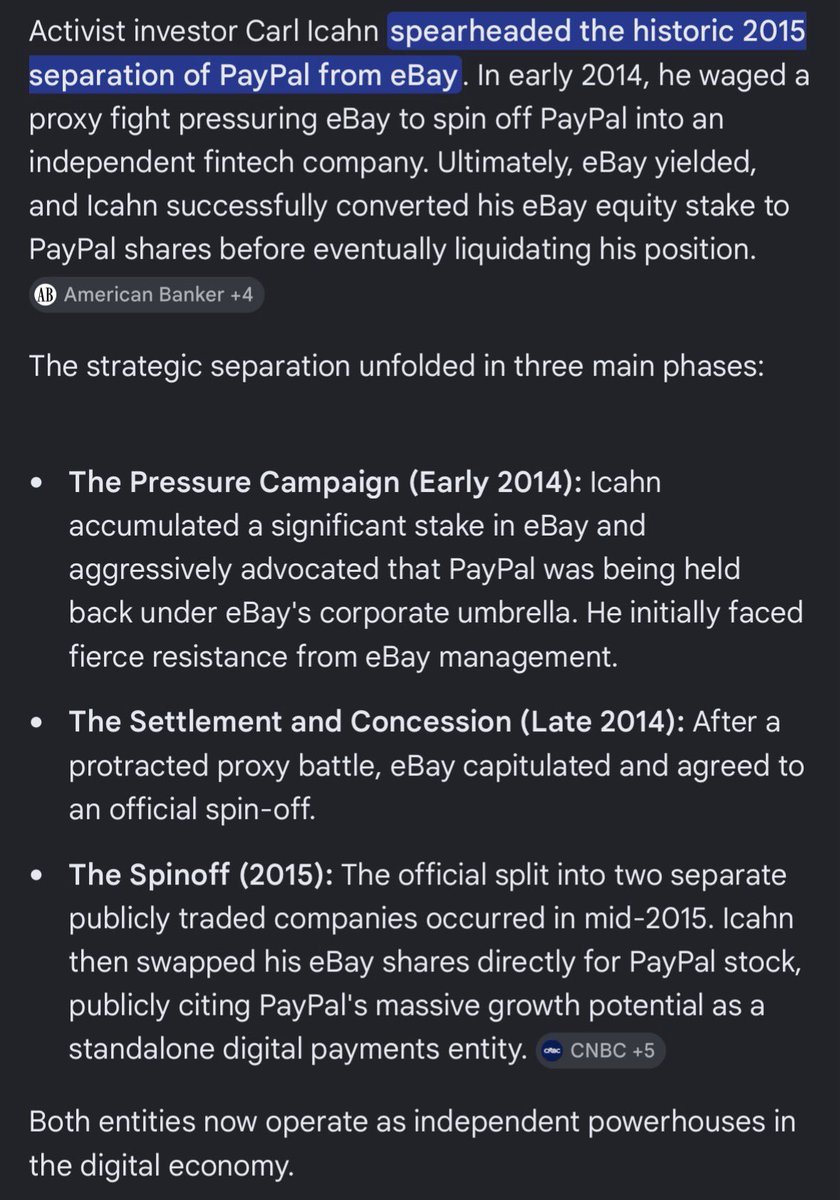
I know I said I wasn’t posting for a while, but this post got me thinking about how $GME could become an instant Berkshire through two sophisticated but hard to execute pieces of M&A activity. Current Firepower GameStop holds $9 billion in cash and has 552 million unissued shares available as deal currency. The company also has a shelf registration (S-3) in place, which enables additional debt financing for an LBO-style acquisition if needed. PayPal Today PayPal generated $33.2 billion in TTM revenue, $5.2 billion in net income, roughly $6 billion in operating income, and $6.4 billion in adjusted free cash flow. On top of that, PayPal holds $40.7 billion in customer funds, which functions as a low-cost *float* that generates spread income. Despite all of this, PayPal trades at just $37 billion market cap, which works out to roughly 7x free cash flow and 6x operating income. They have some really sleepy management. They own PayPal owns Venmo, Honey, Xoom, Zettle (iZettle), Hyperwallet, Paidy, Simility, Chargehound, PayPal Credit, and a 70% stake in GoPay - some of these assets are severely under utilized by the sleepy management team. The Play GameStop doesn’t need to acquire 100% of PayPal. A controlling stake between 51% and 70% would be enough. That level of ownership allows full consolidation of PayPal’s revenue, EBITDA, and cash flow, while governance can be structured through majority board seats or super-voting stock. A control acquisition (with premium) would create a $45 to $50 billion pro forma market cap for the combined entity, with a likely change in valuation multiple through category change. But maybe that wouldn’t be enough to command a 15-20x free cash flow valuation. Enter phase two. Phase Two: eBay Merger eBay now trades above PayPal’s market cap for the first time since the 2015 spinoff. The next move would be to use the post-acquisition equity as currency for a 1:1 stock-for-stock merger with eBay, structured so that GameStop and PayPal holders retain more than 50% voting control. This effectively re-verticalizes marketplace, payments, and wallet under one roof, reversing the 2015 separation but now under GameStop’s control architecture. The Endgame The result is a $100 billion+ combined platform generating roughly $10 billion in EBITDA, combining PayPal’s $6 billion operating income with eBay’s profit pool and deal synergies. eBay provides marketplace GMV, PayPal powers the payments, wallet, BNPL, and stablecoin infrastructure, and GameStop sits at the top controlling capital allocation and strategy. Just some food for thought.




Jackie explaining accretive dilution for the 444th time