English
Arpit Kalla
19 posts
@ArpitKalla
MLE @sundayrobotics | Prev: MSL @meta


1/N Two years ago, we recruited our first Memory Developer off Craigslist and onboarded them in a public library. Today, more than 1,000 Memory Developers have helped us build the data engine behind ACT-2. Here's how we got from that library to here 🧵
This property allows us to hill-climb performance in our office, and trust those gains to hold in unseen homes Our fleet of Memos runs in parallel to rapidly advance reliability, quality, and speed. Left: fleet-scale improvement in-house Right: Memo working across unseen homes
Introducing ACT-2 Preview, the world’s first robotics model that works in your home. 99% success rate, fully autonomous in unseen homes. Zero data from you.




Introducing ABC: open data, training, and infrastructure for robotics. We release the largest teleop dataset to date, and extensively investigate design decisions, pretraining, and post-training techniques. @arthurallshire @Cinnabar233 @adamrasb @redstone_hong @davidrmcall

We’re releasing SAM 3.1: a drop-in update to SAM 3 that introduces object multiplexing to significantly improve video processing efficiency without sacrificing accuracy. We’re sharing this update with the community to help make high-performance applications feasible on smaller, more accessible hardware. 🔗 Model Checkpoint: go.meta.me/8dd321 🔗 Codebase: go.meta.me/b0a9fb

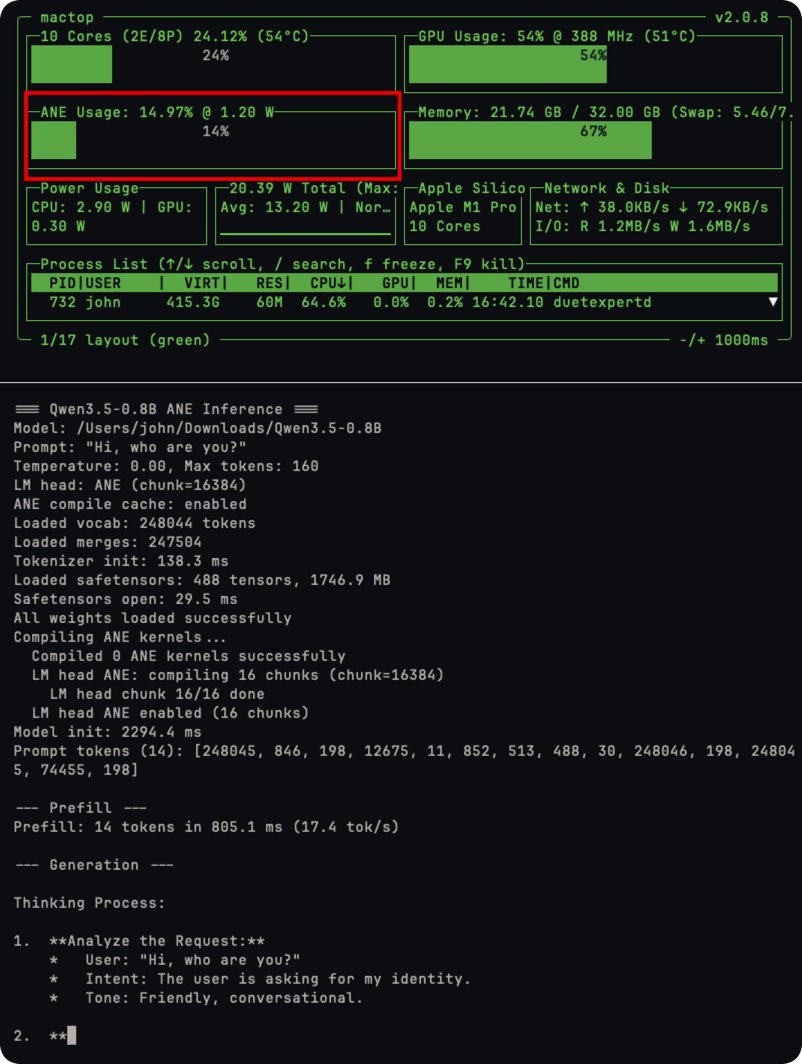
BOOM! Apple’s Neural Engine Was Just Cracked Open, The Future of AI Training Just Change And Zero-Human Company Is Already Testing It! In a jaw-dropping open-source breakthrough, a lone developer has done what Apple said was impossible: full neural network training– including backpropagation – directly on the Apple Neural Engine (ANE). No CoreML, no Metal, no GPU. Pure, blazing ANE silicon. The project (github.com/maderix/ANE) delivers a single transformer layer (dim=768, seq=512) in just 9.3 ms per step at 1.78 TFLOPS sustained with only 11.2% ANE utilization on an M4 chip. That’s the same idle chip sitting in millions of Mac minis, MacBooks, and iMacs right now. Translation? Your desktop just became a hyper-efficient AI supercomputer. The numbers are insane: M4 ANE hits roughly 6.6 TFLOPS per watt – 80 times more efficient than an NVIDIA A100. Real-world throughput crushes Apple’s own “38 TOPS” marketing claims. And because it sips power like a phone, you can train 24/7 without melting your electricity bill or the planet. At The Zero-Human Company, we’re not waiting. We are testing this right now on real ZHC workloads. This is the missing piece we’ve been chasing for our Zero Human Company vision: reviving archived data into fully autonomous AI systems with zero human overhead. This is world-changing. For the first time, anyone with a Mac can fine-tune, train, or iterate massive models locally, privately, and at a fraction of the cost of cloud GPUs. No more renting $40,000 A100 clusters. No more waiting in queues. No more massive carbon footprints. Training costs that used to run into the tens or hundreds of thousands of dollars? Plummeting toward pennies on the dollar – mostly just the electricity your Mac was already using while it sat idle. The AI revolution just moved from billion-dollar data centers to your desk. WE WILL HAVE A NEW ZERO-HUMAN COMPANY @ HOME wage for equipped Macs that will be up to 100x more income for the owner! We’re only at the beginning (single-layer today, full models tomorrow), but the door is wide open. Ultra-cheap, on-device training is here. The future isn’t coming. It’s already running on your Mac. Welcome to the Zero-Human Company era.
Today we’re excited to unveil a new generation of Segment Anything Models: 1️⃣ SAM 3 enables detecting, segmenting and tracking of objects across images and videos, now with short text phrases and exemplar prompts. 🔗 Learn more about SAM 3: go.meta.me/591040 2️⃣ SAM 3D brings the model collection into the 3rd dimension to enable precise reconstruction of 3D objects and people from a single 2D image. 🔗 Learn more about SAM 3D: go.meta.me/305985 These models offer innovative capabilities and unique tools for developers and researchers to create, experiment and uplevel media workflows.