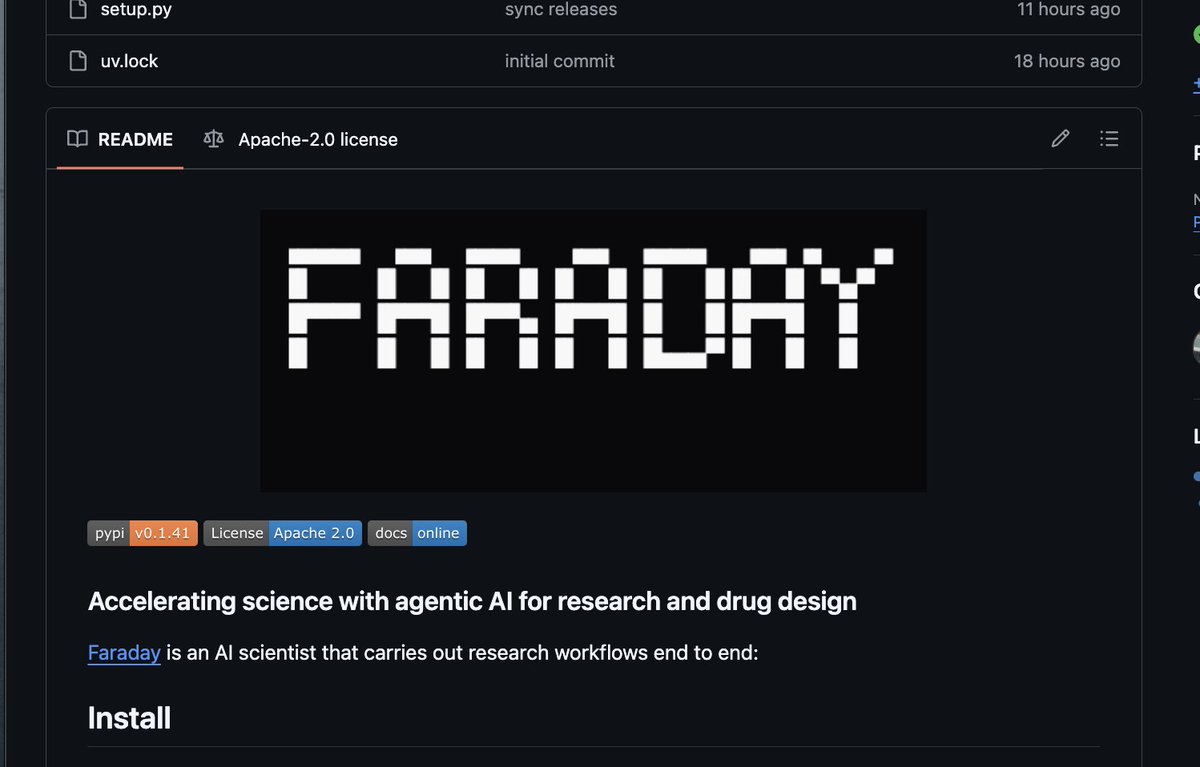
We're open sourcing the core agentic loop of Faraday!
The exciting pace of building agentic science has led to the emergence of many AI scientist efforts, ranging in scale and complexity. It's great to see the design space of agentic scientists so rapidly explored and key points of leverage emerge in this space. We’ve been fortunate to be a part of this shared effort introduce a new paradigm of research to scientists across academia and industry.
With this open AI scientist framework, we hope that scientists will be able to launch their own Faraday agents for their research tasks and explore ways agentic science can move forward. Today, you can use open-source Faraday to do many everyday research tasks with optional extensions like integrating custom tools or scalable hypothesis testing.
Dropping another use case of Faraday changing how scientists work and turning days of work into minutes
Query: analyze obesity drugs' effects on muscles
old way: manual lit search → collect trial data → compile findings → analyze
with LLMs: prompt → get some guidance and descriptions
with Faraday: prompt → comprehensive lit search + clinical trial results + meta-analysis + scientific figures, all traceable to sources
watch:
The way scientists work is changing
A use case example on Faraday⬇️
Query: Based on Orforglipron targeting GLP-1, generate some structurally distinct molecules that could hit the same target site but give us fresh SAR space to explore
Instead of: scientist → days of manual research → hypothesis → designs → iterate
Now: scientist → prompt Faraday → iterate
Faraday handles lit search, mechanism analysis, scaffold generation, and scientists handles the science that matters
Watch:
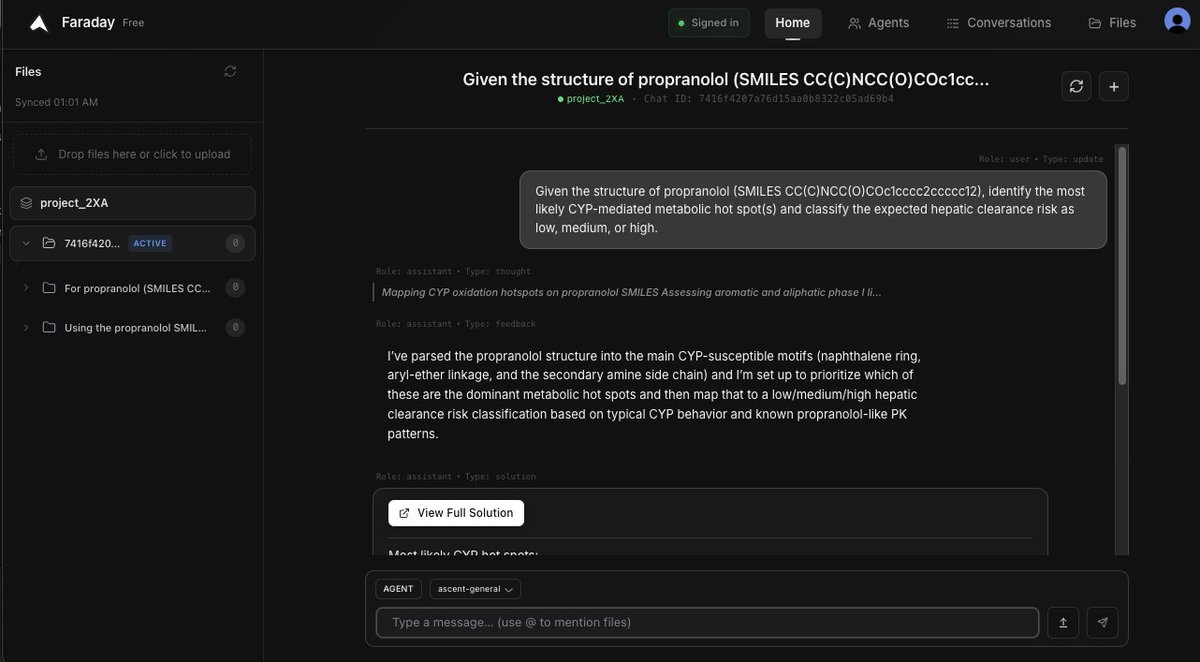
We are excited to announce that Faraday, our AI scientist for drug design, is now available in public beta.
Agentic reasoning. Frontier Models. Seamless code execution.
Starting today, researchers and drug developers worldwide can register and begin using Faraday to accelerate their discovery workflows.
Public beta is now open at platform.ascentbio.ai
Today we opened up access to the @AscentBio platform, letting scientists experience what agentic science can be.
As a former PhD student, it is exciting to envision an era where researcher productivity can 10x.
While not perfect, anyone who’s used Claude code or cursor can see that there’s incredible value in being able to iterate over ideas much quicker. Quality goes up and notably, the pace of progress spikes. In a field where time matters, researchers deserve a tool that can allow for deep domain expertise to be more fully leveraged
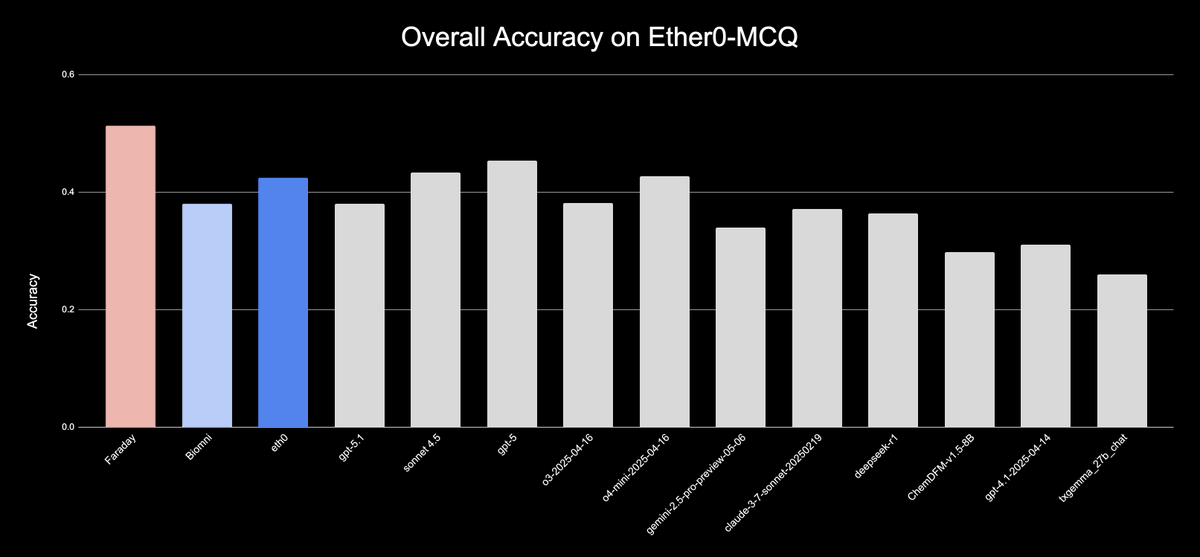
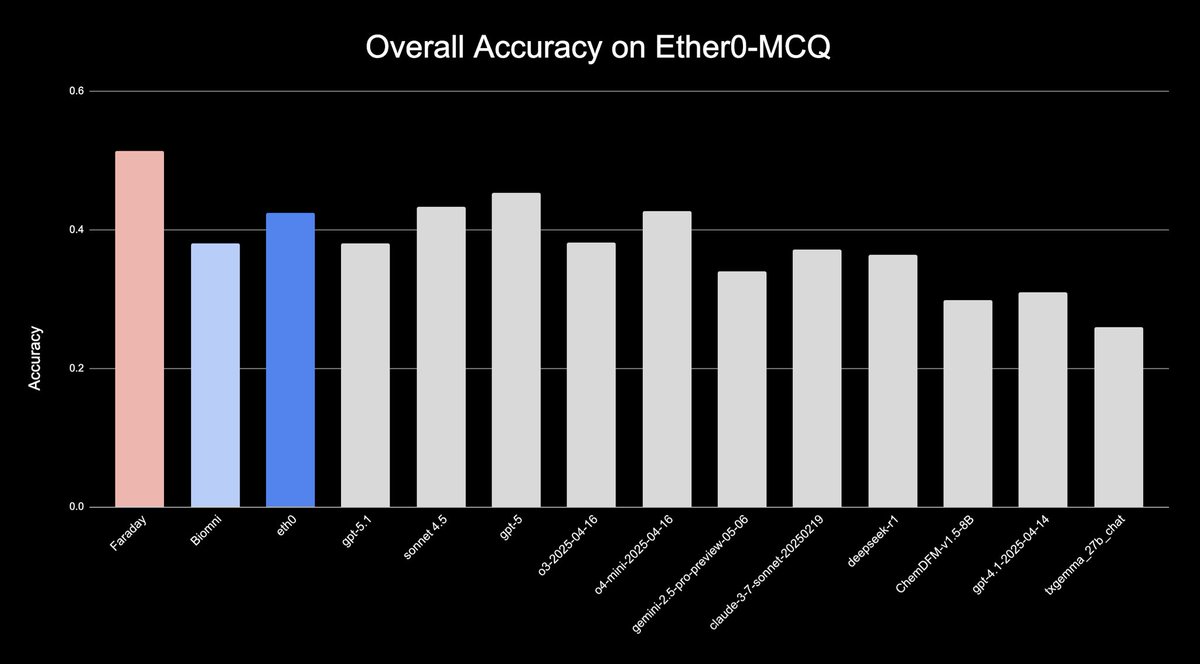
We’ve upgraded Faraday to achieve SOTA on the Ether0-MCQ chemistry benchmark by @FutureHouseSF (51.3% accuracy - highest among all evaluated models), outperforming LLMs including GPT-5, GPT-5.1, O3, O4-mini and GPT-4.1 by @OpenAI and Sonnet 4.5, Claude 3.7 Sonnet by @AnthropicAI , Gemini-2.5, DeepSeek, ChemDFM, TXGemma and other specialized AI scientist agents.
We tested Faraday on the exact same platform our users access, so benchmark performance directly translates to real-world capabilities.
Full blog post: ascentbio.ai/blog/faraday-a…
Get Faraday access here: accounts.platform.ascentbio.ai/waitlist
Today, we’re excited to announce that Faraday by @AscentBio has achieved SOTA performance on the Ether0-MCQ benchmark. This represents a major improvement over existing LLMs and specialized agents in reasoning over molecules. Ether0-MCQ is a 150 question benchmark subset by @FutureHouseSF addressing key tasks including safety and ADME prediction
The agent that designs molecules on demand—just give it a structure + goal 🧪 (like "improve oral bioavailability but keep the core")
Prompt → candidates in minutes.
It will: → Analyze parent properties → Preserve key pharmacophore → Identify bioavailability-limiting features →Generate optimized analogs → Validate the molecules computationally → Deliver a scientific report
#AI#DrugDiscovery#ComputationalChemistry#MedChem#biotech
Launch an agent to design novel derivates of a molecule of interest and watch how it:
→ gets your reference molecule’s structure and analyzes the pharmacophore and binding requirements for the target
→ designs structurally distinct scaffolds using scaffold hopping and fragment-based design
→ checks newly deskg ed molecules for drug-likeness and diversity
→ prepares a deep technical report.
This is the future of science.
#AI#AIScientist#AIAgent#biotech#DrugDiscovery