@Sarahhuniverse That only shows second part of the trick, how to tie this around the Rod is still not clear, how magician brought it to the rod so effortlessly before executed the trick needs to be answered
@rameshofficial0 Indians are one of the most stupid people,Mob violence was manufactured by Politicians to serve their interest, same has now become a tool of public justice. Neither Govt not Courts took active interest in addressing such gaps
🚨Heartless Ghamhapur: Manish Singh didn't flee after his car hit a woman, he tried to help, yet he was lynched in Varanasi?
"Unke hath pair Tod dete Mara kyu ?
Manish was returning from his factory when this tragic accident happened. Refusing to hear any explanations, a furious mob dragged him out and brutally beat him with rods and bricks for 20 minutes until he died.
When the police team arrived to arrest the suspects, violent villagers attacked them and took two constables hostage.
Manish's shattered wife asked why they couldn't just break his legs instead of taking his life.
This brutal lawlessness demands the strictest punishment
This 2 hour Harvard interview with Lee Kuan Yew, the man who turned Singapore from a tiny island into one of the richest nations on Earth, will teach you more about leadership, discipline, and nation-building than most business books ever will.
In 1997, Steve Jobs came back to Apple and canceled 70% of the product line.
The engineers whose projects just died?
Three feet off the ground with excitement.
“They finally understood where in the heck we were going.”
He spent 20 minutes explaining how he was going to bring Apple back:
On focus:
"We looked at the product road map going out for a few years and said a lot of this doesn't make sense."
"There's way too much stuff and not enough focus."
"We got rid of 70% of the stuff on the product road map."
"You're going to see the product line get much simpler. And you're going to see the product line get much better."
On inventory:
"We've got two to three months of inventory in our manufacturing pipeline. And about an equal amount in our distribution pipeline."
"So we're having to make guesses four, five, six months in advance about what the customer wants."
"We're not smart enough to do that. I don't think Einstein's smart enough to do that."
"So we're going to get really simple. Take inventory out of those pipelines. Let the customer tell us what they want. And respond to it super fast."
On marketing:
"To me, marketing is about values."
"This is a very complicated world. A very noisy world. We're not going to get a chance to get people to remember much about us. No company is."
"So we have to be really clear on what we want them to know about us."
On brand neglect:
"Apple is one of the half dozen best brands in the whole world. Right up there with Nike, Disney, Coke, Sony."
"But even a great brand needs investment and caring if it's going to retain its relevance and vitality."
"The Apple brand has clearly suffered from neglect in the last few years."
On what not to do:
"The way to bring it back is not to talk about speeds and feeds. Not to talk about megahertz. Not to talk about why we're better than Windows."
"The dairy industry tried for 20 years to convince you that milk was good for you. It's a lie. But they tried anyway."
"Sales were going like this." [Down]
"Then they tried 'Got Milk.' Sales went like this." [Up]
"Got Milk doesn't even talk about the product. It focuses on the absence of the product."
On Nike:
"The best example of all. One of the greatest jobs of marketing the universe has ever seen is Nike."
"Nike sells a commodity. They sell shoes. Yet when you think of Nike, you feel something different than a shoe company."
"In their ads, they don't ever talk about the product. They honor great athletes. That's who they are."
On Apple's identity:
"Our customers want to know: who is Apple? What do we stand for?"
"What we're about isn't making boxes for people to get their jobs done."
"Apple at its core is that we believe people with passion can change the world for the better."
"Those people crazy enough to think they can change the world are the ones that actually do."
On death:
"For 33 years, I've looked in the mirror every morning and asked: if today were the last day of my life, would I want to do what I'm about to do today?"
"Whenever the answer has been no for too many days in a row, I know I need to change something."
"Remembering that I'll be dead soon is the most important tool I've ever encountered to help me make the big choices in life."
"Almost everything—all external expectations, all pride, all fear of embarrassment or failure—these things just fall away in the face of death."
"You are already naked. There is no reason not to follow your heart."
On time:
"Your time is limited. So don't waste it living someone else's life."
"Don't be trapped by dogma, which is living with the results of other people's thinking."
"Don't let the noise of others' opinions drown out your own inner voice."
"Have the courage to follow your heart and intuition. They somehow already know what you truly want to become."
"Everything else is secondary."
"Stay hungry. Stay foolish."
In 2002, Elon Musk flew to Moscow three times to buy a refurbished missile.
He couldn't close the deal.
On the flight home, he asked himself: "When's the last time you bought something Russian that wasn't vodka?"
He started SpaceX instead.
1 year later, he stood in front of Stanford students and spent 45 minutes explaining everything he'd learned about building companies:
On starting Zip2:
This was 1995. Most VCs on Sand Hill Road hadn't even heard of the internet.
"I thought it would be a pretty huge thing. It was one of those things that only came along once in a very long while."
He got a deferment from Stanford to start the company.
"When I talked to my professor and told him this, he said, 'Well, I don't think you'll be coming back.' That was the last conversation I had with him."
The problem: he had no money.
"I couldn't afford a place to stay and an office. So I rented an office instead, because I got a cheaper office than I could get a place to stay."
"I slept on the futon and showered at the YMCA on Page Mill and El Camino."
"I was in the best shape I've ever been. Go to shower, work out, and you're good to go."
There was an ISP on the floor below them.
"We drilled a hole through the floor and connected a null modem cable. That gave us our internet connectivity for like 100 bucks a month."
"We had an absurdly tiny burn rate. And we also had a really tiny revenue stream. But we actually had more revenue than we had expenses."
They sold Zip2 to Compaq in early 1999 for over $300 million.
"In cash. That's a currency I highly recommend."
On starting PayPal:
"I didn't really take any time off."
He was looking for what remained in the internet. Financial services hadn't seen much innovation.
"When you think about it, money is low bandwidth. You don't need some big infrastructure improvement. It's really just an entry in a database."
They built a platform that combined banking, brokerage, and insurance in one place. That took enormous effort.
Then they added a little feature that took one day: the ability to email money from one customer to another.
"Whenever we demonstrated these two sets of features, we'd say, 'Look how you can see your bank statement and your mutual funds and insurance, all on one page. Look how convenient that is.'"
"And people would go, 'Ho hum.'"
"Then we'd say, 'And by the way, we have this feature where you can enter somebody's email address and transfer funds.'"
"And they'd go, 'Wow.'"
"So we focused the company's business on email payments."
On viral growth:
"PayPal is really a perfect case example of viral marketing."
"One customer would essentially act as a salesperson for you. They would send money to a friend and essentially recruit that friend into the network."
"So you had this exponential growth. The more customers you had, the faster it grew."
"It was like bacteria in a Petri dish. It just goes like this S-curve."
The results:
"I ran PayPal for about the first two years of its existence. We launched after year one. By the end of year two, we had a million customers."
"We didn't have a sales force. We didn't have a VP of sales. We didn't have a VP of marketing. And we didn't spend any money on advertising."
On why product matters:
"The essence of viral marketing is: do you have something where one customer is going to sell another customer without you having to do anything?"
"Product matters incredibly. Because if you're going to recommend something to somebody, you've got to really love the product experience. Otherwise you're not going to recommend it."
"You don't want to burn your friend."
On company culture:
"We had a pretty flat hierarchy. Everybody had a roughly similar cube. Anyone could talk to anyone."
"We had a philosophy of best idea wins. As opposed to the person proposing the idea winning because they are who they are."
"Even though there were times when I thought that should have been the way to go."
On decision-making:
"If there were two paths and one wasn't obviously better than the other, rather than spend a lot of time trying to figure out which one was slightly better, we would just pick one and do it."
"Sometimes we'd be wrong and pick the suboptimal path. But often it's better to pick a path and do it than to just vacillate endlessly on a choice."
On focus:
"We didn't worry too much about intellectual property, paperwork, legal stuff."
"We were very focused on building the best product we possibly could."
"We were incredibly obsessive about how to build something that is really going to be the best possible customer experience."
"That was a far more effective selling tool than having a giant sales force or thinking of marketing gimmicks or 12-step processes."
On why he started SpaceX:
"I was trying to figure out why we had not made more progress since Apollo."
"In the 60s, we went from basically nothing to putting people on the moon. Yet in the 70s, 80s, and 90s, we've kind of gone sideways."
"The computer you could have bought in the early 70s would have filled this room and had less computing power than your cell phone. Just about every sector of technology has improved. Why has this not improved?"
He thought maybe public support was the problem. So he planned a privately funded Mars mission: put plants growing on Mars for $15-20 million.
But the cheapest US rocket was $50 million. So he flew to Moscow.
Three trips. Couldn't close the deal.
"When I got back from the third trip, I thought: why is it the Russians can build these low-cost launch vehicles? It's not like we drive Russian cars, fly Russian planes, or have Russian kitchen appliances."
"When's the last time you bought something Russian that wasn't vodka?"
"I think the US is a pretty competitive place. We should be able to build a cost-efficient launch vehicle."
On why rockets are expensive:
"The energy and velocity required to get into orbit is so substantial that you have almost no margin to play with."
"A launch vehicle will get about 2% of its liftoff mass to orbit."
"If you're wrong by 2%, you're not going to get anything to orbit. It'll come crashing down in the Pacific somewhere."
"That means all of your calculations have to be right. If you miscalculate something, it blows up."
On how SpaceX got costs down:
Their rocket: $6 million. Nearest competitor: $25 million for less capability.
"There's no silver bullet. It's been really hundreds of small innovations and improvements."
"We've done improvements in the propulsion system, the structure, the avionics, and the launch operations."
"Our overhead in a 30-person company is an order of magnitude less than Lockheed or Boeing. Just for starters."
"Every decision we've made has been with consideration to simplicity. Because simplicity both improves reliability and reduces cost."
"If you've got fewer components, that's fewer components to go wrong and fewer components to buy."
On being an entrepreneur:
"I think really an obsessive nature with respect to the quality of the product is very important."
"Being obsessive-compulsive is a good thing in this context."
"Really liking what you do is important. If you don't like it, life is too short."
"If you like what you're doing, you think about it even when you're not working. Your mind is drawn to it."
"If you don't like it, you just really can't make it work."
On parallelization:
"Try not to serialize dependencies. Put as many elements in parallel as possible."
"A lot of things have a gestation period. There's really nothing you can do to accelerate that gestation period."
"If you can have all those things gestating in parallel, that is one way to substantially accelerate your timeline."
"People tend to serialize things too much."
On space as a business:
Someone asked if SpaceX was a good first company to start.
"No. I would not recommend it."
"This is advanced entrepreneuring."
"You know how many people have said: the fastest way to make a small fortune in the aerospace industry is to start with a large one."
This 45 minute Stanford lecture will teach you more about building companies than every startup book combined.
Bookmark & give it 45 minutes today, no matter what.
A woman is allegedly seen losing her cool on Maharashtra cabinet minister Girish Mahajan, over the traffic snarl caused by the BJP morcha in Mumbai on Tuesday evening. This was during a protest march on the issue of the Women's Reservation Bill. She was heard asking the minister to protest on a ground, and not hold up the traffic by marching on the streets. The opposition hit out at the BJP while appreciating the woman.
- @vinivdvc reports
Video: Special Arrangement
It's funny that the armed forces have to hire Agniveers and schools & colleges have to hire temps because we can't give pension, no money saar, but we can totally recruit 300 extra MPs and pay for bungalows, security, pension, health, etcetc.
This 2-hour Stanford lecture breaks down how models like ChatGPT and Claude are actually built, clearer than what many people in top AI roles ever get exposed to.
Save this and set aside two hours today. It might end up being the most valuable thing you learn all week.
@Nagaland_India Must give credit to creators, amazing piece of work.
The Chinese comparison may have something to do with 1962 humiliation on the battlefield and to make up for it, we started name shaming our own countrymen (and women)
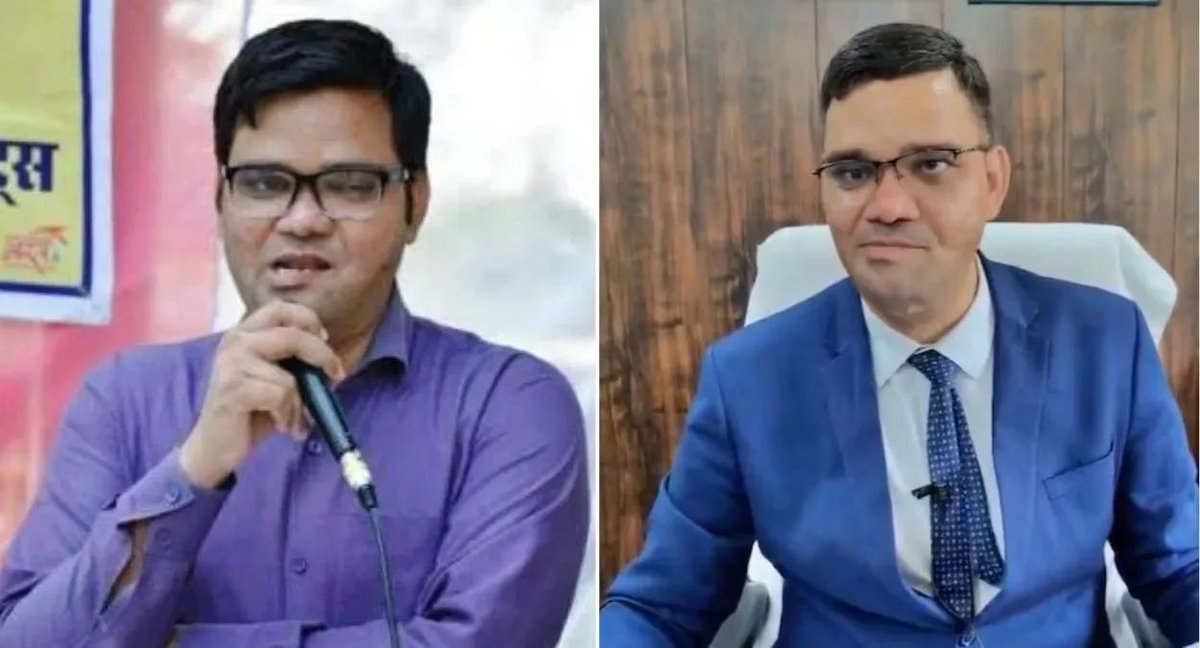
His name is Rinku Singh Rahi.
In 2009 he was a PCS officer in Muzaffarnagar.
He exposed a Rs 100 crore scholarship and pension scam.
Three days later someone shot him seven times.
Two bullets hit his face. His jaw shattered. He lost an eye. Lost hearing in one ear.
He spent 4 months in hospital.
When he came out the government transferred him.
He did not quit.
At age 40 with one eye and a broken jaw he appeared for the UPSC exam under the disability quota.
He got AIR 683.
He became an IAS officer.
In July 2025 on his first field posting as SDM in Shahjahanpur he saw a clerk urinating in the office premises.
He made the clerk do squats as punishment.
The lawyers protested saying it was wrong.
Rinku Singh Rahi said there is no shame in accountability and did five squats himself in public.
Within 36 hours he was transferred.
For 8 months he sat at the Revenue Board with no work. Full salary. Zero responsibilities.
On March 31 2026 he resigned.
His resignation letter said there is a special punishment reserved for honest people in India.
They get paid but no work is given to them.
He said even receiving a salary without working is a form of corruption.
He could not do it.
He walked away.
@Nagaland_India Nation should strive for Education and not Literacy alone.
Didn't get the point either to show ID to use a washroom. What more damge a foreigner can do to an already filthy public washroom 🤔
Racism incident in Patna! Arunachal dance team faced abuse, asked for ID to use public washroom, called derogatory names.Northeast Indians feel unsafe in own country.
In 2019, MIT professor Patrick Winston gave a legendary 1-hour lecture called “How to Speak.”
It has 18M+ views for a reason.
His frameworks:
• Your ideas are like your children
• The 5-minute rule for job talks
• Why jokes fail at the start
15 lessons on communication:
In 2000, Lee Kuan Yew gave a 2-hour masterclass on leadership worth more than an MBA.
He built Singapore into a First World nation in one generation
His frameworks:
- Why IQ alone destroys leaders
- Trustees, not owners
- How trust is built in crisis
12 lessons on how to lead: