

Ashraf Khattab
929 posts

I didn’t realize that Walt Frazier and Willis Reed never existed.
Sam Block@theblockspot
Jalen Brunson went from NBA Role Player to the greatest player in NY Knicks history. This is actually insane.
English
Ashraf Khattab retweetledi
The airline lost my bag for 72 hours.
They handed me a $50 “courtesy” voucher at the baggage desk and smiled like they’d done me a favor.
I kept the voucher. Then I opened my laptop and used a 1999 international treaty they never mention at check-in.
Total recovered: $1,650.
Here are the three legal weapons most passengers never know they have.
English
Ashraf Khattab retweetledi

Elon Musk hasn't sold a Tesla share in years and lives off $1 billion in personal loans
His Tesla stock keeps appreciating
The loans charge him 2-3% interest
The IRS never sees a single dollar of capital gains tax
This is exactly how the wealthiest people in America accumulate wealth without paying taxes and it's available to anyone with $100K+ in assets
The strategy is called "borrow against appreciated assets" or sometimes "buy borrow die." It's the single most powerful tax-minimization strategy used by ultra-wealthy individuals in America
Mechanics:
When you SELL an asset that has appreciated, you owe capital gains tax. Federal long-term capital gains rates: 0%, 15%, or 20% depending on income. Plus state capital gains in most states (CA: 13.3%; NY: 8.82%). Plus net investment income tax of 3.8% for higher earners (IRC Section 1411)
For someone like Elon Musk selling $1B in Tesla stock, the total tax bill would be approximately:
Federal capital gains at 20%: $200M
Net investment income tax at 3.8%: $38M
Texas state tax: $0 (Texas has no state income tax, this is why Elon moved there)
Total tax bill on selling $1B: $238M
When you BORROW against appreciated assets, you owe ZERO tax. Loan proceeds are not income under IRC Section 61. They never appear on your tax return. They never trigger a tax event
For Elon to access $1B in cash for spending purposes, the math is:
Sell $1B in Tesla stock: $762M in net proceeds after tax
OR
Borrow $1B against $1B in Tesla collateral at 2-3% interest: $1B in net proceeds tax-free
Selling costs him $238M in taxes
Borrowing costs him $20-30M/year in interest (or roughly $200-300M over a decade if held that long)
But the borrowing strategy has additional benefits:
Tesla stock continues to appreciate. Over 10 years, $1B in Tesla stock has historically appreciated to multiples of that. Selling locks in the gain at today's value. Borrowing keeps the upside
The interest paid on the loan is potentially tax-deductible if structured as an investment loan (IRC Section 163(d)). Effective after-tax cost can be reduced to 1-2%
The loan never has to be repaid during his lifetime. He can refinance it indefinitely. When he dies, his heirs inherit the stock at a "stepped-up basis" (IRC Section 1014). The accumulated capital gains die with him. The heirs sell the stock at the stepped-up basis, pay off the loan, and keep the entire upside tax-free
The wealth transfers from Elon to his heirs entirely tax-free if structured correctly. Estate tax is a separate question but is largely avoidable through proper trust structures
The ultra-wealthy version of this strategy:
Borrow against appreciated stock
Use the loan proceeds for consumption (homes, cars, art, business operations)
Never sell the underlying stock
Refinance the loan at maturity to extract more cash if the underlying has appreciated
Pass everything to heirs at death with stepped-up basis
Heirs sell with $0 in accumulated capital gains tax owed
This strategy is sometimes called "buy, borrow, die" by tax planners. It's the foundation of how billionaire wealth perpetuates across generations without significant taxation
Available products for this strategy:
Pledged Asset Line (Schwab): borrow up to 50-70% of portfolio value at SOFR + 1-2%
Securities Backed Line of Credit (Morgan Stanley, Goldman): similar terms, $1M+ minimum
Custom Lending Solutions (private banking): for $10M+ portfolios, rates can drop to 1-2%
The accessibility tier:
If you have $100K+ in investment assets at Schwab/Fidelity/Vanguard, you can open a Pledged Asset Line. Typical terms: borrow up to 50% of your portfolio value at SOFR + 1.5-3% (current rates roughly 6-8% all-in). No fixed monthly principal payments. Interest only or pay nothing as long as the loan stays below the maintenance threshold
For someone with $200K in stocks/ETFs:
Borrow $100K at 6.5%
Use the $100K for any purpose (real estate down payment, business operations, etc.)
Annual interest cost: $6,500
Tax savings vs selling stocks: roughly $20,000-$30,000 in deferred capital gains
Net benefit: $13,500-$23,500/year in tax savings during the borrowing period
For someone with $1M in stocks/ETFs:
Borrow $500K at 6.5%
Use the $500K for real estate purchases, business equity, etc
Annual interest cost: $32,500
Tax savings vs selling stocks: roughly $100,000-$150,000 in deferred capital gains
Net benefit: $67,500-$117,500/year
Comparison to the alternative:
If you sell $500K in long-term appreciated stock to access cash:
Federal capital gains at 15%: $75,000 owed
State capital gains (varies): $20,000-$40,000 owed
Net cash to you: $385,000-$405,000
If you borrow $500K against the same stock:
Net cash to you: $500,000
Tax owed: $0
Annual interest cost: $32,500
Even paying $32,500/year in interest, you're $90K-$110K ahead in year 1 and the gap grows because your stock keeps appreciating while you hold it
The compounding effect over 20 years:
Person A sells $100K of Tesla stock at 15% capital gains, takes $85K. Spends it
Person B borrows $100K against $100K of Tesla stock, takes $100K, spends it. Stock keeps growing at historical rate (let's say 20%/yr conservatively)
20 years later:
Person A: stock is gone. Whatever they bought with $85K is whatever it is
Person B: still owns the original $100K in Tesla, now worth $3.8M. Refinanced the loan multiple times. Currently owes maybe $200K against $3.8M in collateral. Net wealth on this position: $3.6M
Same starting position. Different decision. $3.5M+ difference in 20 years
Important caveats:
The strategy works only when underlying asset is appreciating
Margin call risk if asset value drops below maintenance threshold
Interest costs accumulate over time and eventually reduce the net benefit if rates rise enough
Some borrowing limits apply (typically max 50-70% of portfolio value)
The strategy is most powerful for:
Concentrated stock holdings in publicly traded companies (especially employee stock from tech companies, founder stock, ESOP grants)
Large diversified portfolios held in taxable brokerage accounts
Real estate equity (similar strategy via cash-out refinances)
Business equity (some forms of borrowing available against ownership stakes)
The strategy is least useful for:
Small portfolios under $50K (interest costs eat any benefit)
Retirement accounts (can't borrow against IRAs/401(k)s; some 401(k)s allow loans but limited to $50K)
Assets without an established lending market (collectibles, private real estate that's hard to finance)
The reason this isn't standard financial advice:
Most financial advisors are compensated based on assets under management. They make more money when you keep assets invested. They don't necessarily make money when you optimize for cash extraction. The strategy is genuinely good for sophisticated clients but doesn't fit the standard advisor compensation model
Banks DO know about this strategy. They actively market it to wealthy clients. The Pledged Asset Line and securities-backed line of credit products are billion-dollar businesses at every major brokerage. They're just not marketed to ordinary retail clients because the minimums and complexity make them inappropriate for mass market
The threshold for accessing this strategy:
$100K+ in liquid investment assets = entry-level access via Schwab/Fidelity
$1M+ = full access to most products and competitive rates
$10M+ = access to private banking rates of 1-2%
$100M+ = Elon-level rates of essentially 0% real cost after tax deduction and stock appreciation
At each tier, the math becomes more favorable. The richest Americans access this strategy at rates that mean borrowing $1B is essentially free relative to their portfolio appreciation
Most middle-class Americans never use this strategy because:
They don't know it exists
They don't have $100K+ in taxable investment accounts
They follow standard advice that says "live within your means and don't borrow"
The wealthiest Americans use it constantly because:
They have the assets
They understand the math
They follow advice from advisors who are sophisticated about tax optimization
The gap between the two groups isn't talent. It's understanding that the tax code is written to reward holding assets indefinitely and penalize selling them. Selling = taxable event. Holding + borrowing = no taxable event. The system rewards never realizing gains
Elon never sells Tesla. He never pays capital gains tax. The IRS doesn't collect a dollar from his accumulated wealth. The strategy is legal. It's mathematically optimal. And it's been written into the tax code since before any of us were born
You don't need to be Elon to use this strategy. You need $100K and a Schwab account
(we get business owners up to 250k in 0% interest business funding, link in bio)
English
@billsmafiatampa Crazy for you to think there’s a gap between Mahomes and Allen when the last 3 years it’s not even close 😂
English

Im going to end the debate.
1. Mahomes
Gap
2. Allen
Marianas Trench
3. The depths of who cares
English
@ashariukht @Iladelphian215 Allowing taqlid in matters of creed is actually the position of the muhaqiqin of the Ashaʿira such as Dardīr
English

@Iladelphian215 Appreciate you looking out, brother. That’s definitely worth including too.
English
Taqlīd in Aqeedah 🧵
“The majority of Hanafi scholars held that whoever believes in the foundations of religion through imitation (taqlīd), such as tawḥīd, prophethood, and other matters, his faith is valid. This is what is narrated from the Imām al-Aʿẓam (Abū Ḥanīfah), and it is the well-known position among his companions.
This is also the position adopted by Mālik, al-Shāfiʿī, and Aḥmad, as mentioned in Sharḥ ʿAqīdat al-Ṭaḥāwiyyah by Shaykh Abū al-Maḥāsin, al-ʿUmdah by Imām Ḥāfiẓ al-Dīn al-Nasafī and its commentary al-Iʿtimād, and Sharḥ Badʾ al-Amālī by Shaykh ʿAlī al-Qārī.
The majority of Ashʿarī scholars, among them al-Ashʿarī, Qāḍī Abū Bakr al-Bāqillānī, Ustādh Abū Isḥāq al-Isfarāyinī, and Imām al-Ḥaramayn, held that imitation alone is not sufficient in matters of creed, as mentioned in Sharḥ al-Jawharah by Imām al-Laqānī, Sharḥ Umm al-Barāhīn by Imām al-Sanūsī, and Sharḥ al-Amālī by Shaykh ʿAlī al-Qārī.
In the old commentary on ʿUmdat al-Nasafī, it says: Shaykh al-Ashʿarī held that a condition for the validity of faith is that every issue be known through a definitive rational proof.”

Română
@Mark_A_Tink @Rome_Beast Not ridiculous at all, brother he just can’t get it done in the playoffs no defense whatsoever too many bonehead turnovers
English

@Rome_Beast It just shows the cluelessness of fans though- it was ridiculous what was said about him.
English
why did ppl seriously turn on austin reaves after game 1
after another career year ?!
still can’t believe how nasty ppl got
out for a month & zero slack vs one of the greatest defenses ever while he just getting rhythm back not crazy ?
he was improving as series went on too
Basketball Performances@NBAPerformances
Austin Reaves postseason scoring vs OKC • 25/4/7 on 51/39/82 splits last 3 games • Playoff career-high 31 PTS on 76 TS%
English
@Rome_Beast Because every year we gave him a pass and this year we needed him more than ever and he completely choked in that game one and then in the last game, the guy had eight turnovers five fouls and always gets roasted. Not to mention he missed the game tying shot AGAIN.
English
@breamcbride @Kareem_is_it He does this every year. Look at the numbers. Game 2 he wasn’t injured? He’s awful. No excuse. Game 1 and 3 were laughable. Not winning anything with him
English

I am so confused by the disdain for Austin bc he is so unproblematic & just works hard. I don’t think you can use this series to say he is a “playoff dropper” bc he came back not 100% playing w/ a somewhat diff team. If he never got injured I would understand the discourse more
English
@Pro__Ant So you’re saying McDonald over TJ Parker would have been the way to go?
English
Having a good/capable Nose Tackle isn’t purely about size. It doesn’t have to a mountain of a dude. Skillset & play style matter. Do certain physical aspects translate better to that role? Yes. But that’s not all that matters
Deone Walker is literally an in-house example of size not necessarily representing what an IDL is. Walker is huge, and by size or weight classifications would be a “plugger”. But he’s not that, he plays more of a finesse/penetration style.
That being said, it would have been nice to see the Bills add a run defense based plugger/displacement mitigator role at some point this offseason into their IDL rotation. It’d still be nice if they did that
English
Ashraf Khattab retweetledi

A MIT professor gave a 1-hour lecture in 2019 that has 18 million views.
He died 5 months after recording it.
It was his final gift to the world.
Patrick Winston taught at MIT for 50 years.
The smartest engineers on earth sat in his classroom.
And he spent his last lecture teaching them the one skill their degrees never covered.
How to speak.
15 lessons that will change how you communicate forever:
Never open with a joke. Your audience is not ready to laugh yet. Open with a promise of what they will know by the end.
Your ideas are like your children. You are too close to them. What is obvious to you is invisible to everyone else. Explain the obvious.
The 5-minute rule: the first 5 minutes of any talk determine whether people will listen for the next 55. Spend more time on your opening than anything else.
Repeat your most important idea 3 times in 3 different ways. Once is never enough.
Build a fence around your idea. Tell people what it is NOT before you tell them what it IS.
Verbal punctuation. Pause. Let the idea land before moving to the next one.
Ask questions nobody will answer. Then wait 7 seconds. The silence is not awkward. It is processing.
Never read your slides. Your audience can read. They cannot listen and read simultaneously.
Use the board not the slides. Writing forces you to slow down. Slowing down forces clarity.
Inspire before you inform. Nobody learns from someone they are not inspired by.
End with a contribution not a summary. Tell them what you gave them. Not what you said.
Never say thank you at the end. It is weak. End with something that lands.
Stories make ideas stick. Data makes ideas understood. You need both. In that order.
The quality of your communication determines the quality of your ideas in the eyes of the world. Not the ideas themselves.
Practice is not preparation. Practice IS the skill.
Patrick Winston understood something most people spend their entire careers missing.
Your ideas are only as powerful as your ability to transfer them into someone else's mind.
You can be the smartest person in the room and be completely invisible.
Or you can master communication and make average ideas feel like breakthroughs.
He chose to spend his last lecture teaching this.
Watch it tonight.
Bookmark this first.
Follow @cyrilXBT for more lessons from the people who built the future.
English
@UberHansen All those guys suck except for Max and you need 3 starter level corners because ours always get hurt. In fact, if you told me we are cutting all these guys but Max, I wouldn’t mind
English

I'm at a point where I can see the vision for each of the #Bills 2026 draft picks.
The problem, I now don't understand the vision for Max Hairston, Landon Jackson, Jordan Hancock, Chase Lundt, Keon Coleman, DeWayne Carter, Sedrick Van Pran-Granger, and Javon Solomon.
English

I know I am not supposed to, but I'm kind of geeking out over IGB's 2024 film.
English
@NateGearySports Excellent tweet. I feel the same. And the tackle maybe he can play guard. If not solid backup.
English
I finally feel better. The 4th round helped a lot. Elarms-Orr and Skyler Bell have juice for me.
English
@irish7285 @SharpFootball Not that hard to analyze that both these players are backups and you don’t spend second round picks on backups when you have six positions of need for long-term starters. Sheesh.
English
@SharpFootball It's not the offense that has been losing Bills games in the playoffs, it's consistently been the defense. Now with a new d-cordinator and new scheme, need different type of players to fit it. Not that hard to analyze
English
Bills 2026 NFL Draft thru Day 2:
Rd 2: EDGE T.J. Parker
Rd 2: CB Davison Igbinosun
English
@BillsChatPod @SleeperBills Terrible take here. Hairston didn’t play because he was in a meaningless fourth quarter up 35-0
English
The Bills saw their season end because Dane Jackson was needed on one play and it was one play too many.
Never mad about getting corners.
Not sure I get the one they took but they never ask my opinion and they're right a lot more than me
English
@Mike_Bundt Tonight is the first time I’ve come across this account. Now I know never to pay attention to it ever again.
English

The Bills not drafting the player or position you wanted doesn’t necessarily equate to them making a poor selection.
English
@TheBillsGuys Beane should be fired. All you content creators should be tearing him to shreds from here on out. Can’t have this guy waste 2 more years of Josh’s prime
English

The best case scenario for TJ Parker is he outplays and replaces the guy we just paid big money. The best case scenario for Davison Igbinosun is he outplays and replaces the guy we spent a first round pick on last year.
English
@Matt_Bove @billsdaily Yeah? An after nearly a decade at the helm, who’s responsible for that depth in big moments? Makes no sense what you’re saying.
English
Beane is saying without completely saying it that they have lost in big moments because their depth cornerbacks have been targeted and taken advantage of.
He’s right. Whether or not that justifies their pick tonight is completely up to each individual person.
English
@DaveMyersBIB You’re really going to pay attention to the rest of the draft after those first two picks?
English

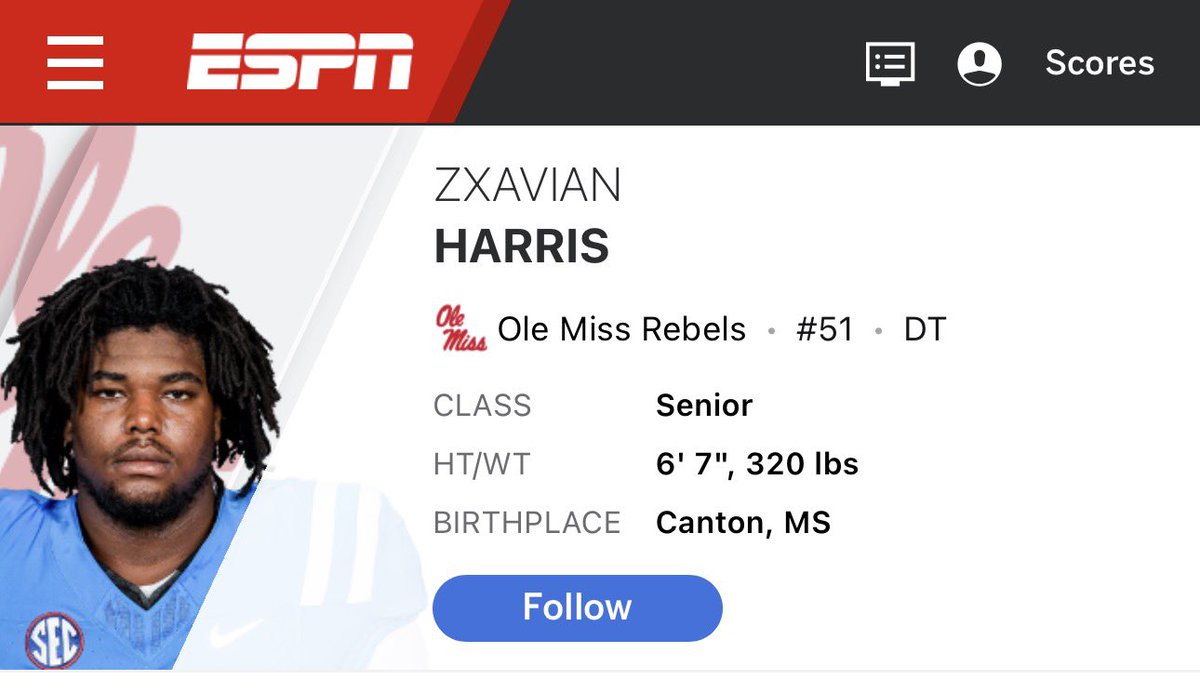
Still available if you are looking for DT…
Zxavian Harris from Ole Miss
6’7” 320lbs
Imagine him next to Deone Walker. Batted balls galore!
English
@TyDunne @JeremyWGR @BobMcGinn You still think with this stellar draft and Brady as coach that this team will do better than they did under McDermott and make the Super Bowl? Asking for a friend
English
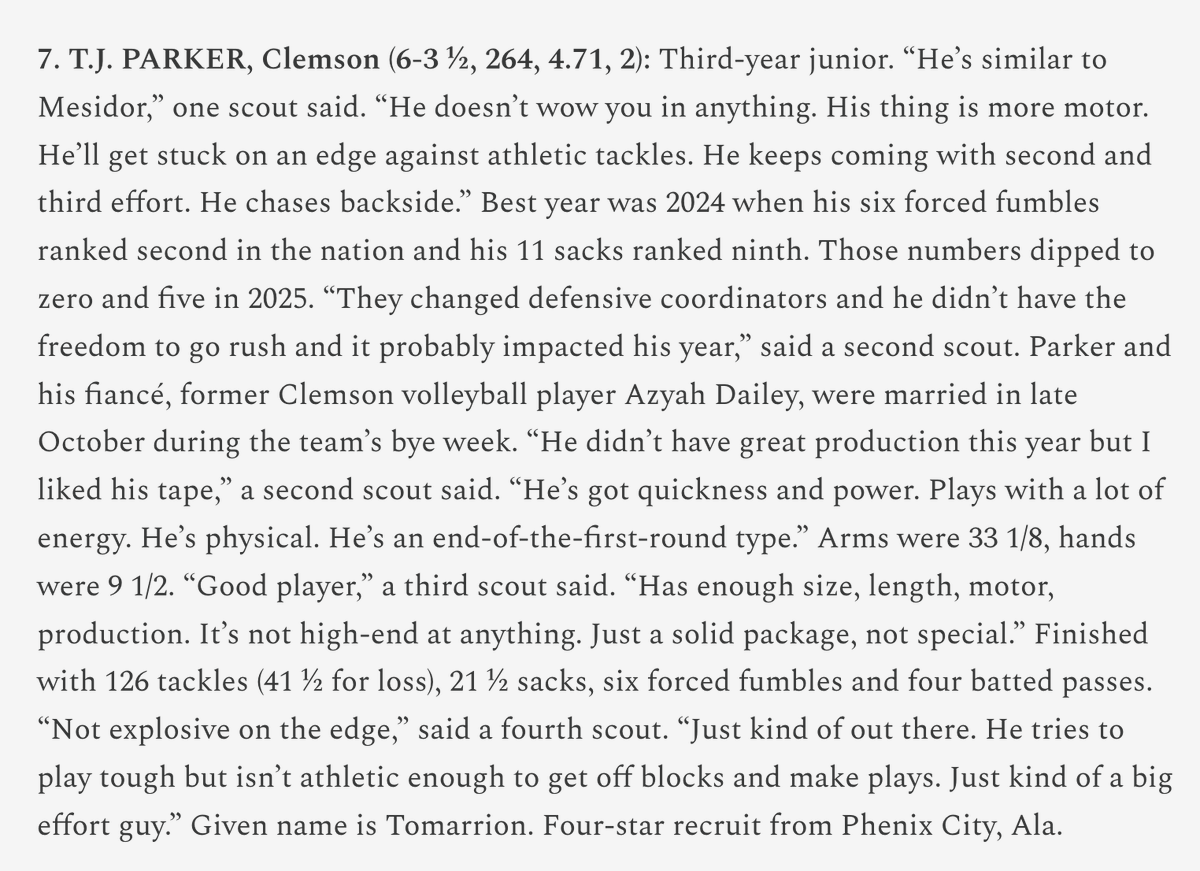
Here's what the scouts told @BobMcGinn on the newest Bill, edge T.J. Parker out of Clemson. golongtd.com/p/part-8-edge-…
English