Sabitlenmiş Tweet

Had a lot of fun using codex to build this menopause tool 🫶🏻
The future of physician-builders is here
menotool.com

English
Kristine MD
45 posts

@Astorshuman
Primary care/Clinical AI


Healthcare in Canada is truly universal. You can be dirt poor or filthy rich, you’ll get the same treatment: absolutely nothing, unless you’re already half-dead, being born, or giving birth. It’s beautiful


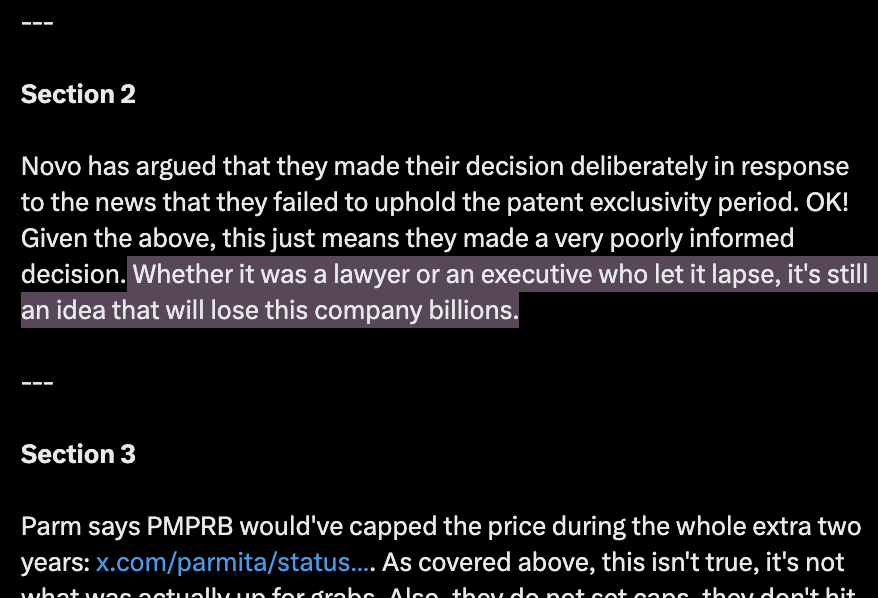
This thread makes no sense, ignores all precedent, misunderstands the law, and—being generous—is probably LLM-researched. (How else could someone smart make mistakes this bad?) --- Section 1 I'm going to write out the key points here and then debunk it in full. In Section 2, I will go into how it doesn't matter why the decision was made to let the patent lapse: it was bad for Novo Nordisk regardless. In Section 3, I will go into Parm's various misunderstandings in a much more pedantic way that's largely unimportant, but will be there for interested readers. Parm's key argument is that it was rational for Novo Nordisk to give up exclusivity because they would've lost more money from the resulting PMPRB price cut than they would've gained from having two additional years of exclusivity. Why is this wrong? Consider a simple constant-volume model for the period in question. Such a model would hold that giving up two extra protected years only makes sense if PMPRB would have forced the price below 80% of the otherwise achievable price for the full ten-year period. Or: 8P > 10qP -> q < 0.8 So, PMPRB would need to impose a greater than 20% price cut on the whole protected period for the intentional lapse path to financially outperform having ten years of exclusivity. But this understates the issue compared to the real world: Ozempic's Canadian utilization grew later in the period! PMPRB's CompassRx report (#9) says Ozempic public-plan beneficiaries rose from 40,576 in 2019-20 to 139,397 in 2021-22, with $255 million in public-plan drug costs in 2021-22. And this was early! The growth has been much greater since. This implies that the price cut to make Novo Nordisk's patent lapse rational would need to be considerably greater than 20%, sustained or retroactively imposed, and it would need to be sufficiently certain, where precedent does not support that as being likely at all. Industry was already projecting massive growth by the last date Novo could've rescued their patent, so they had no excuse. The questions to ask yourself are: - How large a price cut is reasonable from the PMPRB? -- And how large would it need to be to make Novo a rational actor here? - What's the relative impact of generic entry? The size of a PMPRB price cut is unlikely to be even close to large enough. The strongest Ozempic-specific precedent here is the PMPRB's own treatment of Ozempic before it stopped reporting. In their 2020 list, Novo's Ozempic Drug Identification Numbers (DINs) were marked "Expired" in the comments column and "Within Guidelines" in status. This means that the old PMPRB price-screening framework was not treating Ozempic as an excessively priced drug at that point. Ozempic then appeared in PMPRB's 2021 Annual Report as one of the top-selling medicines that stopped reporting to PMPRB in 2021, with a listed exiting effect of -$301 million. From 2022 to 2025, PMPRB was not even positioned to impose a major Ozempic price cut. Even if CA 2601784 had been maintained, the PMPRB interim guidance on the matter said that an existing, patented medicine would not trigger investigation if its national average transaction price stayed at or below the projected non-excessive average price from the latest compliance letter and its list price did not increase. And further, because interim guidance was in place, no complaints-based investigations were opened in 2024 and no undertakings or excessive price hearings were approved or commenced in 2024 or January-March 2025. For Ozempic, there's no basis to say PMPRB would have pushed the prices down in 2022-25 if the patent had remained alive. The product was already "Within Guidelines" and the interim regime was not hard on price-cutting. The first serious PMPRB problem would have been in 2026-28, not over the whole eight years. The 2026 PMPRB guidelines are more relevant to the exclusivity period. These guidelines use a two-step process involving an initial/annual review and then an "In-Depth Review", but PMPRB explicitly says they don't calculate price ceilings, non-excessive prices, excess revenues, etc., and that a Hearing Panel decides excessive pricing cases on a case-by-case basis. For existing medicines, annual reviews start two years before the aforementioned Guidelines take effect and the first annual review applies the highest international price (HIP) criterion. During that two-year period, existing medicines only go to "In-Depth" if there is an approved complaint or they're associated with a DIN under review. The approved complainants are few in number: health ministers, senior public drug program officials, etc. Private parties do not apply. If 2601784 had remained in effect through the end date on March 20, 2028, it could've faced scrutiny in 2026-28, but a routine annual screen would've only arrived near the end of protection and it would create retroactive excess revenue collection risk, but not price suppression for 2018-26, and the likely collections given precedent at the time would've been small at most. Canada's generic drug pricing framework, on the other hand, exerts large effects on pricing. A single source generic drops to 55% of brand reference price after three months, two generics drop to 50%, and three or more price at 35%. Canada so far has had two approvals (Dr. Reddy, April 28; Apotex, May 1) with seven additional submissions under Health Canada review, so the real reduction in a few months is going to be ~65% off. Looking backwards, we can see that Novo failing to maintain exclusivity could've saved it ~0-15% for a few years in a scenario where PMPRB acted unusually aggressively versus an essentially guaranteed 50-70% cost reduction with generic competition, for a smaller number of years. For this to come close to penciling out, Novo would need a lot of simultaneous coincidences: PMPRB acting erratically and winning where they're known not to, less generic competition, etc. But this is a backward-looking take. What did Novo know at the time, at the end of the period where they could've refiled (August 31, 2020)? Turns out, they knew more than enough to realize it was a bad idea! The picture in August 2020 looked like this: - The Amended Patent Medicines Regulations had been published in the Canada Gazette on August 21, 2019 and were scheduled to come into force on July 1, 2020, cutting the U.S. and Switzerland from Canada's price comparison basket ('PMPRB11'). - The June 2020 Draft Guidelines had been published and were in consultation. The extreme Maximum Rebated Price (MRP) regime where there are huge negotiation effects (down to -50% at $125m revenue and $60k/QALY) was the proposal. - The Federal Court and Quebec Court of Appeal decisions that struck down this aggressive level of price reduction as ultra vires came in 2022 and the Innovative Medicines Canada lawsuit was filed in Summer of 2020, but wasn't yet decided. - The Soliris hearing decision in 20017 had been upheld by the Federal Court in June 2019 and the FCA reversal of it didn't come until July 2021, so in August 2020, it looked as though the PMPRB could impose fairly aggressive price cuts and they would stick on judicial review. But though this looks supportive for Parm's case, the "aggressive new guidelines" she relies on (here: x.com/parmita/status…; i.e., the MRP) are not actually concerning for Novo because the Draft Guidelines clearly indicated that Ozempic was a "grandfathered medicine" subject to a much lower Maximum List Price (MLP), which would be the lower of the MAPP/NEAP or PMPRB11 median, meaning that a ~5-11% price ceiling is what Novo was REALLY looking at. This is that Charles River Associates projected a bit later on the basis of data Novo had at the time, so we know it wasn't some abstruse, unknown piece of knowledge. To be fair to Novo, international reference pricing spillover would have multiplied potential list price reduction effects. The Canadian list price feeds into Germany's AMNOG reference, France's CEPS reference, some of the Nordic country baskets, Australia's PBS comparisons, and various less relevant Latin and Middle Eastern references. A reasonable 2020 estimate would be that Canadian list price changes would propagate roughly 1.5-2.5-times their nominal Canadian revenue impact given how these baskets would've updated based on an 11% update. At the time, Novo was projecting $ 600m-$1b in lost net manufacturer revenue across 2026-28, which would become $ 700m-$1.3b, as a result of generic entry. The PMPRB cost avoided by a lapse, with revenue running $300- 400m and growing on contemporary forecasts to $600- $800m, which would be modest given Saxenda's trajectory, and inclusive of Wegovy being on the MRP but somehow getting exempted (this doesn't happen/make sense) would mean that the PMPRB costs avoided would total roughly $500-$1.1b. So to get the numbers within shouting distance of each other, Novo has to (1) weight spillovers aggressively; (2) believe PMPRB will achieve a maximalist position; (3) misunderstand Wegovy's exposure to the MRP/MLP split. Without any of that, there is no reasonable way to get to their decision actually saving/making them money/matching the (now known to be VERY LOW projected) benefits of exclusivity. But this is, of course, incoherent in the first place, because PMPRB's remit includes patents for more than just active ingredients! They also cover "Patented inventions for..." "processes of manufacture", "a particular delivery system or dosage form that are integral to the delivery of the medicine", "indications/uses", "formulations". If PMPRB was already being maximalist, then they would've also regulated Ozempic based on things like the pen patents, which Novo has argued in U.S. courts *ARE* integral. To make the patent lapse case, you have to ignore that Novo also would've needed to drop the rest of their massive patent thicket, and they CLEARLY did not, as evidenced by the fact that they're still on the books! Novo requires staggering coincidences to make their decision seem rational: almost everything bad has to happen, and everything good has to not happen, but some of the bad things also have to be avoided even though they're more plausible than some of the good things not happening and some other bad things happening. How do you even argue this? And I repeat: looking back at franchise growth, the decision was obviously bad. The only way this could not be the case would be if doctors going forward choose not to prescribe generic semaglutide in lieu of prescribing Ozempic. I will take anyone's bet that generics will eat into Novo's share of the market, up to a $50,000 bet, and I will win because several provinces (e.g., Newfoundland and Labrador) REQUIRE dispensers buying the lowest-price brand or approved substitute, with the patient paying the difference if they choose a higher-priced brand, which few people ever do. And let's make my argument even stronger: for Novo's projections to be wise, they would have to be the one company that doesn't act out the generic competition paradox, where they boost list prices in response to generic competition! We have a good prior that this effect exists in Canada (see: Ren, Sketris and Xu, 2011), and as a result, the international pricing-based losses (based on list prices) will be cut down towards $0. Therefore, Novo's projected benefits also fall towards $0 unless they're just the most idiotically mismanaged company ever. Make this argument explicitly with numbers, and Novo was obviously irrational and to the extent their patent lapse was 'strategic', the strategy was dumb. --- Section 2 Novo has argued that they made their decision deliberately in response to the news that they failed to uphold the patent exclusivity period. OK! Given the above, this just means they made a very poorly informed decision. Whether it was a lawyer or an executive who let it lapse, it's still an idea that will lose this company billions. --- Section 3 Parm says PMPRB would've capped the price during the whole extra two years: x.com/parmita/status…. As covered above, this isn't true, it's not what was actually up for grabs. Also, they do not set caps, they don't hit everything, and PMPRB jurisdiction over CSP-protected medicine s came into force on June 30, 2021 after years of not being certain if/when it would. Think about how this looked at the time though. Scenario 1: The CSP amendments come into force before March 2026, so they get meaningful PMPRB exposure across the CSP window. Scenario 2: The CSP amendments *don't* come into force before March 2026, so they get unregulated exclusivity for two more years. The patent lapse gives up optionality and only makes sense if you believe PMPRB will simultaneously be and not be maximalist, as described above. Nonsense view. Parm implies data exclusivity expire means generics were coming regardless: x.com/parmita/status…. They *were* coming, but not at the relevant time (2026). Losing data exclusivity and keeping the patent, the generics would still be delayed. Parm brings up Humira for some reason: x.com/parmita/status…. But despite still making lots of money, it makes much less than the counterfactual, as evidenced by the fact that they couldn't raise the prices globally in response to generic entry, which is objectively successful. Also, Humira maintains profitability in part because of evergreening, which won't be happening in the semaglutide case here (obviously: how could it? Canada has rules that prevent how that could be done here! Or are you forgetting that?). Parm implies Novo's statement to Fortune is meaningful, that it's a sign of a company adapting to a new form of operation: x.com/parmita/status…. The form of operation that sees its stock price fall 34% over the past year? That sees it eschew buying obviously good targets from China that its rival LLY instead did? The form of operation that sees it frequently cutting and reorganizing its executive team due to a failure to perform? Yeah, OK. This is a company whose former CEO explicitly objected to pursuing obesity as an indication. You don't get to handwave concerns about leadership fallibility for this company (or any, really). Parm makes several posts erroneously comparing the American case to the Canadian one and suggesting that somehow manufacturing matters here. What does she know that every financial firm from Goldman on down is missing? (Nothing. Generics will dominate in the market, which she evidently keeps forgetting is CANADA we're talking about here.) Parm outlines the full picture of Novo's competence: x.com/parmita/status… 1. They did not 'escape PMPRB price caps' 2. They did not price in IRA timing in the U.S. based on this decision (it's completely irrelevant to it; why bring this up?). 3. There's no manufacturing moat. Clearly. Teva has stockpiled for ages and they're about to get approved. You know we can look up interviews from companies about how they're stockpiling, right? And there's no angle for product differentiation from generic in this market. The comparison to Humira is not apt because the evergreening matters, and plus, your source CLEARLY shows more switching FROM Humira than BACK TO Humira. How did you think this was a point? I am genuinely baffled. To make things worse, this applies LESS in the Canadian case because of the purchasing requirements I mentioned above. When people have nocebo-driven injection site issues (the overwhelming majority of the very-minor Humira problem), they're not going to be catered to as much in Canada as they are in America. That reduces the scale of this already meager issue. 4. How does letting your patent lapse help keep your brand premium intact? No consumer thinks about this. 5. Doesn't matter. The manufacturing of an equivalent product already works and works well, with competitive pricing coming. --- This was a nonsense thread and anyone who fell for it isn't thinking. --- Sources: canada.ca/en/patented-me… canada.ca/en/patented-me… (See also: cihi.ca/en/prescribed-…; cihi.ca/en/news/canada…) canada.ca/en/patented-me… canada.ca/en/patented-me… canada.ca/en/patented-me… canada.ca/en/patented-me… media.crai.com/wp-content/upl… #tc2-4" target="_blank" rel="nofollow noopener">canada.ca/en/patented-me…
wp.economics.dal.ca/RePEc/dal/wpap… truveta.com/blog/research/…
Sam Altman Overdosed on GLP-1s "Taking enough of it makes you have not a desire for anything else. Few days laying in a hospital bed staring at a white ceiling thinking nothing, not wanting anything." — @sama



Unless our Medical Schools do a better job of screening admission candidates, we won’t have any Doctors. If you don’t want to practice FULL time for at least 20-25 years, pick another profession.
This graph tells a better story than the average. Almost immediately after graduation, doctors start quitting, and it drops at a continuous pace for 25 years. No plateau. Just continuous decay. Looks as bad as some of the survival curves in oncology! 20% are gone in 5 years! 5 years!! They train for 7 years after college and quit in less than that. They get out as soon as they can! That says one thing clearly - Graduating doctors are realizing that this is not what they signed up for The gaslighting during med school and residency fades fast in private practice. Doctors are not dumb.
Neat new survey: Reasons doctors cite for no longer practicing medicine. The top reasons are that it's stressful, that it's a hassle, and that patients have unrealistic demands.


In Canada, unlimited free healthcare has led to situations where single individuals are consulting a family doctor more than 200-300 times in a year. The record number in Quebec was 362 appointments in 2024 by a single person. Yet, many people still struggle getting access with a primary care provider. It has created a lot of inequality between those who have the luxury of having a family doctor and those who don’t. I also have patients frequently asking me for referrals for a second specialist opinion and blood test or imaging that are not indicated because “why not, it is free”. The responsibility of trying to negotiate with patients that these extra tests and referrals are not indicated then fall on the doctors. ctvnews.ca/montreal/healt…
Scoop: Democratic think tank @SearchlightInst is pushing the party to embrace a new idea: Free primary care for all Americans. The group wants Dems to rethink their approach to health care and break out of the M4A vs ACA rut. They’re unimpressed with CAP’s proposal and warn that Dems need to have a vision beyond opposing Trump and restoring expired subsidies. “This is still our best issue, but we have not been on offense in a way that’s capturing people’s imaginations and getting them excited,” says @AJentleson. “We don’t need to be on defense or just advocating for incremental reforms.” Story w/ @BerkeleyJr: nbcnews.com/politics/polit…

Although many might be reading my recent posts about antidepressant withdrawal. I also want to share an opinion piece I wrote many years ago on the topic. I have been steadfast in my advocacy since the start of my career…. cbc.ca/news/opinion/a…
Anyone who works in a hospital realizes this is true. Every doctor has an army of administrators pestering them to update notes and complete bureaucratic minutiae. The more people they hire, the more difficult it is to get anything done.