Karan Jani

11.9K posts

Karan Jani banner
Karan Jani

Karan Jani

@AstroKPJ

Astrophysicist • Prof. at @VanderbiltU • Director of Vanderbilt Lunar Labs • Work on black holes, gravitational waves, @LIGO • Forbes #30Under30

Nashville / Vadodara Katılım Haziran 2011
970 Takip Edilen16.9K Takipçiler
Sabitlenmiş Tweet
Karan Jani
Karan Jani@AstroKPJ·
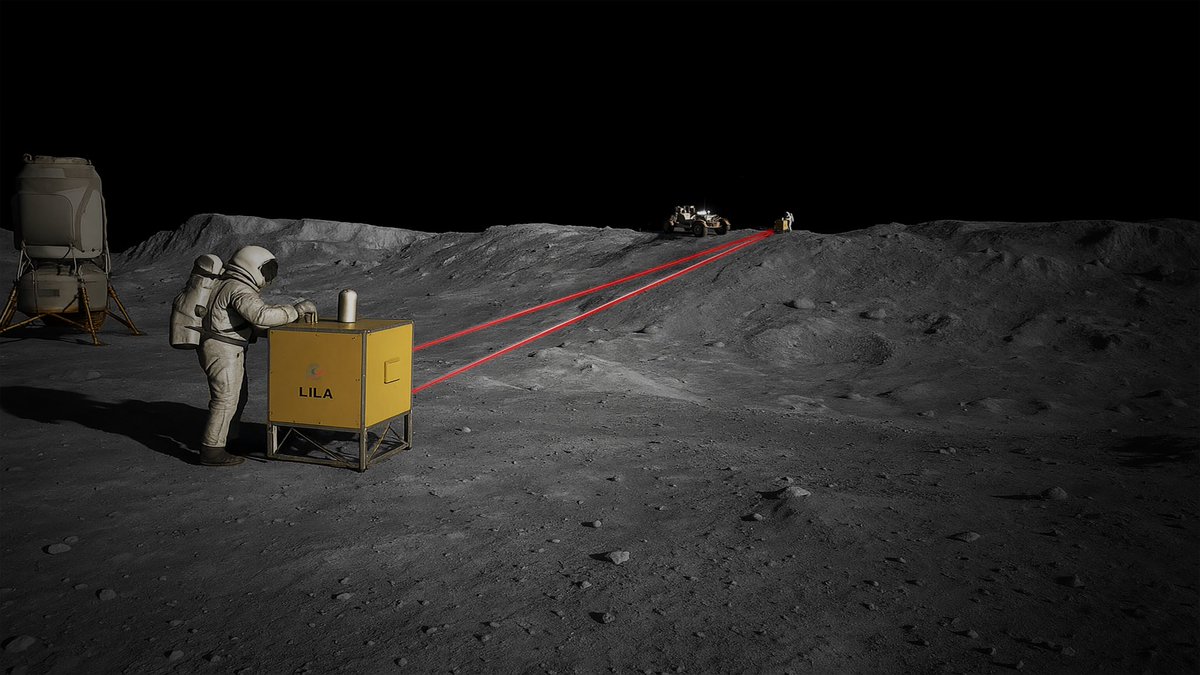
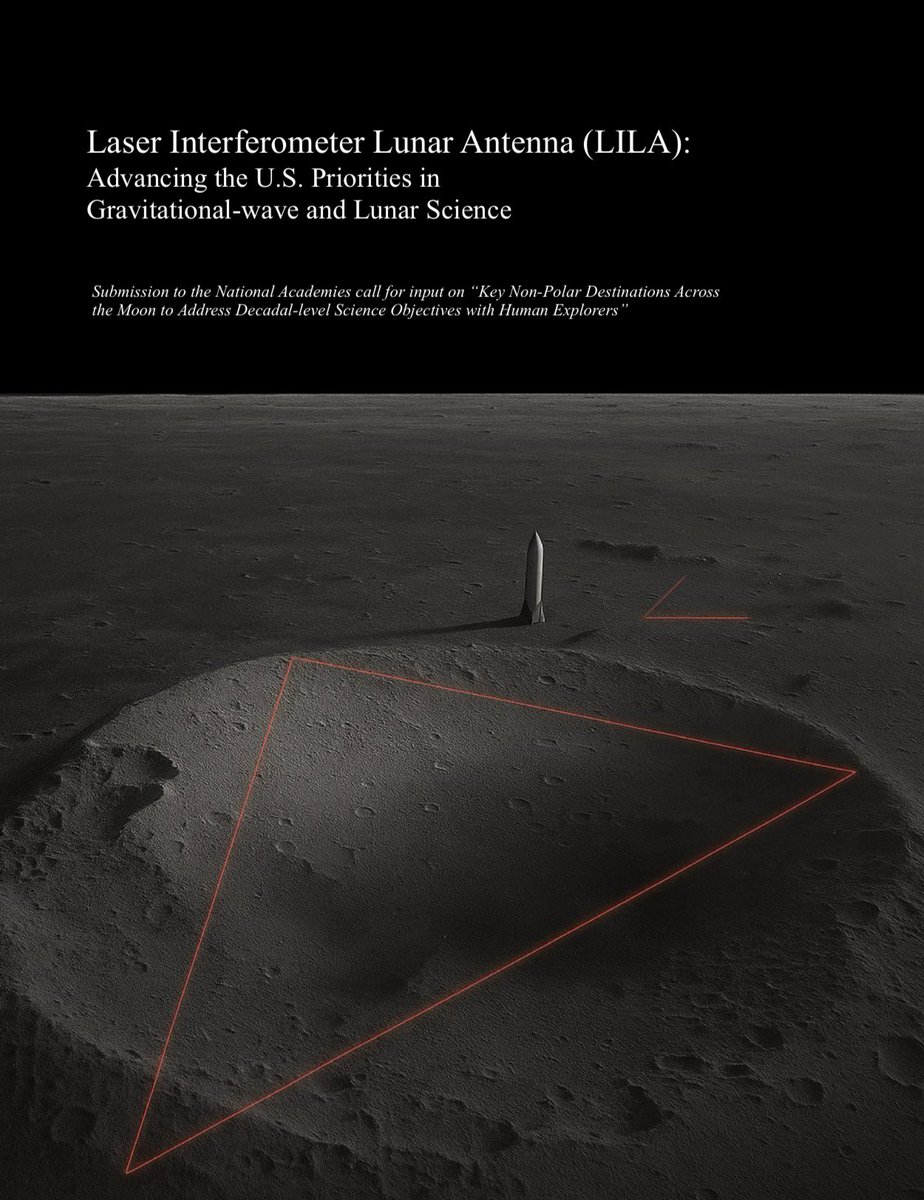
Laser Interferometer Lunar Antenna (LILA): Advancing the U.S. Priorities in Gravitational-wave and Lunar Science Very proud of our new paper out today. An early tribute to the 10th anniversary of the historic discovery of gravitational waves. arxiv.org/abs/2508.11631
Karan Jani tweet media
English
2
4
12
1.4K
Karan Jani retweetledi
NASA Administrator Jared Isaacman
After 50 days on the job, visits to every NASA center, a dozen town halls, and reviewing thousands of workforce submissions, it is clear there is much we can do to better empower our people and focus resources on the most pressing objectives. Getting back to the Moon means getting back to the basics. NASA must regain its core competencies in technical, engineering, and operational excellence, and in doing so, we’ll save up to $1B a year to fund more missions of world-changing science and discovery. With the directive issued today, we are strengthening the NASA team and executing urgently on the President’s national space policy.
English
440
947
8.3K
1.4M
Karan Jani retweetledi
Yann LeCun
Yann LeCun@ylecun·
Hugo Duminil-Copin, French mathematician and 2022 Field Medalist told me he never participated in math competition and was very bad at it. Innovative mathematics requires creativity, intuition, intense concentration, and long reflections, sometimes spread over several years. Good performance at a math olympiad merely tests fast problem solving abilities. AI can do that nowadays. One of the big activities of a researcher, in mathematics and elsewhere, is not to answer questions but to ask the right questions.
English
128
556
5K
684.5K
Karan Jani retweetledi
Jaxie Pidgeon
Jaxie Pidgeon@JaxiePidgeon·
According to PowerOutage.com, as of 3:40 p.m. CT today: - 985,035 TOTAL power outages in U.S. - 316,661 power outages in Tennessee - 206,387 power outages in Davidson Co. @WKRN
English
9
42
274
156.7K
Karan Jani
Karan Jani@AstroKPJ·
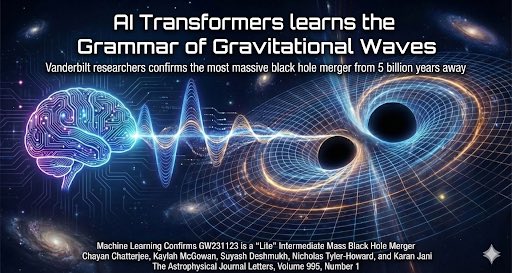
Large language models and audio transformers are known for mastering human speech and tackling complex tasks. But can they learn the grammar of spacetime (gravitational waves) and the elusive ragas of black holes? I’m excited to share my lab’s latest breakthrough, now published in The Astrophysical Journal Letters (@AAS_Office), where we adapted OpenAI's audio transformer to analyze gravitational-wave data from a rare black hole and learn signal structure directly from spacetime itself. By treating gravitational-wave data like an audio “language,” we applied our in-house machine-learning architecture to listen directly to @LIGO data. We found that GW231123 is indeed a rare “Lite” intermediate-mass black hole merger whose signals show hint of some unaccounted physics. More broadly, this work demonstrates how foundation models developed for human communication can be repurposed to probe the laws of nature. This marks the beginning of a new era of gaining deep insights into the General Theory of Relativity with AI. Big kudos to my team led by Dr. Chayan Chatterjee, PhD students Kaylah McGowan, Suyash Deshmukh, and master's student Nicholas-Tyler Howard for this breakthrough work.
Karan Jani tweet media
English
1
4
5
336
Karan Jani
Karan Jani@AstroKPJ·
2025 has been one of the most satisfying and productive academic year. All credit to my amazing group of students and postdocs @VanderbiltU, collaborators from across the gravitational-wave spectrum (LILA, LIGO, LISA) and new partners in lunar geoscience.
Karan Jani tweet media
English
1
1
7
561
Karan Jani
Karan Jani@AstroKPJ·
@demishassabis Perhaps on a similar spectrum to chess, how our brain has evolved to do mathematics that transcend any evolutionary needs, especially by the likes of Ramanujan, is as great a mystery as the origin of spacetime itself.
English
0
0
7
6.9K
Demis Hassabis
Demis Hassabis@demishassabis·
Yann is just plain incorrect here, he’s confusing general intelligence with universal intelligence. Brains are the most exquis​ite and complex phenomena we know of in the universe (so far), and they are in fact extremely general. Obviously one can’t circumvent the no free lunch theorem so in a practical and finite system there always has to be some degree of specialisation around the ​target distribution that is being learnt. But the point about generality is that in theory, in the Turing Machine sense​, the architecture of ​s​uch a general system is capable of learning anything computable given enough time and memory​ (and data), and the human brain (and AI foundation models) are approximate Turing Machines. Finally, with ​regards to ​Yann's comments about chess players, it’s amazing that humans could have invented chess ​in the first place (and all the other ​a​spects ​o​f modern civilization ​from science to 747s!) let alone get as brilliant at it as someone like Magnus. He may not be ​strictly optimal (after all he has finite memory and limited time to make a decision) but it’s incredible what he and we can do with our brains given they were evolved for hunter gathering.
Haider.@slow_developer

Yann LeCun says there is no such thing as general intelligence Human intelligence is super-specialized for the physical world, and our feeling of generality is an illusion We only seem general because we can't imagine the problems we're blind to "the concept is complete BS"

English
817
1.2K
11.7K
13.4M
NASA Watch
NASA Watch@NASAWatch·
When we start to go offworld - in a serious way - whether it is rocky and/or icy worlds (lunar south pole) - we'll need to be able to do things like this. Trying it out on a Hoth-analog in #antarctica is a good start. @NSF @NASA @uw_icecube @rookisaacman #Artemis
IceCube Neutrino Observatory@uw_icecube

🎥 Here is a 7-hour time-lapse at the start of drilling the first hole for the IceCube Upgrade. This comes almost exactly 15 years after drilling for the 86th hole of IceCube was finished on December 18, 2010! 🤯 🎥 Jennifer Wang and Vedant Basu, IceCube/NSF

English
2
5
21
3.6K
Karan Jani
Karan Jani@AstroKPJ·
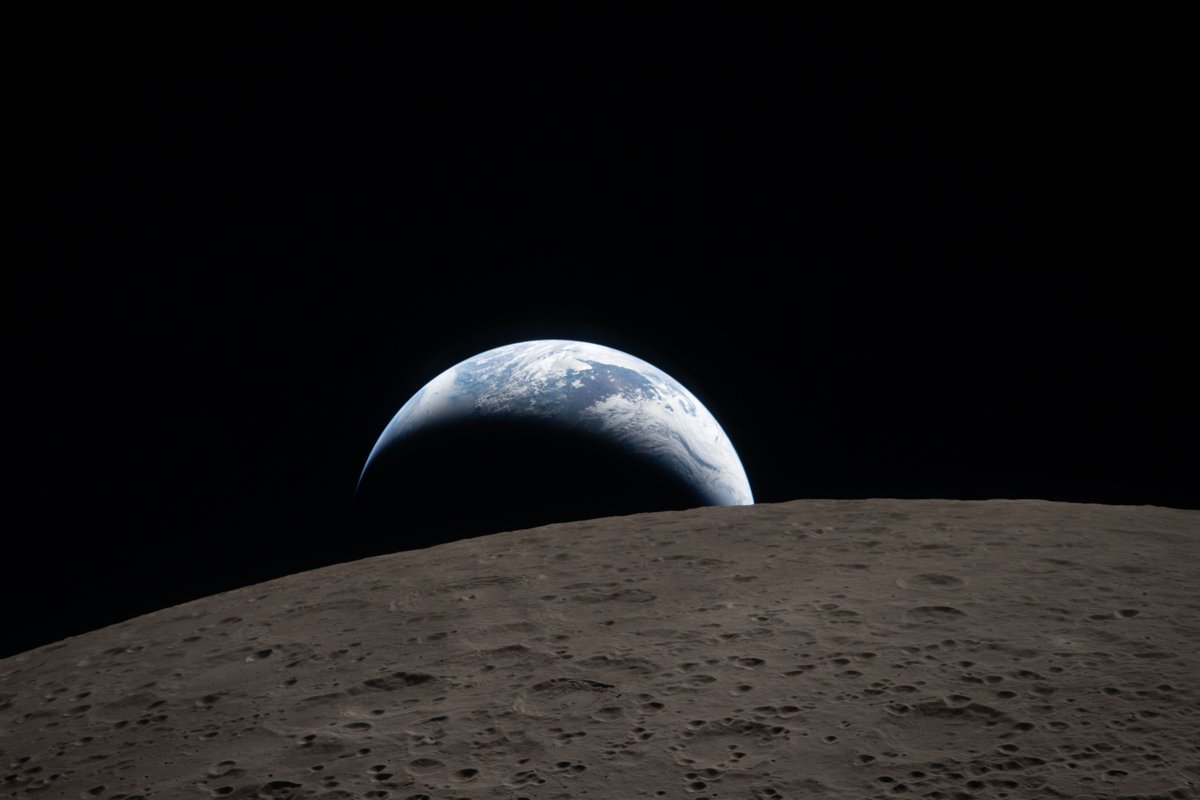
This is a defining moment for NASA’s leadership. Congratulations to @rookisaacman on appointment as @NASAAdmin. Looking ahead to the next phase of Artemis-era science and exploration.
Karan Jani tweet media
English
1
1
2
249
Karan Jani
Karan Jani@AstroKPJ·
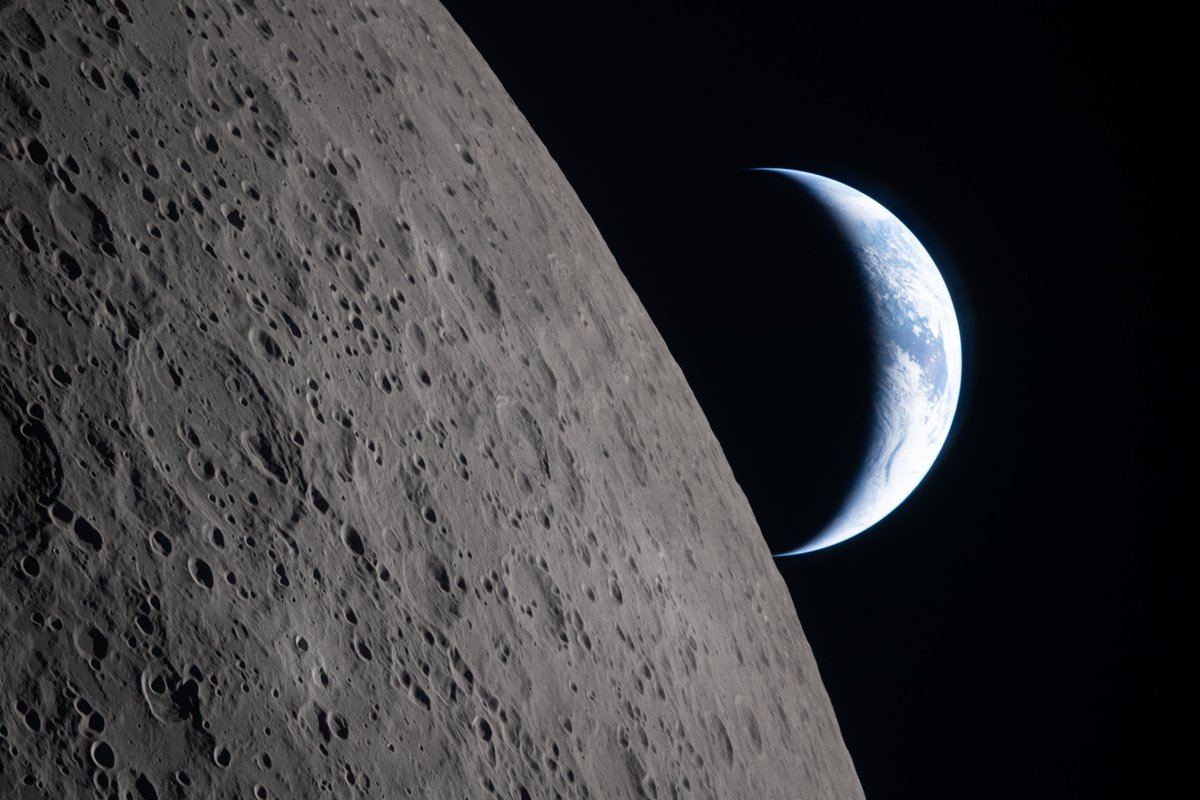
Good morning from the 2025 International LILA Meeting at @JHUAPL - the next frontier for a gravitational-wave detector on the Moon! @VanderbiltU
Karan Jani tweet media
English
1
1
12
416
Karan Jani
Karan Jani@AstroKPJ·
Looking forward to engaging discussions that will define the next frontier of gravitational-wave astronomy, from the Moon. The SOC has developed an agenda that integrates across astrophysics, lunar geoscience, detector technologies, lunar exploration, and industry delivery pathways — aligning LILA with the rapidly evolving Artemis-era landscape and advancing toward near-term flight readiness. Full agenda and confirmed speakers: vanderbilt.edu/lunarlabs/2025…
Karan Jani tweet media
English
0
1
6
439
Karan Jani
Karan Jani@AstroKPJ·
It is my distinct honor to invite the scientific community on behalf of Johns Hopkins Applied Physics Laboratory (APL) and the Vanderbilt University Lunar Labs Initiative to the International LILA Meeting, to be held 13–14 November 2025 at APL, Laurel, Maryland, USA. This meeting continues community discussions on the Laser Interferometer Lunar Antenna (LILA) project - a proposed detector on the lunar surface to measure gravitational waves in the mid-band between ground-based detectors LIGO–Virgo–KAGRA and the future space mission LISA. The primary foci of this workshop will be on defining the science goals, instrument implementation, deployment timeline, and establishing the formal consortium structure for LILA. Sessions will include series of talks and panels from experts in multi-messenger astrophysics, lunar geoscience, and aerospace industry. This is the fifth annual meeting in the Lunar GW Workshop series, following Belle-Île-en-Mer, France (2024), Nashville, USA (2023), Bern, Switzerland (2022) and Cascina, Italy (2021). Registration open till November 1, 2025: vanderbilt.edu/lunarlabs/2025…
Karan Jani tweet media
English
0
3
5
482
Karan Jani retweetledi
arXiv bot (gr-qc)
arXiv bot (gr-qc)@krxiv_gr_qc·
Fundamental Noise and Gravitational-Wave Sensitivity of the Laser Interferometer Lunar Antenna (LILA) arxiv.org/pdf/2508.18437 Teviet Creighton, Philippe Lognonné, Mark P. Panning, James Trippe, Volker Quetschke, Karan Jani. arxiv.org/abs/2508.18437
English
0
1
1
266