AusThinker

9.9K posts

AusThinker banner
AusThinker

AusThinker

@AusThinker3_14

My opinions are my own.

Katılım Kasım 2023
340 Takip Edilen534 Takipçiler
Sabitlenmiş Tweet
AusThinker
AusThinker@AusThinker3_14·
Australia’s Fragile Harvest: Geopolitical Tri-Shock, Decades of Policy Failure, and the 2026 Food-Fuel Crisis As of late March 2026, Australia confronts a converging “triple shock” in global fertiliser and energy markets that threatens both domestic food security and the broader economy. The closure of the Strait of Hormuz amid the ongoing Middle East conflict, Beijing’s sweeping fertiliser export restrictions, and Moscow’s targeted export suspension have collectively placed roughly half the world’s tradable fertiliser under state-mandated limits. Global urea prices have already risen 40%, phosphate and nitrogen supplies are tightening, and the World Food Programme warns of an additional 45 million people facing acute food insecurity if oil stays above US$100 a barrel and fertiliser remains scarce. For Australia, already importing 91% of its fertiliser needs, the timing could scarcely be worse: the April winter-crop planting window has arrived with domestic stockpiles depleting and prices surging. Anyone who has been paying attention understands the crisis is not merely cyclical or accidental. Rather, it is the predictable outcome of thirty years of bipartisan policy choices that systematically traded energy and food sovereignty for cheaper imports, just-in-time global supply chains, and an accelerated decarbonisation agenda. Both Labor and the Liberal-National Coalition bear responsibility for the structural vulnerabilities now exposed. Their current responses (late, incremental, and still subordinated to net-zero timelines) offer little reassurance that the 2026–27 harvest and the national freight network will escape severe disruption. The Global Supply Shock and Its Mechanics China, the world’s largest phosphate exporter and a top-five urea supplier, imposed restrictions covering 50–80% of its fertiliser exports on 19 March 2026. Beijing’s explicit aim is to safeguard its own domestic agriculture; the ban is not expected to lift before August 2026. Russia, the second-largest global fertiliser producer, has layered its own measures: a pre-existing export quota of 18.7 million tonnes for December 2025–May 2026, followed by a complete one-month suspension of ammonium nitrate exports from 21 March to 21 April 2026. These actions alone remove roughly 20% of global nutrient trade from the market at the precise moment Northern Hemisphere spring planting begins. Compounding the problem is the effective closure of the Strait of Hormuz. The chokepoint carries 33% of global seaborne fertiliser trade and 20% of urea exports. Middle Eastern suppliers, Saudi Arabia, UAE, Qatar, accounted for 42% of Australia’s fertiliser imports in recent years. With shipping routes disrupted and natural-gas feedstock costs elevated, the global price signal is unambiguous: urea has already climbed 40% since the conflict intensified, and further spikes are locked in for the current planting cycle. And the result is not abstract. Farmers worldwide will apply lower rates of nitrogen and phosphate; yields will fall by an estimated 5% or more. For import-dependent nations locked into globalisation’s efficiencies, the margin for adaptation has vanished. Australia’s Acute Exposure Australia’s agricultural sector consumes 8.7 million tonnes of fertiliser annually; 7.9 million tonnes are imported. Domestic production covers only 9.2% of demand. Urea (44% of use) and monoammonium phosphate (18%) are the dominant products, precisely those most affected by the Chinese and Middle Eastern disruptions. In the fortnight to late March 2026, landed urea prices in Australia jumped 45 per cent, with quotes reaching A$1,414 per tonne at Kwinana and A$1,320 per tonne elsewhere. Local stockpiles in many regions are projected to exhaust by mid-April, right as winter crops must go in. The downstream effects cascade rapidly. Reduced fertiliser application will lower grain, dairy, fruit, and vegetable yields. University of Technology Sydney analysts and former ACCC chair Allan Fels have flagged potential 40–50% rises in the cost of perishable goods. Rabobank and the Reserve Bank warn of second-order inflationary pressure on bread, meat, and dairy as the 2026–27 harvest materialises. Compounding the farm-gate pain is the AdBlue crisis: urea is the essential feedstock for the diesel-exhaust fluid required by Australia’s modern truck fleet. A sustained shortage risks grounding freight movements, halting supermarket restocking and fuel distribution within weeks. The agricultural export sector alone faces potential losses exceeding A$12.7 billion. Geographically, Australia is doubly squeezed. With Chinese and Middle Eastern supplies curtailed, importers must compete for residual volumes from Morocco and North America, markets already under pressure from Brazilian and United States demand. Freight costs rise accordingly, and Australia’s bargaining position is weak. Bipartisan Policy Roots of Vulnerability To be clear, the fragility did not appear overnight. Over three decades, successive governments of both colours engineered the very dependencies now proving fatal. Labor’s contribution began with the Hawke–Keating era’s aggressive trade liberalisation and tariff removal. The explicit goal was cheaper consumer goods; the collateral damage was the steady closure of “uncompetitive” domestic manufacturing, including fertiliser and ammonia plants. More recently, Labor’s renewables-only energy transition and legislated 2030 emissions targets have driven industrial electricity and gas prices to levels that rendered energy-intensive production uneconomic. The Gibson Island nutrient facility closed under precisely these pressures. While the current Labor government has floated gas-export interventions, industry analysts note the measures arrived years too late to preserve capacity. The Liberal-National Coalition’s record is no less culpable. Its flawed market-fundamentalism philosophy allowed domestic manufacturing to wither whenever lower-cost Chinese product appeared. Policy prioritised the export of raw commodities (iron ore, LNG, coal) over value-adding onshore processing. Australia thus exports the very natural gas required for urea synthesis, only to re-import the finished fertiliser at a premium. Along with Labor, successive Coalition administrations also failed to rebuild strategic fuel reserves or refining capacity, leaving the nation with less than 30 days of fuel stocks and total reliance on imported diesel and petrol. The result is a textbook case of resource nationalism practised by others against a nation that had dismantled its own. Both parties, in short, embraced the post-Cold War globalisation consensus that cheap imports and just-in-time logistics would always be available. That consensus has now collapsed under geopolitical stress, yet neither side has undertaken a root-and-branch reversal of the policies that created such extreme exposure. Current Responses: Too Little, Too Late, and Misaligned The federal government’s immediate actions illustrate the depth of the problem. Importers are scrambling for Moroccan and North American product, but global competition is fierce. Project Ceres, the Perdaman urea facility at Karratha, backed by A$255 million in federal support and ultimately valued at A$6.5 billion, is promoted as the path to urea self-sufficiency. Full production, however, will not stabilise until late 2026 at the earliest, well after the current planting season and the 2026–27 harvest have been decided. The gap remains dangerous indeed. Simultaneously, both major parties voted in late March 2026 to appropriate billions more for the net-zero agenda: the A$5 billion Net Zero Fund within the National Reconstruction Fund, the A$1.5 billion Innovation Package for green metals and low-carbon fuels, and the expansion of the Capacity Investment Scheme targeting 32 GW of new renewables by 2030. The broader “Future Made in Australia” framework now totals A$22.7 billion. Proponents argue these measures will eventually lower long-term energy costs and secure Australia’s place in a re-ordered global economy. Critics (correctly) note that the spending occurs precisely when households face a 24% electricity-price jump from the expiry of the A$6.8 billion Energy Bill Relief Fund, when food inflation is forecast to climb 16–20%, and when fertiliser-driven yield losses loom. The Productivity Commission’s earlier warnings about subsidy-driven market distortion and the risk of backing non-competitive technologies remain unaddressed. The technical critiques of the renewables pathway are equally pertinent in the present crisis. Wind and solar assets require replacement every 20–25 years, unlike baseload plants with 60-year lifespans. Full-system costs (e.g., transmission lines, grid-scale storage, and backup gas peakers) continue to be passed through to consumers. AEMO itself acknowledges that half the transmission infrastructure required by 2050 must be built by 2030, yet social and regulatory delays persist. Australia lacks the interconnector geography of Denmark or the hydro buffering of Norway; the intermittency problem is therefore more acute. Yet the bipartisan commitment to 43% emissions reduction by 2030 and 62–70% by 2035 remains unaltered, even as the immediate energy and food security emergency intensifies to breaking point. Outlook and the Imperative of Strategic Reassessment Independent modelling now projects headline inflation reaching 5.5% in 2026–27, well above the RBA’s earlier 4.2% forecast, driven by electricity (+24%), food (+16–20%), housing (+7.2%), and volatile fuel and insurance costs. The agricultural sector’s profitability is under direct threat; above-average yields will be required merely to break even at current input prices. The national freight network’s dependence on AdBlue adds a systemic risk that no amount of short-term diplomacy can fully mitigate. Australia’s major parties have spent decades demonstrating that ideology, whether flawed market fundamentalism approach or decarbonisation zeal, can override prudent, rational self-reliance. The 2026 crisis is the bill arriving for that choice. Restoring sovereign capability in fertiliser, refining, and baseload energy will require more than incremental projects like Ceres or subsidy-laden innovation funds. It demands an explicit, repudiation of the policies that hollowed out domestic manufacturing and subordinated food and fuel security to global markets and emissions targets. Without that reckoning, the coming harvest will not be the last to suffer the consequences of strategic complacency.
AusThinker tweet media
English
0
2
6
941
AusThinker
AusThinker@AusThinker3_14·
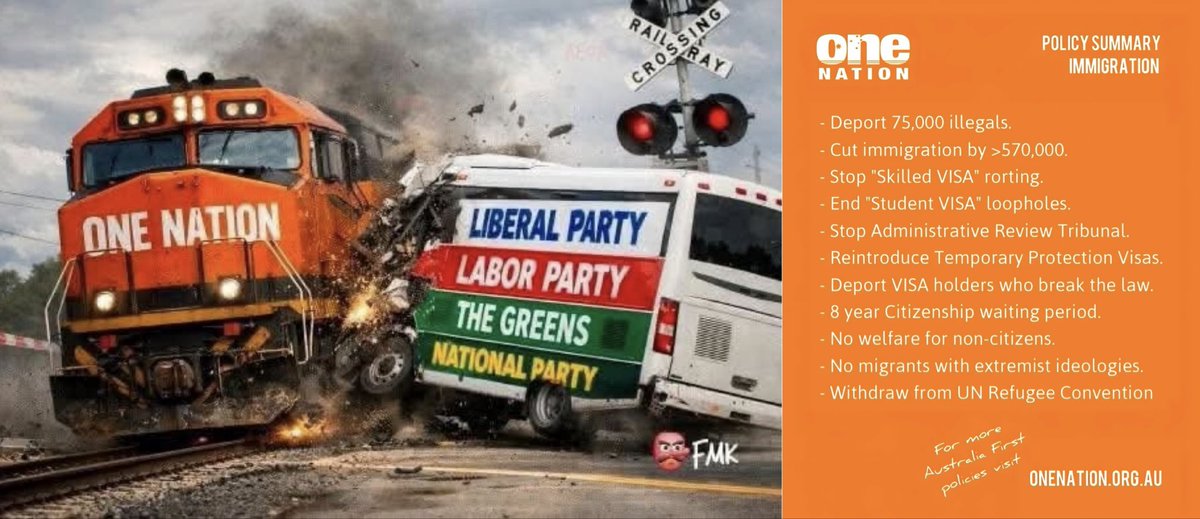
Lies. If you truly believed Australia was worth fighting for, you’d back One Nation, the party that has been fighting for Australia for decades. Instead, your party is openly trying to fight them. Why? Because the Uniparty sees the polls and recognises the real threat. Australia is finally waking up
AusThinker tweet media
English
1
2
12
106
Angus Taylor MP
Angus Taylor MP@AngusTaylorMP·
I believe Australia is worth fighting for. Our migration system should reflect our values, serve our national interest and strengthen our communities. That’s why we’re putting Australian values back at the heart of immigration policy.
English
127
30
226
5.2K
AusThinker retweetledi
AusThinker
AusThinker@AusThinker3_14·
@AngusTaylorMP Not buying your weak attempt to remain relevant. Vote One Nation, Australia.
AusThinker tweet media
English
6
7
102
942
AusThinker
AusThinker@AusThinker3_14·
@SkyNewsAust He offers nothing more than a band-aid for a gushing wound. Australia needs One Nation to step up, take control, and fix the situation it has been warning about for years, a situation that is the direct result of the corrupt Uniparty.
AusThinker tweet media
English
3
1
5
92
AusThinker retweetledi
Lozzy B 🇦🇺𝕏
Lozzy B 🇦🇺𝕏@TruthFairy131·
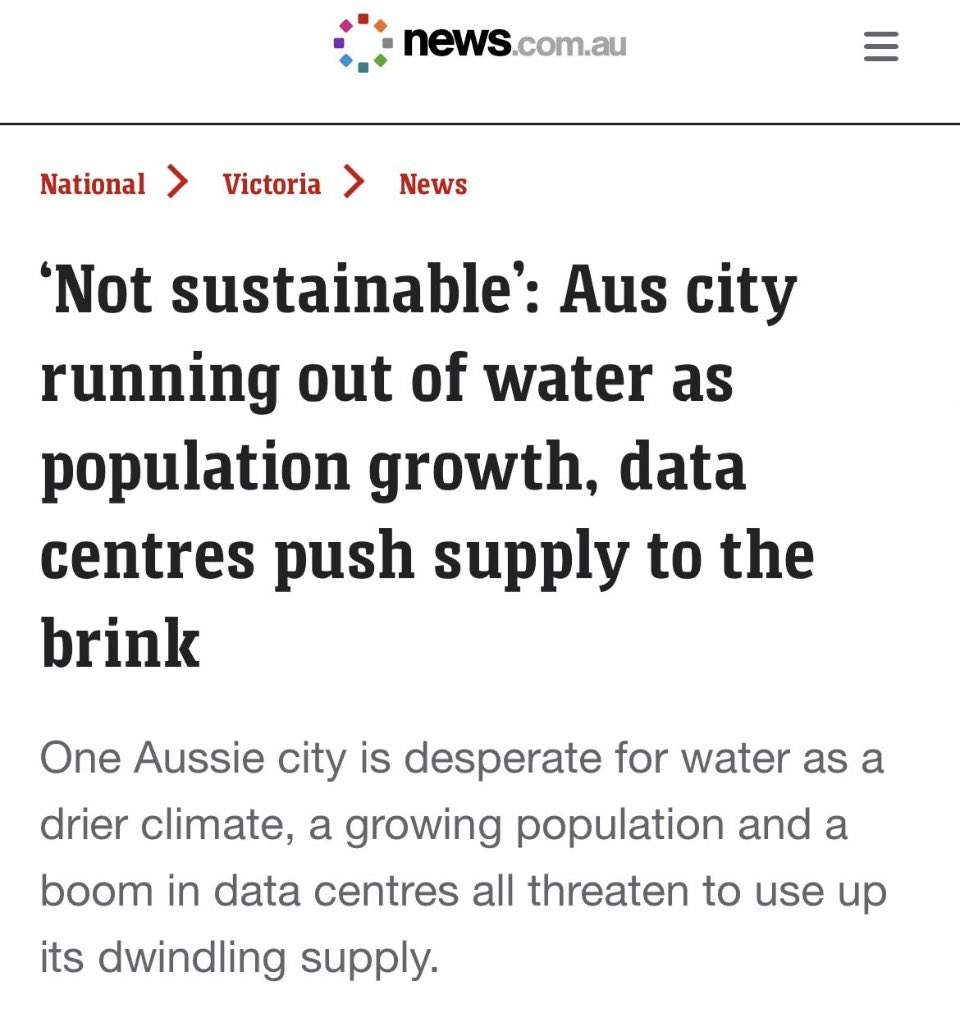
We do not have the resources or infrastructure to sustain mass immigration. 'Not sustainable': Aus city running out of water as population growth, data centres push supply to the brink. One Aussie city is desperate for water as a drier climate, a growing population and a boom in data centres all threaten to use up its dwindling supply.
Lozzy B 🇦🇺𝕏 tweet media
English
25
46
187
4.1K
AusThinker retweetledi
British Intel
British Intel@TheBritishIntel·
The Irish government is on the brink of total collapse. Opposition parties have tabled a no-confidence motion, and multiple politicians are expected to defect and vote it through. This comes after weeks of huge fuel protests across the country, where the government responded by sending in the army against its own citizens. The establishment has lost control.
British Intel tweet media
English
7
70
180
2.7K
AusThinker retweetledi
British Intel
British Intel@TheBritishIntel·
Keir Starmer has just confirmed the Chagos Islands deal is being shelved after America withdrew its support. This is the same man who spent months trying to quietly hand over British territory to Mauritius. Keir Starmer is a traitor.
English
89
644
4.4K
40.5K
AusThinker retweetledi
Don't you worry about that.🇦🇺
Argentina has a population of 45 million and a debt of 650 million dollars. Australia has 28 million and a debt of a trillion dollars. This doesn't include state debt. Goverment spending in Australia is out of control.
Don't you worry about that.🇦🇺 tweet mediaDon't you worry about that.🇦🇺 tweet media
English
301
736
2.8K
51K
AusThinker retweetledi
Topher Field
Topher Field@TopherField·
Is Trump entering his end-game? Events are beginning to unfold quickly in the Middle East and Trump is looking like he's putting a stranglehold on Iran's last source of cash... and weapons. But just because its the end-game, that doesn't mean it'll be over soon. join the Topher Project 1st birthday give-away to be in the running for over $2,000 in free stuff, including $500 in food and fuel vouchers for the winner! Enter here: store.topherfield.com
English
4
9
77
3K
AusThinker retweetledi
Senator Sean Bell
Senator Sean Bell@SenatorSeanBell·
David Farley will ensure Farrer gets a fair go in Canberra
English
8
59
201
1.3K
Angus Taylor MP
Angus Taylor MP@AngusTaylorMP·
If Australia’s success is to continue, we need to take a hard look at our migration system. Right now, the numbers are too high and the standards are too low, and both must change.
English
889
274
2.2K
101.6K
AusThinker retweetledi
Thomas Sowell Quotes
Thomas Sowell Quotes@ThomasSowell·
“Everybody is an environmentalist in the sense of not wanting to breathe polluted air or drink polluted water. But in practice the term has come to refer to a pagan nature worship cult that readily sacrifices other human beings on the altar to their dogmas.” — Thomas Sowell
English
1
9
81
6.9K
AusThinker retweetledi
Kevin Sorbo
Kevin Sorbo@ksorbs·
European governments are purposely importing their own destruction. What's even more amazing is the fact that the citizens overwhelmingly do NOT support these migrants flooding to their cities and towns, yet the government doesn't care.
Dr. Maalouf ‏@realMaalouf

🇭🇺 Hungary was fined €200 million by the EU for refusing to accept Muslim refugees entering illegally into the country. In response, Orbán started busing them straight to EU capital Brussels. Now, he lost the election. And Hungary is about to change.

English
113
630
2.2K
28K
AusThinker retweetledi
AusThinker
AusThinker@AusThinker3_14·
Yeah, sure, it’s all because of a “global fuel shock.” Nothing to do with the Uniparty destroying our energy independence, one of the world’s largest energy exporters. Instead of being the superpower we should be, we’re suffering through an energy crisis while you’re off begging for scraps, giving away our resources, and spending our money lecturing us about checking tyre pressure.
English
1
5
26
371
AusThinker retweetledi
British Intel
British Intel@TheBritishIntel·
Dozens of illegal migrants casually pulling up on a Spanish beach in broad daylight. Spain’s leftist government has already given half a million of them the right to stay and the right to vote. Now millions more are on their way. This is absolute madness.
English
12
41
90
1.7K
AusThinker retweetledi
Hon. Rod Caddies MLC
Hon. Rod Caddies MLC@RodCaddies·
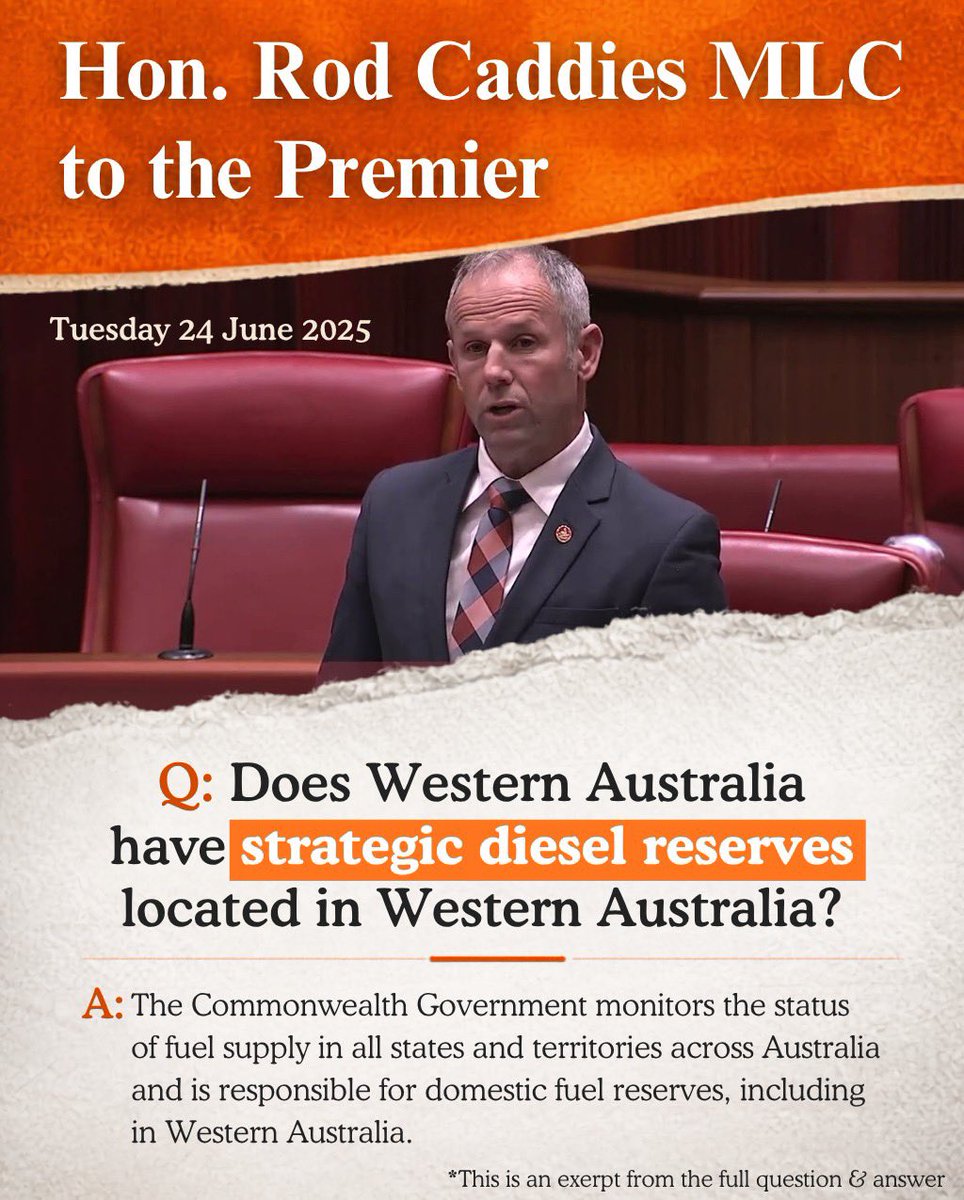
One Nation vindicated. Again. ⛽ Last year, I stood in Parliament and asked the WA Government directly about the State's strategic fuel reserves. As always, I got a dismissive answer saying that's a Federal responsibility. Today, even Labor's climate-crazed Energy Minister is admitting WA needs its own strategic diesel reserve. We said it first. We were ignored. Now it's a crisis. This is exactly why you simply cannot trust any other party on fuel and energy sovereignty. One Nation has been ahead of this the entire time.
Hon. Rod Caddies MLC tweet media
English
9
48
212
5.6K
AusThinker retweetledi
AusThinker
AusThinker@AusThinker3_14·
Australia's energy predicament is a case of self-inflicted vulnerability wrapped in utter ideological delusion. A nation blessed with world-class coal, LNG, uranium, and crude resources, enough to make it one of the most energy-secure and prosperous countries on Earth, has instead been reduced to importing ~90% of its refined fuels, with just two refineries left after decades of closures under both sides of politics. The economy literally runs on diesel: it powers the trucks that move everything, the mining equipment that earns our export dollars, the farm machinery that feeds us, and the generators that keep critical infrastructure alive. Without reliable diesel, the entire supply chain grinds to a halt, yet successive governments, and now the Albanese Labor government, have treated this as nothing but an afterthought. Our current crisis exposes the government's "negotiating" approach for exactly what it is: weak. It is weak, flawed, and dangerously passive at a very critical time for our country. While China bans fertiliser and jet-fuel exports, South Korea caps diesel shipments, and other partners who greatly gain from our exports slam the door on us without a second thought for "diplomatic relationships," Canberra keeps issuing ridiculously polite joint statements and framing everything as a "two-way street." Why in world are we surrendering right now and not using our leverage? Qatar's shutdown handed Australia genuine LNG dominance as the world's new #2 exporter, a once-in-a-generation chance to demand prioritised fuel and fertiliser cargoes in return. Instead, we're getting half-measures, underwritten imports, and pointless excise bandaids while the real bargaining power sits unused. The result is stranded fertiliser cargoes threatening planting season, diesel shortages for mining and agriculture, and price spikes hitting every household and business. All of this is happening because policy has been completely captured by net-zero ideology, and not reality. Renewables still make up only about 9-10% of Australia's total primary energy consumption, despite the billions poured into subsidies, funds, and transition schemes. We produce roughly 1% of the world's carbon emissions, a rounding error globally. Yet the Albanese government continues to sacrifice our energy security at the altar of grand delusions about "saving the world," pouring billions into low-carbon fuels, EV incentives, and decarbonisation while the two remaining refineries limp along on life support and our “strategic” stocks sit at a pathetic 30-odd days. China and India (massive polluters who actually matter for emissions) do whatever they want: ramping coal, restricting exports, and prioritising their own people. They aren't crippling their economies with virtue-signalling targets. We are. This is a vicious downward spiral that could irreversibly damage the country. The hollowing-out of refining capacity, the paper-thin reserves, the refusal to force more domestic crude into local plants or build meaningful stockpiles …none of it was inevitable. It was a policy choice made by foreign captured governments, driven by globalist agendas. Right now, the government is not acting reasonably or responsibly. It's betting Australia's entire future on ideology and diplomacy that the rest of the world has already abandoned in favour of raw self-interest. Meanwhile, ordinary Australians, truck drivers, farmers, miners, families filling up at the pump, will pay the price in higher costs, disrupted supply chains, and lost prosperity. Until we ditch the delusions and start treating energy security as the national-interest imperative it is, this self-sabotage will only deepen and become irreversible. When is it enough, Australia?
AusThinker tweet media
English
0
3
4
172
AusThinker retweetledi
Craig Kelly:🇦🇺Foundation for Economic Education
HYPOCRITE OF THE WEEK goes to Jim Chalmers for having a meltdown over the relationship between Australia wealthiest person Gina Rinehart and One Nation - which doesn’t cost taxpayers a single cent. Meanwhile, Australia’s second-wealthiest person, Twiggy Forrest is engaging in a "Brokeback Mountain" style embrace with Blackout Bowen for the cameras - as Labor funnels him tens of millions of taxpayers’ dollars in blatant corporate welfare.
Craig Kelly:🇦🇺Foundation for Economic Education tweet media
English
67
616
2K
16.1K